Business Funding Palm Beach Gardens: 2026 Cost Guide
Compare business funding in Palm Beach Gardens for 2026: bank lines, SBA loans, term loans and revenue-based financing costs, timing and qualification.

Business funding in Palm Beach Gardens comes down to matching your monthly revenue and time in business to the right structure — a bank line, an SBA loan, a term loan, or revenue-based financing — before you sign anything tied to a factor rate.
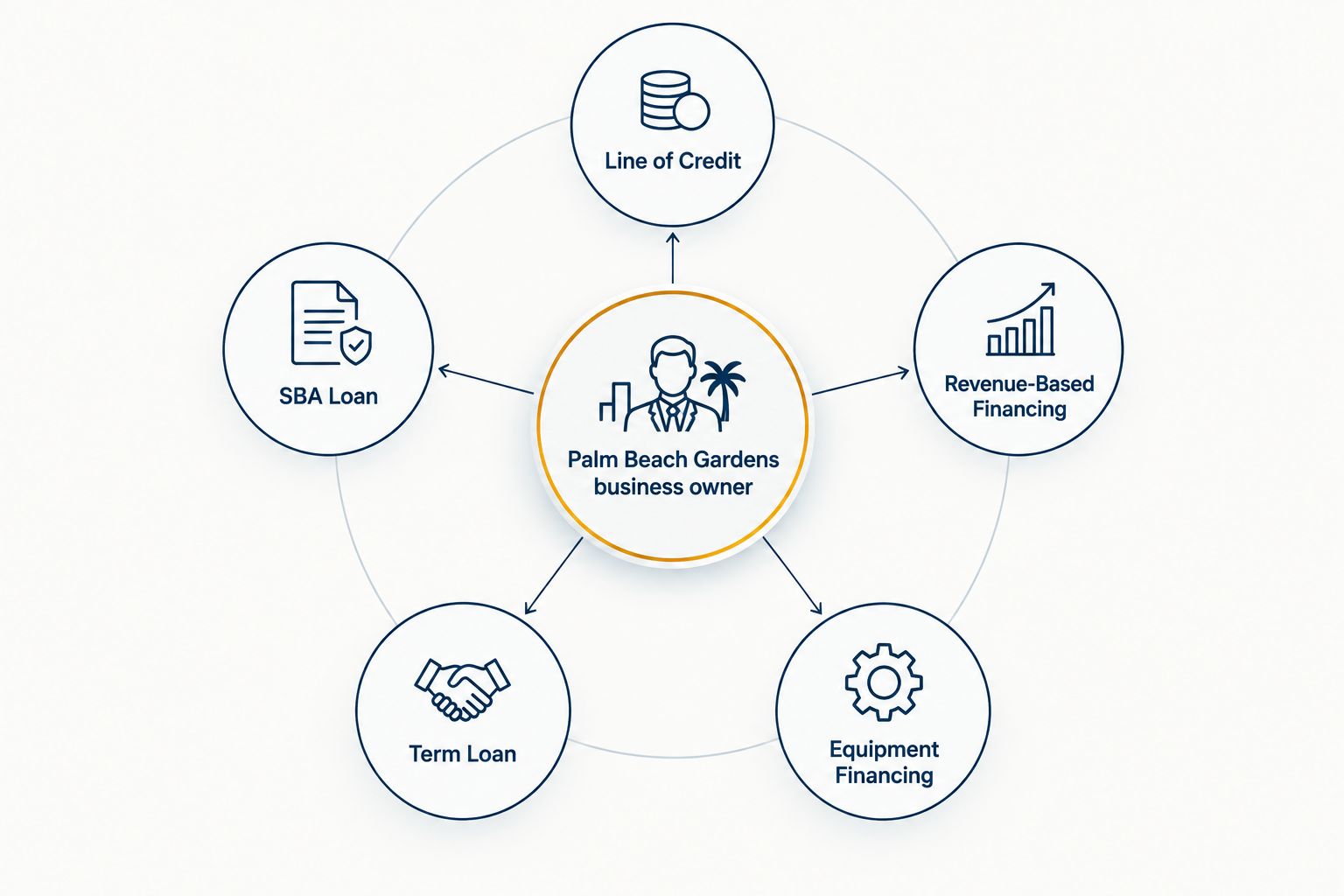
- Business funding in Palm Beach Gardens splits into bank lines, SBA loans, term loans, equipment financing and revenue-based financing (MCA).
- JLFG's primary funding route targets businesses generating at least $35,000 per month in verified bank deposits.
- A $50,000 advance at a 1.35 factor rate repays $67,500 total — know that math before you sign.
- Revenue-based financing can move in 24-48 hours; SBA loans and larger term loans take weeks.
- Businesses under $35,000 per month have a self-serve funding path that doesn't require naming the underlying provider.
Why business funding matters for Palm Beach Gardens business owners
Palm Beach Gardens sits in a Palm Beach County economy built on medical practices, professional services, marine and golf-adjacent retail, and construction tied to the area's continued build-out. Two pressure points show up again and again: seasonal revenue swings tied to South Florida's snowbird season, and commercial real estate costs that eat into working capital reserves faster than owners plan for.
When a local bank declines an application over time-in-business or collateral, owners typically look at revenue-based financing or a business line of credit next — not because it's cheaper, but because it moves faster. Compare Business Funding Options before you commit to a single lender's quote; a broker sees terms across multiple funding partners in one pass, where a solo owner sees one offer at a time.
The same underwriting logic that applies here applies across South Florida. Business owners running similar comparisons in nearby markets can see how the numbers shift by reviewing the Doral business funding guide, which walks through the same structures against a different local mix.
Assess your funding fit before you apply anywhere
Pull your last 4-6 months of bank statements
Every funding partner — bank, SBA lender, or revenue-based financing provider — starts here. Do this yourself before a single application goes out.
- Check average daily balance trend over the period, not just the ending balance
- Count NSF or negative-balance days; more than a handful signals risk to underwriters
- Separate operating revenue from existing loan or advance disbursements already hitting the account
- Flag seasonal dips tied to slower summer months in South Florida
- Save statements as PDFs; most lenders and Plaid-based underwriting want them in that format
Calculate your real monthly revenue, not gross sales
Gross sales and bankable revenue are not the same number, and lenders price off the second one.
- Strip out sales tax collected and passed through
- Subtract refunds and chargebacks from the trailing period
- Average across at least three months to smooth out one strong or weak month
- Note any revenue concentrated in one large client or contract — underwriters ask about this
Check your time in business and entity age
Time in business changes which door is open to you before you ever discuss rate.
- Confirm your LLC or corporation formation date against what's on file with the state
- Verify your EIN registration matches your bank account name exactly
- Note any prior funding history, including active advances or loans still being repaid
- Pull your personal credit score range; it matters more for SBA and bank products than for revenue-based financing
Compare structures side by side before signing anything
Shopping five lenders individually can eat two or three weeks and produce five different application packages. Comparing options through a broker condenses that into one submission reviewed against multiple funding partners at once — this is the faster path once you've done the first two steps above, not a substitute for them.
Run the factor rate or APR math before you sign
A factor rate is not an interest rate, and confusing the two is the single most common mistake in this process.
- Multiply the advance amount by the factor rate to get total repayment owed — a $50,000 advance at 1.35 repays $67,500
- Convert that total cost to an effective APR by accounting for the repayment term in months; shorter terms push the effective APR higher for the same factor rate
- Ask whether repayment is structured as a purchase of future receivables (common with MCA) or as a fixed-schedule loan
- Compare that effective APR against a bank line's variable rate before deciding speed is worth the premium
“A $50,000 advance at a 1.35 factor rate repays $67,500 — know that number before you compare it to a bank line's rate.”
Match repayment schedule to your actual cash flow cycle
Repayment frequency matters as much as total cost for a business with uneven receivables.
- Daily or weekly ACH debits fit businesses with steady daily card volume
- Monthly fixed payments fit businesses with predictable, less frequent deposits
- Seasonal businesses should ask specifically about payment deferral or step-down structures
- Match the repayment cadence to when your receivables actually clear, not to what's offered first
Gather documents before you submit an application
Having these ready cuts days off any funding timeline in 2026.
- Four to six months of business bank statements
- Entity formation documents and EIN confirmation
- Voided business check or bank account verification
- Most recent business tax return, if requested by an SBA or term lender
- Driver's license or government ID for the majority owner
Comparing business funding options in Palm Beach Gardens
| Option | Best for | Cost structure | Key limitation |
|---|---|---|---|
| Business line of credit | Retailers and service businesses with seasonal cash gaps — see working capital options for small retailers | Variable rate, drawn only on funds used | Usually needs 1+ year in business or an existing bank relationship |
| SBA loan | Businesses buying real estate or acquiring another company | Fixed or variable rate plus SBA guaranty fee | Underwriting runs weeks, not days |
| Revenue-based financing (MCA) | Businesses needing capital within days, no real estate collateral | Factor rate applied to the advance, repaid against receivables | Total dollar cost runs higher than bank financing |
| Term loan | Equipment purchases or one-time expansion costs | Fixed rate, fixed monthly payment | Requires stronger credit and documented cash flow history |
| Equipment financing | Medical, marine, or construction equipment purchases | Rate tied to equipment value, asset-secured | Limited strictly to the equipment being financed |
Verdict: a Palm Beach Gardens business generating steady deposits and needing speed over cost fits revenue-based financing; one with 12+ months of stable cash flow and a lower cost-of-capital target fits a bank line or term loan instead.
Common mistakes Palm Beach Gardens business owners make
- Stacking a second MCA on top of an active one during a seasonal slowdown, which compounds daily debits against already-tight cash flow
- Assuming a long-standing local bank relationship guarantees approval — bank underwriting still runs on documented cash flow and time in business, not history alone
- Underestimating SBA documentation timelines, then applying for revenue-based financing at a worse rate out of urgency created by their own delay
- Confusing factor rate with APR when comparing an MCA quote against a bank line's rate, leading to a structure that costs more than it needed to
- Not accounting for South Florida commercial real estate costs when structuring bridge or acquisition financing, leaving too thin a reserve after closing
Compare Business Funding Options
See bank, SBA, and revenue-based financing options side by side before you apply.
FAQ
What's the best business funding option in Palm Beach Gardens for a business under 2 years old?
Revenue-based financing (MCA) typically approves businesses under two years old because underwriting weighs bank deposits over time in business. SBA loans and most bank lines want a longer operating history before approval.
How fast can a Palm Beach Gardens business get funded in 2026?
Revenue-based financing can move within 24-48 hours once bank statements are verified. SBA loans and larger term loans typically take several weeks due to fuller underwriting.
Is an SBA loan or a business line of credit better for a Palm Beach Gardens retailer?
A business line of credit fits recurring seasonal cash gaps better because it's revolving and drawn only as needed. An SBA loan fits a one-time need like buying real estate or acquiring a business.
How much monthly revenue do I need to qualify for business funding?
JLFG's primary funding route targets businesses generating at least $35,000 per month in verified deposits. Businesses below that threshold have a separate self-serve funding path.
What's the difference between a factor rate and an APR?
A factor rate multiplies the funded amount to set total repayment — 1.35 on $50,000 means $67,500 owed. Converting that to an effective APR requires factoring in the repayment term, which is why a factor rate alone doesn't show the full cost.
Does Jon Lynch Financial Group lend directly?
No. Jon Lynch Financial Group is a broker, not a direct lender, and connects business owners with third-party funding partners for working capital, term loans, and purchases of future receivables.
Can a business with bad credit still get funded in Palm Beach Gardens?
Revenue-based financing often weighs bank deposit history over credit score, making it accessible to businesses with weaker credit. The tradeoff is a higher effective cost reflecting that added risk.
What documents does a Palm Beach Gardens business need to apply for funding?
Most applications require four to six months of bank statements, entity formation documents, an EIN confirmation, and a voided business check. SBA and term loan applications may also request the most recent business tax return.
One last thing
The number underwriters weigh hardest in 2026 isn't your credit score — it's the stability of your average daily bank balance over the trailing four to six months. A Palm Beach Gardens business with a lower credit score but a flat, predictable balance often qualifies for better terms than one with strong credit but wide daily swings.



