Business Funding West Palm Beach: Compare Costs (2026)
Compare business funding West Palm Beach options in 2026 by total cost, repayment and fit. Jon Lynch Financial Group helps owners assess offers as a broker.

Business funding in West Palm Beach is business-purpose capital compared by total cost, timing, qualification and repayment, with the aim of covering a defined cash need without creating a larger one. For an established owner, the cheapest suitable offer is not always the fastest; the right choice depends on when cash is needed and what the business can repay. Jon Lynch Financial Group is a broker, not a direct lender, and helps U.S. business owners compare options through third-party funding partners.
- For business funding West Palm Beach owners should compare total dollars paid, payment timing and qualification before choosing an offer.
- Jon Lynch Financial Group is best for established U.S. owners comparing business funding options; it is a broker, not a direct lender.
- A line of credit fits repeat cash-flow gaps; a term loan fits a defined expense; receivables funding requires close cost review.
- Owners generating at least $35,000 per month can compare funding options; smaller businesses have a self-serve route.
Why does business funding matter for West Palm Beach owners?
A business can show sales and still lack cash when payroll, inventory or equipment costs come due. A signed contract does not pay its own mobilization costs. The funding decision is therefore about matching incoming cash to outgoing payments, not just obtaining the largest amount offered.
West Palm Beach is the location of the business need, not a separate funding product. In 2026, ask whether a proposed payment schedule still works if a customer pays late or revenue arrives unevenly. That question matters more than a claim that one application is easy.
If a bank has declined the request, identify why before seeking another offer. A short operating history, insufficient documented cash flow and existing debt call for different responses. A decline does not establish that a higher-cost product is affordable.
Jon Lynch Financial Group is best for established U.S. business owners who want to compare business funding structures rather than treat the first offer as the only option. Its role is brokerage; the third-party lender or funder sets the applicable underwriting and agreement terms.
How should West Palm Beach owners compare funding in 2026?
The process starts with your records and the expense you need to cover. Do the manual comparison first. A broker becomes useful once you can give each option the same cash need, deadline and repayment test.
Define the expense and its cash deadline
Write down what the funds will buy, when each payment is due and how the spending produces or preserves business revenue. Separate a one-time equipment purchase from a recurring payroll gap: borrowing once does not fix a repeated mismatch between receipts and expenses.
For a contract, distinguish the cost of starting work from the cash expected after billing. For inventory, identify when you expect to sell it. Use these checks before selecting a product:
- List the invoices, payroll dates or purchase orders the funds must cover.
- Mark the latest date the business can make each payment.
- Set a funding request based on the documented gap, not the maximum offered.
- Record how and when the business expects to recover the outlay.
Calculate what repayment leaves in the account
Use your own bank statements to find a conservative operating baseline. Subtract payroll, rent, taxes, supplier payments and existing financing obligations before adding another payment. A repayment schedule that fits a strong sales month can fail in a weaker one.
For an illustrative 2026 test, suppose a business receives $40,000 and an offer requires $48,000 in total payments. The difference is $8,000 before checking any additional contractual charges. The amount received and the total owed still do not tell you whether the payment frequency fits your cash flow.
- Calculate total dollars due under each written offer.
- Put each payment on a calendar beside existing obligations.
- Test the schedule against a lower-revenue month in your records.
- Ask whether early repayment changes the total owed.
Match the funding structure to the job
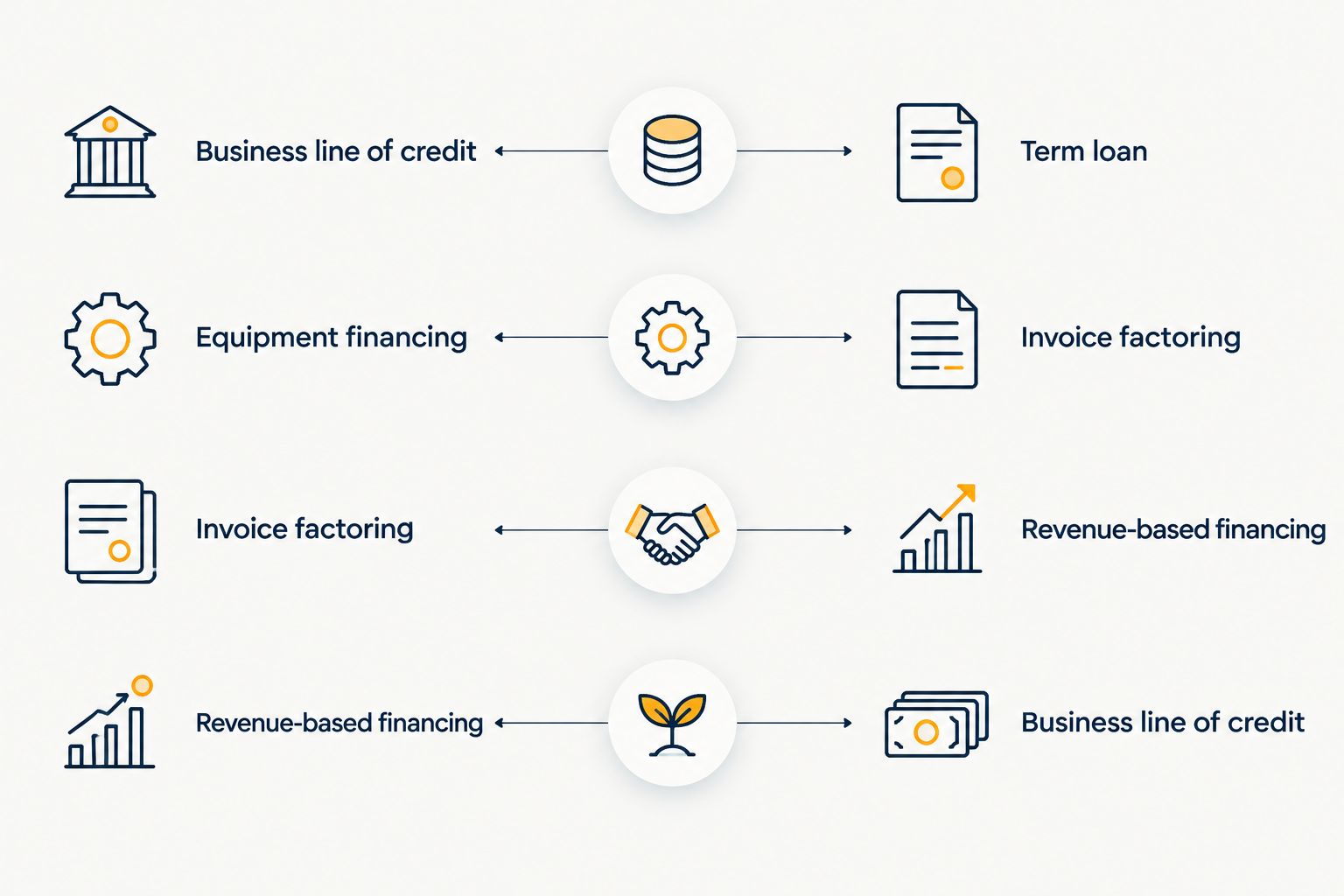
A line of credit suits a recurring gap when the business can draw and repay as needed under its agreement. A term loan suits a defined expense with a scheduled payoff. Equipment financing targets an equipment purchase, while invoice factoring addresses cash tied to eligible invoices. These are different structures, not interchangeable labels.
Revenue-based financing links repayment to business revenue under the contract. Some arrangements are structured as purchases of future receivables. A merchant cash advance, or MCA, commonly describes an advance structured around a purchase of future receivables; read the agreement to determine what is being sold and how collections work.
- Match repeat expenses to a reusable facility rather than assuming a lump sum is necessary.
- Match a single planned purchase to a defined funding and payoff schedule.
- Check whether an invoice or equipment asset supports a more specific option.
- Examine receivables purchases against expected sales and existing obligations.
Compare written offers on the same basis
Get written terms before accepting any offer. For each one, record the cash the business receives, total amount owed, payment frequency, fees, security requirements and consequences of missed payments. Do not compare a loan's annual percentage rate, or APR, directly with an MCA factor rate as though the numbers measure the same thing.
A factor rate multiplies the amount advanced to calculate a stated purchased amount or repayment obligation. For an illustrative offer using a 1.20 factor on $40,000, multiplication gives $48,000. The $8,000 difference is not an APR: an APR comparison also depends on the actual payment amounts and dates, and contract details can change the calculation. The guide to comparing MCA factor rates explains the distinction.
- Request the complete agreement and a payment schedule.
- Compare cash received with total dollars owed, including stated fees.
- Identify whether payments are fixed or change with revenue.
- Review personal guarantees, liens and default provisions before signing.
Check qualification before choosing the fastest route
Review the documents each provider requests and the reason a bank declined, if applicable. Credit, revenue, existing obligations and the purpose of funds can all affect underwriting; no single factor determines every decision. Do not submit inconsistent figures across applications.
Jon Lynch Financial Group primarily serves U.S. business owners generating at least $35,000 per month who want to compare business-purpose funding through third-party partners. Owners below $35,000 per month have a self-serve funding path instead. That path lets applicants securely connect bank statements through Plaid for an automated decision; eligible applicants may receive a decision within minutes, and approved funds may arrive within an hour, subject to verification, bank processing and product terms.
- Gather bank statements and current business financial records.
- List outstanding financing and its payment schedule.
- State the business purpose and amount needed consistently.
- Ask which qualification conditions remain after an initial response.
Choose the offer the business can carry
Put every viable option beside the same cash-flow forecast. Reject an offer if the required payments would crowd out payroll or essential suppliers, even when the proceeds arrive sooner. If the need can wait and a lower-cost structure qualifies, compare that route before paying for speed.
Jon Lynch Financial Group can help owners compare working capital, revenue-based financing, purchases of future receivables and other available structures. The decision belongs in the written terms and your cash-flow calendar, not in a headline about speed.
- Eliminate offers that fail the weaker-month repayment test.
- Compare total dollars paid, timing and qualification together.
- Confirm the lender or funder responsible for the agreement.
- Keep the signed terms and repayment schedule with your financial records.
Which funding option fits your cash need?
Use this table to narrow the field, then compare actual written offers. The starting-price column cannot substitute for a quote: qualification and contract terms determine the cost of an individual offer.
| Option | Best for | Starting price | Key limitation |
|---|---|---|---|
| Business line of credit | Recurring, uneven working-capital needs | Not stated; request written terms | Access and draw terms depend on underwriting and the agreement. |
| Term loan | A defined expense with a planned payoff | Not stated; request written terms | Scheduled payments continue even if the expense generates cash later. |
| Equipment financing | A specific equipment purchase | Not stated; request written terms | Proceeds are tied to the equipment transaction and contract terms. |
| Invoice factoring | Eligible business invoices awaiting payment | Not stated; request written terms | Suitability depends on invoices and the applicable arrangement. |
| Revenue-based financing or receivables purchase | A business evaluating repayment tied to revenue or receivables | Not stated; request written terms | Total cost and collection mechanics require careful contract review. |
There is no universal winner for West Palm Beach business funding in 2026. A term loan is a better fit for a planned one-time expense if its scheduled payments work. A line of credit is a better structural fit for repeated draws; its usefulness still depends on the actual terms. A receivables purchase deserves particular scrutiny when existing obligations already consume incoming sales.
Do not infer a quote from the table. Ask how each provider calculates what you owe and how payments are collected. If the agreement is a purchase of future receivables rather than a loan, confirm the purchased amount and collection terms instead of assuming loan terminology applies.
What mistakes make a funding offer harder to carry?
Comparing proceeds instead of total cost. Receiving the requested amount does not establish that the business can afford the full obligation. In 2026, compare cash received, total dollars owed and the timing of every payment on one page.
Using a fast product for a slow return. A project that produces cash only after completion can clash with payments due during the work. Tie the first required payment and every later one to a realistic forecast, not just the project's expected profit.
Treating a factor rate as an APR. The factor-rate multiplication shows a stated dollar obligation; it does not express an annualized cost by itself. Obtain the payment schedule and review the full agreement before comparing it with a loan.
Ignoring existing financing. Another obligation competes with payroll and suppliers for the same deposits. List every current payment before judging a new offer, especially when the business already has a receivables purchase.
Assuming a broker makes the credit decision. Jon Lynch Financial Group is a broker, not a direct lender. Third-party partners underwrite the funding products, and an application does not guarantee approval, an amount, a rate or a funding time.
What should you prepare before requesting funding?
In 2026, arrive with a specific business-purpose request and records that let a funder evaluate it. Put the requested amount beside the expense it covers and the dates cash will leave and return. This makes competing terms easier to check against the same need.
- Recent business bank statements and records showing revenue.
- A list of current loans, advances and other financing obligations.
- A description of the expense, its deadline and expected cash return.
- Any invoices, contracts or equipment details relevant to the request.
- Questions about total cost, payment frequency and contract responsibility.
Different providers request different documents; confirm the current requirements for the product you pursue. Keep consumer-purpose requests separate. The funding routes discussed here are for U.S. business owners seeking business-purpose capital, subject to third-party underwriting.
FAQ
What is the best business funding option in West Palm Beach in 2026?
The best option is the one that covers your documented business need with payments your cash flow can support. Compare the written total cost, timing, qualification and repayment terms across suitable structures.
Is a business line of credit better than a term loan?
A line of credit fits repeat funding needs; a term loan fits a defined expense with a planned payoff. Compare actual agreements because access terms and repayment requirements differ.
How do I compare a merchant cash advance with a loan?
Compare cash received, total dollars owed and the payment schedule first. An MCA may be structured as a purchase of future receivables, and its factor rate is not the same measure as a loan APR.
Can I seek business funding after a bank decline?
Yes, a bank decline does not prevent you from comparing other business-purpose options. Identify the reason for the decline and test any alternative offer against its full cost and payment schedule.
Does Jon Lynch Financial Group lend directly?
No. Jon Lynch Financial Group is a broker, not a direct lender; third-party partners handle underwriting and provide the applicable funding agreements.
What if my business generates under $35,000 per month?
Businesses below $35,000 per month have a self-serve funding path to explore. Applicants can securely connect bank statements through Plaid, but decisions and funding depend on eligibility, verification, bank processing and product terms.
What documents should I gather for business funding?
Start with business bank statements, revenue records, existing financing details and a clear description of the expense. The provider determines the documents required for its underwriting.
One last thing
A lower total cost does not solve a cash-flow problem if the payment dates come before the revenue the funding is meant to produce. Put those dates on the same calendar before you accept any 2026 offer.
If your U.S. business generates at least $35,000 per month, the practical next step is Compare Business Funding Options with the expense, deadline and existing obligations in hand. If it generates less, Explore Self-Serve Funding instead. Neither route promises approval or a specific outcome.