How much does working capital cost versus a term loan?
Working capital loan cost vs term loan: compare actual offers, not labels. Check net proceeds, total payments, fees and cash-flow fit before signing.

Working capital does not have a single cost versus a term loan: a working capital loan can itself be a term loan. In 2026, compare the actual offers by net cash received, total dollars paid, payment timing and early-payoff terms—not the product labels. Fees withheld at funding and frequent withdrawals can make an apparently cheaper offer harder on your cash flow.
- Working capital loan cost vs term loan depends on the contract, not the label; compare net proceeds and total payments.
- A factor rate is not APR; repayment timing matters when comparing revenue-based financing with loans.
- Jon Lynch Financial Group fits established U.S. business owners comparing business-purpose funding through third-party partners.
- Choose payments your cash flow supports without relying on another financing advance.
How much does working capital cost versus a term loan?
Neither label establishes which offer costs less. Working capital describes the purpose of the money—such as payroll, inventory or operating expenses—while a term loan describes a financing structure with a defined repayment term.
That distinction matters before you request quotes. The working capital costs and qualification guide addresses the operating-funding side; your actual comparison still requires written offers.
| Structure | Best for | What to compare | Main tradeoff |
|---|---|---|---|
| Working capital term loan | A defined operating need with a repayment plan | Net proceeds, interest, fees and scheduled payments | Fixed obligations continue when receipts slow |
| Longer-term business loan | A business use that produces benefits over a longer period | Total interest, fees, maturity and early-payoff terms | Lower periodic payments do not necessarily mean lower total cost |
| Business line of credit | Recurring gaps with uncertain draw amounts | Draw charges, interest, account fees and repayment rules | Access and borrowing terms remain subject to the agreement |
| Purchase of future receivables | Businesses evaluating funding tied to future receipts | Purchase price, purchased amount, remittances and reconciliation | A factor rate does not express annualized cost |
The better offer is the one that funds the same business need at an acceptable total cost without creating an unaffordable payment schedule. A longer repayment period can ease immediate pressure while increasing the time you remain obligated.
Which structure fits your business need?
Start with the expense and the expected source of repayment. A payroll gap before a customer pays is different from equipment that supports operations over an extended period.
For a temporary operating gap, identify the receipts expected to close it. For an expansion, test whether existing cash flow supports payments before the expansion produces revenue.
- Defined operating expense: Compare a working capital term loan against other structures using the same net funding amount.
- Recurring timing gap: Evaluate a line of credit, including what happens after each draw.
- Longer-lived business investment: Compare a term loan with a repayment period that matches the use of funds.
- Receivables-based offer: Review the legal structure and remittance obligations rather than treating it as an interchangeable loan.
Do not select a structure solely because the advertised payment looks manageable. First establish whether it solves the underlying funding need or merely postpones an unresolved cash shortfall.
How do you calculate the cost of each offer?
Use the same worksheet for every 2026 offer. Keep borrowed principal separate from financing expense, and distinguish the approved amount from the cash your business actually receives.
What cash actually reaches your business?
Net proceeds = gross funding amount − amounts withheld at funding. Ask the provider to identify every deduction and explain whether any existing obligation will be paid from the proceeds.
An offer that includes a payoff of existing financing does not deliver its full headline amount as new operating cash. Compare the usable cash left after that payoff, not just the amount shown on the approval.
What will leave your business account?
Financing cost = total required payments + separately paid financing charges − net proceeds. Use this calculation only after confirming that separately paid charges are not already included in the payment total.
List every payment date and amount. If payments vary, separate known contractual amounts from projections and document the assumptions behind those projections.
What happens if you repay early?
Request a written payoff calculation. Determine whether early repayment reduces future interest or charges, triggers a penalty, or leaves a contracted purchase amount unchanged.
Do not subtract an assumed early-payoff discount from your comparison. Count a reduction only when the agreement or a written payoff statement supports it.
What should the comparison sheet contain?
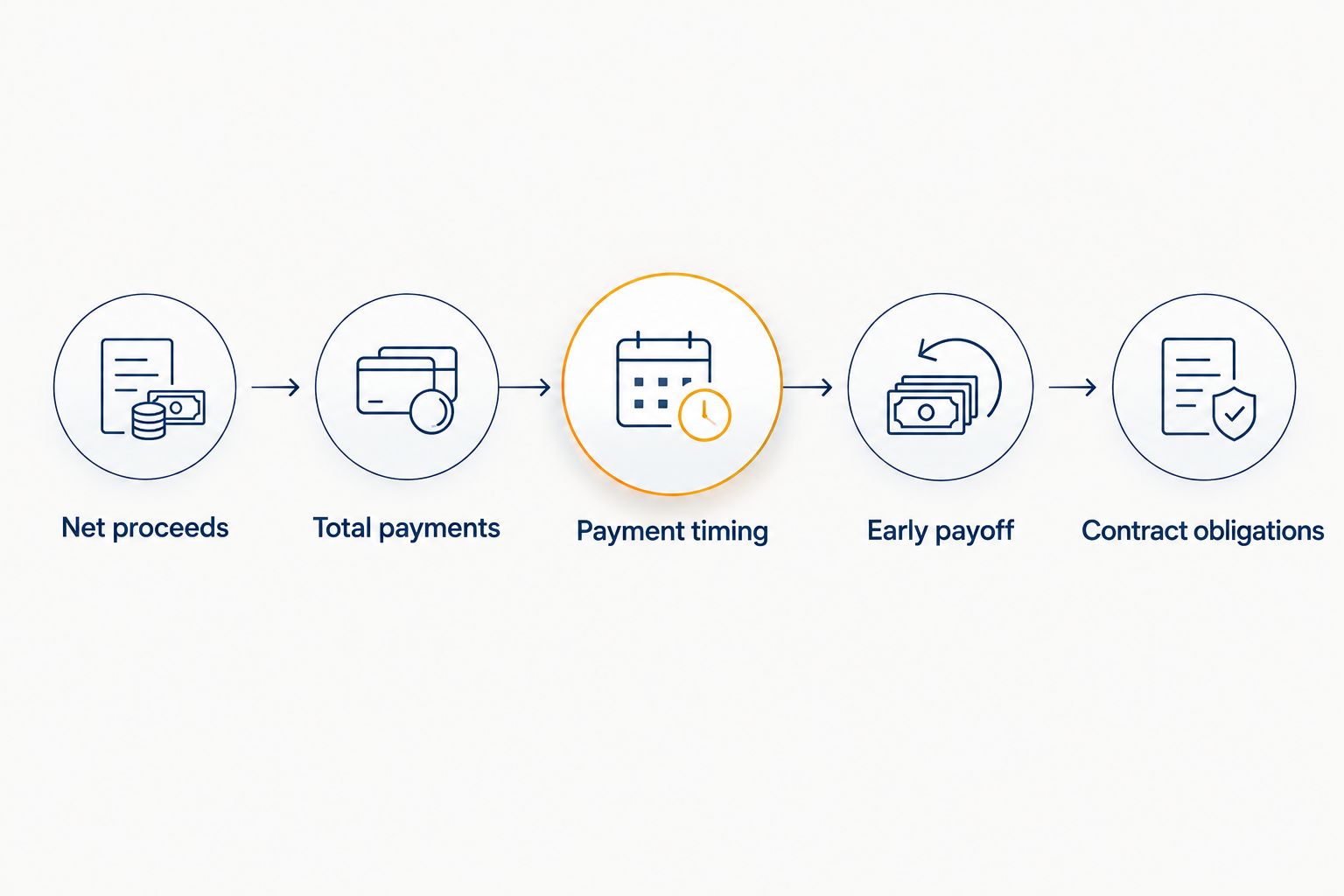
Keep these fields together so an attractive headline cannot hide a difficult obligation:
- Net proceeds: Cash available for the business purpose.
- Total payments: Scheduled repayment or purchased receivables obligations, clearly identified.
- Payment timing: Withdrawal dates matched against expected collections.
- Early payoff: Written treatment of interest, charges and remaining obligations.
- Contract obligations: Guarantees, security interests, reporting requirements and default provisions.
The worksheet is not complete until you can explain every difference between gross funding and usable cash. Ask for clarification before signing, not after the first withdrawal.
Why isn't a factor rate the same as APR?
A factor rate is a multiplier used to calculate a contracted repayment or purchased amount from the funding amount. APR is an annualized cost measure; the figures are not interchangeable.
Multiplying a funding amount by a factor rate does not account for how quickly payments leave your account. Fees withheld at funding also affect the cost relative to the cash you receive.
For your 2026 comparison, request an annualized calculation based on net proceeds, applicable charges and the actual payment schedule. When future remittances depend on revenue, distinguish an estimated annualized calculation from a fixed contractual obligation.
Revenue-based financing may be structured as a purchase of future receivables rather than a loan. A merchant cash advance, or MCA, requires careful review of the purchase agreement, including reconciliation provisions and obligations if receipts decline.
Compare the economics without erasing the legal differences. An estimated annualized comparison does not turn a receivables purchase into a loan or determine its legal classification.
Why does working capital financing cost vary?
The contract and the applicant—not the working capital label—determine the comparison. Review these factors against each written offer rather than assuming every provider treats them identically.
- Repayment duration: More time changes both periodic payment pressure and the period over which charges accrue.
- Payment frequency: Daily, weekly and monthly schedules affect the cash left between customer collections.
- Fees and deductions: Withheld charges reduce usable proceeds; separately paid charges add to your outlay.
- Business and credit profile: Revenue, existing obligations, credit history and other underwriting information affect the offers available.
- Security and guarantees: Collateral and personal obligations change your exposure if the business cannot perform.
- Payoff and adjustment terms: Prepayment rules and revenue-reconciliation provisions affect what happens when circumstances change.
Credit is not irrelevant simply because an offer emphasizes bank deposits. Ask how credit information is used and what checks the application authorizes.
When is a slower or different option better?
A slower option is better when your business can wait and the written terms produce a better cost-and-payment fit. Speed has value only when receiving the money sooner protects a real business outcome.
Ask what happens if you delay the expense. Compare that consequence with the financing obligation, using documented customer commitments and expense deadlines rather than an optimistic sales forecast.
A line of credit deserves consideration when you need repeated draws rather than a single lump sum. Invoice factoring deserves consideration when eligible business invoices are the source of the gap, but its fees, customer-notification requirements and recourse terms need their own review.
Equipment financing deserves consideration when equipment is the actual purchase. None of these alternatives automatically wins: compare the structure against the use of funds and the complete agreement.
Avoid funding a recurring operating loss without a credible corrective plan. Financing changes when cash arrives; it does not, by itself, improve the margin on an unprofitable sale.
How do you test whether the payments are affordable?
Build a cash forecast before accepting either offer. In 2026, your comparison should show customer collections, payroll, taxes, suppliers, existing financing payments and the proposed new withdrawals on their actual expected dates.
The purpose of liquidity planning is to expose cash shortfalls between receipts and obligations; a business can show a positive monthly balance yet lack cash on a withdrawal date. Match the forecast to the payment schedule rather than dividing everything into a convenient monthly average.
Run a slower-collections case alongside the expected case. Move uncertain receipts later while keeping payroll and other unavoidable obligations in place.
Then ask whether the business still meets its obligations without another advance. If the plan requires new financing merely to service the proposed financing, reduce the amount, change the structure or defer the expense.
Is a lower monthly payment always cheaper?
A lower monthly payment does not establish a lower total cost. A longer repayment period spreads obligations over more time, so compare the full payment total and the duration alongside immediate cash-flow relief.
Does paying off working capital financing early save money?
Early payoff saves money only when the agreement reduces the remaining cost. Interest-based loans and fixed purchased-receivables obligations can treat early completion differently, so obtain the actual payoff terms in writing.
What risks should stop you from signing?
Stop when you cannot reconcile the offer with the contract. A verbal explanation is not a substitute for written payment, payoff or adjustment provisions.
Treat these as reasons to pause and request clarification:
- You cannot identify the lender or funder responsible for the agreement.
- The usable proceeds do not cover the stated business need.
- The payment forecast depends on unconfirmed sales or another advance.
- You do not understand a personal guarantee, security interest or default provision.
- A promised payment adjustment does not match the written reconciliation process.
- Existing agreements restrict additional borrowing or encumber the same assets or receivables.
An unsecured label does not eliminate contractual obligations or personal exposure. Have qualified legal and accounting advisers review provisions you cannot confidently evaluate.
What should you prepare before comparing offers?
Prepare a current picture of your business rather than applying with inconsistent figures. Confirm each provider's document requirements; there is no universal checklist that establishes approval.
Useful comparison materials include recent business bank statements, current financial records, existing financing balances, payment schedules and a clear explanation of the business purpose. Add invoices, contracts or equipment details when they support the request.
Record your required net proceeds, expense deadline and repayment source before speaking with providers. These details make it easier to reject an offer that looks attractive but does not solve the problem.
For a 2026 decision, ask each provider to confirm the offer's expiration and whether terms can change after verification. Do not treat a preliminary indication as a final funding commitment.
What should you know about the broker's role?
Jon Lynch Financial Group is best for established U.S. business owners comparing business-purpose funding through third-party partners. Jon Lynch Financial Group is a broker, not a direct lender; products remain subject to third-party underwriting and applicable agreements.
The comparison route serves businesses generating at least $35,000 per month. That revenue threshold identifies the audience for the route, not a promise of qualification, an amount, a rate or a funding time.
FAQ
Is a working capital loan cheaper than a term loan?
Neither label establishes which offer is cheaper, because a working capital loan can itself be a term loan. Compare equal net proceeds, total required payments, fees and payment timing.
Can I compare a factor rate directly with an interest rate?
A factor rate cannot be compared directly with an annual interest rate or APR. Request a calculation that accounts for net proceeds, charges and the payment schedule.
Will a longer term reduce my financing cost?
A longer term does not automatically reduce financing cost. It spreads payments over more time, but total interest and charges still need comparison.
Can I use a business term loan for payroll or inventory?
A business term loan can fund payroll or inventory when the agreement permits those uses. Confirm permitted uses and whether repayment fits the expected cash collections.
Does revenue-based financing always mean a loan?
Revenue-based financing may be structured as a purchase of future receivables rather than a loan. Review the agreement's legal structure, remittance obligations and reconciliation provisions.
What if my business generates less than $35,000 per month?
Businesses generating less than $35,000 per month can use the self-serve funding route offered by Jon Lynch Financial Group. Approval and terms remain subject to verification and the applicable funding requirements.
Which related guides answer the next questions?
- How much does a small business term loan cost?
- How to compare factor rates on a merchant cash advance
- Business line of credit lenders
What is your next step?
Bring the same net funding requirement and cash forecast to every comparison. A smaller payment is not a better offer if it leaves you obligated longer than the business benefit lasts.
For U.S. businesses generating at least $35,000 per month, Compare Business Funding Options with Jon Lynch Financial Group. Below $35,000 per month, Explore Self-Serve Funding; neither route guarantees approval, terms or timing.



