Business Term Loans for Security Guard Companies 2026
Compare business term loans for security guard companies in 2026: payroll-gap sizing, term vs. line of credit, factor-rate math and qualification thresholds.

Security guard companies' business term loans are lump-sum financing arrangements repaid on a fixed schedule, used to close the gap between weekly guard payroll and net-30-to-net-60 client billing. Guard companies carry a labor cost ratio most industries don't: payroll runs every week regardless of when the client pays, and mobilizing a new contract means covering uniforms, radios, background checks and bonding before the first invoice is even sent. That timing mismatch, not a lack of revenue, is what pushes most owners to compare term loans against lines of credit and revenue-based financing in 2026.
- Business term loans for security guard companies close the gap between weekly payroll and net-30-to-60 client billing.
- Jon Lynch Financial Group compares term loans, lines of credit and revenue-based financing side by side before you sign.
- Guard companies generating at least $35,000 a month in monthly revenue typically qualify for the broadest set of term structures.
- A term loan vs. business line of credit decision usually comes down to whether the need is a one-time equipment buy or recurring payroll flex.
- Stacking a merchant cash advance on top of an existing term loan is the fastest way a guard company runs out of cash mid-contract.
Why business term loans matter for security guard companies
Most guard companies operate on thin net margins because payroll is 60-70% of contract revenue, and that payroll doesn't wait for the client's accounts payable department. A term loan converts a future, predictable need — payroll for a newly won contract, a fleet of patrol vehicles, replacement radios — into a fixed monthly payment you can underwrite against the contract's own billing schedule.
The alternative most guard companies default to without comparing options is a merchant cash advance, priced on a factor rate rather than an interest rate. A $50,000 advance at a 1.35 factor rate means $67,500 in total repayment — that's illustrative math, not a quoted rate, and actual factor rates vary by underwriting file. A business term loan for security guard companies with a 24-36 month term and a fixed rate is almost always cheaper total-dollar-for-dollar than a short-term MCA used to cover the same payroll gap. The tradeoff is speed and collateral flexibility — MCAs and revenue-based financing close faster and lean less on hard collateral, which is why they still get used for urgent, short-cycle needs. Working capital loans: costs and qualification breaks down qualification thresholds in more detail; term loan vs. business line of credit walks through the structural difference directly.
Size the loan against your actual payroll cycle
Don't request a round number. Size the loan against the specific gap between when you pay guards and when the client pays you.
- Pull the last 90 days of payroll runs and compare the dates against client invoice payment dates.
- Calculate the average gap in days, not weeks — guard payroll is often weekly, invoices are frequently net 45.
- Add a 15-20% buffer for overtime during contract mobilization or post surges.
- Exclude one-time onboarding costs (uniforms, background checks) from the payroll gap calculation and size them separately.
- Confirm the loan term doesn't outlast the contract it's funding — a 36-month term against a 12-month contract creates repayment risk after the contract ends.
Pull your bank statements before you apply anywhere
Underwriters for term loans, lines of credit and revenue-based financing all start with the same document: 3-6 months of business bank statements. Get them organized before you shop.
- Reconcile deposits against client contracts so underwriters see recurring, named revenue, not lump sums.
- Flag any NSF or overdraft days — lenders count them, and multiple per month lowers your qualification tier.
- Separate payroll company draws from operational transfers so average daily balance isn't understated.
- Note average monthly revenue explicitly; the $35,000/month threshold is the line between traditional term-loan underwriting and faster, self-serve funding paths.
- Have your most recent business tax return ready even if the lender doesn't ask for it upfront — it speeds up a second-look request.
Compare structures before you compare lenders
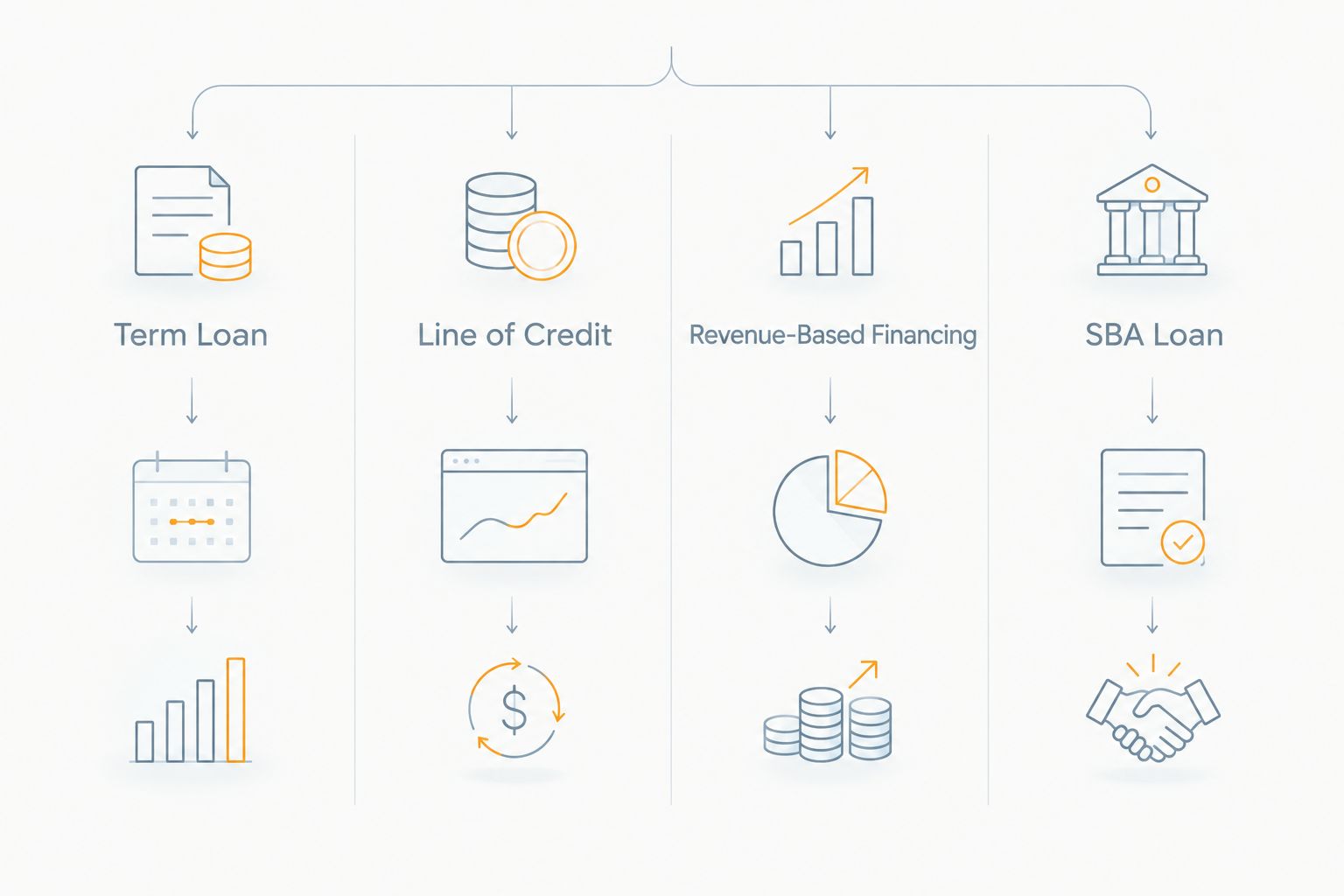
Once your numbers are organized, the faster path is comparing structures side by side rather than calling individual lenders one at a time. This is where a commercial finance broker like Jon Lynch Financial Group earns its role: comparing term loans, lines of credit and revenue-based financing against your actual contract calendar rather than a generic rate sheet. Jon Lynch Financial Group is a broker, not a direct lender — funding is placed with third-party lenders and funders based on your file.
- Compare total dollars repaid across structures, not just the headline rate or factor rate.
- Match the repayment schedule (daily, weekly, monthly) to how often your contracts actually bill.
- Ask each option's minimum time in business and minimum monthly revenue before applying, to avoid wasted hard pulls.
- Confirm whether the structure requires a personal guarantee, and what happens to that guarantee if the contract ends early.
- Get the total cost of capital in writing before signing — factor rate to effective APR conversion matters more than the sticker number.
Build in a payroll buffer before you sign
A loan that covers today's gap but not next month's overtime surge sets up a second funding request within 90 days.
- Model a 90-day cash flow forward, not backward, using the loan proceeds as a starting balance.
- Stress-test one slow-pay client scenario — most guard companies have at least one net-60 payer that occasionally runs net-75.
- Keep 2-3 weeks of payroll in reserve after loan proceeds land, don't deploy 100% immediately.
- Revisit payroll funding for small business if payroll timing, not equipment, is the recurring problem rather than a one-time gap.
Compare Business Funding Options
Compare term loan, line of credit and revenue-based financing structures against your contract calendar.
Watch fleet and equipment costs separately from payroll
Patrol vehicles, radios, cameras and uniforms are capital costs, not payroll costs, and lenders underwrite them differently.
- Separate equipment financing requests from working capital requests — blending them muddies underwriting and can slow both.
- Check whether the equipment can serve as collateral, which typically lowers the rate versus an unsecured term loan.
- Review term loans for equipment-heavy businesses if fleet or camera-system purchases are the bulk of the request.
- Confirm depreciation schedules with your accountant before locking a loan term longer than the equipment's useful life.
Compare the options side by side
| Option | Best for | Key limitation | Verdict |
|---|---|---|---|
| Business term loan | One-time payroll gap, equipment, or contract mobilization cost | Slower approval than an MCA; typically needs 6+ months in business | Best fit for predictable, one-time needs |
| Business line of credit | Recurring payroll flex across multiple contracts | Revolving limit can be lower than a lump-sum term loan need | Best fit for ongoing, variable draws |
| Revenue-based financing / purchase of future receivables | Fast, short-cycle cash need, urgent payroll | Priced on a factor rate; total cost is usually higher than a term loan | Use sparingly, not as a standing structure |
| SBA loan | Larger, longer-term capital needs with time to spare | Longer approval timeline; heavier documentation | Best fit when timing isn't urgent |
Common mistakes security guard companies make
- Sizing the loan to the contract's total value instead of the payroll gap — most guard companies over-borrow against contract size and under-plan for the actual weekly cash need.
- Stacking a merchant cash advance on top of an existing term loan to cover a payroll shortfall, which compounds daily or weekly debits against the same bank account and accelerates cash strain. How to get out of a stacked merchant cash advance position covers the exit math when this has already happened.
- Ignoring bonding and licensing renewal costs when sizing a loan, then hitting a second cash crunch at license renewal season.
- Signing a personal guarantee without asking what triggers release, which matters more for guard companies where owner-operators are personally on the hook for payroll obligations.
- Treating every new contract win as self-funding, when mobilization costs (uniforms, background checks, training) hit before the first invoice clears.
FAQ
What are business term loans for security guard companies used for?
Security guard companies typically use business term loans to cover payroll during the gap between weekly wages and net-30-to-60 client invoices, fund new contract mobilization costs, or purchase patrol vehicles and equipment. The structure fits one-time or predictable needs better than recurring cash flow gaps.
Is a business line of credit better than a term loan for a guard company?
A line of credit fits recurring, variable payroll needs across multiple contracts, while a term loan fits a single, defined cost like equipment or a mobilization gap. Guard companies running several contracts with staggered billing dates often carry both structures at once.
How much does a merchant cash advance cost compared to a term loan?
A merchant cash advance is priced on a factor rate rather than an interest rate, so a $50,000 advance at a 1.35 factor rate repays $67,500 total, illustrative of the math, not a quoted rate. A term loan with a fixed rate over 24-36 months is typically cheaper in total dollars for the same amount, though it usually funds slower.
What monthly revenue does a security guard company need to qualify for a term loan?
Guard companies generating at least $35,000 per month in verified revenue typically qualify for the broadest set of term-loan structures compared through a broker. Businesses under that threshold are usually better matched to a faster, self-serve funding path instead.
Can a security guard company get a business term loan with bad credit?
Credit history plays a role in rate and term but isn't the only factor; consistent bank deposits and contract-backed revenue can offset a lower personal credit score with some lenders. Every file still goes through third-party underwriting, so approval and terms aren't guaranteed.
How fast can a security guard company get funded in 2026?
Timing depends on the lender, verification and product type; some revenue-based financing products can decision within minutes and fund within an hour of approval, while traditional term loans and SBA products take longer. No funding timeline is guaranteed until underwriting is complete.
Does Jon Lynch Financial Group lend directly to security guard companies?
No. Jon Lynch Financial Group is a commercial finance brokerage that compares term loans, lines of credit and revenue-based financing across third-party lenders and funders, it does not fund deals directly.
What documents does a security guard company need to apply for a term loan?
Most lenders request 3-6 months of business bank statements, proof of active contracts, and basic business formation documents; some also request a recent tax return. Having payroll and invoice timing reconciled in advance speeds up the underwriting review.
One last thing
Most guard companies size a loan against the contract's total value instead of the actual weekly payroll gap, which is the single biggest reason owners come back for a second funding request within 90 days of the first. Run the 90-day cash flow model before you apply, not after the loan lands, and match the repayment schedule to how the client actually bills — weekly guard payroll against a net-60 invoice cycle is a specific, calculable number, not a guess.