Business Funding for Startups With No Revenue: Yes, 2026
Business funding for startups with no revenue is possible. Compare startup loans, equity and equipment financing by repayment fit, eligibility and owner risk.

Yes—business funding for startups with no revenue is possible, but you need a source of repayment, an asset a lender can finance, or an investor willing to accept ownership risk. With no operating revenue, debt payments must come from somewhere other than current business sales; revenue-based financing is not a substitute for proving that repayment works. In 2026, choose the funding structure around that constraint before you submit applications.
- Business funding for startups with no revenue requires repayment support, financeable assets, or investors—not just a registered LLC.
- SBA-backed startup loans require lender underwriting; SBA support does not guarantee approval.
- Revenue-based financing depends on business receipts, making it a poor starting point for a pre-revenue company.
- Jon Lynch Financial Group serves established business owners; its self-serve route does not guarantee pre-revenue eligibility.
Why does the funding structure matter before your first sale?
No revenue and no profit are different funding problems. A business with sales but thin margins has operating activity to document; a business before its first sale relies on projections and other repayment support.
Calling both businesses “startups” hides that difference. The guide to business funding options for veteran-owned startups provides related context, but ownership status does not replace a repayment plan.
Your first decision is whether you need money to reach initial sales or to bridge the collection of sales already earned. Those needs point to different structures—and different risks.
Can a startup get business funding with no revenue?
Yes, but no single funding product fits every pre-revenue business. The strongest route depends on what you can document today, not what you expect the business to earn later.
Use this 2026 comparison to separate genuine startup routes from products designed around existing transactions. These are funding categories, not statements that a particular lender will approve your application.
| Funding route | Best for | Main advantage | Main limitation |
|---|---|---|---|
| Founder capital | Testing a business before taking outside obligations | No lender payment schedule | Your personal capital is at risk |
| Equity investment | Businesses suited to investor ownership | No scheduled loan repayment | You give up ownership and potentially control |
| Startup business loan, including eligible SBA-backed financing | Owners with a credible plan and documented repayment support | Can fund eligible startup needs | Underwriting, repayment obligations and possible guarantees |
| Business credit card | Limited purchases with a clear repayment source | Flexible purchasing tool | Personal liability and revolving balances can create risk |
| Equipment financing | A startup buying identifiable business equipment | Financing is tied to a specific asset | Does not necessarily solve payroll or general cash-flow needs |
| Invoice factoring | Businesses with eligible unpaid customer invoices | Converts an existing receivable into usable capital | No invoice means there is nothing to factor |
| Revenue-based financing or MCA | Operating businesses with documented receipts | Funding assessment can focus on business cash flow | Poor fit when no operating receipts exist |
Match the application to evidence you already have. An invoice, an equipment purchase, owner resources and an investor pitch are not interchangeable forms of support.
Who should consider borrowing before earning revenue?
Borrowing before your first sale fits a business only when the owner can explain how obligations will be met if the launch takes longer than planned. A projected sales chart alone does not answer that question.
For example, an equipment purchase creates a specific financing request. An open-ended request to “grow the company” gives an underwriter less information about the use of funds or the path to repayment.
Before considering debt, answer these questions:
- What business expense will the funding cover?
- What must happen before that expense produces collected revenue?
- What will cover payments before those collections arrive?
- What happens if a customer cancels or the opening is delayed?
- What personal assets or guarantees are you being asked to put at risk?
If the only repayment source is another future financing application, stop and revise the plan. Borrowing creates an obligation; it does not prove demand for your business.
How do the main pre-revenue funding routes work?
Can an SBA-backed loan fund a startup?
SBA-backed financing can support eligible startup businesses, but a participating lender still evaluates the request. An SBA guarantee supports the lender; it does not remove your obligation to repay.
Prepare to explain the business model, management experience, use of funds, projections and owner resources. Ask the lender which startup applications it considers and what contribution, collateral or guarantees its current program requires.
Best for: Owners with a documented launch plan and repayment support. The benefit is access to a business-purpose loan structure; the limitation is that preparation and underwriting still matter, even without an operating history.
Can a business credit card cover startup expenses?
A business credit card can cover permitted purchases, subject to issuer approval and terms. For a new business, the issuer can assess the owner's credit and require a personal guarantee.
Best for: Defined purchases you can repay from a documented source. The benefit is purchase flexibility; the risk is carrying obligations that outlast your launch assumptions.
Do not treat a credit limit as revenue. Read the agreement for personal liability, payment obligations and restrictions before using the card to fund operating expenses.
Can equipment financing work before sales begin?
Equipment financing evaluates a specific asset alongside the applicant's financial position. That makes the request different from unsecured cash for a business with no operating receipts.
Best for: A startup whose next step requires identifiable equipment. The advantage is an asset-specific request; the limitation is that equipment funding does not automatically provide money for inventory, payroll or other launch expenses.
Ask what the contract requires if the business never opens or the equipment does not generate the expected work. Owning productive equipment and having customers are separate conditions.
Is equity a better fit than debt?
Equity investment exchanges an ownership interest for capital. It avoids a scheduled loan payment, but it creates an ownership relationship with rights defined by the investment documents.
Best for: Businesses that fit investor objectives and whose founders accept dilution. The benefit is capital without a conventional repayment schedule; the tradeoff is sharing ownership and potentially decision-making authority.
Founder capital is another route, but it has its own limit: the amount you can commit without damaging your personal financial position. Neither route makes an untested business model safe.
Why is revenue-based financing different from startup capital?
Revenue-based financing relies on business revenue as part of the funding and collection structure. A merchant cash advance, or MCA, may be structured as a purchase of future receivables rather than a loan.
That distinction does not eliminate contract obligations. Review the agreement's collection method, reconciliation provisions, default terms and any guarantees instead of assuming the label tells you everything.
For a business without operating receipts, there is no demonstrated sales pattern supporting a revenue-based assessment. Projected sales are not the same as collected revenue.
Invoice factoring has a different requirement: an eligible receivable from a customer. A sales proposal or hoped-for order is not an unpaid invoice for completed work.
How should you compare funding when there is no sales history?
Start with the obligation, not the advertised approval message. In a 2026 funding comparison, put each written offer on the same basis: usable proceeds, total contractual obligation, payment timing and liability.
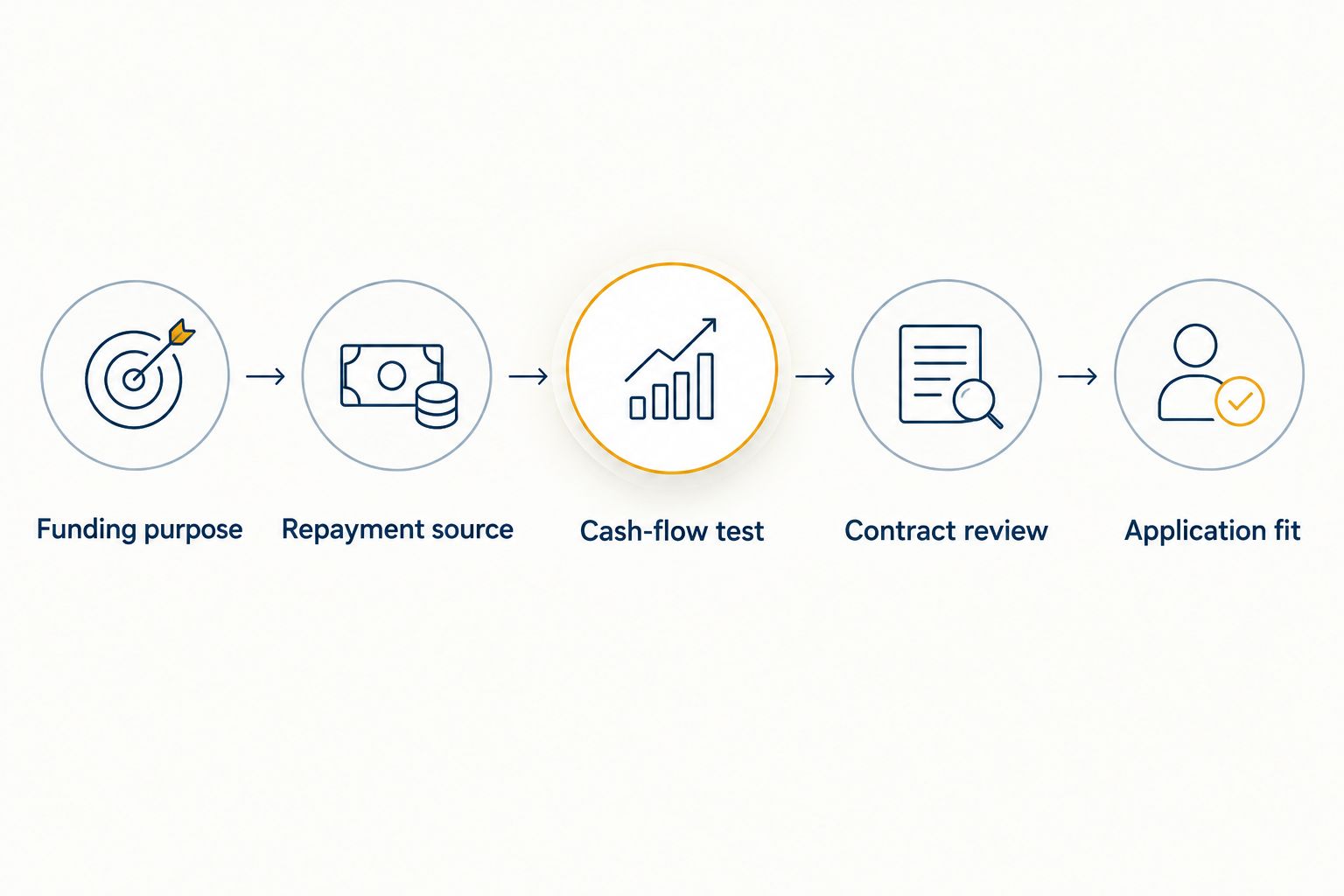
Use this sequence:
- Funding purpose: Identify the expense and the business milestone it supports.
- Repayment source: Document what covers obligations before sales are collected.
- Cash-flow test: Check whether the payment schedule fits that source.
- Contract review: Identify guarantees, collateral, default provisions and early-exit terms.
- Application fit: Confirm that the provider considers pre-revenue businesses before applying.
The sequence prevents a common mismatch: choosing a funding product first, then trying to make the business qualify for it.
A factor rate is a multiplier used to determine a contractual amount; it is not an annual percentage rate. APR accounts for annualized borrowing cost, so a factor rate cannot be compared directly with a loan APR.
If you receive a receivables-purchase offer after revenue begins, request the collection schedule and written terms. Total obligation alone does not show whether withdrawals fit your business's cash flow.
Why does startup funding eligibility vary?
Eligibility varies because providers evaluate different evidence and accept different risks. There is no universal “startup approval” standard.
- Repayment support: A business without sales must explain another supportable payment source.
- Owner credit: Credit can affect underwriting and personal-guarantee decisions; it is not irrelevant.
- Business purpose: The requested funding must match permitted uses under the product.
- Assets and receivables: Equipment and eligible invoices support different financing structures.
- Operating evidence: Bank activity, customer documentation and financial records help distinguish projections from completed transactions.
- Provider rules: Each lender or funder sets its own program criteria and contract requirements.
Do not confuse a broker's audience threshold with a lender's approval rule. A route that accepts an application is not a promise that the applicant qualifies.
What should you prepare before applying in 2026?
Prepare an application that separates facts from forecasts. Label projected revenue as projected revenue, and identify the assumptions behind it.
Your preparation checklist should include:
- Business formation and ownership records.
- A business-purpose use-of-funds explanation.
- Available business bank statements and financial records.
- A launch budget and cash-flow forecast.
- Documentation of owner resources or other repayment support.
- Relevant equipment quotes, customer agreements or eligible invoices.
- A list of existing obligations and guarantees.
The provider determines the actual document requirements. Ask for that checklist before sending sensitive information, and verify who receives the application and who makes the funding decision.
A registered LLC establishes an entity, not creditworthiness. Building a business credit file can support future applications, but it does not create sales, collateral or repayment capacity.
Which Jon Lynch Financial Group route fits your revenue level?
Jon Lynch Financial Group business funding is best suited to established U.S. businesses generating at least $35,000 per month. Its primary audience needs business-purpose working capital or wants to compare financing by total obligation, timing, qualification and repayment.
Jon Lynch Financial Group is a broker, not a direct lender. Funding products are subject to third-party underwriting; revenue-based financing may be structured as a purchase of future receivables.
Businesses below $35,000 per month are directed to its tech-forward self-serve funding path. That route is open to U.S.-based entrepreneurs and uses a secure bank-statement connection through Plaid for an automated decision, but being below the threshold does not establish eligibility with no revenue.
Use Jon Lynch Financial Group to find the appropriate route. For pre-revenue applicants, Explore Self-Serve Funding means explore eligibility—not expect approval; consumer-purpose and non-U.S. requests are outside the primary funding audience.
FAQ
Can I get business funding before my first sale?
Yes, business funding before your first sale is possible through structures such as founder capital, equity investment or eligible startup financing. Debt still requires lender underwriting and a supportable repayment plan.
Can I get an MCA with no business revenue?
An MCA is not a sound starting point for a business with no operating receipts. A purchase of future receivables does not make projected sales equivalent to an established collection history.
Does forming an LLC qualify me for a business loan?
No, forming an LLC does not establish loan eligibility. A provider still evaluates the applicant, funding purpose and repayment support under its program rules.
Can an SBA-backed loan help a startup in 2026?
Yes, eligible startups can seek SBA-backed financing in 2026. A participating lender makes the underwriting decision, and the SBA guarantee does not remove the borrower's repayment obligation.
Can I factor invoices if my startup has no customers yet?
No, invoice factoring requires an eligible customer receivable. A business plan, sales forecast or unsigned proposal is not an invoice for completed work.
Does Jon Lynch Financial Group guarantee funding below $35,000 per month?
No, Jon Lynch Financial Group does not guarantee funding below $35,000 per month. Its self-serve route offers an application path, not a promise of pre-revenue eligibility, approval or funding timing.
Is business funding with no revenue the same as funding with bad credit?
No, missing revenue and impaired credit are separate underwriting issues. Improving a credit file does not by itself establish a repayment source for a pre-revenue business.
Related guides
- Business tradelines for new LLCs with no credit history
- Startup business line-of-credit lenders
- Merchant cash advance requirements and alternatives
One last thing: what should you do before applying?
Your first useful funding document is a repayment plan, not an application. Write down the expense, the source of payment before sales begin and the consequence if those sales are delayed.
For a pre-revenue U.S. business in 2026, Explore Self-Serve Funding and confirm eligibility before taking on an obligation. Once your business generates at least $35,000 per month, use Compare Business Funding Options to evaluate business-purpose offers side by side; approval, amounts, rates and timing remain subject to underwriting and product terms.