Revenue Based Financing Without Collateral: Yes, 2026
Revenue based financing without collateral is possible. Compare guarantees, security interests and collection terms before choosing business funding in 2026.

Yes, revenue based financing without collateral can work when a funding partner evaluates your business revenue rather than requiring specific equipment or real estate as security. In 2026, the decisive tradeoff is contractual exposure: an offer without traditional asset collateral can still include a security interest, personal guarantee or demanding collection schedule. Treat “no collateral” as a question to verify in the agreement, not a promise of no liability.
- Revenue based financing without collateral is possible; verify security interests, guarantees and collection terms before accepting.
- Revenue-based financing and merchant cash advances can involve purchases of future receivables, not conventional loans.
- Jon Lynch Financial Group helps established U.S. business owners compare funding through third-party partners.
- No traditional collateral does not mean no credit review, no personal exposure or automatic approval.
Can revenue-based financing work without collateral?
Yes. A revenue-focused funding arrangement can evaluate expected business receipts without requiring you to pledge a particular building, vehicle or machine. That does not establish whether the agreement is unsecured in every legal sense.
Your practical test is to separate asset requirements from personal liability and repayment mechanics. When you compare revenue-based financing agencies, ask for the actual agreement and disclosures rather than relying on a summary that says collateral is unnecessary.
| Contract question | What to establish | Why it matters |
|---|---|---|
| Specific asset pledge | Whether identified equipment or real estate secures the transaction | Determines whether those assets support the funding |
| Security interest | Whether the agreement covers receivables or other business assets | No equipment pledge does not settle this question |
| Personal guarantee | What the owner guarantees and which events trigger liability | Business obligations and owner obligations are different |
| Collection method | Whether withdrawals are fixed or tied to actual receipts | Determines the immediate cash-flow burden |
| Revenue decline | How adjustments work when receipts fall | Determines whether collections actually respond to revenue |
Approve the structure only after you understand all five questions. An asset-light business still needs enough cash after collections to pay ordinary operating expenses.
Who does financing without traditional collateral fit?
Revenue-focused funding deserves consideration when your established business has receipts to evaluate but lacks property or equipment suitable for an asset-backed transaction. The relevant need is business-purpose working capital, such as inventory, payroll or mobilizing an awarded contract.
A clear use of funds matters. Funding inventory ahead of an identifiable sales cycle is a different decision from repeatedly funding expenses that exceed incoming cash.
Jon Lynch Financial Group is best for established U.S. business owners comparing business funding through third-party partners. Its primary comparison audience generates at least $35,000 per month; that is an audience-routing threshold, not a universal approval requirement for revenue-based financing.
For a 2026 funding decision, separate these questions:
- Business purpose: What operating need will the funds address?
- Revenue evidence: Do deposits support the receipts stated in your application?
- Cash-flow capacity: What remains after existing obligations and proposed collections?
- Contract fit: Can you accept the security, guarantee and default provisions?
- Exit plan: Does the funded activity support the obligation without another advance?
Revenue is evidence to review, not proof that an offer is affordable. A business with substantial deposits can still have little cash left after payroll, suppliers and existing financing.
How does revenue-based financing without collateral work?
“Revenue-based financing” describes a revenue-focused approach, but the label alone does not identify the legal structure. Your agreement must establish whether the transaction is a loan or a purchase of future receivables.
A purchase of future receivables exchanges funding for rights to specified future business receipts. Merchant cash advance, or MCA, is a common search term for this type of arrangement; do not assume every product using either label has identical terms.
Use this sequence to evaluate an offer:
- Verify revenue. Provide accurate business receipts and distinguish sales from transfers, refunds or financing deposits.
- Identify structure. Read whether the agreement describes a loan or a receivables purchase, and identify the contracting funding partner.
- Check collections. Establish the withdrawal schedule, calculation method and procedure for adjustments when revenue changes.
- Review exposure. Read security interests, guarantees, default events and restrictions before signing.
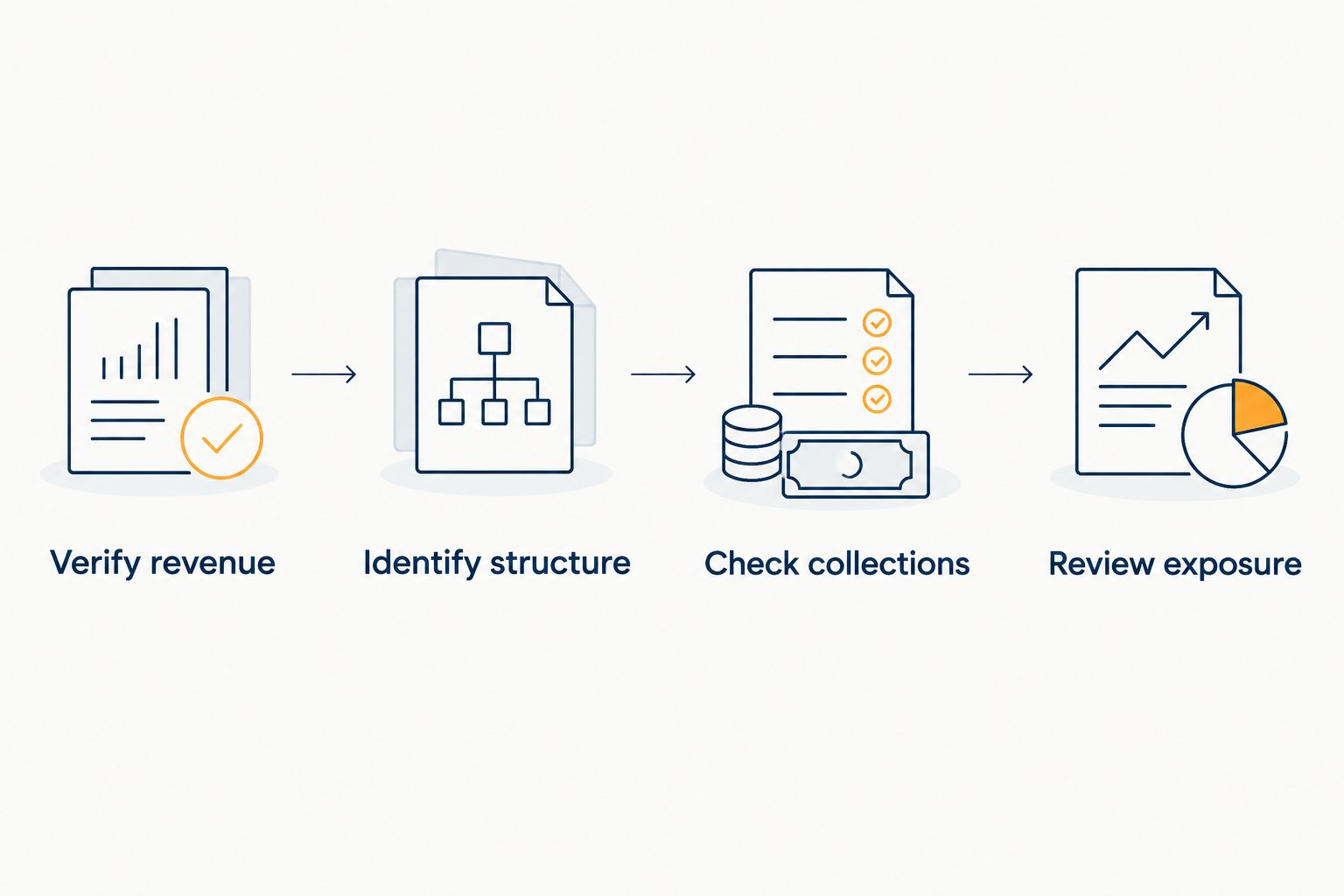
A revenue-linked description does not establish that withdrawals automatically shrink when sales fall. If the agreement uses estimated collections, ask how reconciliation works: reconciliation means adjusting collections to reflect actual receipts under the contract.
Get the procedure in writing. Identify who requests an adjustment, what records are required and how the funding partner handles the request.
Why do collateral requirements and funding terms vary?
Revenue-based financing has no single contract that governs every provider. The funding partner’s underwriting and the signed documents determine the transaction, not the phrase on an advertisement.
The relevant differences include:
- Legal structure: A loan and a purchase of future receivables create different contractual obligations.
- Revenue pattern: Steady receipts and irregular receipts create different collection-planning problems.
- Existing obligations: Current financing reduces cash available for another collection schedule.
- Security provisions: An agreement can address business assets even without naming equipment as collateral.
- Guarantee language: Liability depends on what is guaranteed and the triggering conditions.
- Collection mechanics: Fixed withdrawals and receipts-linked collections affect cash differently.
Compare the written terms, not the product names. Two offers described as revenue-based financing can require materially different commitments from the same business owner.
What do the revenue numbers tell you?
The primary business-funding comparison route uses $35,000 per month as its audience threshold. Multiplying $35,000 by 12 months produces $420,000 in annualized revenue, assuming that monthly level continues throughout the year.
That calculation is revenue arithmetic, not an approval forecast or a recommended funding amount. It also says nothing about profit, seasonality or cash available for collections.
For your 2026 review, use actual operating records rather than treating annualized revenue as money available to repay funding. Separate these measures:
- Gross receipts: Money generated by business activity before operating expenses.
- Operating cash needs: Payroll, suppliers, rent, taxes and other business obligations.
- Existing collections: Payments or remittances already committed to financing agreements.
- Remaining cash: What the business retains after those obligations.
Ask the funding partner to show the amount delivered, total contractual obligation, deductions and collection method in writing. Compare those fields on the same basis across offers; a larger headline funding amount does not establish a better outcome.
If an offer quotes a factor rate, that multiplier describes a calculation applied to the funded amount under the offer’s terms. A factor rate is not APR. APR is an annualized cost measure that accounts for timing; a factor rate alone does not communicate that annualized burden.
Which alternatives should you compare before accepting?
For a 2026 decision, match the financing structure to the expense. Revenue-based financing is one option, not the default answer whenever a business lacks real estate.
These are use-case labels, not claims that a particular applicant qualifies. Collateral, guarantees and other requirements depend on the provider and agreement.
| Option | Best for | Main advantage | Main limitation |
|---|---|---|---|
| Revenue-based financing or future-receivables purchase | Comparing working capital against established business receipts | Centers the evaluation on business revenue | Requires careful review of collections, security and guarantees |
| Business line of credit | Recurring cash-flow gaps | Supports repeated draws within the agreement’s limits | Access and draw terms depend on underwriting and the contract |
| Term loan | A defined business expense with a repayment plan | Provides a scheduled financing structure | Scheduled payments still require adequate cash flow |
| Equipment financing | Purchasing qualifying equipment | Connects financing to the asset being acquired | Equipment-focused funding does not address every working-capital need |
| Invoice factoring | Cash tied up in eligible unpaid invoices | Uses existing invoice receivables | Invoice eligibility and customer payment obligations matter |
A business buying equipment should compare equipment-focused financing before using a general working-capital arrangement. A business waiting on customer invoices should examine invoice-based funding rather than treating all future revenue as the same asset.
Choose the structure that matches the cash-flow problem. If an available alternative produces a more manageable contractual obligation and your business can wait, urgency alone is not a reason to reject it.
Does no collateral mean no personal guarantee?
No collateral does not mean no personal guarantee. Collateral identifies property supporting an obligation; a personal guarantee creates specified obligations for the person signing it.
Read the scope rather than accepting a verbal description. Establish whether the guarantee covers payment, specified conduct or other contractual duties, and ask qualified counsel to explain unfamiliar provisions.
Does revenue-based financing adjust when sales fall?
Revenue-based financing adjusts with falling sales only as provided by the agreement’s collection and reconciliation terms. The product label does not establish an automatic reduction.
Ask how actual receipts are measured and how you request an adjustment. Preserve the written instructions and identify the records the funding partner requires.
Does revenue-based financing ignore your credit?
Revenue-based financing does not make credit irrelevant. Ask the funding partner whether business credit, personal credit or both are reviewed and whether the process involves a credit inquiry.
Do not confuse a revenue-focused review with a promise to overlook payment history. Eligibility remains subject to the applicable third-party underwriting.
What risks should stop you from signing?
Do not accept an offer you cannot explain in plain English. Collateral is only one part of the risk; collection pressure and contractual default provisions also affect your business.
Pause when you cannot establish:
- What business property or receivables the security provisions cover.
- Whether you are personally liable and under which circumstances.
- How collections change, if at all, when revenue falls.
- Whether existing agreements permit additional financing.
- What happens after a missed withdrawal or another default event.
- What amount and process would satisfy or terminate the obligation.
Adding another obligation does not fix an operating loss. If your plan depends on repeatedly replacing funding before the business generates sufficient cash, reassess the operating plan before signing.
An offer without traditional collateral is not automatically unsuitable. An offer with unexplained exposure is unsuitable for an informed decision.
What documents and questions should you prepare?
Prepare accurate records before comparing offers in 2026. Ask for the current partner-specific checklist rather than assuming every funder requests the same documents.
Useful preparation includes business bank statements, revenue records, a list of existing financing obligations and a specific explanation of the intended use of funds. Keep transfers and borrowed deposits distinguishable from operating receipts.
Request the proposed agreement and a written explanation of deductions, collections, guarantees and security provisions. If a term remains unclear, resolve it before authorizing withdrawals.
For businesses comparing working capital, Jon Lynch Financial Group is a broker, not a direct lender. Funding products are for business purposes and remain subject to third-party underwriting and product terms.
FAQ
Can I get revenue based financing without collateral?
Revenue based financing without collateral is possible when a funding partner evaluates business revenue without requiring specific equipment or real estate as security. Review the agreement for security interests, guarantees and collection obligations.
Does no collateral mean the funding is completely unsecured?
No collateral does not establish that funding is completely unsecured. The agreement can contain security provisions covering receivables or other business assets.
Will I have to sign a personal guarantee?
A personal guarantee depends on the funding partner and agreement. Ask what the guarantee covers and which events create personal liability before signing.
Is revenue-based financing the same as a merchant cash advance?
Revenue-based financing and merchant cash advance labels can overlap, but they do not establish identical legal structures. Read whether the agreement is a loan or a purchase of future receivables.
Will my collections automatically fall if sales decline?
Collections fall with sales only as provided by the agreement. Confirm the adjustment or reconciliation procedure, required records and request process in writing.
Is a factor rate the same thing as APR?
A factor rate is not APR. A factor rate is a multiplier used in the offer’s calculation, while APR expresses cost on an annualized basis and accounts for timing.
How much monthly revenue do I need to compare funding?
Jon Lynch Financial Group’s primary funding-comparison audience generates at least $35,000 per month. That audience threshold is not a universal funder approval rule; businesses below it have a separate self-serve route.
Does Jon Lynch Financial Group lend directly?
Jon Lynch Financial Group is a broker, not a direct lender. Business-purpose funding is subject to third-party underwriting, and approval, amounts, rates and timing are not guaranteed.
Which related guides answer the next questions?
- How to Compare Factor Rates on a Merchant Cash Advance
- Business Funding Without a Personal Guarantee
- Revenue-Based Financing vs. Merchant Cash Advance
What should you do before applying?
Ask for the guarantee and security provisions alongside the collection schedule—not after deciding to proceed. Those pages answer the collateral question more precisely than a sales description.
For your 2026 funding decision, choose the route that matches your revenue. If your U.S. business generates at least $35,000 per month, use Compare Business Funding Options; below that threshold, use Explore Self-Serve Funding through Jon Lynch Financial Group.
The self-serve route lets U.S.-based entrepreneurs securely connect bank statements through Plaid for an automated decision. Neither route promises approval, a funding amount, a rate or a funding time. Your next step is to gather your bank statements and existing obligations, then select the appropriate route.