Commercial Real Estate Financing for Churches: 2026 Guide
Commercial real estate financing for churches in 2026: compare bank loans, bridge financing and working capital options, plus why SBA loans don't apply.
Commercial real estate financing for churches in 2026 means matching a purchase, refinance or renovation to a nonprofit's giving-based cash flow instead of a for-profit balance sheet, and getting the structure wrong costs congregations months of delay and a bigger down payment than expected.
- Churches cannot use SBA 7(a) or 504 loans; nonprofit religious organizations are excluded from both programs in 2026.
- Sanctuaries are classified as special-purpose property, so lenders typically require a larger down payment than for a retail or office building.
- Bridge financing closes the timing gap between a capital campaign pledge and a closing date without waiting on a permanent mortgage.
- Jon Lynch Financial Group compares commercial real estate financing for churches across bank lenders, church bond programs and working capital options as a broker, not a direct lender.
Why commercial real estate financing matters for churches
A church buying, refinancing or renovating a building in 2026 runs into three problems a for-profit business doesn't face: income comes from tithes and offerings instead of invoiced revenue, the building itself is a special-purpose property with a narrow resale market, and several mainstream loan programs exclude religious nonprofits by rule.
Lenders still calculate a debt-service coverage ratio, but they pull it from giving statements and pledge records instead of a profit-and-loss statement. That changes which lender fits the deal, and it changes how a congregation should compare business funding options before anyone signs a term sheet.
Congregations that skip this planning discover mid-underwriting that their preferred lender won't touch a religious-use property, or that the appraisal came in below the purchase price because the building has no easy alternate use.
How to finance a church real estate purchase in 2026
1. Organize three years of ministry financials and giving records
Lenders underwriting a church loan read giving trends the way they'd read revenue trends for a business, and gaps or unexplained drops slow the file down.
- Three years of income statements and balance sheets for the ministry entity
- Weekly or monthly giving records broken out by general fund vs. designated or building fund
- Attendance or membership trend data, if the lender asks for it
- A current list of outstanding debt, including equipment leases or vehicle loans
- A board-approved budget for the current fiscal year
2. Calculate your congregation's debt-service coverage ratio
DSCR for a church is net operating income, general fund giving minus operating expenses, divided by the annual payment on the proposed loan; most lenders want that number comfortably above 1.0 before they'll quote a rate.
- Pull 12 trailing months of general fund income, excluding one-time capital campaign gifts
- Subtract fixed operating costs: staff, utilities, insurance, existing debt service
- Divide by the proposed annual payment on the new mortgage
- Stress-test the result against a 10% drop in giving, since attendance and giving both move with the economy
- Get a second opinion from your denomination's finance office, if one exists
3. Rule out financing that doesn't apply to religious nonprofits
Skip the wasted underwriting cycle: SBA 7(a) and SBA 504 loans exclude nonprofit religious organizations by program rule, so a loan officer suggesting SBA financing for a sanctuary purchase is either misinformed or talking about a separate for-profit entity.
- Confirm whether the purchasing entity is the church itself or a separate 501(c)(3) corporation
- Ask any SBA-focused lender directly whether religious use disqualifies the property
- Check whether your denomination runs its own bond or loan program instead
- Rule out USDA business loans too; they follow similar for-profit eligibility rules
- Keep conventional bank, credit union, church bond and bridge financing on the table
4. Choose the loan structure that matches your timeline
A church buying a building it can move into next quarter needs a different structure than one financing a multi-year renovation funded partly by a capital campaign still in progress.
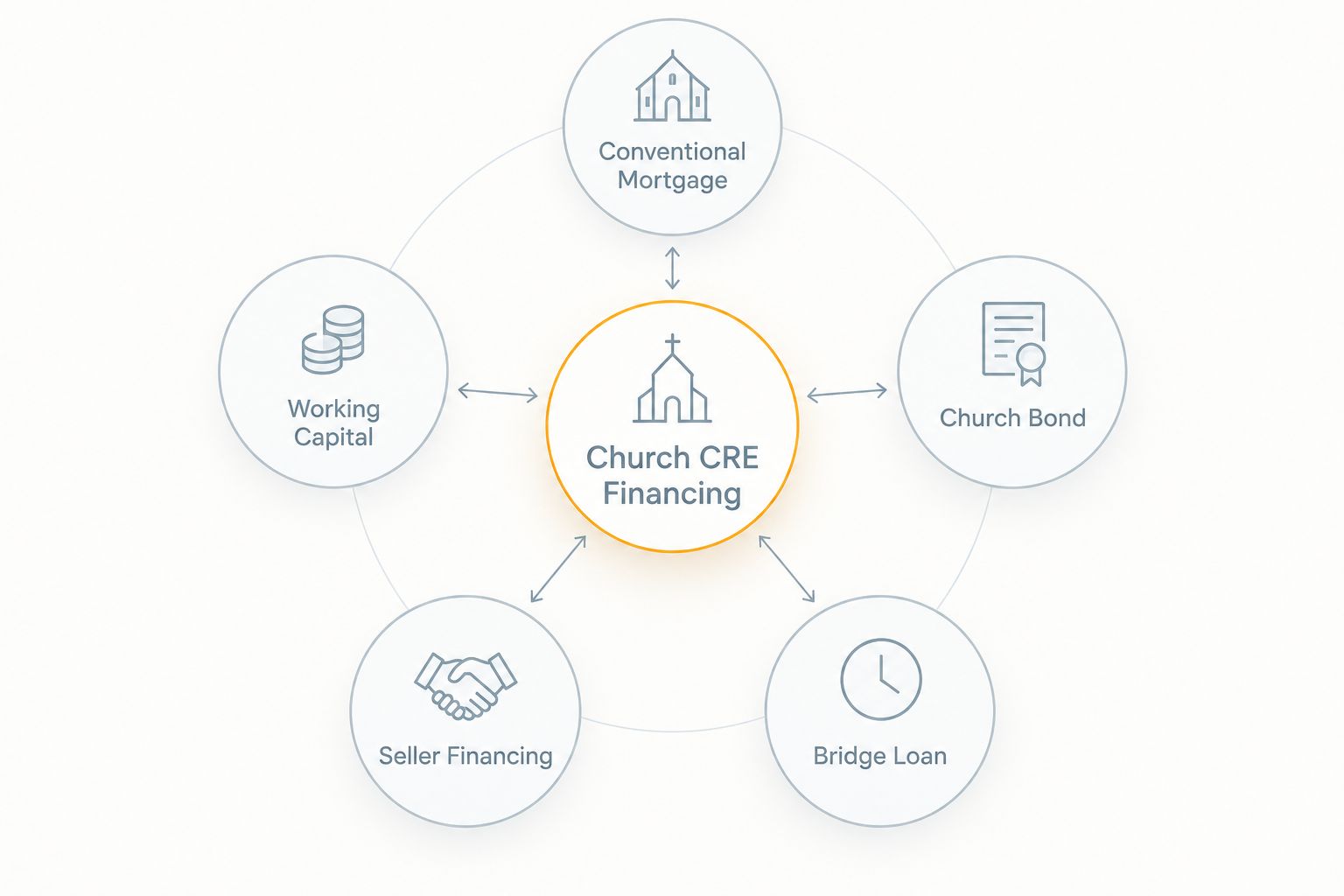
- Conventional mortgage: best fit when financials are clean and the building is ready to occupy
- Church bond: works when the congregation can sell bonds to its own members over a longer timeline
- Bridge loan: closes the gap when pledged capital campaign funds haven't been collected yet
- Seller financing: an option when buying from another congregation willing to carry a note
- Working capital or revenue-based financing: covers renovation costs or a down payment shortfall without touching the primary mortgage
5. Get an appraisal that reflects special-purpose use
A general commercial appraiser who values a sanctuary the same way as an office building produces a number your lender won't accept, because a building with pews, a baptistry and limited alternate use doesn't compare directly to standard retail or office stock. Self-storage facilities run into a similar appraisal problem; see commercial real estate financing for self-storage facilities for how lenders treat another special-purpose asset class.
- Ask for an appraiser with documented experience valuing religious-use property
- Request both an "as-is" and "as-renovated" value if the project includes construction
- Expect the appraised value to lean on replacement cost more than comparable sales, since comps are scarce
- Review how the appraisal treats specialized improvements like a sanctuary, baptistry or fellowship hall
- Flag any mismatch between appraised value and purchase price before underwriting goes deep
“A sanctuary is a special-purpose property to an appraiser, not a marketable asset, and that's the real reason churches carry a bigger down payment than a retail buyer.”
6. Prepare governance and authorization paperwork
Loan officers who don't regularly work with religious nonprofits often don't know what to ask for, so bring the documentation before they request it.
- Board or elder board resolution authorizing the purchase and the borrowing amount
- Church bylaws showing who has legal authority to sign
- Current 501(c)(3) determination letter
- Articles of incorporation for the church or holding entity
- Any denominational approval required before taking on debt
7. Bridge the gap between pledges and closing with working capital
A capital campaign can pledge more than enough to cover a down payment or a renovation scope, but pledges collect over years while a closing date or a contractor's schedule doesn't wait. This is the point where Jon Lynch Financial Group's funding partners enter the picture, structuring capital against the ministry's ongoing operating cash flow rather than the pledge balance itself, the same mechanics laid out in bridge loan for commercial property acquisitions.
- Compare a short-term bridge loan against the projected pledge collection schedule
- Look at revenue-based financing structured against ongoing operating cash flow for renovation costs that can't wait on pledge collection
- Confirm the repayment schedule doesn't compete with the permanent mortgage payment once that closes
- Ask whether the product is a loan or a purchase of future receivables, since the repayment mechanics differ
- Get the total dollar cost of the bridge financing in writing before comparing it to waiting on pledges
Comparing church real estate financing options in 2026
| Financing Option | Best For | Typical Structure | Key Limitation |
|---|---|---|---|
| Conventional bank or credit union mortgage | Congregations with three-plus years of clean financials | Amortizing term loan secured by the property | Down payment requirements run higher than for a standard commercial building |
| SBA 504 or 7(a) loan | Not available to churches | N/A | Nonprofit religious organizations are excluded from SBA 7(a) and 504 eligibility |
| Church bond program | Congregations able to sell bonds to their own members | Bonds sold to members or investors, fixed repayment | Longer setup timeline than a bank loan |
| Bridge loan | Closing before capital campaign pledges are fully collected | Short-term, often interest-only | Higher cost than permanent financing; needs a clear exit |
| Seller financing | Buying from another congregation willing to carry the note | Seller holds the note directly | Terms depend entirely on the seller's willingness and often balloon |
| Working capital / revenue-based financing | Renovation costs or down payment gaps outside the primary mortgage | Repaid from ongoing giving and operating cash flow; may be structured as a purchase of future receivables | Not a substitute for the mortgage itself; higher cost, works best as a bridge |
Verdict: a conventional mortgage or church bond covers the permanent purchase; working capital and bridge financing exist to close timing gaps, not to replace the mortgage.
Compare church financing options
See how bank, bridge and working capital options line up for your congregation.
Common mistakes churches make when financing real estate
- Submitting giving records without separating general fund from building fund, which makes DSCR look weaker than it is
- Assuming the appraisal will match comparable retail or office sales instead of budgeting for a lower special-purpose valuation
- Waiting until underwriting is underway to discover SBA programs don't work for a religious nonprofit
- Sending a loan file to the lender without a signed board resolution, which stalls the closing date
- Treating a bridge loan like permanent financing instead of lining up the exit before signing
FAQ
What is commercial real estate financing for churches?
It's capital used to purchase, refinance or renovate a house of worship or affiliated building, underwritten against tithes, offerings and pledge records instead of standard business revenue. Structures include conventional mortgages, church bonds, bridge loans, seller financing and working capital.
Can a church qualify for an SBA loan?
No. SBA 7(a) and SBA 504 loan programs exclude nonprofit religious organizations by rule in 2026. A church would need conventional bank financing, a church bond, seller financing or working capital instead.
Why do churches need a bigger down payment than other commercial buyers?
Lenders classify a sanctuary as a special-purpose property with a narrow resale market, so they typically require more equity upfront than they would for a retail or office building. The exact amount varies by lender and by the congregation's financial strength.
What is a church bond, and how does it work?
A church bond is a fixed-repayment note sold to a congregation's own members or outside investors to fund a purchase or building project. It takes longer to set up than a bank loan but can work when a congregation has strong internal fundraising capacity.
How does a bridge loan help a church close on a building?
A bridge loan provides short-term capital to close a purchase before capital campaign pledges are fully collected. It carries a higher cost than permanent financing and needs a defined exit, either the pledge proceeds or the permanent mortgage.
Is revenue-based financing a good fit for church renovation costs?
It can cover a renovation scope or a down payment gap that can't wait on pledge collection, repaid from the ministry's ongoing operating cash flow. It costs more than a bank note and works best as a bridge, not as the permanent facility.
What documents does a church need to apply for real estate financing?
Three years of financials, giving records, a board resolution authorizing the borrowing, church bylaws, a 501(c)(3) determination letter and articles of incorporation. Lenders unfamiliar with religious nonprofits may not ask for all of these upfront, so bring them anyway.
How long does church real estate financing take to close in 2026?
Timing depends on the lender, the appraisal and how complete the documentation is at submission; a conventional church mortgage generally takes longer to close than a bridge loan structured against existing cash flow. Approval, amounts and funding times are never guaranteed.
One last thing
Most congregations wait until 100% of a capital campaign is collected before applying for a mortgage, which stretches a building timeline by months for no underwriting reason. Lining up bridge financing against a signed pledge schedule, then converting to permanent financing once pledges clear, is usually faster and doesn't require the whole campaign to finish first. Jon Lynch Financial Group works this comparison as a broker, not a direct lender, weighing total dollar cost and timing across bank, bond and working capital paths before recommending one.