RV Park & Campground Real Estate Financing: 2026 Guide
Commercial real estate financing for RV parks and campgrounds in 2026: SBA 504 vs 7(a) vs bank loans, down payment math, and how to bridge the off-season gap.

Commercial real estate financing for RV parks and campgrounds means securing a loan or funding structure specifically underwritten against seasonal recreational-use land, not a standard stabilized commercial property, with the goal of buying, refinancing or expanding a park without straining off-season cash flow. Lenders treat these assets as special-purpose real estate, which changes the down payment, the DSCR test and which loan programs even qualify.
- SBA 504 and 7(a) loans are the two most workable paths for commercial real estate financing for RV parks and campgrounds in 2026, but both classify the asset as special-purpose property.
- Special-purpose classification typically pushes down payments toward 15-20% instead of the standard 10% for owner-occupied commercial real estate.
- Seasonal revenue swings are the single biggest underwriting obstacle - lenders want 2-3 years of trailing occupancy data, not a single peak season.
- Bridge financing or revenue-based financing can cover the off-season gap while a permanent SBA or bank loan closes.
- Jon Lynch Financial Group is a broker, not a direct lender, and structures the capital stack across third-party funding partners rather than issuing loans directly.
Why commercial real estate financing matters for RV parks and campgrounds
RV parks and campgrounds don't generate level monthly revenue the way an office building or a strip mall does. A park in a northern climate might collect 60-70% of annual bookings between May and September, then run near-breakeven the rest of the year. Underwriters know this, and they size debt service coverage against the trailing twelve months, not against peak-month numbers.
The property itself also gets flagged differently. SBA and conventional lenders both treat RV parks and campgrounds as special-purpose real estate - similar to how they treat car washes or self-storage facilities - because the improvements (pads, hookups, septic, a bathhouse) have limited alternative use if the business fails. That classification is the reason financing here looks different from commercial real estate financing for self-storage facilities or a standard multifamily purchase, even though the loan programs overlap.
If you're evaluating whether to buy, refinance or expand a park in 2026, the manual path below gets you underwriting-ready before you ever talk to a lender. Business owners generating at least $35,000 a month in revenue can compare commercial real estate lenders directly once the financials are in order; smaller operators typically need a working capital bridge first.
How to finance an RV park or campground purchase in 2026
Pull three years of trailing financials, not one peak season
Lenders reject more RV park applications for thin documentation than for weak credit. Before you approach anyone, assemble:
- Three years of profit and loss statements, broken out by month
- Site occupancy reports showing seasonal swings by pad type (RV, tent, cabin)
- Utility and septic maintenance records for the past 24 months
- A current rent roll if any sites are leased long-term or seasonally
- Tax returns for the business and, if applicable, the holding entity
A single strong summer doesn't offset two flat winters in an underwriter's model - trailing data across the full seasonal cycle is what gets a file approved.
Classify the property correctly before you apply
Misclassifying an RV park as general commercial real estate is the fastest way to get re-underwritten mid-process. Confirm with your appraiser and lender upfront:
- Whether the park is owner-occupied (you run day-to-day operations) or investor-owned with third-party management
- Percentage of revenue from long-term seasonal leases versus nightly/weekly transient stays
- Whether utilities are metered per site or bundled into a flat rate
- Zoning classification and any conditional-use permits tied to expansion plans
- Whether the sale includes a going concern (business plus real estate) or land only
Compare SBA 504, SBA 7(a) and conventional bank financing
This is where most of the real decision-making happens, and it's the point where a broker relationship starts to save time instead of just money. SBA 504 loans are built for owner-occupied real estate and typically carry a standard 10% down payment for stabilized properties - but special-purpose assets like RV parks commonly add a 5% surcharge, and a business under two years old can add another 5%, pushing total equity toward 15-20%. SBA 7(a) loans can combine real estate and working capital in one facility, useful if you're buying the park and need cash for site improvements in the same transaction, but they carry a personal guarantee and a full underwriting file.
Conventional bank CRE loans work best for parks with three or more years of stabilized net operating income and a debt service coverage ratio the bank is comfortable modeling against off-season months, not just July and August. If your file doesn't fit a bank's box yet, comparing SBA loan qualification against limited collateral is worth doing before you assume you're stuck with higher-cost alternatives.
Cover the off-season gap before it becomes a payment problem
A permanent real estate loan doesn't solve the month you're carrying a mortgage payment on 20% winter occupancy. Options that bridge that gap:
- A working capital line sized to your slowest quarter, not your average month
- Revenue-based financing structured around your actual seasonal collection pattern - see how this works for seasonal businesses generally
- A short-term bridge loan timed to close before your permanent SBA or bank loan funds
- A cash reserve covenant negotiated into the permanent loan instead of a separate facility
- Deferred principal payments for the first two off-season months, if the lender allows it
Revenue-based financing here may be structured as a purchase of future receivables rather than a traditional loan - the repayment scales with collections instead of a fixed monthly amount, which fits a park's uneven cash flow better than a level installment.
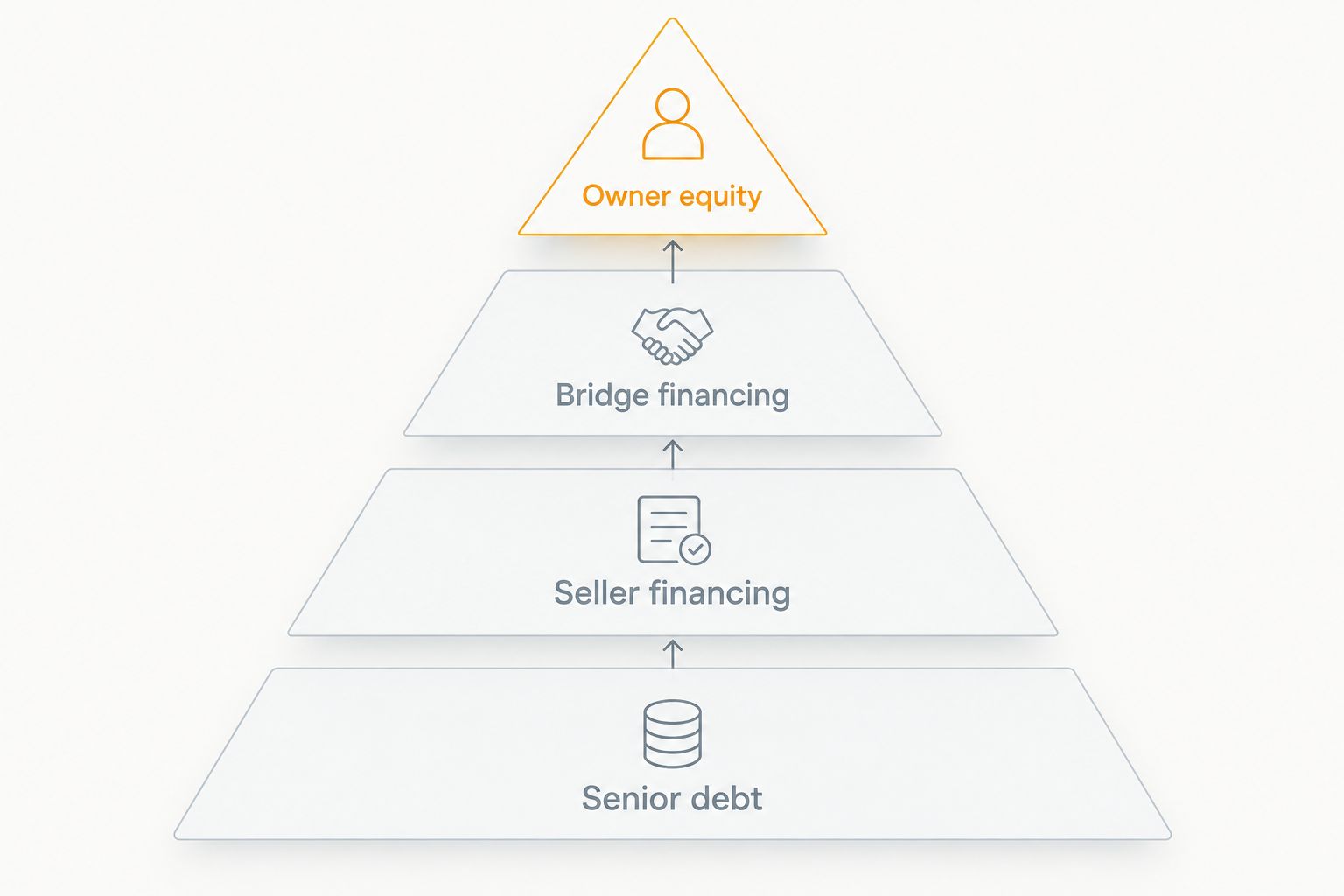
Structure the capital stack across equity, senior debt and gap financing
Most RV park acquisitions in 2026 aren't single-loan transactions. A workable stack usually layers:
- Owner equity or a down payment from a partner group
- Senior debt from SBA 504, SBA 7(a) or a conventional bank loan
- Seller financing or a seller carryback note to close the gap between senior debt and total price
- A short-term bridge or working capital facility for immediate site improvements
- Sometimes a mezzanine piece if the senior lender caps loan-to-value below what the deal requires
Getting this sequencing wrong - putting expensive short-term debt in the senior position, for example - raises your blended cost of capital for the life of the loan. Structuring a capital stack for a commercial acquisition before you sign a purchase agreement avoids that mistake.
Prepare the underwriting file lenders actually ask for
Beyond financials, RV park underwriting files typically require:
- A current appraisal specific to recreational-use property, not a generic commercial comp
- Environmental Phase I report, especially where septic or well systems are on-site
- Proof of flood zone status and current flood insurance if applicable
- A capital improvement plan if the loan includes funds for pad expansion or utility upgrades
- Management resumes if the buyer has no direct RV park operating history
Compare Business Funding Options
See how RV park and campground deals get structured against total cost and timing.
Comparison: financing options for RV parks and campgrounds
| Option | Best for | Key limitation |
|---|---|---|
| SBA 504 loan | Owner-occupied park acquisition with a long hold period | Special-purpose surcharge raises equity requirement; slower closing timeline |
| SBA 7(a) loan | Combining real estate purchase with working capital in one loan | Personal guarantee required; full document underwriting |
| Conventional bank CRE loan | Stabilized parks with 3+ years of consistent NOI | Strict DSCR test against off-season months, not just peak season |
| Bridge loan | Time-sensitive acquisition or gap before permanent financing closes | Higher cost of capital; short term structure |
| Seller financing / carryback | Off-market or family-owned park sales | Limited availability; terms depend entirely on the seller's flexibility |
Common mistakes RV park and campground owners make
- Underwriting against peak season only. A great July doesn't offset a break-even January in a lender's model - trailing twelve-month data matters more than your best month.
- Skipping the special-purpose property conversation. Assuming a park will underwrite like general commercial real estate leads to a re-quote mid-process when the appraisal comes back classified differently.
- Waiting until closing to arrange off-season working capital. The gap between a mortgage payment and winter occupancy needs a plan before the real estate loan funds, not after the first slow month.
- Ignoring environmental and septic documentation. Phase I reports and well/septic records get requested late and can delay closing by weeks if they're not ready.
- Layering short-term debt into the senior position. Putting a bridge loan or MCA ahead of permanent financing in the capital stack raises the blended cost of capital for the entire hold period.
FAQ
What is the best commercial real estate financing for RV parks and campgrounds in 2026?
SBA 504 and SBA 7(a) loans are the most commonly used paths for RV park and campground real estate in 2026, because both allow long amortization on special-purpose property. A conventional bank loan works once the park has 3+ years of stabilized income.
Is an RV park considered special-purpose real estate?
Yes. Lenders classify RV parks and campgrounds as special-purpose property, similar to self-storage or car washes, because the site improvements have limited alternative use. This typically raises the down payment above the standard rate for general commercial real estate.
How much down payment does an RV park purchase require?
SBA 504 loans generally start near a 10% down payment for stabilized owner-occupied real estate, but special-purpose surcharges commonly push RV park deals toward 15-20% total equity. Exact requirements depend on the lender, the appraisal and business age.
Can seasonal revenue disqualify a campground from a real estate loan?
Seasonal revenue alone doesn't disqualify a park, but a thin financial file does. Lenders want 2-3 years of month-by-month trailing data to model debt service coverage against the slow season, not the peak one.
What's the difference between a loan and revenue-based financing for a seasonal business?
A traditional loan carries a fixed monthly payment regardless of your collections that month. Revenue-based financing, sometimes structured as a purchase of future receivables, scales repayment with your actual revenue, which fits a campground's uneven seasonal cash flow more closely.
Does Jon Lynch Financial Group fund RV park purchases directly?
No. Jon Lynch Financial Group is a broker, not a direct lender, and works to structure commercial real estate financing for RV parks and campgrounds through third-party lending and funding partners.
How long does it take to close commercial real estate financing on a campground?
SBA 504 and 7(a) closings on special-purpose property commonly take longer than a standard commercial loan because of the additional appraisal and environmental review. A bridge loan can close faster but is meant to be replaced by permanent financing, not held long-term.
What documents does a lender need to underwrite an RV park loan?
Expect to provide three years of monthly financials, occupancy reports by site type, a recreational-use appraisal, an environmental Phase I report, and flood zone documentation. Missing septic or well records are a common cause of closing delays.
One last thing
The detail that trips up most first-time RV park buyers isn't the loan program - it's the appraisal. A generic commercial appraiser without recreational-use experience can undervalue a park by missing income from add-on revenue like propane sales, laundry, or seasonal site premiums, which drags down the loan-to-value a lender will approve. Confirm your appraiser has direct RV park or campground experience before the order goes in, not after the number comes back low.



