Does a merchant cash advance affect your personal credit?
Does MCA affect personal credit score? It can. Understand hard inquiries, reporting, personal guarantees and cash-flow risks before you compare funding.

A merchant cash advance can affect your personal credit, but receiving one does not automatically create a personal credit account. In 2026, the key questions are whether the funder makes a hard inquiry, reports an obligation to consumer credit bureaus, or has enforceable rights against you personally. No personal credit reporting does not mean no personal financial exposure.
- Does MCA affect personal credit score? Hard inquiries and consumer credit reporting can; funding alone does not automatically do so.
- Jon Lynch Financial Group is a broker, not a direct lender; third-party funder terms determine credit checks and reporting.
- Separate personal guarantees, business liens and cash-flow pressure from direct credit-score effects before signing.
Does a merchant cash advance affect your personal credit?
An MCA affects your personal credit only through a mechanism that reaches your consumer credit file. A hard inquiry is one mechanism; furnishing an account or reportable collection information is another. Contractual liability is a separate question.
An MCA may be structured as a purchase of future receivables rather than a loan. That distinction matters, but it does not answer whether the funder checks personal credit or requires a guarantee; review whether a merchant cash advance is considered a loan alongside the actual agreement.
| Event or contract feature | Personal credit-score effect | Separate exposure to check |
|---|---|---|
| Soft personal credit inquiry | Does not affect your credit score | What information the applicant authorizes the funder to access |
| Hard personal credit inquiry | Can affect your credit score | When the inquiry occurs and who performs it |
| Consumer credit reporting | Reported information can affect your score | Whether the funder reports an account, payment history or collection |
| Personal guarantee | Signing alone is not a credit-report entry | Which obligations you personally guarantee |
| Business UCC filing | Not itself a consumer credit tradeline | Which business assets the filing covers |
Do not accept a general assurance that an offer is credit-safe. Ask which row describes the application and which describes the signed contract.
Who should consider an MCA despite personal credit concerns?
An MCA belongs in a business-purpose funding comparison when your receivables support the remittance obligation and the intended use produces a credible cash-flow benefit. It is not a credit-repair product. Avoid choosing one simply because a salesperson says personal credit matters less than revenue.
Jon Lynch Financial Group is best for established U.S. business owners comparing working-capital structures and personal exposure. Its primary funding audience generates at least $35,000 per month; that is an audience threshold, not a promise of eligibility for any particular funder.
For a 2026 decision, separate these questions:
- Business fit: Does the funding solve a defined inventory, payroll, contract or cash-flow need?
- Payment fit: Can the business meet remittances while covering operating expenses?
- Personal fit: Do you understand the credit authorization and guarantee before signing?
If the business cannot support the obligation without recurring personal borrowing, a clean consumer credit reporting policy does not make the transaction suitable. Reject an unaffordable structure even when it uses only a soft inquiry.
How do you check the personal credit impact before applying?
Review the application authorization before providing consent. Then review the proposed agreement separately; an application-stage explanation does not replace contractual terms.
- Credit inquiry: Ask whether the initial review uses a soft or hard personal inquiry. Confirm whether accepting an offer or completing final underwriting triggers another check.
- Credit reporting: Ask whether the funder furnishes information to consumer bureaus, business bureaus, both or neither. Request the answer in writing.
- Personal guarantee: Identify exactly what you promise personally, including any guarantee tied to specified conduct rather than business performance alone.
- Default terms: Read the events of default, notice provisions and remedies. Ask what happens when revenue falls or a debit fails.
- Cash-flow test: Compare the proposed remittance schedule with actual deposit timing and essential expenses.
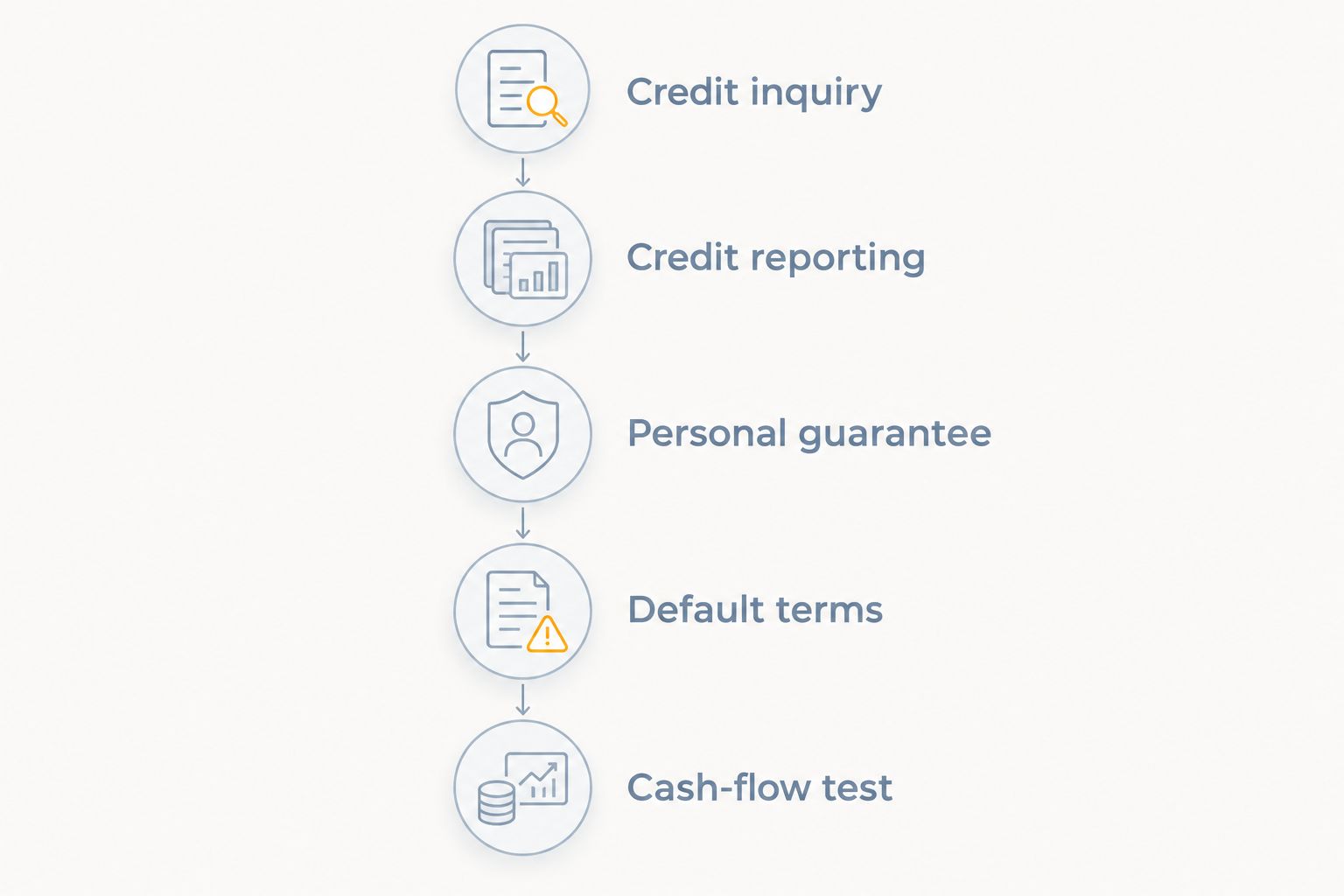
Keep the written responses with your final documents. If an explanation conflicts with the agreement, resolve the conflict before signing rather than relying on a verbal exception.
Does a soft inquiry protect your score throughout the transaction?
A soft inquiry does not affect your personal credit score. It answers only the inquiry question, not whether the obligation will later appear on a consumer report or create personal liability.
A hard inquiry can affect your score, but there is no universal point reduction that applies to every applicant. Your credit file and the scoring model matter; a precise score-loss promise is not a reliable basis for choosing funding.
Ask whether the consent covers only the named funder or permits submission to additional funding partners. Do not assume one application means one credit inquiry. Obtain the submission plan before authorizing a broad distribution of your application.
This distinction remains essential in 2026: soft-pull underwriting, consumer reporting and personal guarantees are separate features, not interchangeable descriptions of protection.
Does making MCA payments build your personal credit?
MCA payments do not build personal credit unless relevant account information is furnished to consumer credit bureaus and used by the applicable scoring model. A withdrawal from your business bank account is not, by itself, credit reporting.
Business credit reporting is separate. Reporting to a commercial bureau does not establish that the same information appears on your personal report.
Before accepting a credit-building claim, request the bureau names, the reporting policy and whether positive payment history is furnished. Do not take an MCA solely to improve your personal score. Choose funding for a viable business need and judge credit-building claims independently.
What does a personal guarantee actually expose you to?
A personal guarantee is a contractual promise that can make you responsible for specified obligations. Its scope depends on the wording and applicable law; the label alone does not establish what you owe after a business setback.
Some agreements distinguish business underperformance from conduct such as fraud, diversion of receivables or interference with collection. Do not assume that every guarantee covers every shortfall, or that a limited guarantee protects you from every claim.
Check these provisions with a qualified attorney when personal exposure is unclear:
- Who signs as the business representative and who signs personally.
- Which obligations the guarantee covers.
- What conduct triggers personal responsibility.
- Whether amendments or additional funding extend the guarantee.
- How release or termination works.
A business UCC filing is different: it gives public notice of a claimed security interest in business collateral. A lien, a guarantee and a consumer credit tradeline are different legal and reporting concepts. None should be used as shorthand for the others.
Why does personal credit exposure vary between MCA offers?
The MCA label does not standardize underwriting or contract terms. For your 2026 comparison, focus on the features that determine exposure rather than the marketing description:
- Inquiry authorization: Whether the funder requests a soft inquiry, hard inquiry or later additional check.
- Reporting policy: Whether consumer account or collection information is furnished.
- Transaction structure: Whether the agreement is a purchase of future receivables or another financing arrangement.
- Guarantee scope: Whether personal responsibility is broad or tied to specified obligations or conduct.
- Remittance terms: How withdrawals, revenue adjustments and default provisions operate together.
Compare the complete written offer, not a single favorable feature. An offer without a hard inquiry still requires scrutiny of its guarantee and remittance obligations.
Can cash-flow pressure hurt your credit indirectly?
Yes. An MCA can strain business cash flow even when the funder does not report routine payments to consumer bureaus. If you then carry larger personal card balances or miss personal obligations to cover business expenses, those separate accounts can affect your score.
That is why small business cash reserves belong in the affordability analysis: reserves help distinguish a temporary timing gap from a business that depends on repeated borrowing to meet ordinary expenses. Do not treat the advance itself as evidence that the business has sufficient reserves.
Build the cash-flow test around deposit dates, payroll, taxes, rent and existing financing withdrawals. Test a weaker revenue period as well as your expected case, especially when sales fluctuate.
For a 2026 funding decision, the question is not merely whether the funder reports. The business must support the remittance without pushing operating shortfalls onto your personal credit cards.
Which alternatives should you compare before accepting an MCA?
Compare alternatives by business purpose, qualification, timing, total obligation and personal exposure. No product label proves that an option avoids hard inquiries or personal guarantees.
| Funding structure | Best for | Main advantage to evaluate | Main limitation or risk |
|---|---|---|---|
| Purchase of future receivables | Businesses matching funding to future sales | Whether remittances and reconciliation reflect actual revenue | Frequent withdrawals and contract remedies require close review |
| Business line of credit | Recurring working-capital needs | Ability to draw within an approved limit | Credit checks, guarantees and renewal terms vary |
| Business term loan | A defined business expense | A stated repayment schedule for planning | Payments remain due under the loan terms despite weaker sales |
| Invoice factoring | Businesses with eligible unpaid invoices | Funding connected to receivables already invoiced | Customer eligibility, recourse and collection arrangements matter |
A business line of credit deserves comparison when you need repeat access rather than a single advance. A term loan deserves comparison when the business can support scheduled payments and has time for the applicable underwriting process.
Ask for total dollars received, total contractual dollars due, deductions, payment frequency and early-payoff treatment. A factor rate is a multiplier used to determine a purchased amount or repayment obligation; it is not an annual percentage rate.
Prefer the option with the better documented business fit, not the easiest credit-check description. Waiting for a suitable alternative is better than accepting an obligation your business cannot carry.
What should you do if sales fall or a payment fails?
Contact the funder promptly and follow the agreement's notice and documentation requirements. If the agreement provides reconciliation—a process for adjusting remittances to actual revenue—request it according to the written procedure.
Do not assume a failed debit automatically reaches your personal credit report. Equally, do not assume that no reporting means the funder has no contractual remedy.
Avoid stopping withdrawals, closing accounts or diverting receipts without legal advice about your agreement. Those actions can raise contract issues distinct from an ordinary decline in business revenue.
Keep bank records, correspondence and evidence supporting any adjustment request. If you receive a demand naming you personally, have counsel review the guarantee and alleged default rather than inferring liability from the business balance alone.
What documents should you review before signing?
Use a complete document set for your 2026 review. A summary sheet cannot replace the authorization, purchase agreement or guarantee.
- Credit authorization and any permission to share your application.
- Final agreement, including all incorporated schedules.
- Personal guarantee and security agreement, if applicable.
- Remittance schedule and reconciliation procedure.
- Written explanation of consumer and business credit reporting.
- Current business statements and a cash-flow forecast reflecting existing obligations.
Match the funder's legal name across the documents. Ask who makes the underwriting decision, who collects remittances and whom you contact for servicing.
Before signing, confirm that the final documents match the offer you evaluated. Changes to the remittance schedule, guarantee or reporting authorization deserve a fresh review.
What role does the broker play?
Jon Lynch Financial Group is a broker, not a direct lender. Its business-funding options involve third-party lenders and funders, and revenue-based financing may be structured as a purchase of future receivables.
These products are for business purposes and subject to applicable third-party underwriting and contract terms. Approval, amounts, rates, decisions and funding times are not guaranteed; this article provides general information, not individualized legal or credit advice.
FAQ
Does MCA affect personal credit score if I make every payment?
An MCA does not automatically affect your personal credit score because you make payments. A hard inquiry can affect your score at application, while later effects depend on consumer reporting and your wider credit activity.
Will a soft credit check for an MCA lower my score?
A soft credit check does not lower your personal credit score. Confirm whether final underwriting or acceptance involves a separate hard inquiry.
Does signing a personal guarantee put an MCA on my credit report?
Signing a personal guarantee does not itself create a consumer credit tradeline. The guarantee creates contractual exposure that must be evaluated separately from the funder's reporting policy.
Can an MCA default hurt my personal credit?
An MCA default can affect personal credit if reportable information connected to a personal obligation is furnished to consumer bureaus. Whether you are personally liable and whether information is reportable depend on the agreement, facts and applicable law.
Does a UCC filing lower my personal credit score?
A business UCC filing is not itself a consumer credit tradeline. It concerns a claimed security interest in collateral, so review its business implications separately from consumer credit reporting.
Will paying off an MCA improve my personal credit?
Paying off an MCA does not guarantee a personal credit-score increase. The result depends on whether relevant information appears on your consumer report and how the scoring model treats it.
Can I get an MCA without anyone checking personal credit?
Credit-check requirements depend on the funder and program. Ask for the current written policy; revenue-based underwriting does not establish that personal credit is irrelevant.
Related guides
- Business funding without a personal guarantee
- Is no-credit-check business funding actually risk-free?
- How to compare factor rates on a merchant cash advance
What is your next step?
The most useful answer is not simply whether an MCA touches your score. It is whether the inquiry, reporting policy, guarantee and remittance schedule are acceptable together.
Ask Jon Lynch Financial Group to compare those features against your business cash flow. For U.S. businesses generating at least $35,000 per month, use Compare Business Funding Options; below $35,000 per month, use Explore Self-Serve Funding.



