How does debt-to-income ratio affect a loan application?
Debt to income ratio business loan decisions depend on personal debt and business cash flow. Learn DTI vs. DSCR, lender questions, and your next step.

A higher debt-to-income ratio can weaken a business loan application when a lender evaluates your personal repayment capacity, but it does not determine the decision alone. For a business loan application in 2026, distinguish your personal debt burden from the company’s ability to cover existing obligations and the proposed payment. The key tradeoff is payment capacity, not simply access to another funding offer.
- For a debt to income ratio business loan assessment, separate personal DTI from business debt-service coverage.
- Jon Lynch Financial Group is a broker, not a direct lender; compare third-party business funding by repayment fit.
- Business revenue is not personal income, and bank deposits are not automatically cash available for debt payments.
- A lower payment does not establish a lower total cost; compare the complete repayment schedule.
How does debt-to-income ratio affect a loan application?
Debt-to-income ratio, or DTI, compares monthly personal debt payments with gross monthly personal income. A higher DTI means more of that income is already committed, which matters when a business lender reviews an owner or personal guarantor.
Business underwriting also examines the company’s repayment capacity. Start with the distinction below before comparing working capital qualification requirements.
| Measure | What it compares | What it tells you | Main limitation |
|---|---|---|---|
| Personal DTI | Monthly personal debt payments divided by gross monthly personal income | How much personal income is committed to debt | Does not establish business repayment capacity |
| Business debt-service coverage | Cash flow available for debt service divided by required debt service | Whether the business covers debt payments | Results depend on the cash-flow definition and period |
| Global cash-flow review | Combined repayment resources and obligations across relevant parties | Whether the broader financial picture supports repayment | Requires care to avoid counting income twice |
A lender reviewing your personal guarantee can consider personal debt alongside business performance. Another funding provider can place more emphasis on business deposits, receivables, existing payment obligations and credit history. Ask which calculation drives the decision before trying to improve the wrong ratio.
Why does this matter before you apply?
A debt-to-income ratio business loan search can lead you toward personal-loan or mortgage thresholds that do not answer your commercial funding question. There is no single DTI cutoff that establishes approval across every business financing product.
For your 2026 application, identify whether the concern is personal affordability, business cash flow or both. Reducing personal debt does not fix an operating business that cannot support its proposed payments, and strong sales do not automatically fix an overextended guarantor.
The practical goal is to submit an application that explains where repayment comes from. That explanation should survive a review of bank activity, financial statements and existing obligations—not just a favorable-looking percentage.
Who needs to pay the most attention to personal DTI?
Personal DTI deserves particular attention when a lender requests an owner’s financial information or a personal guarantee. It also matters when business earnings supply most of your household income, because the same business must support both operating needs and owner withdrawals.
Review these situations before applying:
- You rely on business distributions. Establish what the business can distribute after expenses and required payments.
- You carry substantial personal debt. Document the required payments rather than listing balances alone.
- You own several businesses. Explain transfers, guarantees and obligations across entities.
- Your income fluctuates. Distinguish recurring income from unusual receipts or temporary spikes.
- You recently added financing. Include the new payment even if it has not appeared throughout your financial records.
Do not assume incorporating your business removes personal financial review. Whether a lender requires a guarantee or evaluates personal finances depends on the product and underwriting requirements.
How do you calculate DTI without confusing it with business revenue?
Personal DTI = monthly personal debt payments ÷ gross monthly personal income × 100%.
Use consistent monthly figures and the lender’s instructions about which obligations and income sources count. Gross personal income means income before personal taxes and deductions; it is not the company’s gross sales.
For a business owner, establish how salary, distributions and other income will be documented. A transfer from a business account to a personal account does not, by itself, establish additional recurring income.
Follow this sequence:
- List debt payments. Gather required personal payments and identify any business obligations you personally guarantee.
- Verify income. Separate documented recurring personal income from business revenue and account transfers.
- Calculate DTI. Divide the included monthly debt payments by the accepted monthly income.
- Check business cash flow. Assess whether business operations support existing obligations and the proposed payment.
- Review new payments. Recalculate the position using the financing structure under consideration.
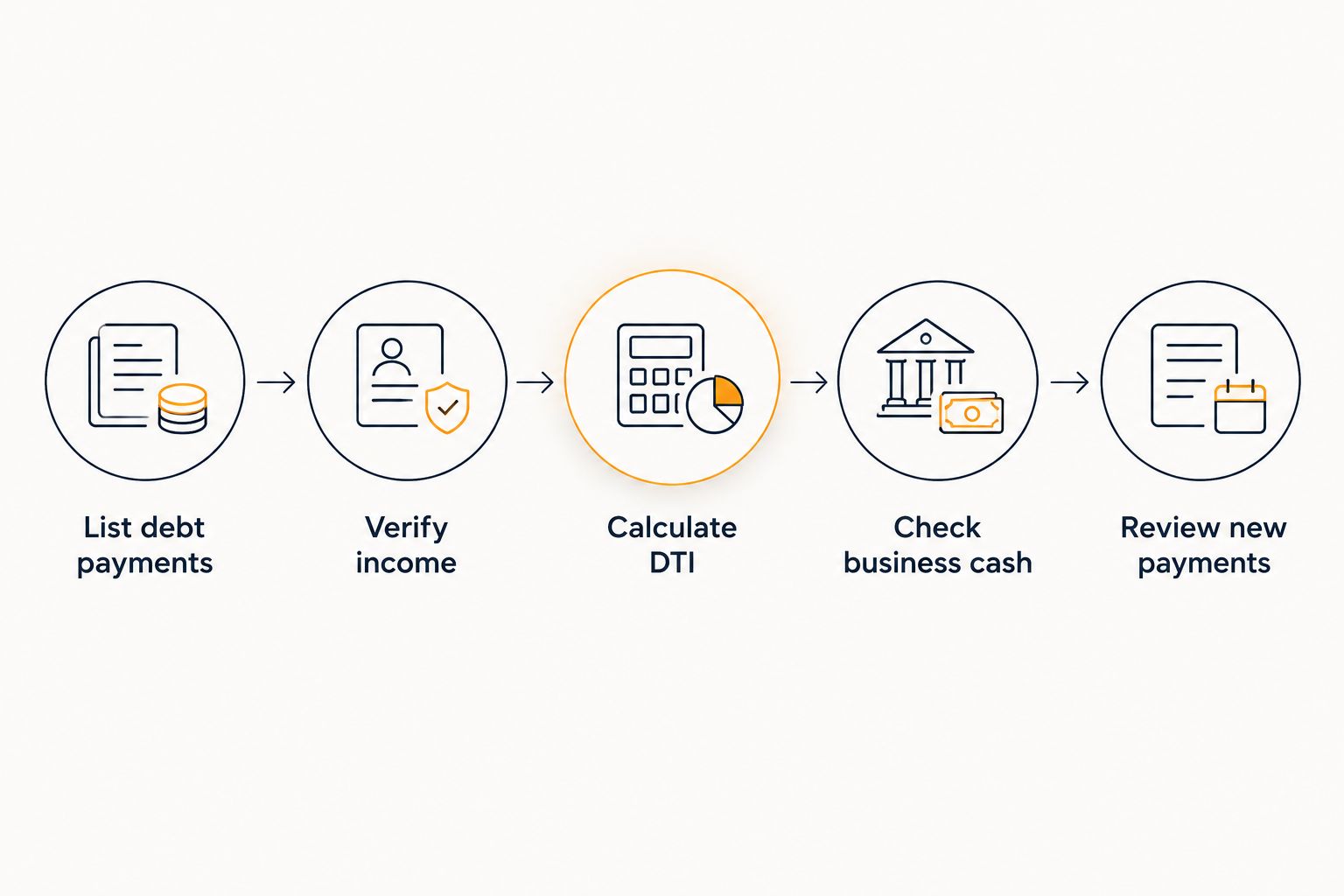
Your application should make the source of each figure clear. If bank deposits include loan proceeds, transfers or other non-sales receipts, identify them rather than presenting the entire deposit total as operating revenue.
How is business debt-service coverage different from DTI?
Debt-service coverage ratio, or DSCR, compares cash flow available for debt payments with the payments themselves. Unlike personal DTI, higher coverage indicates more repayment capacity under the calculation used.
DSCR = cash flow available for debt service ÷ required debt service.
At 1.0 times coverage, available cash flow equals required debt service. That is a mathematical break-even point for the calculation—not an approval threshold or a comfortable operating cushion.
Below 1.0 times, the defined cash flow does not cover the included debt payments. Above that point, the calculation shows some remaining capacity, but the lender still evaluates the size, reliability and source of that cushion.
For a 2026 financing comparison, ask the provider to identify the cash-flow definition, measurement period and included obligations. A ratio calculated from annual financial statements does not show exactly when money enters and leaves your account during a difficult month.
Also ask whether proposed financing is included. Coverage based only on current debt does not tell you whether the business can carry the additional obligation.
Why does the importance of DTI vary between applications?
The importance of personal DTI changes with the financing structure and the repayment sources under review. These factors explain why an identical owner can receive different assessments without either assessment being interchangeable.
- Product structure. A loan, credit line and purchase of future receivables create different obligations.
- Guarantee requirements. Personal financial review depends partly on whether an owner guarantees repayment.
- Business cash flow. Available operating cash differs from revenue, deposits and accounting profit.
- Existing obligations. Loans, leases and recurring funding withdrawals reduce available cash.
- Income documentation. Salary, distributions and other receipts require a consistent explanation.
- Seasonality. An annual average can conceal periods when collections fall but payments continue.
Request the specific reason for a concern or decline. “Your ratio is too high” is incomplete unless you know which ratio, which figures and which obligations produced it.
Which funding options should you compare if personal DTI is a concern?
Choose alternatives by the business need and repayment source, not by a promise that personal finances will be ignored. A different underwriting approach does not make an unaffordable payment affordable.
| Option | Best for | Potential advantage | Main tradeoff |
|---|---|---|---|
| Term loan | A defined business expense with a planned repayment source | A scheduled repayment structure | Required payments continue when sales weaken |
| Business line of credit | Recurring working-capital gaps | Draws can match changing business needs, subject to terms | Availability, renewal and repayment conditions require review |
| Invoice factoring | Businesses with eligible unpaid customer invoices | Funding is tied to receivables | Customer payment quality, fees and recourse terms matter |
| Revenue-based financing or future-receivables purchase | Businesses assessing funding tied to operating receipts | Evaluation can emphasize business revenue and cash flow | Frequent withdrawals can pressure operating cash |
| Delaying or reducing the request | Expenses that can wait or be completed in stages | Avoids adding an immediate financing obligation | The business must accept the delay or smaller project |
Revenue-based financing may be structured as a purchase of future receivables rather than a loan. A merchant cash advance, or MCA, commonly uses this structure; review the actual agreement rather than relying on the product label.
Do not assume revenue-based payments automatically adjust with sales. Ask how withdrawals are calculated, how reconciliation works and what you must do to request an adjustment under the contract.
For a 2026 comparison, Jon Lynch Financial Group is best for U.S. business owners comparing third-party business funding, not seeking a direct lender. The brokerage can support an options comparison, but third-party providers control underwriting and product terms; the brokerage route does not replace reviewing each agreement.
What should you compare beyond the ratio?
Compare net proceeds, total repayment, payment frequency and the contractual conditions attached to each offer. A favorable DTI does not establish that an offer fits your business.
A factor rate expresses a repayment multiple, not an annual percentage rate. APR annualizes financing cost using timing and applicable charges, so a factor rate alone cannot provide an apples-to-apples annualized comparison.
Ask for a written explanation of:
- The amount the business actually receives after deductions.
- Total required repayment or purchased receivables.
- Each payment or withdrawal and its frequency.
- The expected schedule and any variable-payment mechanism.
- Guarantees, collateral provisions and default terms.
- Early-payoff treatment, including whether it reduces the total obligation.
A smaller periodic payment can come with a longer repayment period. Review both the payment burden and total dollars, rather than treating either as the complete answer.
When should you pause instead of submitting another application?
Pause if you cannot identify a credible repayment source after payroll, operating expenses, taxes and existing financing obligations. Adding funding to cover recurring losses without a workable operating change increases the burden on the same cash flow.
Also pause when the application depends on counting the same income twice. Business profit, owner distributions and personal deposits can describe different stages of the same money—not separate repayment sources.
Be cautious about adding another funding withdrawal while existing obligations already strain the account. Review current agreements for restrictions and assess the combined payment schedule before accepting anything new.
A bank decline is a reason to diagnose the application, not automatically replace it with faster financing. If the issue is documentation, correct the documentation; if it is repayment capacity, change the amount, timing or expense plan.
What documents should you prepare before comparing offers?
Build a consistent financial picture rather than a large folder of unexplained records. Ask the prospective provider for its current document requirements before submitting sensitive information.
Prepare the records relevant to your application:
- Business bank statements and explanations for unusual deposits.
- Current financial statements and requested tax returns.
- A debt schedule showing balances, required payments and maturity dates.
- Personal income and obligation records when requested.
- Receivables reports when invoices support the funding request.
- The intended business use and expected repayment source.
For your 2026 application, reconcile differences between statements and the application before submission. Disclose existing financing, including obligations whose withdrawals appear in bank activity but are not obvious in your accounting summary.
FAQ
What is a good debt-to-income ratio for a business loan?
There is no single good DTI that establishes approval across all business loans. Ask the lender whether it evaluates personal DTI, business debt-service coverage or a combined cash-flow picture, and request its current requirements.
Can I get a business loan with a high personal DTI?
A high personal DTI does not decide every business funding application by itself. The provider can also evaluate business cash flow, credit, existing obligations, guarantees and the requested financing structure.
Does business revenue count as personal income for DTI?
Business revenue is not automatically personal income for DTI. Document the salary, distributions or other income the lender accepts, without counting the same business earnings twice.
Is DTI the same as debt-service coverage ratio?
DTI and DSCR measure different things. Personal DTI compares debt payments with gross personal income, while business DSCR compares available cash flow with required debt service.
Does a DSCR of 1.0 mean my business qualifies?
A DSCR of 1.0 times means the defined available cash flow equals the included debt payments. It is not an approval threshold and leaves no excess within that calculation.
Does revenue-based financing mean my personal credit is irrelevant?
Revenue-based financing does not mean personal credit is irrelevant. Credit review, guarantees, existing obligations and business cash-flow requirements depend on the third-party provider and product.
Is Jon Lynch Financial Group the lender on my application?
Jon Lynch Financial Group is a broker, not a direct lender. Business-purpose products are subject to third-party underwriting, and approval, amounts, rates, decisions and funding times are not guaranteed.
Which related guides answer your next funding question?
- Business line of credit lenders
- How to compare factor rates on a merchant cash advance
- Revenue-based financing versus merchant cash advance
What is the next practical step?
Before applying, write down the business expense, repayment source and payment burden you can support during a weaker collection period. That short exercise is more useful than chasing a ratio without knowing how the provider calculates it.
Jon Lynch Financial Group offers business funding comparisons as a broker, not a direct lender. Funding is for business purposes and subject to third-party underwriting; approval, amounts, rates, decisions and funding times are never guaranteed.
If your U.S. business generates at least $35,000 per month, Compare Business Funding Options. If it generates below $35,000 per month, Explore Self-Serve Funding.



