How long does it take to build credit using tradelines?
How long to build business credit with tradelines has no fixed deadline. Check reporting, payment history, and funding fit before opening another account.

There is no fixed number of days to build business credit with tradelines: an account must report to a business credit bureau before its payment history can affect that bureau’s file. A reported account does not automatically produce a score increase or financing approval. For your 2026 funding decision, separate the time needed to establish reported payment history from the lender’s requirements for revenue, repayment capacity, and credit.
- How long to build business credit with tradelines depends on reporting, payment history, and the credit model used.
- A new tradeline is not proof of funding eligibility; revenue and repayment capacity still matter.
- Jon Lynch Financial Group is a business-funding broker, not a direct lender or a credit bureau.
- Verify reporting before opening an account, and do not delay urgent working-capital planning for an unconfirmed score improvement.
How long does it take to build credit using tradelines?
Use reporting milestones, not a promised calendar deadline. Opening an account, seeing it on a credit report, improving a score, and qualifying for financing are separate events. Completing one does not establish that the next has happened.
For business-funding comparisons, Jon Lynch Financial Group serves U.S. business owners through third-party funding partners. Credit-building work should support that funding decision, not replace a review of current cash flow.
| Milestone | Evidence to check | What it does not establish |
|---|---|---|
| Account opened | Agreement identifies your business as the account holder | That the provider reports payments |
| Payment made | Payment cleared and the provider recorded it correctly | That a bureau has received the update |
| Account reported | The tradeline appears on the relevant business credit report | That every bureau has the same information |
| Score reviewed | A current report shows a score under its scoring model | That a lender uses that score or approves the application |
| Funding evaluated | A funder reviews the business and proposed obligation | Approval based solely on the tradeline |
Ask the account provider which business bureaus receive information, what triggers the first report, and how to investigate missing updates. Ask your prospective funder which credit information matters before paying to build a file the funder does not use.
Why does the timeline matter for working capital?
If payroll, inventory, or a contract requires cash before a confirmed reporting update, tradelines are not a dependable funding plan. Your obligation has a due date; a potential score change does not.
In 2026, keep two plans separate: build accurate business credit for future applications, and evaluate the funding needed for today’s operating expenses. Neither plan excuses taking on an obligation your business cannot repay.
Do not buy unnecessary goods or borrow solely to create an account entry. Reporting is useful only when the underlying obligation makes business sense and stays affordable.
Who should build business credit before applying for funding?
Building reported payment history fits businesses that can meet current obligations and have time to prepare for a future application. It is especially relevant when your business file is thin or existing payments are not reaching the bureau a prospective funder checks.
A credit-building plan is less useful as an immediate response to a cash shortfall. If you cannot cover an upcoming payment, adding another obligation can worsen the problem instead of solving it.
For a bank decline, first identify the actual reason. A tradeline does not correct insufficient repayment capacity, an unsupported funding request, or incomplete financial records.
The practical test is simple: will the proposed account address a documented weakness in your next application? If the answer is unclear, resolve that question before committing money.
How does a business tradeline become useful credit history?
A business tradeline is an account record that can include payment information reported about your company. Supplier credit, business credit cards, and business loans can create tradelines, but reporting practices differ by provider.
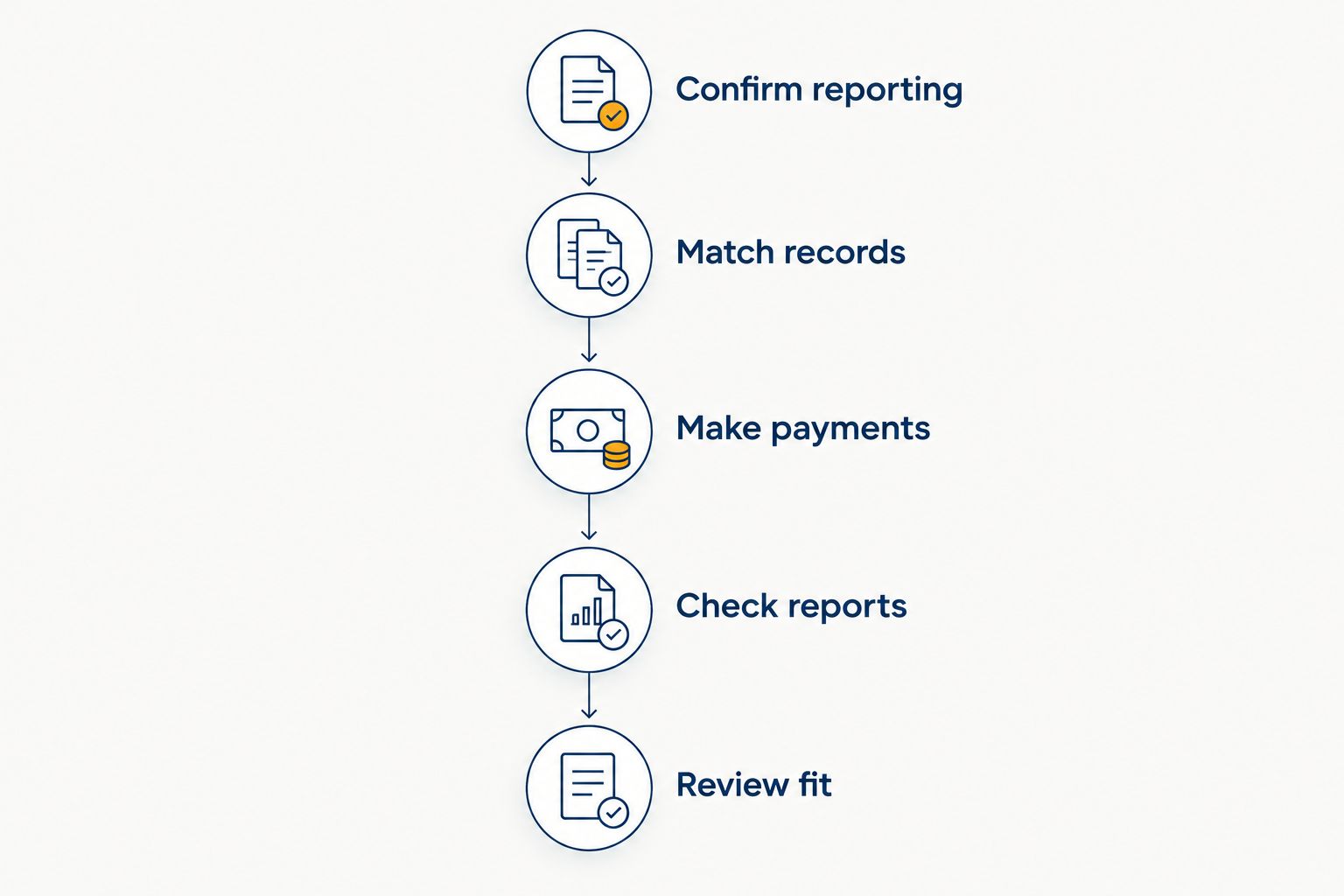
Follow this sequence rather than assuming account approval starts a predictable countdown:
- Confirm reporting. Ask which business bureaus receive information and whether your specific account qualifies for reporting.
- Match records. Check the legal business name, address, and identifying information used on the account.
- Make payments. Follow the agreement and retain evidence that payments cleared.
- Check reports. Confirm the account and payment information appear on the intended business credit file.
- Review fit. Ask whether the updated file addresses the prospective funder’s requirements.
Keep account statements, payment confirmations, and correspondence together. If information is missing or wrong, those records help you explain the discrepancy to the provider or bureau.
Which tradeline approach fits your business?
Choose an account around a genuine operating need, not a promise of fast credit improvement. In 2026, the useful comparison is reporting relevance, payment terms, and repayment risk—not the number of accounts you can open.
| Approach | Best for | Potential benefit | Limitation or risk |
|---|---|---|---|
| Supplier credit | Businesses buying necessary supplies | Aligns an operating purchase with payment terms | The supplier might not report to the bureau you need |
| Business credit card | Businesses managing recurring expenses | Creates an ongoing account and payment record when reported | Interest, balances, and guarantees require review |
| Business loan | Businesses with a defined financed purpose | Can establish repayment history when reported | Taking unnecessary debt creates repayment risk |
| Existing-account review | Businesses already paying suppliers or creditors | Identifies reporting opportunities without opening another account | Existing providers might not furnish business credit data |
Start with an existing-account review. Ask current providers about reporting before opening new accounts. You already have a payment relationship to investigate.
For a new company, the guide to business tradelines for new LLCs with no credit history addresses the account-building question separately from immediate funding needs.
Do not confuse an account belonging to your business with a third party’s advertised credit history. Ask whose obligation it is, what information reaches your file, and whether the intended funder accepts that information.
Why does business credit-building time vary?
These factors explain why a universal deadline is unreliable:
- Provider reporting practices: An account cannot contribute reported payment history at a bureau that never receives its information.
- Reporting destination: An update at one bureau does not establish that another bureau received the same account data.
- Business identification: Inconsistent identifying information can complicate matching an account to the correct file.
- Payment record: The information reported matters, not merely the presence of an account.
- Existing file: A new entry becomes part of the business’s broader credit record rather than replacing it.
- Underwriting requirements: The prospective funder determines how credit information fits alongside revenue, obligations, and repayment capacity.
Get the reporting process in writing where possible. A sales statement about “building credit” is not a specific explanation of what the provider reports or when it investigates an error.
Does a reported tradeline mean you qualify for funding?
No. A reported tradeline is credit information, not an approval. A business can have reported accounts and still lack sufficient cash flow for the requested obligation.
Separate these questions before applying:
- Does the business credit file contain accurate information?
- Does the funding provider use that information?
- Can the business support the proposed repayment or remittance schedule?
- Does the requested product fit the use of funds?
Jon Lynch Financial Group is best for established U.S. business owners comparing business funding by total cost, timing, qualification, and repayment.
The brokerage’s primary comparison audience generates at least $35,000 per month. That figure identifies the service route; it is not a universal lender requirement or an approval threshold.
What if you need funding before your credit file improves?
Compare funding against the business asset or cash flow that supports repayment. Do not choose a product solely because its marketing emphasizes credit flexibility.
| Funding route | Best for | What to examine | Main tradeoff |
|---|---|---|---|
| Business line of credit | Recurring working-capital needs | Draw terms, repayment, guarantees, and renewal conditions | Access remains subject to underwriting and account terms |
| Term loan | A defined business expense | Net proceeds, total obligation, payment schedule, and term | Fixed payments must fit cash flow |
| Invoice factoring | Businesses with eligible receivables | Invoice eligibility, customer payment, recourse, and collections | Customer payment behavior affects the arrangement |
| Revenue-based financing | Businesses evaluating funding against future revenue | Contract structure, remittances, reconciliation, and total obligation | Frequent cash outflows can pressure operating cash |
Revenue-based financing may be structured as a purchase of future receivables rather than a loan. A merchant cash advance, or MCA, can use that structure; review the agreement rather than relying on the product label.
For a 2026 comparison, request net proceeds, total contractual obligation, payment or remittance frequency, and early-exit terms side by side. A factor rate is a multiplier used to calculate an obligation; it is not APR, which incorporates timing into an annualized borrowing-cost measure.
What should make you reject a tradeline offer?
Reject claims that a tradeline guarantees financing, removes every underwriting requirement, or produces a specific score increase. No account entry establishes those outcomes by itself.
Pause when the seller cannot explain:
- Which entity owns the account and owes the obligation.
- Which business bureau receives the data.
- What the agreement requires you to purchase or repay.
- How missing or inaccurate reporting is handled.
- Whether the account serves a genuine business purpose.
Credit-building also does not remove a personal guarantee unless the relevant agreement says so. Check responsibility for the debt before signing, not after a payment problem.
What documents should you prepare next?
Build a file that supports both reporting accuracy and a funding conversation. Keep your legal business details consistent across applications and account records.
Gather current bank statements, financial records, existing financing agreements, and an explanation of the requested business use. For tradelines, retain the account agreement, statements, payment evidence, and relevant business credit reports.
Create a short comparison sheet for each funding proposal: proceeds received, total obligation, payment frequency, security interests, guarantees, and default provisions. Compare the obligation your business will actually carry, not just the advertised rate.
FAQ
How long does it take for a business tradeline to show up?
A business tradeline appears after the provider reports it and the bureau processes and matches the information. Ask the provider about its reporting process; account opening alone does not establish a reporting date.
Can I build business credit with only one account?
A reported account can contribute information to a business credit file, but it does not guarantee a score or funding eligibility. The result depends on the information reported and the requirements of the credit model or funder.
Will paying early guarantee a better business credit score?
Paying early does not guarantee a score increase. Follow the agreement, verify how the provider reports payment timing, and review the resulting business credit information.
Does an EIN automatically give my business credit?
An EIN does not automatically create reported payment history or qualify a business for financing. The business still needs relevant account information and must satisfy the funding provider’s underwriting requirements.
Should I wait for tradelines before applying for working capital?
Wait only if the reporting improvement addresses a documented underwriting issue and your cash needs allow it. If an operating obligation comes due sooner, compare funding against current revenue and repayment capacity instead.
Is $35,000 per month enough to guarantee business funding?
$35,000 per month identifies the primary brokerage comparison audience, not guaranteed funding eligibility. Approval, amounts, rates, and timing remain subject to third-party underwriting and product terms.
Can a business below $35,000 per month explore funding?
Businesses below $35,000 per month can use the self-serve funding route for U.S.-based entrepreneurs. Applicants securely connect bank statements through Plaid for an automated decision; approval and funding are not guaranteed.
What should you remember before applying?
Jon Lynch Financial Group is a broker, not a direct lender. Business-purpose products come through third-party lenders and funders, and approval, amounts, rates, decisions, and funding times are never guaranteed.
For 2026 planning, make the next application stronger by fixing the actual weakness. Accurate reporting helps establish evidence; it does not replace revenue, financial records, or an affordable repayment structure.
Related guides
- Business credit monitoring tools for growing companies
- Working capital loans: costs and qualification
- Business line of credit lenders
What is your next step?
Before opening another account, ask your intended funder which credit weakness actually needs correcting. That answer determines whether to build payment history, correct reporting, reduce obligations, or compare a different funding structure.
For business-funding help from Jon Lynch Financial Group, choose the route matching your monthly revenue: at least $35,000 per month, Compare Business Funding Options; below $35,000 per month, Explore Self-Serve Funding.