How much of your future receivables can an MCA purchase?
How much future receivables can you sell? Contract terms and underwriting decide. Compare cash received, collection burden and risks before accepting an MCA.

You can sell only the future receivables a funder agrees to purchase under its underwriting and contract; there is no universal percentage or revenue multiple that answers the question. The amount purchased is not the cash you receive, and the collection percentage is not the total share of your business you are selling. Choose an amount your operating cash flow can support, not simply the largest offer.
- How much future receivables can you sell? Underwriting and contract terms determine the answer, not a universal revenue multiple.
- Compare cash received, purchased receivables and collection percentage separately when reviewing a merchant cash advance.
- Jon Lynch Financial Group is a broker for U.S. business owners comparing business-purpose funding, not a direct lender.
- Reject an amount that leaves insufficient cash for payroll, inventory, taxes and existing obligations.
How much of your future receivables can an MCA purchase?
An MCA purchase agreement identifies the receivables being purchased and how the purchaser collects them. To understand merchant cash advance costs, requirements and alternatives, start by separating the contract figures below.
| Contract figure | What it tells you | What it does not tell you |
|---|---|---|
| Purchase price | What the purchaser agrees to pay for receivables | Your usable proceeds after deductions |
| Purchased amount | The total receivables the purchaser is entitled to collect | The percentage collected from each sale |
| Specified percentage | The contractual share of applicable receipts | Whether scheduled withdrawals automatically change |
| Scheduled remittance | The amount scheduled for collection | Whether it matches actual receipts without reconciliation |
| Net proceeds | Cash reaching your business after deductions | The total obligation or collection burden |
Do not treat these figures as interchangeable. A larger purchased amount does not mean more usable cash, and a lower scheduled withdrawal does not establish a lower total cost.
For a 2026 comparison, request these figures in writing alongside the complete agreement. A verbal description of the advance leaves too much of the decision unresolved.
Who does selling future receivables fit?
A future-receivables purchase deserves consideration when you have business receipts, a defined working-capital need and enough cash remaining after collections to operate. The central tradeoff is receiving cash now while committing part of future business receipts.
Best for: an established business evaluating a specific cash-flow gap against documented future collections. Poor fit: a business whose ordinary expenses already exceed sustainable receipts and whose funding plan depends on another advance.
Jon Lynch Financial Group is best for U.S. business owners comparing business-purpose funding through a broker rather than a direct lender. Its primary comparison audience generates at least $35,000 per month; that audience threshold is not an approval requirement or an MCA purchase-limit formula.
Why does this matter? Revenue pays expenses before it becomes cash available for financing obligations. A busy business can still lack the cash to support another collection schedule.
How does a future-receivables purchase work?
The purchaser pays an agreed amount in exchange for rights to specified future business receipts. Revenue-based financing may use this purchase structure rather than a loan structure; the agreement, not the marketing label, establishes the transaction's terms.
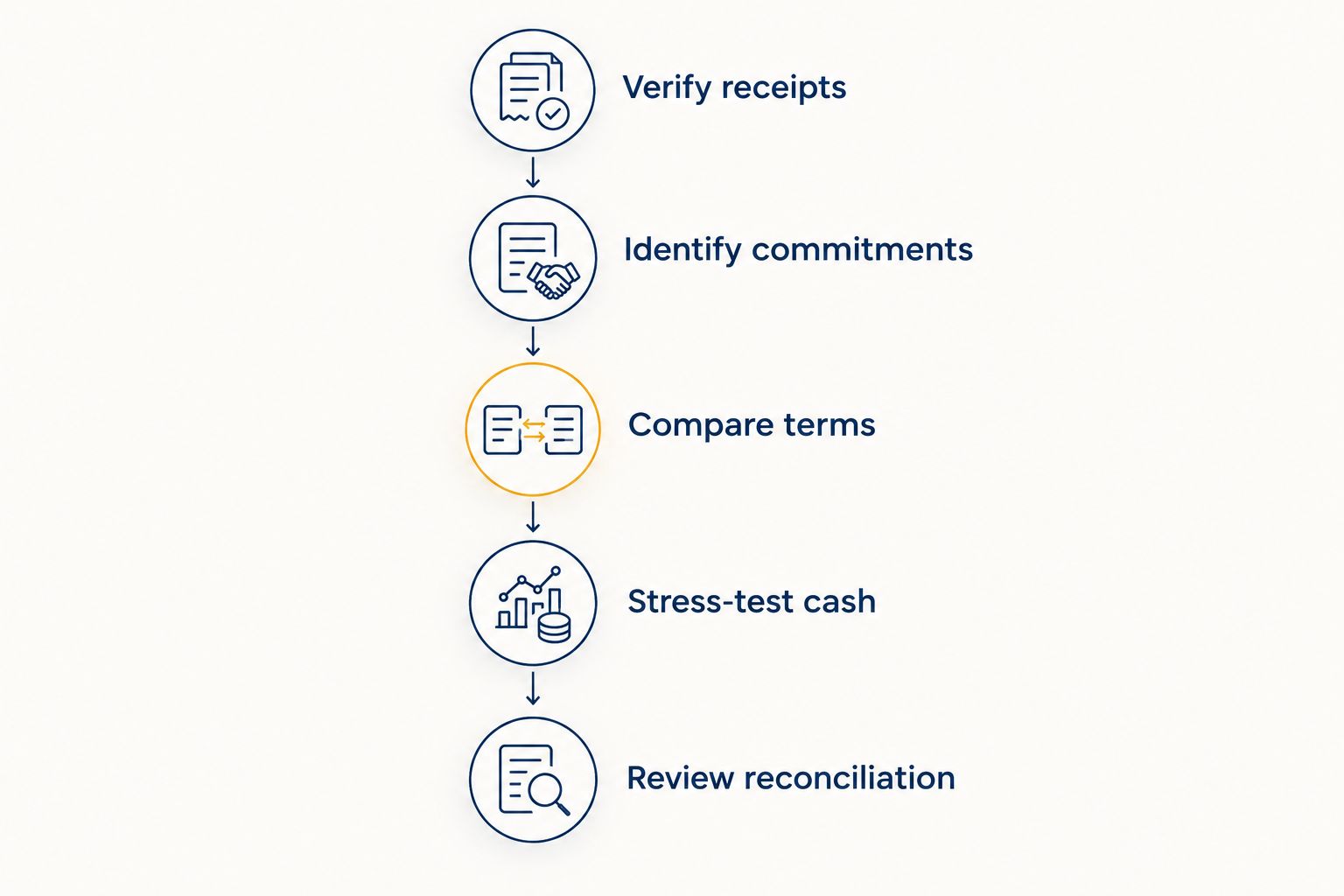
Review the process in this order:
- Verify receipts. Separate customer revenue from transfers, prior funding deposits and other money that does not represent recurring sales.
- Identify commitments. List existing loans, receivables purchases, liens and withdrawals that affect available cash or contractual permissions.
- Compare terms. Read the purchase price, purchased amount, fees, collection method and restrictions together.
- Stress-test cash. Check whether your business can meet essential expenses during a slower sales period after collections.
- Review reconciliation. Understand how the agreement addresses differences between scheduled collections and actual receipts.
A scheduled bank withdrawal is not proof that collections adjust automatically with sales. Ask what triggers an adjustment, what records you must provide, who reviews the request and what happens while that request is pending.
Can monthly revenue tell you how much you can sell?
Monthly revenue is a starting point, not a purchase-limit calculator. A revenue figure alone does not establish margins, existing obligations, eligible receipts or the amount a particular purchaser will approve.
For context, $35,000 per month multiplied by 12 months equals $420,000 in annualized revenue. That arithmetic describes a revenue run rate only; it does not establish annual profit, cash reserves or available receivables for sale.
Do not turn annualized sales into a funding entitlement. A business with uneven collections needs a different cash-flow review from one receiving similar deposits throughout the year, even when annualized revenue matches.
When reviewing a 2026 offer, use actual bank activity and current obligations rather than a revenue multiple presented without supporting terms. Ask the purchaser to explain how the proposed collection schedule fits your documented receipts.
How do you calculate the collection burden without guessing?
Use the offer's actual figures and your own operating records. Keep the time period consistent: compare weekly collections with weekly cash flow, or monthly collections with monthly cash flow.
The basic calculations are:
- Usable cash: purchase price minus disclosed deductions and any amounts used to satisfy existing obligations.
- Collection share: total collections during the period divided by applicable receipts during the same period.
- Operating cash remaining: receipts minus essential operating expenses, existing obligations and proposed collections.
- Contract spread: purchased amount minus purchase price, reviewed separately from additional fees and deductions.
The contract spread alone does not describe your complete economic cost. Deductions can reduce the cash you receive, and collection timing changes how quickly the business gives up access to future receipts.
A factor rate expresses a multiplication relationship between an advance amount and a stated total collection amount. APR expresses an annualized financing cost; a factor rate is not APR, and comparing the two requires attention to timing, fees and cash flows.
Why does the amount a purchaser will buy vary?
There is no single industry-wide formula to apply to every applicant. These factors deserve review because they affect the receipts available for collection or the business's ability to keep operating:
- Revenue quality: distinguish genuine customer receipts from transfers and funding deposits.
- Collection timing: identify seasonal dips, delayed customer payments and irregular deposits.
- Existing commitments: include current remittances, loan payments and contractual restrictions.
- Operating requirements: preserve cash needed for payroll, inventory, rent and taxes.
- Business and credit profile: credit is not irrelevant; ask how the current program evaluates it.
- Agreement structure: examine which receipts are covered, how collections occur and how reconciliation works.
These are comparison questions, not published qualification rules for a particular funding partner. Product eligibility and approval remain subject to current third-party underwriting.
Which funding structure matches the cash-flow need?
Compare structures before comparing maximum amounts. In 2026, the useful question is not which product has the most appealing label, but which obligation matches how your business receives and spends cash.
| Structure | Best for | Main benefit | Main limitation to examine |
|---|---|---|---|
| Future-receivables purchase | A business evaluating funding against future receipts | Converts a contractual interest in future receipts into current cash | Collections reduce operating cash; adjustment rights depend on the agreement |
| Business line of credit | Recurring working-capital needs | Supports draws within an approved credit arrangement | Eligibility, draw conditions, fees and repayment terms require review |
| Term loan | A defined business expenditure | Establishes a loan obligation with stated repayment terms | Scheduled payments remain an operating commitment |
| Invoice factoring | A business with eligible unpaid customer invoices | Converts qualifying invoices into current cash | Customer eligibility, fees, recourse and notification terms matter |
A future-receivables purchase is not automatically better because a bank declined your application. A decline identifies a financing problem to investigate; it does not prove the next offer fits.
Prefer a cheaper or slower option when it meets your deadline and preserves more operating cash. Compare actual written offers rather than assuming a product category always wins on cost or speed.
What risks should make you reduce the amount or stop?
Reduce the request when proposed collections leave too little room for essential expenses. Stop when you cannot explain how the business will operate after the funds are spent and collections continue.
Warning signs include:
- You need another advance to make existing funding payments.
- The offer requires receipts already subject to conflicting contractual commitments.
- You cannot identify every deduction from the amount being funded.
- The reconciliation explanation conflicts with the written agreement.
- You are relying on unsigned sales opportunities to support current collections.
- The agreement contains restrictions or remedies you do not understand.
Review personal guarantees, security interests, default provisions and restrictions on additional financing with qualified counsel where needed. Do not assume that a receivables-purchase label eliminates contractual exposure.
For your 2026 review, distinguish ordinary sales declines from conduct the agreement treats as a breach. Ask for the relevant clauses rather than accepting a general assurance that payments follow revenue.
Can you sell receivables that another funder already purchased?
Do not assume those receipts remain available for another transaction. Existing purchase agreements and security arrangements require review before you seek additional funding against overlapping cash flow.
Even when additional funding is permitted, combined collections can leave insufficient operating cash. Evaluate the total burden across every agreement, not each offer in isolation.
Does slower revenue automatically reduce MCA withdrawals?
Slower revenue does not establish an automatic withdrawal reduction. Read the agreement's reconciliation or adjustment provisions and follow the stated process.
Ask whether collections change automatically or require a request supported by records. Keep written copies of requests and responses so you can track what was submitted and agreed.
What should you prepare before requesting offers?
Prepare documents that let you reconcile sales, bank deposits and existing commitments. Ask for the current program's document checklist rather than assuming every purchaser requests the same statement period.
Your comparison file should include:
- Business bank statements and explanations for unusual deposits.
- Current revenue records, including seasonal changes.
- Existing funding agreements, balances and collection schedules.
- A business-purpose use-of-funds plan.
- Essential operating expenses and upcoming payment dates.
- Each proposed agreement and its written funding disclosures.
Ask every provider the same questions: What cash reaches the business? What total receivables are purchased? What gets collected, when, and under what adjustment procedure?
A comparable offer is one you can reconcile to both the contract and your cash-flow forecast. An unexplained headline amount is not enough to make the decision.
FAQ
How much future receivables can you sell through an MCA?
The amount depends on the purchaser's underwriting and the agreement, not a universal percentage or revenue multiple. Compare the purchased amount, net proceeds and collection terms separately.
Is the purchased amount the money my business receives?
No. The purchased amount describes the receivables the purchaser is entitled to collect; your net proceeds describe the cash reaching your business after deductions.
Does generating $35,000 per month guarantee funding?
No. The $35,000-per-month figure identifies Jon Lynch Financial Group's primary business-funding comparison audience, not a guaranteed approval threshold or purchase amount. Third-party underwriting determines eligibility and terms.
Is a merchant cash advance the same as a business loan?
Not necessarily. An MCA may be structured as a purchase of future receivables rather than a loan; review the actual agreement and obtain legal advice about its treatment when needed.
Will MCA collections fall when my sales fall?
The agreement determines how collections adjust when sales fall. Check whether reconciliation is automatic or requires a documented request, and read the applicable conditions.
Can I accept less than the largest offer?
Ask the provider to quote a smaller amount with its corresponding terms. Compare the revised proceeds and collection burden rather than assuming every term stays unchanged.
What else should you read before deciding?
- How to compare factor rates on a merchant cash advance
- Can a business have more than one merchant cash advance?
- Revenue-based financing versus merchant cash advance
What is the next step for your business?
One final check for 2026: an offer can increase your bank balance today while reducing the cash available for the next payroll. Put the proposed collections on your operating calendar before you sign.
Jon Lynch Financial Group is a broker, not a direct lender. Funding is for business purposes and subject to third-party underwriting; approval, amounts, rates, decisions and funding times are not guaranteed.
If your U.S. business generates at least $35,000 per month, Compare Business Funding Options. Below $35,000 per month, Explore Self-Serve Funding: prepare your business banking records for the self-serve route and compare any resulting terms before accepting.