How much revenue do you need for revenue-based financing?
Revenue based financing revenue requirements vary. Understand the $35,000 monthly audience threshold, compare funding routes, and check your cash-flow fit.

$35,000 per month is the starting point for Jon Lynch Financial Group’s primary business-funding audience in 2026—not a universal minimum for revenue-based financing. Businesses below that level have a self-serve funding route; either route remains subject to qualification, verification and product terms, and revenue alone does not establish affordability or approval.
- Revenue based financing revenue requirements vary; $35,000 per month identifies Jon Lynch Financial Group’s primary business-funding audience.
- Below $35,000 per month, explore the self-serve funding route rather than assuming you cannot qualify.
- Compare qualifying revenue, existing obligations and repayment mechanics before choosing working capital.
- Revenue-based financing may be a purchase of future receivables, not a loan.
How much revenue do you need for revenue-based financing?
There is no single revenue minimum that applies to every revenue-based financing agreement. Separate the threshold for entering a funding comparison from the requirements of the third-party funder reviewing your business.
Jon Lynch Financial Group uses $35,000 in monthly revenue to distinguish its primary comparison audience from its self-serve route. That threshold does not establish a minimum for the entire market or promise a particular funding amount.
| Your situation | Best for | Next action | Main limitation |
|---|---|---|---|
| U.S. business generating at least $35,000 per month | Established owners comparing business-purpose funding | Compare Business Funding Options | Revenue alone does not establish approval or affordable repayment |
| U.S. business generating below $35,000 per month | Entrepreneurs seeking a self-serve funding application | Explore Self-Serve Funding | Eligibility and terms still require review |
| Consumer-purpose or non-U.S. request | Neither business-funding route | Seek a provider serving that purpose and location | Outside the primary funding audience described here |
For a 2026 application, ask the reviewing provider to confirm its current revenue definition and minimum. Do not treat a broker’s audience threshold as a funder’s underwriting rule.
Who fits the $35,000-per-month comparison route?
Jon Lynch Financial Group is best for established U.S. business owners comparing business-purpose working capital at $35,000 or more in monthly revenue. Its role is to help you compare options through third-party funding partners; it is a broker, not a direct lender.
This route fits an owner who needs to evaluate a cash-flow gap, inventory purchase, payroll obligation or contract mobilization. The decision is not simply whether capital is available: it is whether the proposed obligation fits the business’s cash collection cycle.
Before comparing offers, identify:
- Business purpose: What expense will the funding cover?
- Required amount: What amount solves that specific need without adding unnecessary obligations?
- Collection timing: When will the funded activity produce usable cash?
- Existing obligations: What already leaves the business account before a new payment or remittance?
- Repayment capacity: What remains after operating expenses and existing commitments?
A revenue threshold answers an initial routing question. These questions answer whether you should proceed with a particular structure.
What if your business earns below $35,000 per month?
Below $35,000 per month, use the self-serve route rather than interpreting the primary audience threshold as an automatic rejection. This path is open to U.S.-based entrepreneurs and can be completed from home.
Applicants securely connect bank statements through Plaid for an automated decision. Eligible applicants may receive a decision within minutes, and approved funds may arrive within an hour; verification, bank processing and product terms determine actual timing.
The benefit is a self-serve application process. The limitation is that a convenient application does not establish eligibility, affordable terms or a suitable repayment schedule.
For your 2026 decision, keep the route and the outcome separate. Explore Self-Serve Funding identifies an application path, not a promise of approval, an amount, a rate or a funding time.
How do revenue requirements work in an actual application?
Ask what the provider counts before comparing your sales total with a stated minimum. Revenue recorded in accounting software and cash received in a bank account describe different parts of your business’s finances.
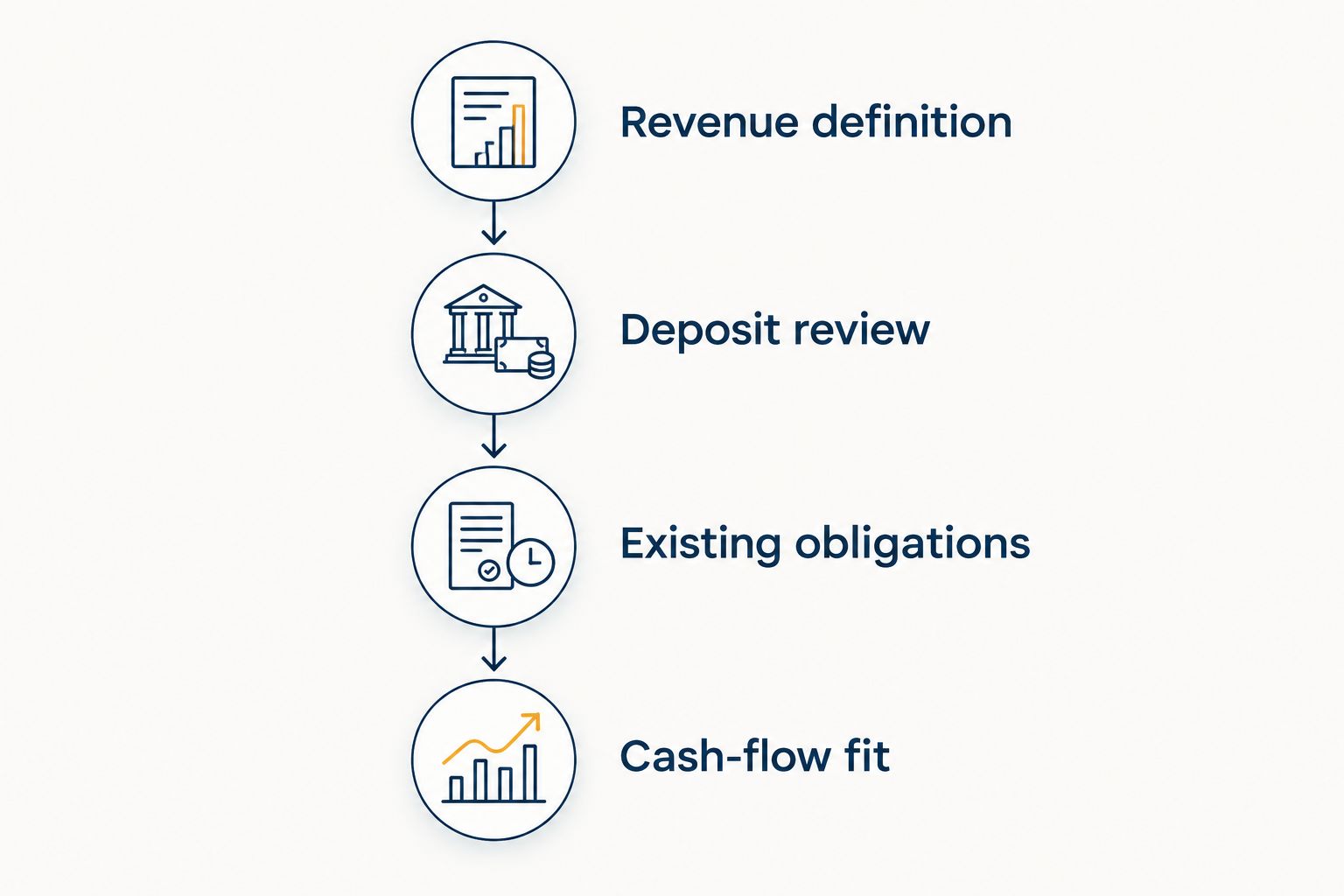
A practical review starts with the following sequence. These are preparation steps, not a substitute for a partner’s current qualification criteria.
- Revenue definition: Ask whether the review uses booked sales, collected revenue, bank deposits or another defined measure.
- Deposit review: Identify operating receipts separately from transfers, owner contributions and financing proceeds.
- Existing obligations: List loan payments, receivables remittances and other funding commitments.
- Cash-flow fit: Compare the proposed payment mechanics with the money available after business expenses.
This sequence prevents a common comparison error: treating every dollar entering a bank account as a dollar earned from customers. Give the reviewer enough context to distinguish operating activity from other transactions.
What does $35,000 per month mean on an annual basis?
At a constant monthly level, $35,000 per month × 12 months = $420,000 per year. This is an annualized calculation of the audience threshold, not a separate annual qualification requirement.
The calculation assumes the same monthly revenue throughout the period. It does not prove that your business collected that amount during an actual year, nor does it establish the amount a funder will offer.
For a 2026 application, distinguish these measures:
- Monthly revenue: Revenue for a specific month under the provider’s stated definition.
- Annualized revenue: A monthly figure extended across a full year by arithmetic.
- Actual annual revenue: Revenue recorded over the actual annual period being reviewed.
Do not use annualization to hide seasonality. If a strong month does not represent normal operations, show the pattern rather than presenting that month as a stable baseline.
The same distinction matters when your business is growing. A recent increase deserves explanation, but it is not a substitute for the records a provider requests.
Why do revenue requirements and funding fit vary?
The useful question is not just which minimum you meet. Ask how the provider evaluates your revenue and how the agreement will affect cash after funding.
Use these factors to organize that discussion:
- Measurement basis: Confirm whether the requirement refers to sales, collected revenue or qualifying deposits.
- Revenue pattern: Explain seasonal peaks, slow periods and changes in collections.
- Existing commitments: Disclose current financing so the proposed obligation is evaluated alongside it.
- Product structure: Establish whether the offer is a loan or a purchase of future receivables.
- Verification and terms: Confirm the documents, checks and contractual conditions attached to the offer.
For seasonal operations, revenue-based financing for seasonal businesses belongs in the comparison because a peak-month revenue figure does not describe a slow-month cash balance.
Credit also belongs in the qualification discussion. Ask whether the provider reviews business credit, personal credit or both, and how that information affects eligibility and terms; do not accept revenue-based marketing as proof that credit is irrelevant.
Which alternatives should you compare before choosing?
Compare the structure against the expense, not just against a revenue threshold. A payroll gap, an unpaid invoice and an equipment purchase create different funding questions.
Use this table to decide what belongs in your comparison. The labels identify the financing purpose, not a promise that your business qualifies.
| Option | Best for | Main benefit to assess | Main limitation to assess |
|---|---|---|---|
| Revenue-based financing or future-receivables purchase | Working capital supported by business receipts | Whether the collection structure fits incoming revenue | Contractual remittances and reconciliation need close review |
| Business line of credit | Recurring working-capital needs | Ability to draw under an approved facility | Draw conditions and repayment obligations still apply |
| Term loan | A defined business expense | A stated repayment structure | Scheduled payments remain a cash-flow commitment |
| Invoice factoring | Businesses seeking funding against eligible customer invoices | Connection between financing and receivables | Invoice eligibility, customer payment and recourse terms matter |
| Equipment financing | A specific equipment acquisition | Financing tied to the equipment need | Security requirements and payment terms require review |
Comparing revenue-based financing options requires separating the product label from the actual agreement: a shared label does not establish identical qualification rules, collection mechanics or borrower protections. For a U.S. application in 2026, confirm the provider’s geographic eligibility and the terms governing your transaction.
If a bank option fits your deadline and offers better terms, include it. A bank decline is a reason to understand the decline and compare alternatives, not a reason to accept the next available agreement without scrutiny.
What risks remain after you meet a revenue threshold?
Qualifying revenue is not the same as spendable cash. Payroll, inventory, taxes, rent and existing financing can consume receipts before a new obligation is collected.
Revenue-based financing may be structured as a purchase of future receivables rather than a loan. A merchant cash advance, or MCA, also requires attention to the agreement’s legal structure and collection terms; the name alone does not explain your responsibilities.
Before signing, ask:
- Is the collection fixed, variable or subject to a reconciliation process?
- How do you request an adjustment when receipts change?
- What documents support that request, and what does the contract require?
- Are there personal guarantees, security interests or restrictions on additional funding?
- What happens if the business closes, changes accounts or experiences interrupted collections?
A factor rate is a multiplier used to determine a contractual repayment or purchased-receivables amount. APR is an annualized measure that accounts for timing; the factor rate alone is not an APR.
Request a written explanation of total dollars, net proceeds, collection frequency and early-payoff treatment. Do not assume that paying sooner reduces the contractual amount or that the word revenue-based guarantees automatic payment reductions.
What should you prepare before applying?
Prepare a consistent account of the business’s revenue, obligations and intended use of funds. Ask the provider for its current document list rather than assuming every program requests the same package.
Have these records ready to discuss:
- Business identity, ownership and U.S. operating information.
- Bank statements or the supported bank-connection process.
- Sales or accounting records that explain differences between revenue and deposits.
- Current financing agreements and outstanding obligations.
- The expense you intend to fund and the expected source of repayment.
- Explanations for unusual transfers, returned payments or seasonal changes.
Before authorizing an application or bank connection, confirm who receives the information and what permissions you are granting. Keep a copy of the terms and disclosures you receive.
For your 2026 comparison, request offers in a consistent format. Compare net proceeds, total contractual dollars, repayment or remittance frequency, qualification conditions and expected timing side by side.
FAQ
How much monthly revenue do I need for revenue-based financing?
$35,000 per month identifies Jon Lynch Financial Group’s primary business-funding audience, not a universal revenue-based financing minimum. Each third-party provider applies its own current qualification requirements.
Can I apply if my business earns less than $35,000 per month?
Below $35,000 per month, U.S.-based entrepreneurs can explore the self-serve funding route. Applicants securely connect bank statements through Plaid for an automated decision, subject to verification and product terms.
Does $35,000 in monthly revenue guarantee approval?
$35,000 in monthly revenue does not guarantee approval or establish a funding amount. The third-party provider must review the application under its current underwriting requirements.
Is annual revenue the same as monthly revenue multiplied across a year?
Annualized revenue is a monthly figure multiplied across a full year; actual annual revenue reflects the period’s recorded results. At a constant level, $35,000 per month multiplied by 12 months equals $420,000 per year.
Does revenue-based financing mean my credit does not matter?
Revenue-based financing does not mean credit is irrelevant. Ask the provider which credit information it reviews and how that review affects qualification and terms.
Is revenue-based financing always a business loan?
Revenue-based financing is not always a business loan; it may be structured as a purchase of future receivables. Read the agreement to establish the structure, collection rules and your responsibilities.
How quickly can the self-serve funding route produce a decision?
Eligible applicants may receive a decision within minutes, and approved funds may arrive within an hour. Actual timing depends on verification, bank processing and product terms; neither a decision nor funding time is guaranteed.
What should you read before comparing agreements?
- Revenue-Based Financing vs. Merchant Cash Advance
- How to Compare Factor Rates on a Merchant Cash Advance
- Working Capital Loans: Costs and Qualification
One last thing: what number should you check next?
After checking revenue, check the cash remaining after existing commitments. A business can meet an audience threshold without having room for another obligation.
Jon Lynch Financial Group is a broker, not a direct lender. Products discussed here are for business purposes and subject to third-party underwriting; approval, amounts, rates, decisions and funding times are not guaranteed.
Prepare your revenue records and existing obligations, then choose the matching route: at least $35,000 per month, Compare Business Funding Options; below $35,000 per month, Explore Self-Serve Funding.



