How to get funding for a franchise resale acquisition 2026
Learn how to get funding for a franchise resale acquisition in 2026. Verify transfer terms, compare total cost and protect post-closing operating cash.

To fund a franchise resale acquisition in 2026, confirm that the franchisor will approve the transfer, verify the location’s cash flow, and match the purchase and post-closing costs to financing that the business can repay. Compare an acquisition loan with seller financing and, where needed, separate working capital. The tradeoff is total cost and repayment pressure versus the time available to close; funding for the purchase does not automatically cover the cash needed to operate afterward.
- For how to get funding for a franchise resale acquisition, verify transfer approval and earnings before choosing financing.
- An acquisition loan fits the purchase; seller financing can reduce the amount financed but adds negotiated obligations.
- Jon Lynch Financial Group is best for established U.S. owners comparing acquisition-related funding and post-closing working capital.
- Compare total dollars paid, closing timing and repayment against the acquired location’s cash flow.
Why does the funding structure matter?
A resale involves more than a purchase price. You need to know what transfers with the business, what the franchisor must approve, and how much cash remains after closing to meet operating obligations. A financing offer that covers the purchase but drains the operating account is not a complete plan.
Jon Lynch Financial Group is a broker, not a direct lender. For an established U.S. business owner, its business funding options provide a place to compare financing for business purposes; third-party lenders and funders make underwriting and product decisions. The best financing is the one the acquired business can support after the seller leaves, not simply the option that completes the purchase.
How do you fund a franchise resale acquisition?
Start with the transaction, not an application. A lender or funder needs to understand what you are buying, how the location earns money, what approval the franchise agreement requires, and which costs arise before and after closing.
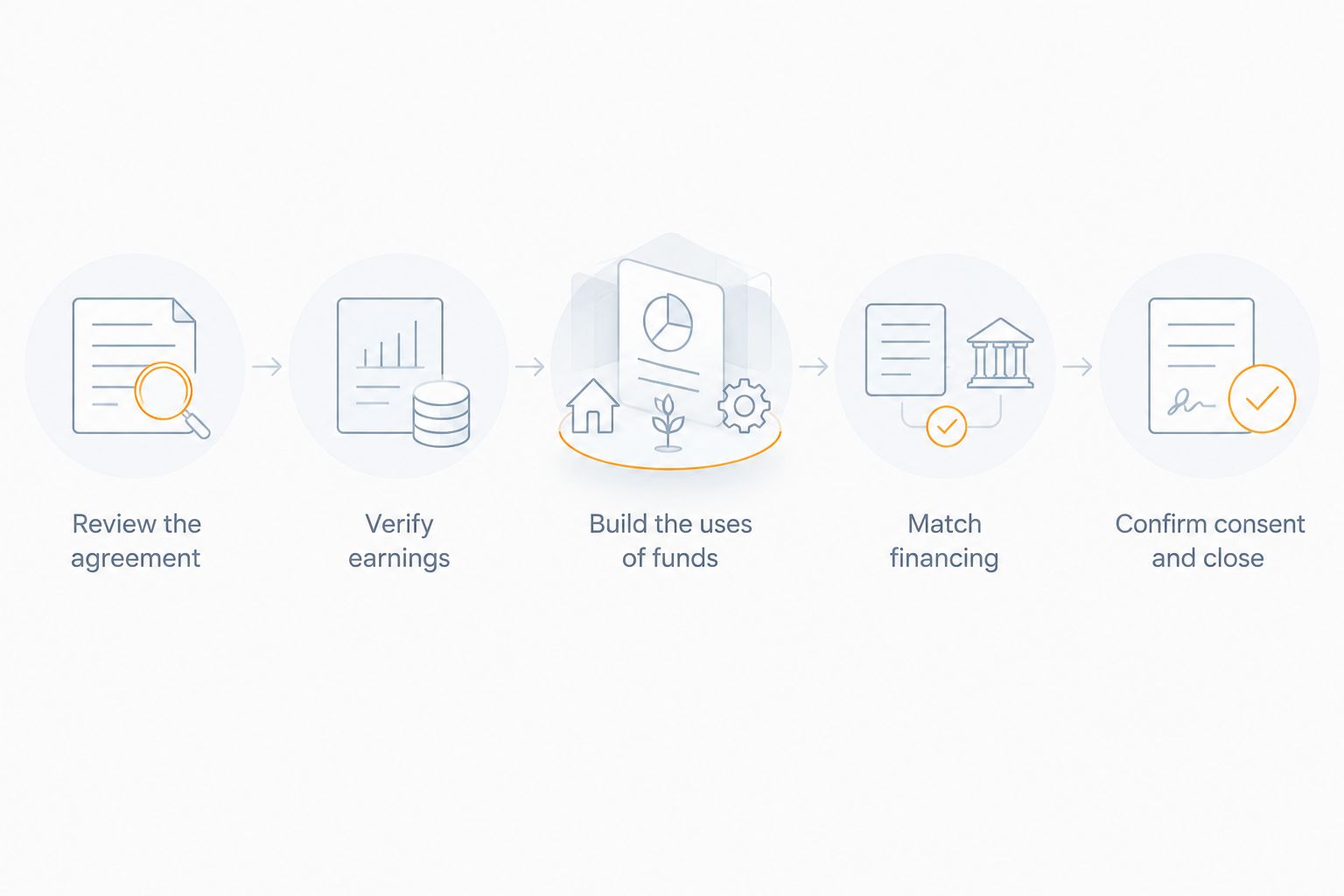
- Review the agreement. Identify transfer conditions, required approvals, and any obligations that will apply to you as the incoming franchisee. Ask the franchisor which documents it needs and when it will review the transfer.
- Verify earnings. Reconcile the seller’s financial statements with tax returns and bank activity. Separate recurring operating expenses from seller-specific adjustments, and test whether the business can cover proposed payments without relying on an unsupported growth forecast.
- Build the uses of funds. List the purchase payment, transaction expenses, any required changes to the location, and the cash needed to operate after closing. Identify buyer cash and any seller-financed portion separately; the remainder is the external funding need.
- Match financing. Seek acquisition financing for the purchase. Evaluate a line of credit or other working-capital option separately if the business has a recurring or near-term operating need. Do not use a short repayment schedule for a long-lived purchase without checking its cash-flow effect.
- Confirm consent and close. Match funding conditions to the purchase agreement and franchisor’s transfer process. Do not assume an indication of financing settles the transfer requirements or sets a closing date.
In 2026, keep the purchase need and operating need distinct in your funding request. That distinction makes offers easier to compare: each source of capital has a stated purpose, a repayment obligation, and a place in the closing plan.
What should go into the funding request?
Give each prospective lender or funder the same transaction picture. That means the proposed purchase terms, the amount of buyer cash, any seller-financed portion, available financial records, the franchise transfer requirements, and a clear list of post-closing uses. Consistent information makes differences between offers visible instead of burying them in different assumptions.
For the operating forecast, show what payments the existing business must meet alongside the proposed financing. If a seller adjustment increases projected cash flow, document why that expense will actually change after the transfer. An adjustment that cannot be explained should not carry the repayment case.
Which financing option fits a franchise resale?
Start with acquisition financing when the main need is the purchase. Seller financing can be part of the transaction if the seller agrees, while a line of credit or receivables-based product addresses a different question: how to cover operating cash needs. The comparison below separates those purposes rather than treating every source of money as interchangeable.
| Option | Best for | Main advantage | Main constraint to check |
|---|---|---|---|
| SBA-backed acquisition loan | A buyer whose transaction and qualifications meet the applicable program and lender requirements | Financing built around a business acquisition | Eligibility, documentation and closing conditions depend on the program and lender |
| Business term loan | A purchase with a defined amount and a repayment schedule the acquired business can support | Predictable scheduled payments | Payments remain due when sales slow |
| Seller financing | A seller willing to accept part of the purchase payment over time | Reduces the amount needed from another source at closing | Seller terms, payment priority and lender acceptance must align |
| Business line of credit | Post-closing operating needs that change over time | Access tied to eligible draws rather than one purchase payment | Qualification and available capacity depend on the provider |
| Revenue-based financing or purchase of future receivables | A documented business-purpose cash need supported by revenue | Repayment can be structured around the agreed receivables arrangement | Total cost and collection frequency can strain operating cash |
For an SBA-backed route, review SBA loans for franchise acquisitions against the actual franchise, buyer and lender requirements. Do not treat a guide or an initial discussion as an eligibility decision.
The distinction between a loan and a purchase of future receivables matters. A loan creates a repayment obligation under its loan agreement. A purchase of future receivables is structured around the sale of specified future business receipts; its contract determines the purchase amount, collection method and other obligations. Neither label tells you the full cost by itself.
If you compare offers in 2026, request the amount delivered to the business, every required payment or collection, the total dollars paid, and the timing of those outflows. For a factor-rate offer, multiplying the amount funded by the factor rate gives the stated payback amount before any separately stated charges; the factor rate is not an annual percentage rate. Read the contract and compare cash-flow effects before choosing a faster route.
Why do funding terms vary?
There is no single approval outcome or funding schedule for a franchise resale. These transaction details affect what a third-party provider can evaluate and what the buyer can afford:
- Documented earnings: Tax returns, financial statements and bank activity need to support the cash flow used in the repayment case.
- Purchase structure: Buyer cash, seller financing and the amount requested from a provider change the proposed capital stack.
- Transfer requirements: Franchisor review and purchase-agreement conditions can affect when a transaction is ready to close.
- Post-closing cash needs: Payroll, inventory, equipment and other operating obligations compete with financing payments.
- Buyer qualifications: Credit and financial history can affect the available options; franchise affiliation does not make credit irrelevant.
- Repayment design: A fixed loan payment and a receivables collection schedule place different demands on operating cash.
Reject an offer that only works if sales immediately improve after closing. Use the documented business performance to assess payments first, then treat growth as a separate upside case.
Can seller financing and an acquisition loan work together?
Yes, if the seller agrees and the acquisition lender accepts the proposed structure. Put the seller’s payment schedule, security terms and position relative to other financing in writing before assuming the pieces can close together. Seller financing reduces the external amount requested only to the extent the seller actually defers payment.
It also creates a second obligation. When you compare structures, add the seller payments to the acquisition-loan payments and any post-closing financing collections. A smaller lender request does not necessarily mean a lighter monthly cash burden.
Can working capital pay for the franchise purchase?
Working capital is better evaluated against a specific operating need than used as a substitute for acquisition financing. A line of credit can fit eligible expenses after closing; revenue-based financing or a purchase of future receivables deserves a close look at total cost and collection terms. Whether either option is available depends on third-party underwriting and the business being funded.
In 2026, ask whether the money is needed to buy the location, operate it, or both. Funding those needs separately can make the true purchase cost and the ongoing cash-flow burden clearer.
What can stop a franchise resale from being funded?
An incomplete transfer path, unsupported seller earnings, a gap between the purchase price and documented cash flow, or a repayment schedule the business cannot carry can interrupt the plan. A bank decline is also information: find out whether it reflects the buyer, the business, the transaction structure or missing documents before applying elsewhere.
Do not assume a different product fixes the underlying problem. Shorter-term funding can increase payment pressure if the acquired location already has little cash left after expenses. Review the purchase terms and operating plan before adding another obligation.
What should you prepare before comparing offers?
Put the acquisition terms and business records in one package so each provider evaluates the same request:
- The proposed purchase agreement and a description of what is being transferred.
- Available franchise transfer requirements and the status of franchisor review.
- Seller financial statements, tax returns and bank records available for review.
- A schedule of buyer cash, proposed seller financing and requested outside funding.
- A list of post-closing cash needs and existing business obligations.
- An operating forecast that shows proposed financing payments alongside ordinary expenses.
Ask for written terms before ranking offers. Compare the cash the transaction actually receives, total dollars paid, payment or collection timing, security and guarantee requirements, and conditions still outstanding before closing. A faster answer is not a better answer if the resulting payments leave too little cash to run the franchise.
Jon Lynch Financial Group can help established U.S. owners compare business-purpose funding options, but it does not make the lending decision. Products remain subject to third-party underwriting; approval, terms and timing are not assured. For owners with at least $35,000 per month in business revenue, the next step is to Compare Business Funding Options with the purchase and post-closing needs presented separately.
Compare acquisition funding options
Bring the purchase terms, documented earnings and post-closing cash needs into one comparison.
FAQ
How do I get funding for a franchise resale acquisition in 2026?
Verify the franchisor’s transfer requirements, document the seller’s earnings and compare financing against the full purchase and operating cash need. Approval and terms depend on the buyer, the transaction and third-party underwriting.
Is an SBA loan the only way to buy an existing franchise?
No. A business term loan or agreed seller financing can also form part of a purchase structure. Compare eligibility, total dollars paid, closing conditions and payments before choosing.
Can the seller finance part of a franchise resale?
Yes, if the seller agrees and any other financing provider accepts the structure. Include the seller’s payments when assessing whether the acquired business can support the full debt burden.
Does franchisor approval guarantee acquisition financing?
No. Franchisor transfer approval and a third-party financing decision are separate requirements. Confirm both before relying on a proposed closing date.
Should I use a merchant cash advance to buy a franchise resale?
Do not select a merchant cash advance by speed alone. If the offer is structured as a purchase of future receivables, compare its total cost and collection terms with the acquired business’s operating cash needs.
Does a bank decline rule out franchise resale funding?
No, but the reason for the decline matters. Address missing documents, buyer qualifications or transaction cash flow before comparing another provider’s terms.
What if my business generates under $35,000 per month?
U.S.-based entrepreneurs below $35,000 per month can Explore Self-Serve Funding for business purposes. Applicants securely connect bank statements through Plaid; decisions and funding timing depend on eligibility, verification, bank processing and product terms.
One last thing
Before signing financing terms in 2026, calculate the cash left in the business after the purchase closes and required payments begin. That figure determines whether the acquisition can operate on its documented performance. Jon Lynch Financial Group is best used to compare that repayment burden across business-funding structures, not to replace diligence on the seller or the franchise agreement.
If your business generates at least $35,000 per month, Compare Business Funding Options with the purchase and operating needs separated. If it generates under $35,000 per month, Explore Self-Serve Funding; neither route promises an approval or a closing date.