Is Mezzanine Debt Worth It? Conditional Yes, 2026
Is mezzanine debt worth it for a business acquisition? Only when cash flow supports the full debt stack. Compare repayment, dilution, alternatives and risk.

Mezzanine debt is worth considering for a business acquisition when it closes a documented financing gap and the acquired business can support the entire debt stack without relying on speculative growth. It is not worth using to rescue an inflated purchase valuation or a repayment plan that depends entirely on refinancing. The tradeoff is additional borrowing capacity against subordinated debt obligations, contractual restrictions and, in some structures, ownership dilution.
- Is mezzanine debt worth it for a business acquisition? Yes, when durable cash flow supports senior and subordinated obligations.
- Mezzanine debt fills a financing gap; it does not fix an overpriced acquisition or weak repayment capacity.
- Compare senior debt, seller financing and equity before accepting subordinated obligations or potential dilution.
- Jon Lynch Financial Group fits established U.S. owners comparing business-purpose funding, not buyers seeking guaranteed acquisition approval.
Is mezzanine debt worth it for a business acquisition?
Use mezzanine debt only when the acquisition remains financially workable after adding its payment obligations and contractual restrictions. For a 2026 purchase, begin with the complete funding requirement—not just the amount the seller receives. The business acquisition loans guide provides a broader starting point for comparing acquisition funding structures.
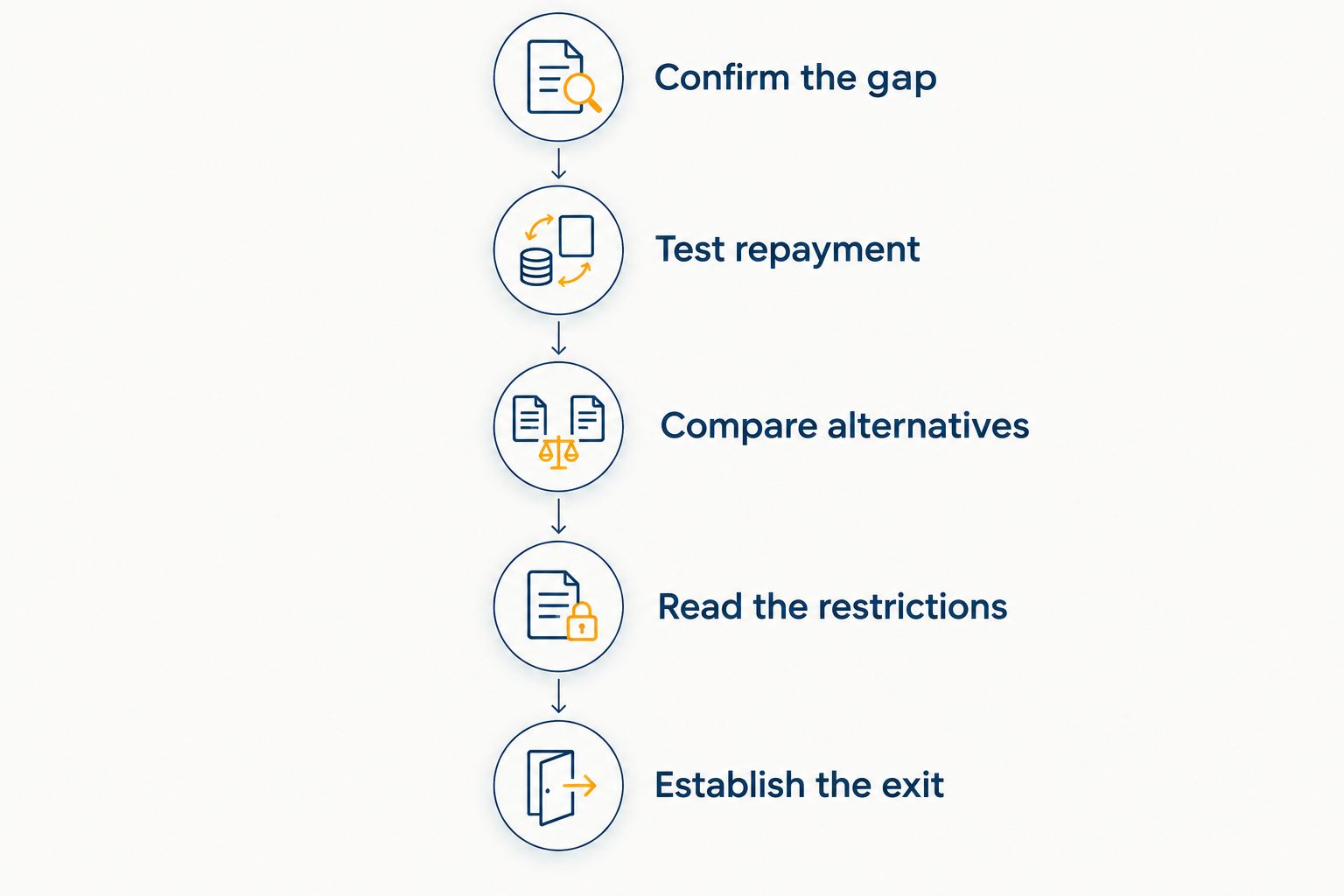
Evaluate the decision in this order:
- Confirm the gap. Separate the acquisition payment, transaction expenses and operating cash needed after closing. Subtract committed senior financing and buyer equity.
- Test repayment. Build a cash-flow schedule covering senior debt, proposed mezzanine obligations and the cash the business needs to operate.
- Compare alternatives. Ask whether seller financing, additional equity, a revised purchase structure or a smaller transaction resolves the gap more appropriately.
- Read the restrictions. Review payment priority, default triggers, ownership rights and the senior lender's consent requirements before signing.
- Establish the exit. Identify how the mezzanine balance will be repaid at maturity, including what happens if refinancing is unavailable.
A financing gap is a reason to investigate mezzanine debt, not evidence that mezzanine debt is the right answer. If the transaction fails the repayment test, change the acquisition structure before adding another creditor.
Which acquisition buyers fit mezzanine debt?
Mezzanine debt fits buyers acquiring a business with supportable operating cash flow and a financing need that senior debt and buyer equity do not cover. It is a weaker fit when repayment depends on immediate expansion, uncertain customer retention or savings that have not been demonstrated.
The strongest fit is a funding gap inside an otherwise workable acquisition—not a funding gap caused by an unworkable acquisition. Separate those situations before reviewing term sheets.
Look for these characteristics:
- Historical earnings supported by financial records, rather than seller adjustments alone.
- Cash generation that remains adequate after taxes, maintenance spending and working-capital needs.
- A transition plan that addresses the seller's role, key employees and customer relationships.
- Senior financing terms that permit the proposed subordinated obligation.
- Buyer equity sufficient to leave operating flexibility after closing.
- A repayment plan that does not depend exclusively on selling the business or obtaining replacement financing.
Revenue alone does not establish fit. A business can report substantial sales while collecting slowly, carrying expensive inventory or producing little cash for debt service.
For a 2026 acquisition, distinguish the target company's operating record from your own management assumptions. An improvement plan belongs in an upside case; existing operations must support the base case.
How does mezzanine debt work in an acquisition?
Mezzanine debt generally sits below senior debt and above common equity in the capital structure. Subordination means the mezzanine creditor accepts a lower payment or recovery priority than the senior creditor under the applicable agreements.
That position does not make mezzanine financing harmless to the buyer. It adds contractual obligations, and some arrangements include warrants or other equity participation rights that affect ownership economics.
What does the senior lender control?
The senior lender's documents can restrict additional borrowing, distributions, liens and payments to subordinated creditors. An intercreditor agreement governs specified rights between creditors, including payment restrictions and enforcement arrangements.
Do not assume a mezzanine commitment can close alongside your senior financing. Obtain confirmation that the proposed structure is permitted and have counsel reconcile the documents.
What is payment-in-kind interest?
Payment-in-kind interest, often shortened to PIK, is interest added to the outstanding obligation rather than paid in cash when it accrues. It reduces immediate cash payments but increases the balance that must ultimately be addressed.
A smaller current payment therefore does not prove that one offer creates a smaller total obligation. Read the accrual terms and maturity schedule together.
How do warrants affect ownership?
Warrants give the holder a contractual right to acquire equity under specified terms. When exercised, they can dilute existing owners and change how future business value is shared.
Review the exercise terms, dilution provisions and treatment upon a sale. Debt repayment and ownership economics are separate obligations; both belong in the acquisition decision.
How should you work through the numbers without a headline rate?
For a 2026 term-sheet review, use the actual lender documents to build a payment schedule. A single advertised rate does not describe payment timing, accumulated interest, ownership participation or the balance due at maturity.
Start with these calculations:
- Funding gap: total closing and operating cash required, minus committed senior financing and buyer equity.
- Cash available: operating cash receipts, minus operating payments, taxes, maintenance spending and working-capital requirements.
- Combined debt service: senior debt payments plus mezzanine cash payments and other permitted financing obligations.
- Cash remaining: cash available minus combined debt service.
- Maturity obligation: principal still outstanding plus accrued amounts payable under the agreement.
Keep loan proceeds out of operating cash receipts. Borrowing creates liquidity, but it does not demonstrate that operations can repay the borrowing.
Model cash payments and the outstanding balance separately. A structure can protect near-term liquidity while creating a difficult maturity obligation.
Run a downside case using risks identified during diligence: customer losses, collection delays, transition expenses or necessary equipment replacement. Do not insert arbitrary reductions just to produce a stress-test label; connect each assumption to the target's records and acquisition risks.
Show the assumptions to your accountant and acquisition counsel. Their review should test whether the model matches the agreements, not merely whether the spreadsheet balances.
Which alternatives should you compare before mezzanine debt?
Compare structures by the problem each solves. Senior debt, seller financing and equity are not interchangeable, and a working-capital facility does not automatically provide suitable acquisition financing.
| Option | Best for | Main advantage | Main limitation |
|---|---|---|---|
| Senior acquisition debt | Buyers whose transaction fits lender underwriting | Establishes the primary acquisition borrowing structure | Borrowing capacity and covenants can leave a financing gap |
| Seller financing | Buyers and sellers able to negotiate deferred payment | Keeps part of the transaction funding within the purchase negotiation | Requires seller agreement and coordination with senior financing |
| Additional buyer equity | Buyers able to commit more capital | Avoids adding debt-service obligations | Reduces the buyer's remaining liquidity |
| Outside equity | Buyers willing to share ownership | Adds capital without contractual loan repayments | Shares ownership, decision rights and future value |
| Mezzanine debt | Buyers with a supportable gap above senior financing | Adds subordinated capital to the funding structure | Adds repayment risk, restrictions and possible dilution |
Ask for an alternative structure before accepting mezzanine debt as inevitable. A seller note, revised closing payment or additional equity contribution changes the acquisition differently from another layer of borrowing.
Seller financing is not automatically acceptable to a senior lender. Its repayment schedule, subordination and documentation must fit the senior financing requirements.
Outside equity avoids loan debt service but is not consequence-free. Review governance rights, distributions and exit provisions, not just the ownership percentage.
Why does the mezzanine debt decision vary between acquisitions?
The decision changes with the target's cash generation and the actual agreements. For a 2026 transaction, focus on these drivers rather than a generic financing label:
- Cash-flow durability: recurring collections and customer concentration determine how dependable operating cash is.
- Existing obligations: senior payments and restrictions affect the room for another financing layer.
- Payment structure: cash interest, accrued interest and maturity terms place demands on different periods.
- Ownership participation: warrants or other equity rights change the buyer's retained economics.
- Operating cash requirements: inventory, payroll, receivables and maintenance spending compete with debt service.
- Exit dependence: a structure requiring refinancing creates exposure to future underwriting and financing conditions.
These factors interact. A payment structure that looks manageable before closing can become restrictive if the target needs more working capital during the ownership transition.
Judge the combined structure, not each financing offer in isolation.
When should you reject mezzanine debt?
Reject mezzanine debt when the acquisition only works after assuming unsupported growth or an assured refinancing exit. Additional capital does not correct weak diligence, poor earnings quality or a purchase structure that consumes all operating liquidity.
Pause the transaction when:
- The seller's adjusted earnings cannot be reconciled to underlying records.
- The buyer cannot explain how cash will cover combined financing obligations.
- Required senior-lender consent is unresolved.
- Accrued interest or the maturity balance is missing from the model.
- Ownership participation is unclear or absent from the buyer's economic analysis.
- Personal guarantees, default provisions or creditor remedies have not been reviewed.
A balloon payment is a balance due at maturity rather than fully repaid through scheduled installments. If that balance requires refinancing, document the fallback before closing.
Do not treat a broker conversation or preliminary indication as a commitment. Financing remains subject to the actual provider's underwriting, documentation and closing conditions.
What documents should you prepare before comparing structures?
Prepare a transaction file that lets each financing provider evaluate the same acquisition. Inconsistent assumptions make offers difficult to compare and can hide differences in the amount of cash required.
Your preparation checklist should include:
- The purchase agreement or current transaction outline.
- Historical financial statements and available tax records.
- Current interim financial information and bank statements.
- Receivables, payables and inventory information where relevant.
- A schedule of existing debt and proposed senior financing.
- Sources and uses of funds, including post-closing operating cash.
- Buyer ownership information and evidence of the planned equity contribution.
- A cash-flow forecast with documented assumptions and a downside case.
- Proposed guarantees, security arrangements and ownership participation terms.
This is a preparation checklist, not a universal lender requirement. The actual document request depends on the financing provider and transaction.
Ask each provider to identify conditions still outstanding. Separate underwriting approval from documentation, senior-lender consent and closing readiness.
Where does Jon Lynch Financial Group fit in the decision?
Jon Lynch Financial Group is best for established U.S. business owners comparing business-purpose funding by qualification, repayment and timing. Jon Lynch Financial Group is a broker, not a direct lender; financing is subject to third-party underwriting and product terms.
Do not treat a general business-funding comparison as confirmation that mezzanine financing is available for your acquisition. Identify the transaction purpose, financing gap and proposed senior structure before discussing a specific product.
Revenue-based financing may be structured as a purchase of future receivables rather than a loan. That distinction matters: a receivables purchase is not interchangeable with subordinated acquisition debt, and adding it requires a fresh review of cash-flow demands and existing agreements.
For U.S. businesses generating at least $35,000 per month, the primary route is to Compare Business Funding Options. This audience threshold is not a mezzanine qualification rule or an approval promise.
FAQ
Is mezzanine debt worth it for a business acquisition?
Mezzanine debt is worth considering when it fills a documented acquisition funding gap and durable cash flow supports all financing obligations. Reject it when repayment depends on unsupported growth or assured refinancing.
Is mezzanine debt the same as a second loan?
Mezzanine debt is subordinated financing, but its structure can include more than ordinary loan payments. Review payment priority, accrued interest and any equity participation rather than relying on the label.
Can mezzanine debt reduce how much equity I contribute?
Mezzanine debt can fill part of a gap that otherwise requires equity, subject to the transaction and senior financing terms. It replaces an equity requirement with contractual obligations and sometimes ownership participation; it does not remove acquisition risk.
Does mezzanine debt always dilute ownership?
Mezzanine debt does not always dilute ownership. Dilution depends on whether the agreement includes warrants, conversion rights or other equity participation and how those rights operate.
Is seller financing better than mezzanine debt?
Seller financing is better when its negotiated repayment and legal terms fit the acquisition more closely. Compare senior-lender consent, cash payments, maturity obligations and default provisions before choosing.
Can revenue-based financing replace mezzanine debt?
Revenue-based financing is not interchangeable with mezzanine debt. It may be structured as a purchase of future receivables, and its cash-flow demands and compatibility with existing agreements require separate review.
Does monthly revenue establish acquisition financing eligibility?
Monthly revenue alone does not establish acquisition financing eligibility. The $35,000 per month threshold identifies Jon Lynch Financial Group's primary business-funding audience, not an acquisition underwriting standard.
What happens if I cannot refinance mezzanine debt at maturity?
If refinancing is unavailable, the contractual maturity obligation still applies unless the parties agree otherwise. Review repayment alternatives and default remedies before closing rather than assuming an extension will be granted.
Related guides
- Insurance agency valuation and acquisition financing
- Funding a franchise resale acquisition
- Releasing a personal guarantee on a business loan
What is the next step before you commit?
Ask for the projected maturity balance alongside the payment schedule. That single request exposes the difference between manageable current payments and a manageable acquisition financing structure.
For your 2026 review, bring the purchase outline, sources and uses, senior terms and cash-flow forecast. U.S. businesses generating at least $35,000 per month should choose Compare Business Funding Options; businesses below $35,000 per month should choose Explore Self-Serve Funding for the separate business-funding path, not as a promise of acquisition financing. Approval, amounts, rates, decisions and funding times are never guaranteed.
Compare Your Business Funding Route
Identify your funding purpose and compare qualification, repayment and timing before committing.