Is Unsecured Business Funding Risky? Terms Decide | 2026
Is unsecured business funding risky? Terms decide, not labels. Compare guarantees, collateral, repayment and receivables purchases before choosing an offer.

Unsecured business funding is not automatically riskier than a secured loan: it avoids pledging specific collateral only when the contract actually excludes a security interest, but repayment pressure and personal liability can still put your business at risk. A secured loan exposes pledged assets to enforcement after default, while unsecured funding still creates a payment obligation. Choose by cash-flow fit, guarantees, security interests and total contractual obligations—not the unsecured label.
- Is unsecured business funding risky? Contract terms and cash-flow fit matter more than the unsecured label.
- Unsecured business loans can include personal guarantees; secured loans expose pledged collateral after default.
- Revenue-based financing can be a purchase of future receivables, not a loan.
- Jon Lynch Financial Group serves U.S. business owners comparing third-party working capital; it is a broker, not a direct lender.
Why does this distinction matter in 2026?
An owner protecting equipment can still accept a payment schedule that leaves too little cash for payroll. Another owner can pledge equipment under a secured loan whose repayment schedule fits the business comfortably. Those are different risks, not a simple safe-versus-dangerous choice.
Jon Lynch Financial Group helps business owners compare funding through third-party partners. Jon Lynch Financial Group’s business funding brokerage is best for established U.S. business owners comparing working-capital structures rather than choosing by a product label. The brokerage route provides access to comparisons, but it does not replace the funding partner’s underwriting or your review of the agreement.
Is unsecured business funding riskier than a secured loan?
Neither structure is safer in every situation. A secured loan gives the lender an agreed security interest in collateral; an unsecured loan does not grant that security interest, but the creditor can still pursue contractual and legal remedies for unpaid debt.
Use this side-by-side review for a 2026 funding decision. The signed documents—not advertising language—determine the actual obligations.
| Risk question | Unsecured business loan | Secured business loan |
|---|---|---|
| Best for | Owners seeking borrowing without pledging business assets, when qualification and repayment fit | Owners willing to pledge assets for terms that fit their financing need |
| Main advantage | No contractual security interest in collateral if genuinely unsecured | Collateral supports the financing structure |
| Main disadvantage | Debt collection and personal-guarantee exposure remain possible | Pledged assets face enforcement after default |
| Personal guarantee | Check whether the owner guarantees repayment | Check separately; collateral does not eliminate a guarantee |
| Cash-flow exposure | Depends on payment amount, frequency and term | Depends on payment amount, frequency and term |
| Default consequences | Depend on the agreement and applicable law | Depend on the agreement, collateral and applicable law |
Do not assume collateral makes a secured loan cheaper or that unsecured funding is faster. Compare actual offers with the same funding purpose and repayment assumptions.
Who should consider unsecured business funding?
Unsecured business funding fits a business that has a defined working-capital need, a credible repayment source and a reason to avoid pledging assets. Inventory tied to documented demand or payroll bridging a collectible customer payment gives you a specific use and an identifiable cash source. That does not establish affordability by itself.
The benefit is preserving assets from an agreed collateral pledge when the funding is genuinely unsecured. The drawback is that the business still needs to satisfy its obligations, and an owner guarantee can create personal exposure.
For businesses generating at least $35,000 per month, Jon Lynch Financial Group’s primary business funding route focuses on comparing third-party options. That revenue figure identifies the intended audience; it is not an approval threshold, an affordability test or a promise that any partner will fund the business.
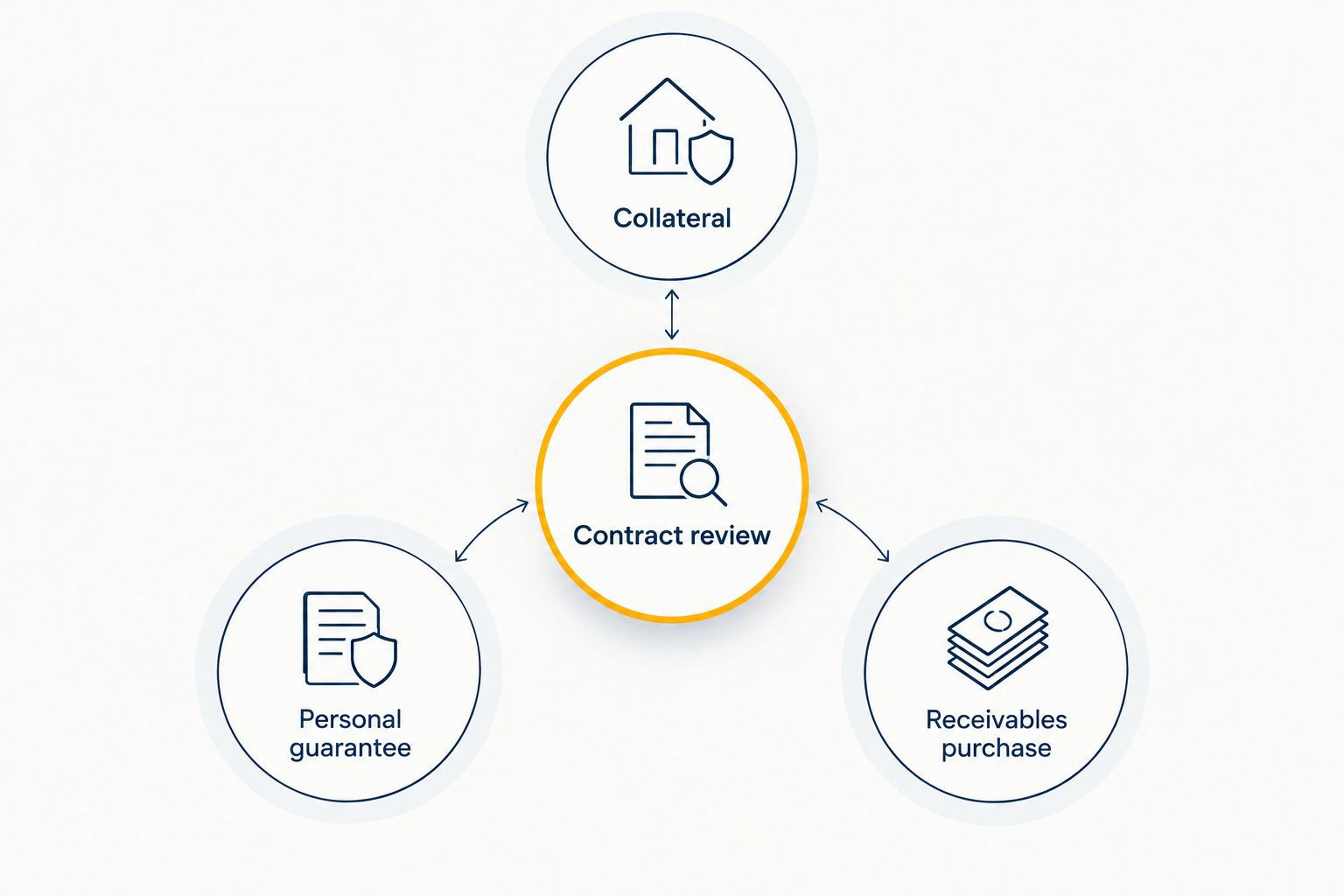
How do collateral, guarantees and receivables purchases differ?
These terms answer different questions. Review each separately before treating an offer as unsecured.
- Collateral: Assets subject to a contractual security interest. Review the description of the assets and the creditor’s rights after default.
- Personal guarantee: An owner’s contractual promise to meet specified obligations. Read its scope, triggers and any limitations rather than assuming every guarantee works alike.
- Receivables purchase: A transaction structured around purchasing future business receivables rather than lending money. Review delivery obligations and the provisions governing changes in revenue.
A merchant cash advance, or MCA, can be structured as a purchase of future receivables. Revenue-based financing can also use that structure. Neither label proves that the agreement lacks a security interest, a guarantee or restrictive covenants.
A UCC financing statement is a public filing associated with a claimed security interest; it is not a substitute for reading the security agreement. Ask which assets are covered, how an existing filing affects the proposed transaction and what releases are required when obligations end.
How should you compare repayment obligations in 2026?
Start with the amount your business actually receives, then identify every required payment or receivables-delivery obligation. Ask for the schedule, contractual charges, deductions from proceeds and early-payoff terms in writing. A headline rate does not answer those questions.
A factor rate is a multiplier used to calculate a contractual amount from a funding amount. APR is an annualized measure that accounts for applicable financing charges and payment timing. A factor rate is not APR, and subtracting the original funding amount does not produce an annualized rate.
Use the guide to compare factor rates on a merchant cash advance when that structure appears in your offers. For a receivables purchase, also distinguish the contractual purchased amount from the actual timing of collections.
Ask whether early completion reduces your obligation or leaves it unchanged. Compare offers over the period you realistically expect to use the capital, and do not assume that paying sooner creates savings unless the agreement says so.
Which alternative fits the funding need?
A 2026 comparison should include structures that match the purpose of the funding, not just offers advertised as unsecured. A recurring cash-flow gap, an equipment purchase and a delayed customer invoice are different financing problems.
| Funding structure | Best for | Advantage to evaluate | Risk or limitation to review |
|---|---|---|---|
| Business line of credit | Recurring working-capital needs | Access to draws under an approved facility | Draw restrictions, renewal terms, fees and guarantees |
| Term loan | A defined expense with a planned repayment period | A stated borrowing and repayment structure | Payments remain due under the agreement despite weaker sales |
| Equipment financing | Acquiring business equipment | Financing tied to the asset being acquired | Security interests and remedies affecting the equipment |
| Invoice factoring | Businesses with eligible customer invoices | Converting receivables into working capital | Recourse, customer notification and invoice eligibility |
| Future-receivables purchase | Businesses comparing funding tied to future receipts | A structure based on purchased receivables | Remittance mechanics, reconciliation and default provisions |
These are comparison categories, not recommendations for every applicant. Qualification, documentation, cost and timing depend on the actual provider and program.
Choose the structure that funds the business need without creating an unaffordable cash obligation. If waiting for another option protects your cash flow and the business can tolerate the delay, waiting is a valid decision.
Why does unsecured business funding risk vary?
The unsecured label leaves several questions unanswered. Risk varies with the following contract and business factors:
- Payment frequency: Frequent withdrawals affect the cash available between customer receipts.
- Repayment source: Collected revenue is different from projected sales or an unsigned contract.
- Owner obligations: Personal guarantees change who bears specified contractual exposure.
- Security interests: The agreement determines whether business assets secure obligations.
- Existing funding: Other payments and contractual restrictions affect capacity for additional obligations.
- Adjustment rights: Receivables-based arrangements require close review of reconciliation procedures and revenue-change provisions.
Test the proposed obligation against your actual cash calendar. A business can show positive monthly results while running short when payroll, taxes and funding withdrawals fall before customer payments arrive.
Does unsecured funding protect your personal assets?
Unsecured funding does not automatically protect your personal assets. A personal guarantee can expose an owner to claims under its terms, and an unsecured creditor can seek legal remedies after default.
An LLC or corporation does not erase a guarantee you sign personally. Have counsel explain the guarantee, enforcement provisions and governing law before signing if owner exposure is material to your decision.
Is a secured loan always the safer choice?
A secured loan is not always the safer choice. Pledging an asset essential to operations creates a different downside from accepting unsecured debt, even if the secured loan’s repayment schedule fits better.
Ask what happens to the business if the pledged asset becomes unavailable after enforcement. Then compare that operational exposure with the unsecured offer’s cash-flow burden and owner obligations.
Does revenue-based financing adjust automatically when sales fall?
Revenue-based financing does not automatically mean every payment adjusts when sales fall. The agreement determines whether remittances vary directly with receipts or whether an adjustment requires a reconciliation request.
For a future-receivables purchase, inspect the reconciliation process, supporting-document requirements and default triggers. Do not treat a fixed withdrawal as revenue-sensitive merely because the product name includes revenue.
When should you reject or pause a funding offer?
Pause a 2026 funding decision when you cannot explain how the business will meet the obligation without taking another financing product. A planned repayment source should be identifiable and supported by operating records, not just optimism about future sales.
Warning signs that require resolution include:
- The agreement’s security provisions conflict with an unsecured sales pitch.
- Required withdrawals compete with essential payroll or tax obligations.
- A personal guarantee is broader than you understood.
- New funding violates restrictions in an existing agreement.
- You need another advance to cover the proposed obligation.
- Reconciliation, default or early-completion provisions remain unclear.
These issues are reasons to stop and ask questions, not proof that every offer in the category is unsuitable. Do not sign until the written terms answer the risk you are trying to avoid.
What documents should you review before comparing offers?
Organize the records that show how cash enters and leaves the business. A provider’s final document requirements depend on its program, so confirm the current list before submitting an application.
Prepare:
- Business bank statements showing deposits, withdrawals and existing funding payments.
- Current financial records identifying operating expenses and outstanding obligations.
- Existing funding agreements and information about security interests.
- A clear business purpose and the intended repayment or receivables-delivery source.
- Customer invoices, contracts or purchase orders when relevant to that purpose.
- Ownership and business-identification information requested by the provider.
Next, put each offer on the same comparison sheet. Record proceeds received, total contractual obligations, payment frequency, expected duration, security interests, guarantees and default triggers.
For variable arrangements, document how the collection estimate was calculated and what happens when actual receipts differ. Keep quoted terms separate from final approved documents, and compare the final agreement again before signing.
What should a cash-flow review include?
Build the review around collection dates rather than invoice dates. Include payroll, rent, taxes, supplier payments and every existing funding obligation before adding the proposed one.
Then examine a weaker collection period using your business’s own history. If a customer pays late, determine which obligations still come due and whether available cash covers them. Do not use a funding provider’s maximum offer as your borrowing target.
Also identify the exit. A short-term obligation should have a credible completion path; refinancing is not certain, and another provider can decline a future application.
Who provides the funding and makes the decision?
Jon Lynch Financial Group is a broker, not a direct lender. Third-party lenders and funders underwrite the business, determine available terms and provide funding under their own agreements.
Products discussed here are for business purposes. Approval, amounts, rates, decisions and funding times are not promised; the provider’s underwriting and product terms control the outcome.
A brokerage comparison helps you examine alternatives, but it does not eliminate repayment, collateral or contractual risk. Obtain legal advice on guarantees, security interests and receivables-purchase provisions when those obligations require interpretation.
FAQ
Is unsecured business funding risky for a small business?
Unsecured business funding creates risk when payment obligations exceed available cash or contract terms expose the owner to obligations they did not understand. Compare repayment, guarantees, security interests and default terms before choosing.
Can an unsecured business loan have a personal guarantee?
Yes, an unsecured business loan can include a personal guarantee. Unsecured describes the absence of a contractual security interest, not the absence of owner liability.
Can a secured business loan also require a personal guarantee?
Yes, a secured business loan can include both collateral and a personal guarantee. Review each obligation separately because they address different sources of recovery.
Is a merchant cash advance the same as an unsecured loan?
No, a merchant cash advance can be structured as a purchase of future receivables rather than a loan. The agreement determines security interests, guarantees, remittance requirements and reconciliation rights.
Does a bank decline mean unsecured funding is my only option?
No, a bank decline does not establish that unsecured funding is your only option. Review the reason for the decline and compare structures that fit your cash flow, assets and receivables.
Does meeting the monthly revenue audience mean I qualify?
No, generating at least $35,000 per month identifies Jon Lynch Financial Group’s primary business funding audience, not guaranteed qualification. Third-party underwriting determines available options.
What should I ask before signing a business funding agreement in 2026?
Ask what the business receives, what it must pay or deliver, when obligations fall due and what happens after default. Also confirm guarantees, security interests, adjustment rights and early-completion terms in the final agreement.
Related guides
- Compare fast unsecured working-capital offers
- Business funding without a personal guarantee
- Revenue-based financing versus merchant cash advance
What is the next step?
The overlooked question is not whether funding is secured. It is whether the contract protects the specific thing you cannot afford to lose: operating cash, essential equipment or personal financial capacity.
For your 2026 decision, write that priority down before requesting offers. Businesses generating at least $35,000 per month should use Compare Business Funding Options; businesses below that monthly revenue should use Explore Self-Serve Funding through Jon Lynch Financial Group’s tech-forward route for U.S.-based entrepreneurs.
Choose your business funding route
Compare contract obligations and cash-flow fit before choosing funding.



