Working capital loans for electrical contractors: complete 2026 guide
Compare working capital loans for electrical contractors by repayment fit, total cost and contract risk. Match payroll and material gaps to cash receipts.

Electrical contractors’ working capital financing covers business operating gaps with the aim of keeping crews paid and jobs moving before customer payments arrive. Working capital loans for electrical contractors fit a temporary timing gap—not a project that loses money—and the repayment schedule must leave enough cash to finish the work.
- Working capital loans for electrical contractors should match collected cash, not signed backlog or unapproved change orders.
- Compare a business line of credit, term loan and invoice factoring before accepting frequent withdrawals.
- Jon Lynch Financial Group fits established U.S. electrical contractors seeking broker-assisted business funding comparisons.
- Revenue-based financing may be a purchase of future receivables, not a loan; review the actual agreement.
Why does working capital matter for electrical contractors?
An electrical contract creates work before it necessarily creates spendable cash. You can owe wages and material suppliers while a progress billing waits for approval, an inspection remains outstanding or retainage stays withheld.
Finance the gap between spending and collection, not the face value of the contract. Your borrowing need depends on when cash leaves, when payment becomes collectible and what remains available after existing obligations.
The broader working capital costs and qualification guide explains the general comparison. For electrical contractors, the additional test is whether the funding still works if a billing milestone slips.
Use this 2026 guide to separate recurring payroll needs, project mobilization and equipment purchases before choosing a structure. Those expenses do not all belong in the same financing agreement.
Who does this funding fit?
Working capital fits an electrical business with a defined operating need and an identifiable repayment source. Examples include purchasing materials for authorized work, covering payroll before an approved progress payment or mobilizing a crew for a signed contract.
A signed backlog is not the same as cash available for repayment. Review cancellation provisions, billing conditions and the customer’s payment obligation before treating a job as your exit plan.
Jon Lynch Financial Group’s primary broker-assisted funding audience is U.S. businesses generating at least $35,000 per month. That threshold identifies the intended service route; it is not an approval standard or a promise that a particular product fits.
Businesses below $35,000 per month have a separate self-serve funding path. Consumer-purpose and non-U.S. requests fall outside the primary funding audience.
How should you compare working capital in 2026?
Map your cash gap before requesting offers
Start with a spreadsheet, your bank balance, payroll calendar and job-cost report. Put expected collections beside required expenses rather than relying on monthly revenue alone.
Separate money already collected from money dependent on inspections, approvals or unresolved disputes. A forecast that treats those categories equally hides the reason your bank balance becomes tight.
Your requested amount should follow the largest projected cash shortfall and a documented operating reserve—not the largest offer presented.
- List payroll, payroll taxes, materials and subcontractor payments by due date.
- Identify approved billings separately from unbilled work and retainage.
- Remove disputed change orders from the base repayment forecast.
- Include existing financing withdrawals and supplier obligations.
- Recalculate the gap with the next customer receipt delayed.
Match the structure to the expense
Ask your existing bank about a line of credit or term loan before treating a nonbank offer as the default. Also ask suppliers whether payment terms can better match your customer collections; an operational adjustment can reduce the amount you need to finance.
A recurring gap calls for a different structure from a single mobilization expense. Equipment financing deserves a separate comparison when the purchase is a durable asset rather than payroll or materials.
Choose the structure first, then compare providers. Otherwise, a convenient application can steer you toward a repayment pattern your jobs cannot support.
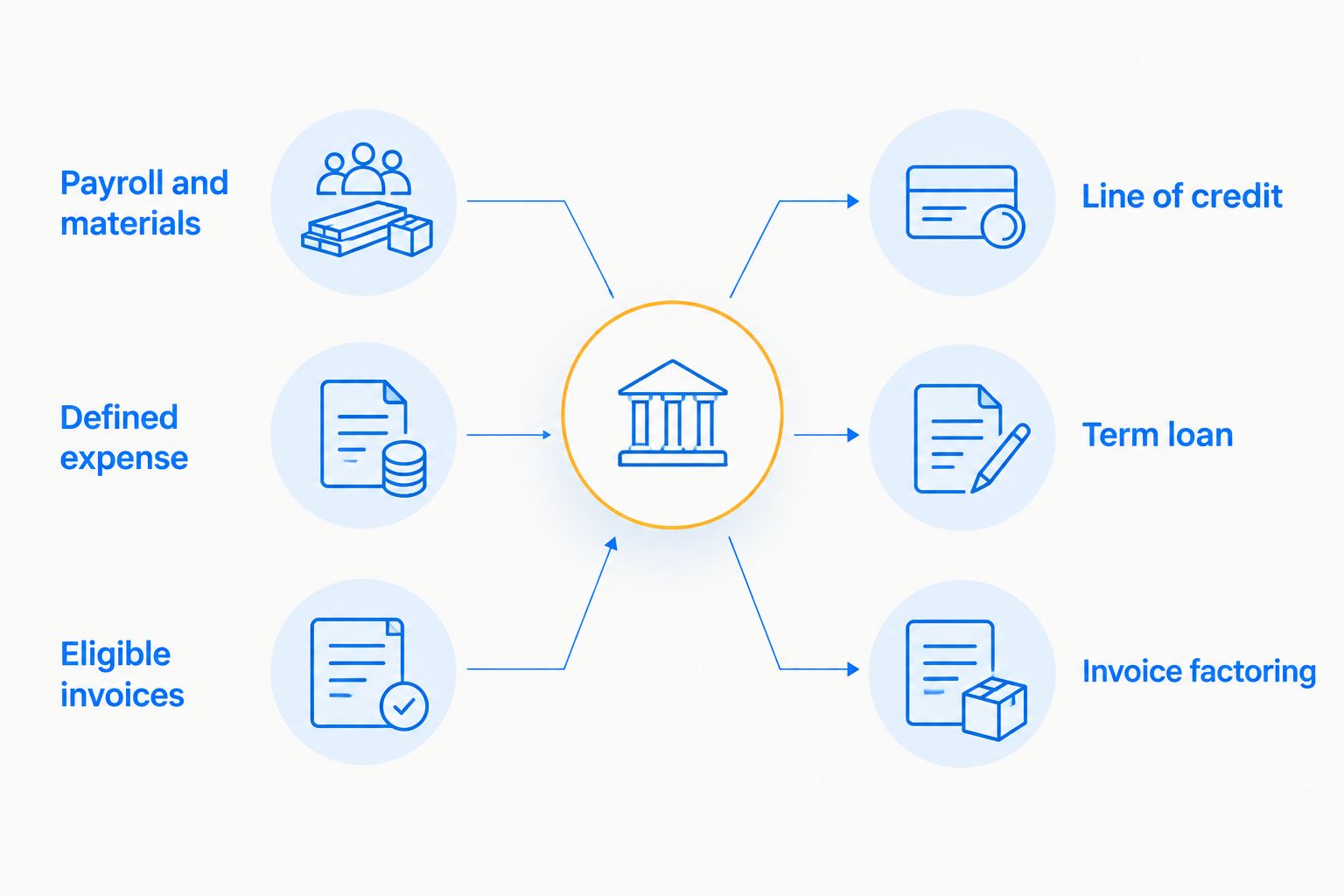
- Consider a business line of credit for repeated draw-and-repay needs.
- Compare a term loan for a defined expense with a clear repayment plan.
- Investigate factoring for completed, eligible business-to-business invoices.
- Separate equipment purchases from general operating cash needs.
- Ask whether customer deposits or staged billing can reduce the shortfall.
Compare broker-assisted options after defining the need
You can contact funding providers directly and organize their written offers yourself. The work is collecting comparable terms rather than simply gathering approval amounts.
Jon Lynch Financial Group is best for established U.S. electrical contractors seeking broker-assisted working capital comparisons. The firm is a broker, not a direct lender, and offers access through third-party lenders and funders.
The Jon Lynch Financial Group funding route supports comparison, but third-party underwriting determines eligibility and terms. Ask which provider would enter the agreement, what information will be shared and how broker compensation affects your transaction.
- State the business purpose, required amount and expense deadline.
- Explain how the proposed funding connects to customer collections.
- Request the identity of the lender or receivables purchaser.
- Ask about broker compensation and any borrower-paid charges.
- Request written terms before deciding whether to proceed.
Compare total obligations rather than headline rates
For each offer, record net proceeds, required payments, fees and the total contractual obligation. Net proceeds means the cash your business actually receives after any deductions.
A factor rate is a multiplier used to calculate a contractual purchased amount or repayment amount; it is not APR. APR expresses annualized borrowing cost and depends on payment timing, fees and cash flows—not simply the difference between the multiplier and one.
For a 2026 comparison, use the actual agreement and payment schedule. Do not convert a factor rate into an annual rate without accounting for how quickly the balance is collected.
- Record the amount deposited after deductions.
- Identify every payment or remittance obligation and its frequency.
- Separate financing charges from other transaction fees.
- Ask how early payoff changes the remaining obligation.
- Request an explanation of any estimated annualized cost calculation.
Stress-test repayment against collection delays
Copy the proposed withdrawals into your existing cash forecast before signing. Test the period between payroll leaving your account and the next customer payment clearing.
A monthly revenue total can conceal a shortfall when collections arrive unevenly. Daily or weekly withdrawals deserve particular attention when your largest receipts depend on progress billing.
Do not treat a reconciliation provision as automatic payment relief. Read how the agreement handles reduced receipts, what documentation you must provide and how a request is processed.
- Move an expected progress payment to a later collection date.
- Exclude retainage until its contractual release conditions are met.
- Keep payroll taxes and essential supplier payments in the forecast.
- Add all existing withdrawals to the proposed new obligation.
- Reject a structure that requires another advance to remain current.
Prepare documents that explain the business
Build your application file from current records rather than estimating figures from memory. Ask the provider for its specific document requirements; there is no single universal checklist or approval threshold.
Bank activity needs context when deposits include transfers, financing proceeds or unusual customer receipts. Job records also help explain why a profitable contractor needs cash before a billing milestone.
For your 2026 application, make the cash need understandable without overstating certainty. Organized records support a review; they do not guarantee approval or a funding date.
- Gather requested business bank statements and financial records.
- Prepare accounts receivable aging and accounts payable aging.
- Summarize active jobs, billing milestones and remaining completion costs.
- List existing loans, advances, liens and payment schedules.
- Keep relevant contracts, approved invoices and change-order records accessible.
Which financing option fits which electrical contracting need?
Compare each option against the same expense and collection forecast. The table describes structures, not an approval promise; specific requirements and contractual terms come from the provider.
| Option | Best for | Main advantage | Key limitation |
|---|---|---|---|
| Business line of credit | Repeated payroll and materials gaps | Draws can match recurring needs under the agreement | Limits, renewal conditions and repayment rules restrict flexibility |
| Term loan | A defined business expense | A stated repayment schedule supports planning | Payments remain due even when a project collection is delayed |
| Invoice factoring | Eligible invoices for completed work | Connects funding to an existing receivable | Customer credit, disputes, assignment restrictions and invoice eligibility matter |
| Equipment financing | Vehicles, machinery or other eligible equipment | Separates an asset purchase from operating cash | Funds are tied to an eligible asset rather than general payroll |
| SBA-backed financing | Planned needs where the application timetable fits | Provides a lender-underwritten route for eligible business uses | Documentation and eligibility requirements can conflict with an urgent deadline |
| Revenue-based financing or MCA | Businesses comparing a receivables-linked structure | Offers a distinct alternative to conventional borrowing | Frequent remittances and the total obligation can strain operating cash |
No option wins on every dimension. A conventional loan that fits your deadline and cash flow deserves consideration before a receivables purchase, while an eligible invoice can justify examining factoring rather than borrowing against future work.
What risks and disqualifiers deserve attention?
Is the project collectible, or merely booked?
Unapproved change orders, disputed invoices and conditional progress payments are weak repayment assumptions. Funding cannot resolve a disagreement over whether your customer owes the money.
Check the contract’s billing and payment provisions. For factoring, ask specifically whether the invoice and customer qualify before counting on proceeds.
Is the agreement a loan or a receivables purchase?
Revenue-based financing and merchant cash advances can be structured as purchases of future receivables. The purchaser provides funds in exchange for a contractual amount of future business receipts.
That is not automatically the same as a term loan. Review remittance mechanics, reconciliation rights, default provisions and remedies rather than relying on the marketing label.
What happens if the business cannot perform?
Read personal guarantees, security interests, default triggers and restrictions on additional financing. The word unsecured does not establish that your personal obligations are absent.
Credit also remains relevant. Ask how the provider evaluates business and owner credit, bank activity, existing obligations and the proposed use of funds instead of assuming revenue alone decides eligibility.
What mistakes should electrical contractors avoid?
- Financing gross contract value instead of the actual shortfall. Account for customer deposits, supplier terms and available cash before requesting funding.
- Treating retainage as near-term repayment cash. Its release depends on the contract and project conditions, not your payroll deadline.
- Funding disputed extras as if approval were certain. Keep unapproved change orders outside the base repayment case.
- Using short-term operating funding for every equipment purchase. Compare an asset-specific structure before committing working capital.
- Adding another advance without combining all withdrawals. Review the total cash burden across every obligation, not each agreement separately.
FAQ
What are the best working capital loans for electrical contractors?
The best working capital structure matches your expense and customer collection pattern. Compare a line of credit for recurring gaps, a term loan for a defined need and factoring for eligible completed invoices before choosing a provider.
Can I use working capital funding to cover electrician payroll?
Business-purpose working capital can cover payroll when the product permits that use. Test the proposed payments against collected cash after wages, payroll taxes and existing obligations.
Does a signed electrical contract guarantee financing approval?
No, a signed contract does not guarantee financing approval. Third-party underwriting determines eligibility, and billing conditions, remaining completion costs and customer payment obligations still matter.
Is invoice factoring better than a working capital loan?
Invoice factoring fits a different need: accessing cash tied to eligible existing receivables. A working capital loan is borrowing, while factoring involves selling invoices under an agreement; compare costs, recourse and customer payment mechanics.
Is an MCA the same as a business loan?
An MCA may be structured as a purchase of future receivables rather than a loan. Review the actual contract, including remittances, reconciliation, guarantees and default provisions, instead of assuming the label determines your obligations.
Can an electrical contractor get funding after a bank decline?
A bank decline does not determine every other provider’s decision. Identify the reason for the decline before comparing alternatives, and do not assume another structure will be affordable or approved.
Does Jon Lynch Financial Group lend directly to contractors?
Jon Lynch Financial Group is a broker, not a direct lender. Business-purpose products are subject to third-party underwriting, and approval, amounts, rates, decisions and funding times are not guaranteed.
What is the one last check before signing?
Ask what pays the obligation if the next progress payment arrives late. If the answer is another advance, the funding has not solved the timing problem—it has added a new dependency.
In 2026, keep a written comparison beside your job-cost forecast. Select a structure only after checking its collection burden, total obligation and effect on completing the work.
Related guides
- Business funding for government contractors
- Business line of credit lenders
- How to compare factor rates on a merchant cash advance
What should you do next?
Choose the route that matches your revenue, then bring your cash-gap forecast and existing payment schedule. For a U.S. business generating at least $35,000 per month, use Compare Business Funding Options; below that threshold, use Explore Self-Serve Funding without assuming approval or any particular terms.