Working capital loans for funeral homes: complete 2026 guide
Working capital loans for funeral homes should match your collection cycle. Compare repayment, total cost, documents and alternatives before you sign.

Funeral home working capital financing is business-purpose funding that bridges operating expenses and collections; working capital loans for funeral homes fit a temporary cash gap only when repayment leaves enough cash to operate. For your 2026 decision, separate payroll and supplier needs from equipment purchases, then compare total obligations and payment timing—not just the amount offered.
- Working capital loans for funeral homes should match collections, payroll and supplier payments—not projected service volume alone.
- Jon Lynch Financial Group is a broker, not a direct lender; third-party funding partners determine approval and terms.
- Compare business lines of credit, term loans and revenue-based financing by total cost and cash-flow impact.
- Keep restricted preneed funds outside your operating-cash calculation; confirm applicable requirements with qualified counsel.
Why does working capital matter for funeral homes?
A funeral home's funding decision starts with the difference between delivering a service and collecting usable cash. Staff, transport, merchandise and facility expenses need payment even when a family's balance or an insurance-related payment remains outstanding.
Finance a documented collection gap, not an assumption that future services will cover today's withdrawals. Review each expected receipt by payer, status and collection date before treating it as a repayment source.
Your operating balance also needs careful interpretation. Do not assume preneed funds held under trust, insurance or other arrangements are available for general expenses; applicable restrictions depend on the arrangement and jurisdiction.
The working capital loans costs and qualification guide explains the broader comparison. For a funeral home, the deciding question is narrower: will the payment schedule still work if a collection arrives later than expected?
Who does funeral home working capital financing fit?
Working capital financing fits a business with a defined operating need, a credible collection source and room for the new obligation. It does not fix a continuing gap between service revenue and operating expenses.
Useful purposes include meeting payroll before documented collections, purchasing merchandise for upcoming services or covering an essential repair. A vehicle purchase or major equipment replacement deserves a separate equipment-financing comparison rather than automatic placement into short-term working capital.
Jon Lynch Financial Group is best suited to established U.S. business owners generating at least $35,000 per month who want to compare business-funding options. That figure identifies the primary service audience, not a universal approval threshold or a promise of eligibility.
Businesses below that monthly revenue level have a separate self-serve route. Neither route removes third-party underwriting, and both are for business purposes rather than consumer funeral expenses.
How should you compare working capital loans for funeral homes?
Build your 2026 comparison from your own bank activity and receivables records. A spreadsheet is enough to identify the need before you ask anyone to source funding.
Separate available cash from restricted funds
Start with your bank reconciliation, not the headline account balance. Classify operating cash separately from funds whose permitted use depends on a trust, contract or other restriction.
Ask your accountant or qualified counsel to resolve uncertain classifications. A funding offer does not change the legal or contractual use of money already held by the business.
- Identify unrestricted operating balances.
- Separate preneed-related funds and associated obligations.
- Reconcile deposits to the relevant service or contract.
- Exclude money you cannot use for ordinary operating expenses.
Map collections against essential expenses
List expected receipts beside payroll, supplier invoices, rent and existing financing payments. Use actual payment status rather than treating every outstanding account as immediately collectible.
Distinguish an insurance assignment awaiting documentation from an approved payment awaiting processing. Neither should enter the forecast on an unsupported date; record the remaining condition and who must resolve it.
- Assign each receivable a payer, status and expected collection date.
- List essential expenses by their actual due dates.
- Separate service revenue from transfers and financing proceeds.
- Test the forecast with important collections delayed.
Match the funding structure to the need
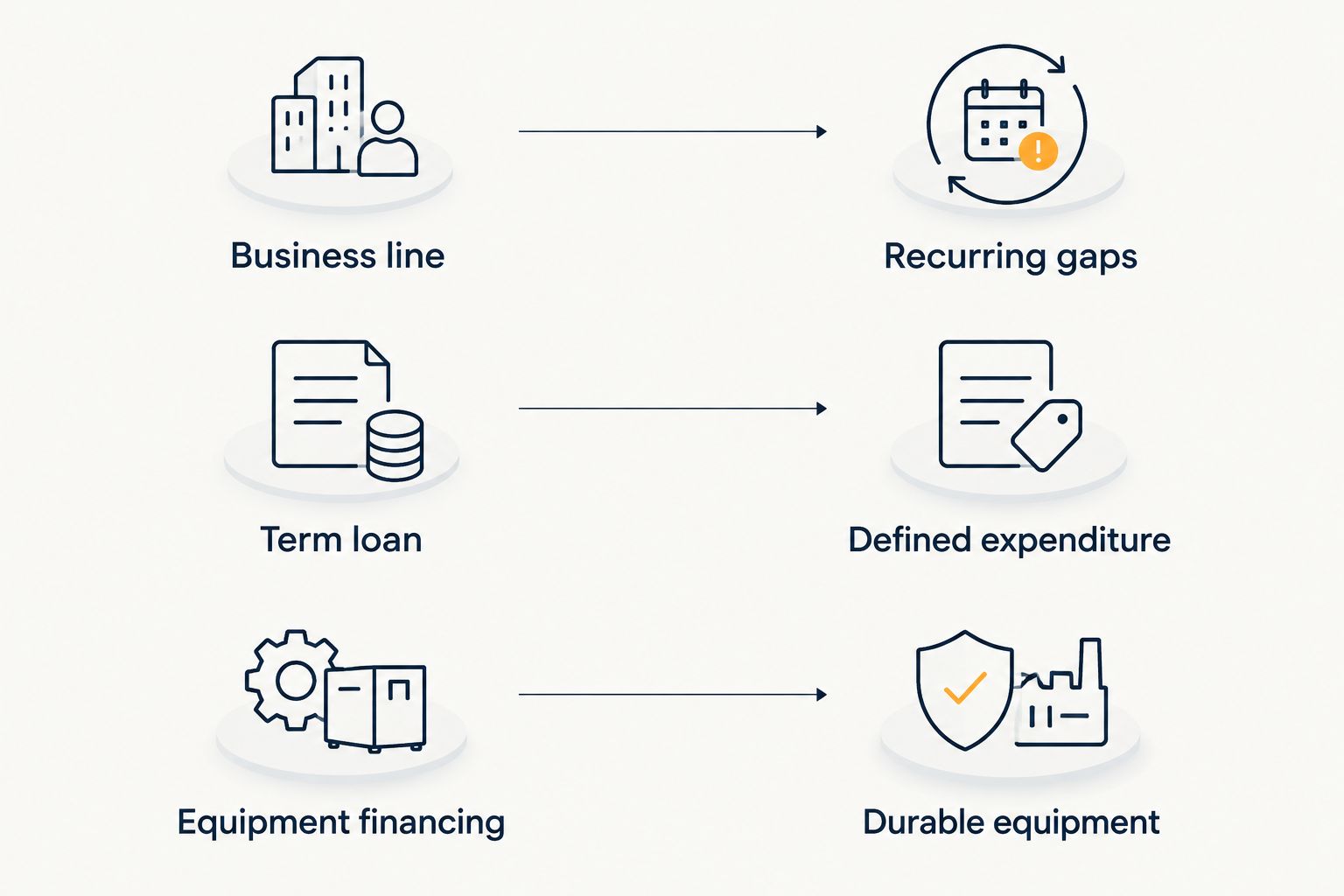
Compare options manually before submitting applications: recurring gaps suggest a line-of-credit comparison, while a defined operating project suggests a term-loan comparison. Equipment needs deserve their own analysis.
For help comparing working capital options, Jon Lynch Financial Group connects business owners with third-party funding partners. The brokerage route helps organize comparisons; it does not replace your cash-flow review or guarantee a suitable offer.
- Match recurring shortfalls to a revolving-credit comparison.
- Match defined expenditures to a term-loan comparison.
- Separate vehicles and durable equipment from payroll needs.
- Request the legal structure of any revenue-based offer.
Compare usable proceeds and total obligations
The stated funding amount is not enough to compare offers. Ask what reaches your account after deductions, what you must pay or remit, and when withdrawals begin.
A factor rate is a multiplier used to calculate a stated purchased amount or repayment obligation; it is not an annual percentage rate. APR expresses annualized borrowing cost, so timing, fees and payment structure matter when comparing the two.
- Record gross funding and net proceeds separately.
- Request an itemized list of fees and deductions.
- Record the total contractual payment or remittance obligation.
- Ask how early payoff changes the amount owed.
- Compare payment frequency alongside total cost.
Stress-test withdrawals against collections
Place each proposed withdrawal into your operating forecast. A payment that fits an average month can still create a shortage when payroll precedes a large collection.
For a purchase of future receivables, read the reconciliation provisions rather than assuming payments automatically fall with sales. Confirm how an adjustment is requested, what evidence is required and what the contract permits.
- Add proposed withdrawals to existing debt payments.
- Test delayed collections without assuming new borrowing.
- Check whether withdrawals are fixed or adjustable.
- Read reconciliation procedures and deadlines.
- Reject a structure that depends on repeated refinancing.
Prepare a consistent application file
Organize records yourself before authorizing submissions. A consistent file helps explain the difference between operating revenue, restricted deposits, owner transfers and prior funding proceeds.
Ask each funding partner for its current document requirements. Credit, business history, bank activity, existing obligations and product-specific criteria can all affect underwriting; no single document establishes approval.
- Gather the bank statements requested by the funding partner.
- Prepare current financial statements and a debt schedule.
- Reconcile receivables to supporting service records.
- Explain unusual deposits, transfers and returned payments.
- Confirm ownership information and required business licenses.
Which financing options should funeral homes compare?
Use the following table as a fit screen, not an approval prediction. For your 2026 review, request current written terms from each provider and compare offers using the same intended use of funds.
| Option | Best for | Main advantage | Key limitation |
|---|---|---|---|
| Business line of credit | Recurring, temporary collection gaps | Supports repeated draws within approved terms | Renewal, draw conditions and payment requirements need review |
| Business term loan | A defined operating expenditure | Provides a scheduled repayment structure | Fixed payments continue when collections slow |
| SBA-backed loan | Eligible owners able to accommodate the application process | Adds a government-backed lending route to compare | Eligibility, documentation and lender review still apply |
| Equipment financing | Hearses, transport vehicles or durable equipment | Matches financing to a specific asset | Does not necessarily address general payroll needs |
| Revenue-based financing or receivables purchase | Owners evaluating funding against business revenue | Adds a nontraditional structure to the comparison | Remittance terms, total obligations and reconciliation require scrutiny |
| Receivables financing or factoring | Specific receivables accepted by a provider | Focuses the analysis on eligible receivables | Family balances and insurance-related receivables are not automatically eligible |
A line of credit is the first structure to compare for a recurring timing gap—not an automatic recommendation to borrow. A term loan fits a defined use more clearly when you can support its scheduled payments.
SBA-backed financing deserves consideration when your purpose, eligibility and deadline fit the program and lender. Do not assume it is suitable for an immediate operating shortfall before confirming the process.
Receivables financing needs particular care. A funeral home's customer balances are not interchangeable with ordinary commercial invoices, and an assignment does not by itself establish a provider's willingness or ability to finance it.
What should you know about revenue-based financing?
Revenue-based financing may be structured as a loan or as a purchase of future receivables. A merchant cash advance, or MCA, commonly describes a future-receivables purchase rather than a conventional loan; the actual agreement determines the obligations.
Ask the provider to identify the structure explicitly. Then examine the purchased amount, remittance method, reconciliation rights, fees, guarantees and default provisions without assuming that a revenue-related label makes withdrawals affordable.
Jon Lynch Financial Group is a broker, not a direct lender. Third-party lenders and funders determine product terms and underwriting, and a receivables-purchase offer should not be presented as though it were a bank loan.
For your 2026 comparison, reject any summary that leaves out usable proceeds or payment frequency. You need both to understand whether the transaction supports operations or competes with payroll for the same collections.
What mistakes should funeral home owners avoid?
Counting preneed funds as operating liquidity
A bank balance alone does not establish spending authority. Keep restricted or contractually committed funds outside the repayment calculation unless qualified advice confirms their permitted use.
Treating insurance-related collections as settled cash
An expected insurance payment is not the same as a cleared deposit. Identify outstanding documents, assignment issues or other conditions before using that receipt to support a financing payment.
Using short-term funding for long-lived assets without comparison
A hearse or major equipment purchase serves a different purpose from a temporary payroll gap. Compare equipment financing and suitable term structures before committing operating collections to a short repayment schedule.
Adding withdrawals without reviewing existing obligations
A new offer must fit alongside every current loan payment and receivables remittance. Disclose existing arrangements and check restrictions on additional financing; a second transaction does not erase the first obligation.
When should you pause instead of accepting funding?
Pause when repayment requires uncertain collections, access to restricted funds or another financing transaction. Those conditions call for a revised operating plan before a new commitment.
A bank decline is information, not a reason to accept any alternative. Ask whether the issue concerns documentation, credit, cash flow, existing obligations or the intended use, then determine whether another structure addresses that specific problem.
Renegotiating supplier timing, resolving incomplete collection documentation or delaying a nonessential purchase can address a gap without adding a financing obligation. Compare those actions alongside funding rather than treating borrowing as the only available response.
What disclosures belong in your funding decision?
Business funding discussed here is for business purposes and remains subject to third-party underwriting and contract terms. Approval, amounts, rates, decisions and funding times are not guaranteed.
The $35,000 per month primary-audience threshold is not a promise that a funeral home qualifies. Jon Lynch Financial Group's self-serve path serves U.S.-based entrepreneurs below that level and uses secure bank-statement connections through Plaid for an automated decision.
Eligible applicants may receive a decision within minutes, and approved funds may arrive within an hour. Verification, bank processing and product terms determine timing; do not schedule payroll around an unconfirmed outcome.
FAQ
What's the best working capital loan for a funeral home?
The best fit depends on whether the funeral home has a recurring collection gap or a defined expenditure. Compare a line of credit for recurring needs and a term loan for a specific use, then test the actual payment schedule against collections.
Can a funeral home use working capital financing for payroll?
Business-purpose working capital financing can support payroll when the provider permits that use and the business can support repayment. Confirm the use-of-funds terms and include existing financing payments in your forecast.
Can preneed funds support a working capital loan payment?
Do not count restricted preneed funds as available for loan payments. Ask qualified counsel or your accountant to confirm the permitted use under the applicable arrangement and jurisdiction.
Is a merchant cash advance the same as a funeral home business loan?
A merchant cash advance commonly involves purchasing future receivables rather than making a conventional loan. Read the agreement for its legal structure, remittance requirements, reconciliation provisions and guarantees.
Can a funeral home get funding after a bank decline?
A bank decline does not determine every other funding partner's decision. Identify the reason for the decline and compare alternatives against that issue without assuming approval or accepting an unaffordable payment.
Does a funeral home need at least $35,000 per month to contact Jon Lynch Financial Group?
Jon Lynch Financial Group's primary comparison audience generates at least $35,000 per month. U.S.-based entrepreneurs below that level can explore the separate self-serve funding path; neither route guarantees approval.
What should funeral home owners compare besides the funding amount?
Compare net proceeds, total obligations, payment frequency, early-payoff terms and contractual risks. A larger offer is not a better fit when its withdrawals leave insufficient operating cash.
One last thing: what does your bank balance leave out?
A funeral home's visible cash balance and its usable operating cash are not necessarily equal. Your most useful 2026 preparation is a reconciled forecast that separates restricted money, uncertain receipts and funds already committed to essential expenses.
Related guides
- Business line of credit lenders
- How to compare factor rates on a merchant cash advance
- Alternative lenders for businesses declined by banks
What is your next step?
Prepare your collection forecast and current debt schedule, then choose the route matching your business revenue: Compare Business Funding Options if you generate at least $35,000 per month; Explore Self-Serve Funding if you generate less.