Working Capital Loans for Tire and Auto Shops 2026
Compare working capital loans for tire and auto service shops in 2026: lines of credit, term loans and revenue-based financing, with real factor rate math.

Working capital loans for tire and auto service shops cover the gap between paying for tires, parts and payroll today and collecting from customers over the next 30 to 60 days. A tire and auto shop's biggest cash drain is inventory sitting on the shelf, not slow-paying customers, which changes which funding structure actually fits.
- Working capital loans for tire and auto service shops range from bank lines of credit to revenue-based financing structured as a purchase of future receivables.
- Shops generating at least $35,000 a month in revenue typically qualify for a full comparison across products; smaller shops have a faster self-serve path.
- A factor rate of 1.30 on a $40,000 advance means $52,000 in total payback, regardless of how fast the shop repays it.
- Jon Lynch Financial Group is a broker, not a direct lender, and compares structures by total cost, timing and repayment before recommending one.
Why this matters for tire and auto service shops
A tire and auto service shop ties up cash in inventory that a service-only business never has to carry. Buying a truckload of tires ahead of a seasonal swap, stocking common OEM parts, or covering a payroll cycle while a fleet account pays net-30 all create the same problem: cash out now, cash in later.
Bank term loans move slowly and often require two years of tax returns most independent shops can't produce cleanly. That's why shop owners search for working capital loans for tire and auto service shops instead of a standard business loan — they need a structure that matches how a repair bay actually makes money, day by day, ticket by ticket.
Diagnose your cash flow gap before you apply
Most shops that apply for funding haven't actually isolated what's causing the gap. "I need cash" is not a plan; "I need $35,000 to restock tires before the fall swap" is.
- Separate inventory cash (tires, batteries, filters) from payroll cash
- Flag seasonal swings — spring and fall tire changeover months versus slow summer stretches
- Note any fleet or commercial accounts paying on 30- to 60-day terms
- Check whether the gap is one-time (a big fleet contract) or recurring (every payroll cycle)
- Estimate the exact dollar amount and the exact date you need it by

Pull your bank statements and know your real numbers
Every funding conversation for a tire and auto shop starts with three to six months of business bank statements, whether the path is a bank line or revenue-based financing.
- Average daily balance across the last 90 days
- Number of negative-balance days, if any
- Monthly deposit volume from card and cash sales combined
- Any existing MCA or loan payments already coming out daily or weekly
- Whether the account shows seasonal deposit swings tied to tire season
A shop with $60,000 in average monthly deposits and no existing daily debits looks very different to an underwriter than one already repaying two stacked advances — the second shop needs a working capital loan cost and qualification review before adding anything new.
Match the funding structure to the need
A one-time equipment purchase, a recurring payroll gap, and an emergency fleet contract mobilization are three different problems, and they call for three different structures.
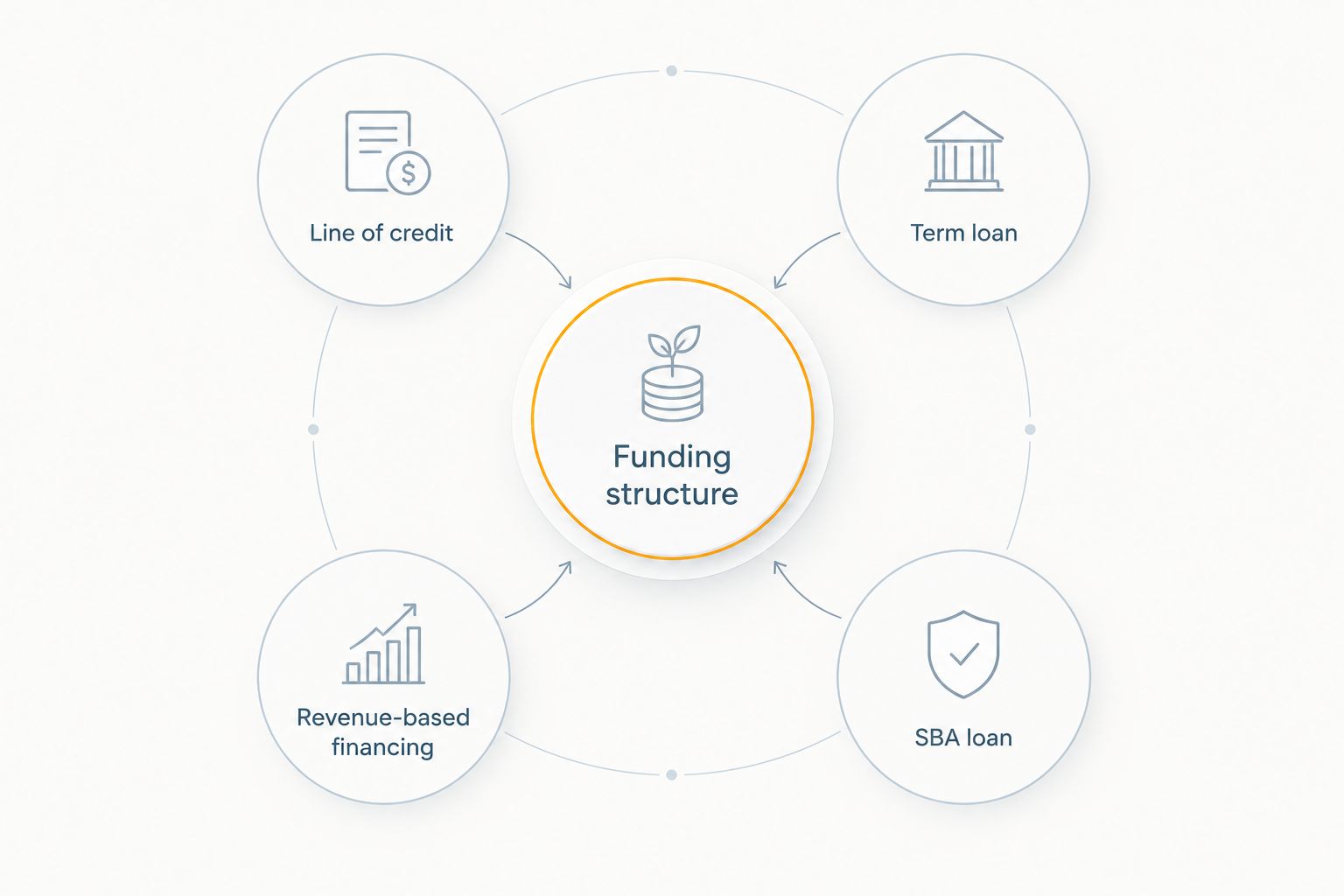
- Revolving need (seasonal restocking, ongoing parts float): a business line of credit for auto repair shops that you draw and repay repeatedly
- One fixed purchase (a new lift, an alignment machine): a term loan sized to the asset
- Fast cash after a bank decline or thin credit file: revenue-based financing, structured as a purchase of future receivables rather than a loan
- Larger buildout or a second bay: SBA financing, with a longer approval timeline in exchange for lower total cost
Compare total cost, not just the headline rate
Revenue-based financing is priced with a factor rate, not an APR, and the difference changes how much a shop actually pays back.
A factor rate of 1.30 on a $40,000 advance means $52,000 in total payback — that number doesn't change if the shop repays it in 90 days or 150 days, because factor rate math isn't amortized like a loan. Compare that to a bank line of credit charging interest only on the drawn balance, where paying it back faster genuinely lowers the total cost. Before signing anything, run the factor rate comparison against an effective APR so the numbers are apples to apples.
A tire shop comparing a $40,000 line of credit against a $40,000 advance at a 1.30 factor rate is comparing two structurally different products, not two prices for the same thing.
Check qualification requirements before you apply
Qualification for tire and auto shop funding in 2026 depends more on cash flow consistency than personal credit score alone.
- Monthly revenue, generally $35,000 or more, opens the door to the fullest set of options
- Time in business — most funders want at least six months of operating history
- Bank statement consistency, not a specific FICO cutoff
- Existing daily or weekly debits from other advances, which lower how much new capital a shop can carry
- Business entity type and whether the shop is franchised or independently owned
Credit still matters, but it isn't disqualifying on its own — a thin file with strong, consistent deposits often outperforms a good score with erratic cash flow.
Put the capital where it changes revenue
Capital that sits in the operating account doesn't fix anything; capital tied to a specific revenue-driving purchase does.
- Restock tires ahead of the spring or fall swap instead of during it
- Cover payroll through a slow stretch without cutting technician hours
- Add a lift or alignment rack that lets the shop take on jobs it currently turns away
- Fund a fleet contract's first 30 to 60 days before the account starts paying
Avoid stacking positions on top of each other
Stacking a second or third advance on top of an existing one is the fastest way for a tire shop to go from a manageable cash gap to a daily-debit problem that outpaces revenue.
- Know the exact daily or weekly debit amount already leaving the account
- Calculate combined debits as a percentage of average daily deposits
- Ask whether a consolidation or restructure beats adding a new position
- Get a second opinion before signing a stacked advance under time pressure
Comparing the options side by side
| Option | Best for | Typical funding speed | Key limitation |
|---|---|---|---|
| Business line of credit | Recurring tire and parts restocking | Days to a few weeks | Needs stronger credit and full underwriting |
| Term loan | One fixed purchase like a lift or alignment rack | Days to weeks | Fixed payment regardless of a slow month |
| Revenue-based financing (purchase of future receivables) | Fast cash after a bank decline or thin file | Often within 24-48 hours | Priced by factor rate, higher total cost than a line |
| SBA loan | Shop expansion or a second bay buildout | Weeks to months | Slowest approval, heaviest documentation |
Common mistakes tire and auto shops make
- Treating a factor rate like an interest rate — a 1.30 factor rate is not "30% APR," and comparing it that way hides the real cost
- Applying without three months of clean bank statements ready — this alone delays most approvals by days
- Timing the draw for the middle of tire season instead of 30-60 days ahead — by the time cash arrives, the restocking window has already passed
- Stacking a second advance to cover payments on the first — this compounds the daily debit instead of solving the shortfall
- Ignoring a business line of credit because the shop assumes its credit is too thin — many shops qualify for a smaller line than they expect and never ask
Compare Business Funding Options
See how a line of credit, term loan and revenue-based financing stack up for your shop.
FAQ
What is the best working capital option for tire and auto service shops in 2026?
There is no single best option — a business line of credit fits recurring inventory restocking, a term loan fits a one-time equipment purchase, and revenue-based financing fits a fast, urgent need after a bank decline. The right fit depends on the shop's revenue, timeline and existing debt.
How fast can an auto repair shop get business funding?
Revenue-based financing can sometimes fund within 24-48 hours after bank statement review; bank lines of credit and SBA loans take longer because of fuller underwriting. Actual timing depends on verification, bank processing and the specific product's terms.
Is a merchant cash advance the same as a loan?
No. A merchant cash advance is typically structured as a purchase of future receivables, not a loan, and it's priced using a factor rate rather than an APR. Jon Lynch Financial Group is a broker, not a direct lender, and can explain how a specific offer is structured before a shop signs it.
Can a tire shop get a business line of credit with average credit?
Average personal credit doesn't automatically disqualify a shop — consistent bank deposits and time in business carry significant weight in underwriting. A thin credit file paired with steady cash flow often qualifies where a strong score with erratic deposits does not.
How much revenue does an auto service shop need to qualify for full funding comparison?
Shops generating at least $35,000 per month in revenue generally have access to the fullest range of working capital options. Shops below that level typically have a faster, tech-forward self-serve path instead.
What's the difference between a term loan and a business line of credit for an auto shop?
A term loan delivers a lump sum with a fixed repayment schedule, best for a single purchase like a lift or alignment machine. A line of credit is revolving — draw it, repay it, draw it again — which fits recurring tire and parts restocking better.
Does JLFG lend directly to tire and auto shops?
No. Jon Lynch Financial Group is a commercial finance brokerage, not a direct lender, and compares offers from third-party funding partners on total cost, timing, qualification and repayment.
What documents does a tire shop need to apply for working capital?
Most applications start with three to six months of business bank statements, connected securely through Plaid for an automated review. Additional documents like tax returns or entity paperwork may be requested depending on the product and funder.
One last thing
The shops that get the most out of a working capital draw time it 30 to 60 days ahead of the seasonal tire swap, not during it — by the time cash lands mid-rush, the restocking window that justified the funding is already half gone.