Best equipment financing companies for construction equipment 2026
Compare the best equipment financing companies for construction equipment by fit, repayment, ownership, and risk. Match the funding route to your needs.

Best for comparing funding structures: Jon Lynch Financial Group. Best for a Caterpillar purchase: Cat Financial. Best for John Deere equipment: John Deere Financial. Best for a Komatsu purchase: Komatsu Financial. For construction equipment financing in 2026, start with the machine and your cash-flow capacity—not the smallest advertised payment; a longer obligation or final buyout changes the decision.
- The best equipment financing companies for construction equipment match the machine, ownership plan, and repayment capacity.
- Jon Lynch Financial Group fits established U.S. businesses comparing equipment financing with broader working capital needs.
- Cat Financial, John Deere Financial, and Komatsu Financial provide manufacturer-linked financing routes worth comparing against independent offers.
- Compare total payments, upfront cash, collateral, and end-of-term obligations before signing.
Why does the financing choice matter beyond the machine?
A financed excavator still needs an operator, fuel, maintenance, transportation, and paying work. If equipment payments consume the cash you need to mobilize a contract, acquiring the machine has not solved the funding problem.
Separate the equipment purchase from the operating cash needed to put it to work. A construction business with uneven collections needs to assess both obligations against the same cash-flow forecast.
The right 2026 financing decision also depends on ownership. A loan intended to finance a long-term asset and a lease with return conditions do not deliver the same outcome, even when their scheduled payments look similar.
What makes the best construction equipment financing company?
Use these criteria before you compare company names:
- Equipment fit: Confirm eligibility for the exact make, model, age, condition, seller, and intended business use.
- Total obligation: Compare upfront cash, scheduled payments, fees, and any required final payment or ownership purchase.
- Repayment fit: Match the payment schedule to collections, existing debt, and seasonal downtime.
- Ownership outcome: Establish who owns the machine during the agreement and what happens at the end.
- Collateral exposure: Identify equipment liens, broader business liens, personal guarantees, and default remedies.
- Execution requirements: Ask what documents, inspections, insurance, and seller information must clear before disbursement.
A provider belongs on your shortlist only after the proposed agreement fits these criteria. Familiar branding does not replace contract review.
Which financing companies should you compare at a glance?
This 2026 shortlist separates a broker-led comparison from manufacturer-linked financing. It is a use-case ranking, not a claim that one company offers every applicant better terms.
| Company | Best for | Standout role | Key limitation |
|---|---|---|---|
| Jon Lynch Financial Group | Comparing equipment and working capital structures | Brokerage access to third-party funding options | Not a direct lender; third parties determine underwriting and terms |
| Cat Financial | Contractors acquiring Caterpillar equipment | Financing connected to the Caterpillar equipment ecosystem | Compare independently when considering other equipment brands |
| John Deere Financial | Contractors selecting John Deere construction equipment | Manufacturer-linked equipment financing | A Deere-focused quote does not replace a mixed-brand comparison |
| Komatsu Financial | Contractors acquiring Komatsu equipment | Financing connected to a Komatsu purchase | Does not replace separate planning for payroll or mobilization |
1. When is Jon Lynch Financial Group best for comparing structures?
Jon Lynch Financial Group is a commercial finance broker, not a direct lender. Its equipment-financing access sits alongside working capital, term loans, lines of credit, and other business-funding options through third-party lenders and funders.
Jon Lynch Financial Group is best for established U.S. business owners who need to compare equipment financing with working capital needs. That distinction matters when your real requirement includes a machine, payroll, and contract-start expenses rather than equipment alone.
Brokerage pros:
- Equipment financing can be considered alongside other business-funding structures.
- The discussion can separate a long-lived asset from short-term operating needs.
- Business owners have a comparison route rather than relying only on a seller-arranged quote.
Brokerage cons:
- The brokerage does not make the final lending decision.
- Qualification, documentation, collateral, and terms depend on the third-party program.
- Comparing options still requires reviewing each proposed agreement separately.
Best for: U.S. businesses generating at least $35,000 per month that want to compare financing by total obligation, timing, qualification, and repayment.
Verdict: Hold the purchase commitment until the equipment obligation and operating cash requirement are evaluated together.
2. When is Cat Financial best for a Caterpillar purchase?
Cat Financial is Caterpillar's financial-services business and provides equipment-financing services. It belongs on the shortlist when the selected machine is Caterpillar equipment and you want to compare a manufacturer-linked financing proposal with an independent alternative.
Ask for the specific transaction documents. The company name alone does not establish whether a proposed agreement is a loan or lease, what security it requires, or how ownership transfers.
Cat Financial pros:
- Direct relevance to a Caterpillar equipment purchase.
- A financing route connected to the equipment manufacturer's ecosystem.
- A useful comparison point against an independent equipment-financing offer.
Cat Financial cons:
- A Caterpillar-focused proposal does not settle a comparison involving other brands.
- Equipment financing does not automatically address separate operating expenses.
- Your actual obligations depend on the written agreement, not the manufacturer relationship.
Best for: Contractors who have selected Caterpillar equipment and want a manufacturer-linked financing quote.
Verdict: Hold until the Cat Financial proposal is compared with an independent offer on the same ownership basis.
3. When is John Deere Financial best for Deere equipment?
John Deere Financial provides financing associated with John Deere equipment. For a contractor selecting Deere construction machinery, it is a relevant starting point for evaluating the financing attached to that purchase.
Keep equipment selection and financing selection separate. A machine that fits the job still needs a repayment structure that fits your collections.
John Deere Financial pros:
- Direct relevance to John Deere construction equipment.
- An established manufacturer-linked financing route.
- A comparison point for evaluating equipment ownership and payment obligations.
John Deere Financial cons:
- A Deere-focused proposal does not answer a mixed-brand fleet decision.
- A manageable scheduled payment does not establish a manageable total obligation.
- Separate working capital needs require their own assessment.
Best for: Contractors who have selected John Deere construction equipment and want to evaluate its manufacturer-linked financing route.
Verdict: Hold until payment timing, final obligations, and independent alternatives are compared in writing.
4. When is Komatsu Financial best for Komatsu equipment?
Komatsu Financial provides financing associated with Komatsu equipment. It belongs on the comparison sheet when your equipment decision centers on a Komatsu machine.
Evaluate the financing against the work the machine will perform. Ownership obligations continue even when a project pauses or a customer pays late.
Komatsu Financial pros:
- Direct relevance to a Komatsu equipment acquisition.
- A manufacturer-linked route for discussing the equipment transaction.
- A useful proposal to compare with bank or independent financing.
Komatsu Financial cons:
- A Komatsu-focused financing discussion does not replace a mixed-brand comparison.
- Equipment payments must be assessed alongside existing business obligations.
- Payroll, fuel, and mobilization still need separate cash-flow planning.
Best for: Contractors who have selected Komatsu equipment and want a financing proposal connected to that purchase.
Verdict: Hold until the proposed obligation fits both the machine's expected use and your collection cycle.
How should you compare the numbers in an equipment offer?
For your 2026 comparison, request a written payment schedule and a complete list of required payments. Calculate the total before deciding whether the scheduled payment is acceptable.
Illustrative arithmetic only—not a provider quote: Assume a business receives $100,000 in equipment financing and makes 60 monthly payments of $2,000, with no upfront payment, fees, or final payment in this simplified example.
- Scheduled payments: 60 months × $2,000 per month = $120,000.
- Amount above the financed principal: $120,000 − $100,000 = $20,000.
- Monthly cash-flow commitment: $2,000, separate from maintenance and operating expenses.
That $20,000 difference is not an APR. Annual percentage rate accounts for the timing of borrowing and payments; additional fees or different payment dates change the calculation.
For a lease, include any required ownership payment before comparing it with a loan. A return option and an ownership outcome are different transactions.
Use the guide to equipment financing costs versus a bank loan to frame the broader comparison.
Which alternatives deserve a place beside equipment financing?
A bank equipment loan deserves consideration when you can meet the bank's requirements and your purchase timeline allows its process. Compare the actual proposal rather than assuming a bank or nonbank label determines the outcome.
Leasing deserves consideration when continued ownership is not essential. Rental deserves consideration when the work requirement is temporary or uncertain.
| Alternative | Best for | Main advantage | Main drawback |
|---|---|---|---|
| Bank equipment loan | An ownership purchase that fits bank underwriting | Separate financing comparison outside the manufacturer route | Bank requirements and process must fit the transaction |
| Equipment lease | Contractors evaluating use rather than automatic ownership | Different end-of-term choices depending on the agreement | Return conditions or ownership payments need close review |
| Equipment rental | Temporary or uncertain equipment needs | Avoids committing to a long-term ownership purchase | Continued access depends on the rental agreement |
| Working capital funding | Operating expenses surrounding equipment use | Addresses business cash needs beyond the machine | Repayment or remittances can pressure operating cash |
Revenue-based financing is not interchangeable with an equipment loan. It may be structured as a purchase of future receivables, including arrangements commonly called merchant cash advances, rather than a loan.
A factor rate is a multiplier used to determine a contractual purchased or repayment amount; it is not APR. Review the agreement's remittance, reconciliation, and default provisions rather than comparing the factor rate directly with a loan's interest rate.
What risks should stop you from signing?
Wait when you cannot explain the final payment, ownership outcome, or collateral exposure. Those are transaction fundamentals, not details to resolve after delivery.
Pause the application or purchase when:
- The proposed payment depends on winning work you have not secured.
- The agreement includes obligations missing from the comparison sheet.
- The machine's condition or expected usefulness remains uncertain.
- Existing liens conflict with the proposed financing.
- A personal guarantee exposes assets you have not evaluated.
- Equipment payments leave insufficient cash for payroll and essential operations.
Credit still matters. Do not interpret asset-backed financing or revenue-based underwriting as a statement that personal or business credit is irrelevant.
What documents and steps should come next?
Prepare a consistent transaction packet for your 2026 comparison. Exact requirements depend on the financing provider and program; confirm them before submitting sensitive information.
Organize the process around these steps:
- Define the purchase: Identify the equipment, seller, intended use, and ownership goal.
- Document cash flow: Assemble business bank statements, financial information, and existing debt details as requested.
- Compare written offers: Use the same financed amount and ownership outcome wherever possible.
- Review obligations: Check payments, collateral, guarantees, default provisions, and final requirements.
- Authorize funding: Proceed only after required conditions and transaction instructions are clear.
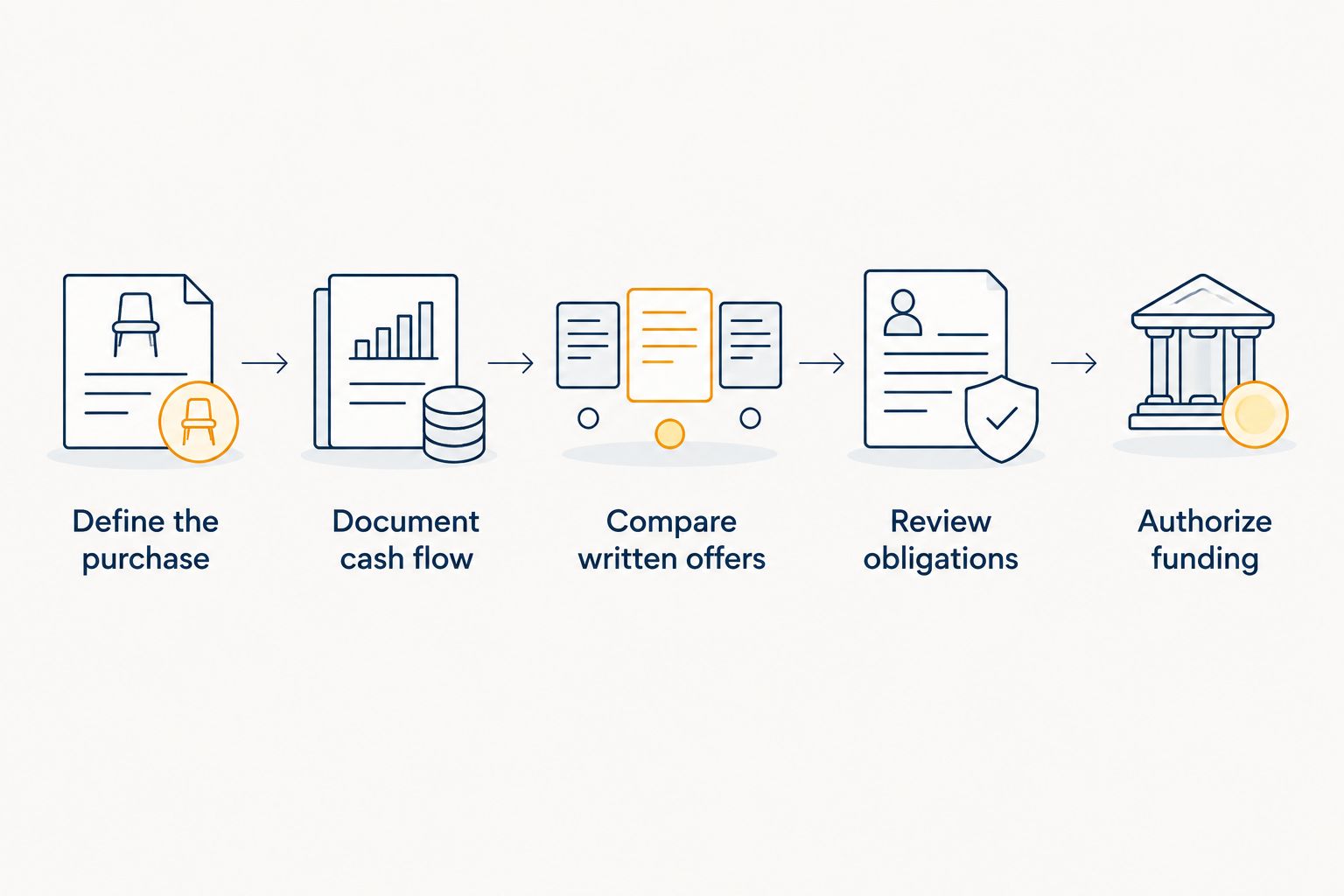
Ask who will receive your application and whether the proposed review involves a credit inquiry. Keep copies of the offer and final agreement so you can check that the signed terms match your comparison.
How does this ranking help you choose?
The ranking uses equipment fit, total obligation, repayment fit, ownership, collateral, and execution requirements. Each company occupies a distinct decision slot rather than receiving an unsupported overall score.
For a manufacturer-specific purchase, obtain the relevant manufacturer-linked quote and an independent comparison. For equipment plus operating cash needs, start with a broker-led structure comparison; for uncertain utilization, examine rental before taking on an ownership obligation.
FAQ
What's the best equipment financing company for construction equipment in 2026?
The best fit depends on the machine, ownership goal, and repayment capacity. Cat Financial, John Deere Financial, and Komatsu Financial are relevant manufacturer-linked routes; Jon Lynch Financial Group is a broker-led route for comparing equipment financing with broader business-funding needs.
Is manufacturer financing better than a bank equipment loan?
Manufacturer financing is not automatically better than a bank equipment loan. Compare written offers using the same financed amount, ownership outcome, upfront cash, payment schedule, and final obligations.
Should I lease or finance a construction machine?
Finance and lease proposals should be compared by ownership outcome and total required payments. Review a lease's return conditions and any ownership purchase requirement before treating its scheduled payment as comparable to a loan payment.
Can a contractor finance used construction equipment?
Used-equipment eligibility depends on the financing provider and the specific machine. Confirm equipment age, condition, seller requirements, and valuation requirements before committing to the purchase.
Does equipment financing mean credit doesn't matter?
No. Credit can remain part of underwriting even when the equipment secures the obligation. Ask the provider how it evaluates personal credit, business credit, cash flow, existing debt, and the equipment.
Can revenue-based financing pay for construction equipment?
Check the agreement's permitted business uses before using revenue-based financing for equipment. It may be structured as a purchase of future receivables rather than a loan, so compare remittances and contractual obligations separately from equipment-loan payments.
Is Jon Lynch Financial Group a direct equipment lender?
Jon Lynch Financial Group is a broker, not a direct lender. Business-purpose financing is subject to third-party underwriting and product terms; approval, amounts, rates, decisions, and funding times are not guaranteed.
Related guides
- Working capital loans for construction contractors
- Equipment leasing options for manufacturing businesses
- Business funding for government contractors
What is the next practical step?
Before accepting a 2026 equipment offer, ask: What cash remains for operations after the upfront requirement and scheduled payments? A machine that fits the job can still create a financing obligation that does not fit the business.
These are business-purpose funding routes, not consumer financing. Third-party underwriting and product terms apply, and no approval, amount, rate, decision, or funding time is guaranteed.
If your U.S. business generates at least $35,000 per month, Compare Business Funding Options. If your U.S. business generates below $35,000 per month, Explore Self-Serve Funding; this tech-forward route uses a secure Plaid bank-statement connection for an automated decision, subject to verification and product terms.



