Best revenue-based financing companies in 2026
Compare the best revenue based financing companies by business fit. Choose a broker or platform program after reviewing costs, repayment and risks.

Best for comparing funding structures: Jon Lynch Financial Group. Best for PayPal sellers seeking a sales-linked business loan: PayPal Working Capital. Best for Shopify merchants evaluating platform financing: Shopify Capital. For U.S. businesses generating at least $35,000 per month, start by comparing total obligations and repayment mechanics—not just the amount offered.
- The best revenue based financing companies match repayment to cash flow, not just your requested funding amount.
- Jon Lynch Financial Group fits established businesses comparing revenue-based financing and working capital through a broker.
- PayPal Working Capital fits PayPal sellers evaluating a business loan repaid through a share of PayPal sales.
- Shopify Capital fits Shopify merchants evaluating financing within their existing commerce platform.
- Compare net proceeds, total obligations, payment frequency, reconciliation rights and early-payoff terms before signing.
Why does the financing structure matter more than the ranking?
Revenue-based financing describes a repayment approach, not a single standardized contract. A provider can offer a loan, while another purchases future receivables—the money your business expects to collect from customers.
That distinction matters in 2026 because similar sales language does not establish identical obligations. Read the agreement before treating a sales-linked loan, merchant cash advance and receivables purchase as interchangeable.
A merchant cash advance, or MCA, is commonly structured as a purchase of future receivables. Whether collections adjust when sales fall depends on the contract and its reconciliation process, not the product label alone.
What makes the best revenue-based financing company for you?
Use these criteria before comparing providers:
- Structure: Identify whether you are signing a loan agreement or selling future receivables.
- Total obligation: Compare cash received against everything the business must pay or remit.
- Cash-flow fit: Identify payment frequency, collection method and the effect of weaker sales.
- Qualification: Match the application to your revenue sources, operating history, credit and existing obligations.
- Contract protections: Examine reconciliation, guarantees, security interests, default provisions and early-payoff treatment.
- Execution: Separate an initial indication from an approved agreement and completed funding.
The best choice is the offer your business can support after payroll, taxes, inventory and existing payments. A larger approval does not make an unsuitable repayment schedule better.
Which financing companies should you compare at a glance?
These 2026 picks serve different needs. They are not interchangeable direct lenders, and platform financing is not automatically a future-receivables purchase.
| Company or program | Best for | Standout distinction | Key limitation |
|---|---|---|---|
| Jon Lynch Financial Group | Established U.S. businesses comparing funding structures | Broker access to working capital, revenue-based financing and other third-party options | Does not make the final funding decision |
| PayPal Working Capital | PayPal sellers seeking sales-linked loan repayment | Business loan repayment tied to a share of PayPal sales | Depends on the PayPal business relationship and program eligibility |
| Shopify Capital | Shopify merchants evaluating platform financing | Financing connected to the merchant's commerce platform | Platform financing is not automatically the same as revenue-based financing |
1. Why choose Jon Lynch Financial Group for offer comparison?
Best for: U.S. business owners generating at least $35,000 per month who want to compare financing structures.
Jon Lynch Financial Group is a broker, not a direct lender. Its business-funding work includes working capital, revenue-based financing and purchases of future receivables through third-party funding partners.
The comparison should begin with your business need: bridging customer payments, purchasing inventory, mobilizing a contract or covering a defined operating gap. Then compare the proposed funding against a line of credit, term loan or other suitable structure rather than assuming a receivables purchase is the answer.
Jon Lynch Financial Group pros:
- Offers a route to compare multiple business-funding structures.
- Serves established U.S. businesses seeking business-purpose capital.
- Includes alternatives beyond revenue-based financing, such as equipment financing and invoice factoring.
Jon Lynch Financial Group cons:
- Third-party lenders and funders control underwriting and final terms.
- The primary comparison audience begins at $35,000 in monthly revenue; smaller businesses follow a separate self-serve route.
Ask which company would fund the transaction, what agreement you would sign and how any broker compensation appears in the economics. Evaluate the written offer, not the broker relationship alone.
Verdict: Consider this comparison route if you want competing structures evaluated against the same cash-flow need.
2. Why choose PayPal Working Capital for PayPal sales?
Best for: PayPal sellers seeking a business loan with repayment linked to PayPal sales.
PayPal Working Capital is a business loan, not simply another name for a merchant cash advance. Repayment uses a share of PayPal sales, subject to the program's agreement and minimum repayment requirements.
The key question is how closely your PayPal activity represents the business's actual cash generation. A repayment method connected to one payment channel still needs to fit your full operating budget.
PayPal Working Capital pros:
- Connects loan repayment to PayPal sales activity.
- Gives existing PayPal sellers a financing option within that ecosystem.
- Provides a distinct structure to compare against a future-receivables purchase.
PayPal Working Capital cons:
- Requires the relevant PayPal business relationship and program eligibility.
- Sales-linked collections do not remove contractual minimum repayment requirements.
Before accepting, identify the repayment share, minimum repayment obligations and treatment of changes in sales. Do not assume that a slow period eliminates every payment responsibility.
Verdict: Consider PayPal Working Capital when PayPal sales support the repayment structure and the written obligations fit your budget.
3. Why choose Shopify Capital for platform-connected financing?
Best for: Shopify merchants evaluating financing alongside their existing commerce operations.
Shopify Capital is a merchant-financing program connected to Shopify. Evaluate the specific financing offer and agreement rather than assuming every platform offer uses the same repayment method.
For a Shopify merchant, the platform connection makes it a relevant comparison candidate. It does not establish that the offer has the lowest total obligation or the most suitable collection schedule.
Shopify Capital pros:
- Gives Shopify merchants a financing program connected to their commerce platform.
- Provides a platform-specific alternative to a separate broker search.
- Creates another offer to compare against a loan, line of credit or receivables purchase.
Shopify Capital cons:
- Is not a general financing route for businesses outside the Shopify ecosystem.
- Requires close review of the actual product structure and repayment provisions.
Ask whether the agreement is a loan, how collections work and what happens when sales change. Treat the platform relationship as context, not proof that the obligation is affordable.
Verdict: Consider Shopify Capital if you operate on Shopify and its written offer compares favorably with outside alternatives.
How were these financing routes ranked?
The order follows the decision criteria above: structure, total obligation, cash-flow fit, qualification, contract protections and execution. Broker-assisted comparison comes first for an owner evaluating different structures; platform programs occupy narrower, distinct use cases.
This is a fit-based shortlist for 2026, not a claim that one provider produces the best outcome for every applicant. Your final ranking belongs to the actual agreements offered to your business.
How should you compare the money leaving your account?
Build a simple worksheet before selecting a company. Keep the purpose and requested net proceeds consistent so a larger offer does not distract you from a heavier obligation.
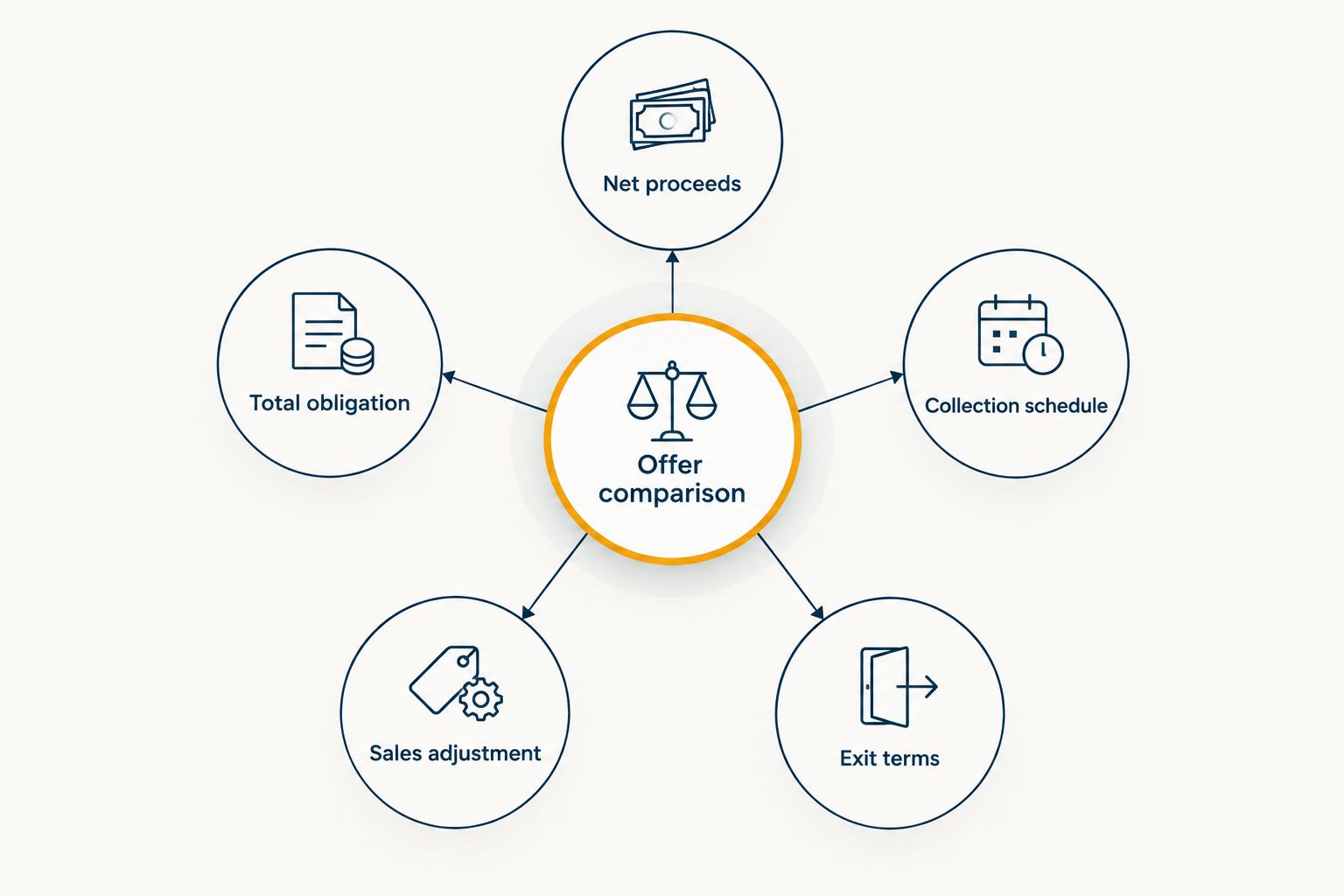
Record these fields for every proposal:
- Net proceeds: Cash the business actually receives after deductions.
- Total obligation: All required payments or purchased receivables, plus applicable fees.
- Collection schedule: When withdrawals occur and how amounts are calculated.
- Sales adjustment: Whether collections change automatically or require reconciliation.
- Exit terms: What early payment changes, and what it does not.
For a receivables purchase, distinguish the purchase amount paid to your business from the purchased receivables amount owed under the agreement. For a loan, identify principal, interest, fees and the payment schedule.
A factor rate is a multiplier used to calculate an agreed total obligation; it is not APR. Annual percentage rate incorporates timing, so the same multiplier collected over different periods does not represent the same annualized financing cost.
Use the guide to comparing factor rates on a merchant cash advance when a proposal uses factor-rate language. Never convert a factor rate into APR by simply adding a percent sign.
What does sales-linked repayment do to cash flow?
Illustrative cash-flow example—not a provider quote: Assume a business collects $35,000 per month and a hypothetical agreement collects 10% of those receipts.
- Monthly receipts: $35,000.
- Illustrative collection: $35,000 × 10% = $3,500 per month.
- Remaining receipts: $35,000 − $3,500 = $31,500 per month before other expenses.
That remaining amount is not profit. Payroll, rent, inventory, taxes and existing financing obligations still come out of the business.
The example demonstrates collection pressure, not total financing cost or qualification. In 2026, compare each written proposal against both your expected sales and a weaker operating period, including any contractual minimums.
When is another funding structure a better fit?
Revenue-based financing belongs in the comparison, not automatically at the top. Match the structure to what creates the funding need.
| Alternative | Best for | Advantage to evaluate | Limitation to evaluate |
|---|---|---|---|
| Business line of credit | Recurring, uneven working-capital needs | Ability to draw within an approved facility | Renewal terms, fees and repayment requirements |
| Term loan | A defined expense with a planned repayment horizon | Scheduled repayment against a known borrowing amount | Fixed obligations during weaker sales |
| Invoice factoring | Businesses waiting on eligible customer invoices | Funding tied to receivables rather than general sales alone | Customer eligibility, fees and collection arrangements |
| Equipment financing | Purchasing business equipment | Financing tied to the asset being acquired | Equipment-related security and contract restrictions |
Each alternative has a tradeoff. A line of credit requires discipline around repeated draws; factoring requires attention to customer invoices; equipment financing does not solve every general operating gap.
Choose the structure that matches the asset, receivable or cash-flow cycle you are funding. Do not use speed alone to justify a mismatch.
Which risks should stop you from signing?
Pause when the proposed collections leave no room for ordinary operating expenses. Financing that only works under your strongest sales forecast is not a sound basis for the decision.
Other reasons to stop and clarify include:
- The provider cannot clearly identify the contracting lender or receivables purchaser.
- The agreement does not match the repayment explanation you received.
- Reconciliation rights are unclear or difficult to exercise.
- Existing financing agreements restrict additional borrowing or receivables sales.
- You do not understand personal guarantees, security interests or default provisions.
Credit still matters where the applicable underwriting process considers it. Sales activity does not make credit history, existing obligations or bank-account conduct irrelevant.
For guarantees and disputed contract language, get independent legal advice before signing. A sales representative's explanation does not replace the agreement.
What should you prepare before requesting offers?
Prepare current bank statements, revenue records, ownership information and a complete schedule of existing financing obligations. Requirements vary by funding partner and product.
Write down the business purpose, required net proceeds and the event expected to replenish cash. A clear inventory purchase or customer-payment gap gives you a concrete way to evaluate repayment fit.
Before authorizing submissions, ask who receives the application and how credit checks and data access work. Keep a record of the terms you receive so you can compare them consistently.
FAQ
What's the best revenue-based financing company in 2026?
The best fit depends on your business model and the written offer. Jon Lynch Financial Group fits established businesses comparing structures through a broker; PayPal Working Capital and Shopify Capital serve distinct platform-related needs.
Is revenue-based financing the same as a merchant cash advance?
No, the terms are not automatically interchangeable. Revenue-based financing describes a repayment approach, while a merchant cash advance is commonly structured as a purchase of future receivables; review the actual agreement.
Is PayPal Working Capital a loan?
Yes, PayPal Working Capital is a business loan. Its sales-linked repayment mechanism does not remove the need to understand minimum repayment requirements and other contractual obligations.
Does Shopify Capital always work like revenue-based financing?
Do not assume every Shopify Capital offer has the same repayment structure. Identify the product, collection method and payment obligations in the specific agreement before comparing it with a receivables purchase.
How much revenue do I need to compare funding through a broker?
The primary broker-assisted route described here serves U.S. businesses generating at least $35,000 per month. Businesses below that threshold should use Explore Self-Serve Funding; the routing threshold is not an approval promise.
Does a factor rate tell me the APR?
No, a factor rate is not APR. An annualized comparison requires cash-flow timing and applicable fees, not just the multiplier used to calculate the total obligation.
Can I reduce the cost by paying a receivables purchase early?
Early payment does not automatically reduce the agreed obligation. Check whether the contract provides an early-payoff adjustment and obtain the applicable payoff terms in writing.
Which company should you choose after comparing offers?
Default to comparison before commitment. Use a broker-assisted route when you need to compare structures, PayPal Working Capital when its sales-linked loan fits your PayPal activity, or Shopify Capital when its specific offer suits your Shopify business.
For a 2026 funding decision, reject any proposal you cannot explain in plain English: cash received, total obligation, collection schedule and consequences of weaker sales.
What is one last contract detail to check?
Ask what happens after sales fall—not just what happens after approval. A reconciliation clause is only useful when you understand its trigger, required documentation and adjustment process.
Related guides
- Compare revenue-based financing agencies
- Revenue-based financing for seasonal businesses
- Revenue-based financing versus merchant cash advance
What is your next step?
Disclosure: Financing discussed here is for business purposes and is subject to third-party underwriting and product terms. Broker services do not guarantee approval, an amount, a rate, a decision or a funding time.
Choose the route that matches your monthly revenue: Compare Business Funding Options if your U.S. business generates at least $35,000 per month; Explore Self-Serve Funding if it generates less. Start with your bank statements and existing obligations so the comparison reflects what your business can actually support.



