Best SBA lenders for buying an existing business in 2026
Compare SBA loans for buying a business. Start with an acquisition-focused lender, then assess bank fit, repayment, buyer equity and closing risks before signing.

Best overall: an acquisition-focused SBA 7(a) lender. Best for an established banking relationship: your existing SBA-participating bank. Best after a bank declines for an internal lending-policy reason: an SBA-authorized nonbank lender. For SBA loans for buying a business in 2026, choose the lender that can underwrite the acquisition—not simply the institution with the most recognizable name; longer repayment does not remove the need for verified earnings, buyer equity and personal financial exposure.
- SBA loans for buying a business usually start with the SBA 7(a) program, which permits eligible ownership changes.
- Choose an acquisition-focused SBA lender for a purchase involving goodwill, seller financing or a complicated ownership transition.
- Compare your existing bank when it participates in SBA lending; compare nonbank lenders when bank policy blocks an eligible deal.
- Jon Lynch Financial Group is a broker, not a direct lender; compare acquisition funding and working capital separately.
Who should use an SBA loan to buy an existing business?
An SBA acquisition loan fits a buyer purchasing an eligible operating business with documented repayment capacity. The target's historical earnings matter, but the lender also evaluates your experience, financial position and plan for running the company.
Jon Lynch Financial Group helps U.S. business owners compare funding through third-party lenders and funders. Jon Lynch Financial Group is best for established U.S. business owners comparing business-funding structures, not for buyers seeking a direct lender.
The SBA's published 7(a) program guidance permits eligible changes of ownership and sets a maximum loan amount of $5 million. That is a program ceiling, not an amount every buyer qualifies to receive.
For most non-real-estate uses, the published program generally allows repayment terms of up to 10 years; eligible real estate financing can extend up to 25 years. Apply those program boundaries to your 2026 acquisition budget, then have the lender confirm the term for your actual transaction.
What makes an SBA lender a good acquisition fit?
Rank lenders by their ability to finance your transaction and explain the conditions before you commit to closing.
- Acquisition experience: Ask whether the lender handles ownership changes involving goodwill, seller notes and management transitions.
- Repayment analysis: Require a clear explanation of earnings adjustments, buyer compensation and existing debt obligations.
- Equity treatment: Confirm the required buyer contribution, acceptable sources and treatment of any seller financing.
- Complete cost disclosure: Compare interest, applicable fees, outside closing expenses and repayment terms—not just the quoted rate.
- Closing coordination: Identify who manages valuation, legal documents, landlord consent and final funding conditions.
- Policy fit: Ask about industry restrictions, collateral expectations and buyer experience before assembling a full application.
A lender that answers these questions directly deserves a place on your shortlist. A lender that cannot explain its acquisition process should not control your purchase deadline.
Which SBA lender routes are best at a glance?
These rankings compare lender routes by transaction fit. They do not claim that one institution offers every buyer better terms.
| Rank and lender route | Best for | Standout feature to seek | Key limitation |
|---|---|---|---|
| Acquisition-focused SBA 7(a) lender | A purchase requiring detailed ownership-change underwriting | A dedicated acquisition process covering goodwill, valuation and seller financing | Specialization does not guarantee approval or lower cost |
| Your existing SBA-participating bank | A buyer with an established banking relationship | Familiarity with your financial history and an identifiable banking contact | Your relationship does not override acquisition policy |
| SBA-authorized nonbank lender | An eligible acquisition rejected under a bank's internal policy | A separate credit policy and another opportunity for review | SBA eligibility and repayment requirements still apply |
The default choice in 2026 is the acquisition-focused route. Use the relationship-bank route when your bank confirms that it actively finances transactions like yours, rather than merely offering SBA loans generally.
1. Acquisition-focused SBA lender: best for a complex ownership change
An acquisition-focused SBA lender evaluates the purchase as a transfer of an operating business. The lender must understand what you are buying, how the business generates cash and whether the proposed debt fits those earnings.
This route belongs first when the purchase includes substantial goodwill, a seller note or an ownership transition that needs careful coordination. Ask for an acquisition specialist rather than stopping at a general small-business lending desk.
Acquisition-focused SBA lender pros:
- A dedicated acquisition process can keep valuation, underwriting and closing requirements connected.
- Ownership-change experience helps identify seller-note issues before documents are finalized.
- Detailed earnings review exposes unsupported adjustments to reported profit.
- Transaction-specific questions help you assess the deal, not just the financing.
Acquisition-focused SBA lender cons:
- Detailed review requires cooperation from the seller and access to reliable records.
- Acquisition experience does not eliminate collateral, equity or guarantee requirements.
- A specialized lender's industry policy can still exclude your transaction.
Best for: A buyer whose purchase requires more than a straightforward review of an existing banking customer.
Ask the lender to identify the unresolved issues before you negotiate a firm closing date. Verdict: Buy—choose this route first when the lender confirms acquisition experience and your transaction fits its policy.
2. Your existing SBA bank: best for an established banking relationship
Your existing bank is a useful comparison when it participates in SBA lending and finances business acquisitions. It already has a relationship with you, but familiarity with your accounts is not a substitute for reviewing the target business.
Start by asking whether the bank handles ownership changes in the target's industry. A bank that offers working capital loans does not automatically finance acquisitions involving significant goodwill.
Existing SBA bank pros:
- An established contact gives you a clear starting point for the application.
- Existing account history provides context about your current business finances.
- The bank can assess how the purchase interacts with your existing obligations.
- A direct lender relationship avoids uncertainty about who makes the credit decision.
Existing SBA bank cons:
- Internal policy can be narrower than the SBA program's permitted uses.
- A strong deposit relationship does not establish the target's repayment capacity.
- Your usual banker might need a separate acquisition underwriting team.
Best for: A financially established buyer whose current bank confirms that the acquisition fits its lending policy.
Compare the bank's complete written proposal against an acquisition-focused lender. Verdict: Hold—keep this route on the shortlist until the bank confirms acquisition appetite, conditions and closing responsibilities.
3. SBA-authorized nonbank lender: best after a bank-policy decline
An SBA-authorized nonbank lender offers another review route when a bank rejects an otherwise eligible transaction under its own lending policy. A different lender can apply a different credit policy, but it cannot make an ineligible SBA transaction eligible.
First establish why the bank declined. A policy restriction, weak repayment capacity and an incomplete application are different problems; switching lenders addresses only some of them.
SBA-authorized nonbank lender pros:
- A separate credit policy provides another route for an eligible acquisition.
- The application can be assessed without an existing deposit relationship.
- A direct explanation of underwriting requirements helps distinguish fixable issues from structural problems.
SBA-authorized nonbank lender cons:
- The buyer and transaction must still satisfy applicable SBA requirements.
- Another application does not repair insufficient cash flow or unsupported financial statements.
- Different terms require a fresh comparison of total obligations and closing conditions.
Best for: A buyer with a documented, eligible transaction that a bank rejected for an institution-specific reason.
Obtain the decline explanation before submitting again. Verdict: Hold—pursue this route when the rejection concerns lender policy, not an unresolved eligibility or repayment problem.
How does an SBA business acquisition loan work?
The lender makes the loan; the SBA provides a guarantee on an eligible portion under program rules. The guarantee protects the lender's position—it does not cancel your repayment obligations.
An acquisition review connects the business being purchased, your proposed ownership and the funding structure. Follow this sequence:
- Define the purchase: Identify the assets or ownership interests being transferred and the proposed use of loan proceeds.
- Verify earnings: Reconcile tax returns, financial statements and claimed adjustments to profit.
- Confirm equity: Document the buyer contribution and any proposed seller note.
- Clear conditions: Resolve valuation, legal, lease and other underwriting requirements.
- Close funding: Execute the approved documents and satisfy disbursement conditions.
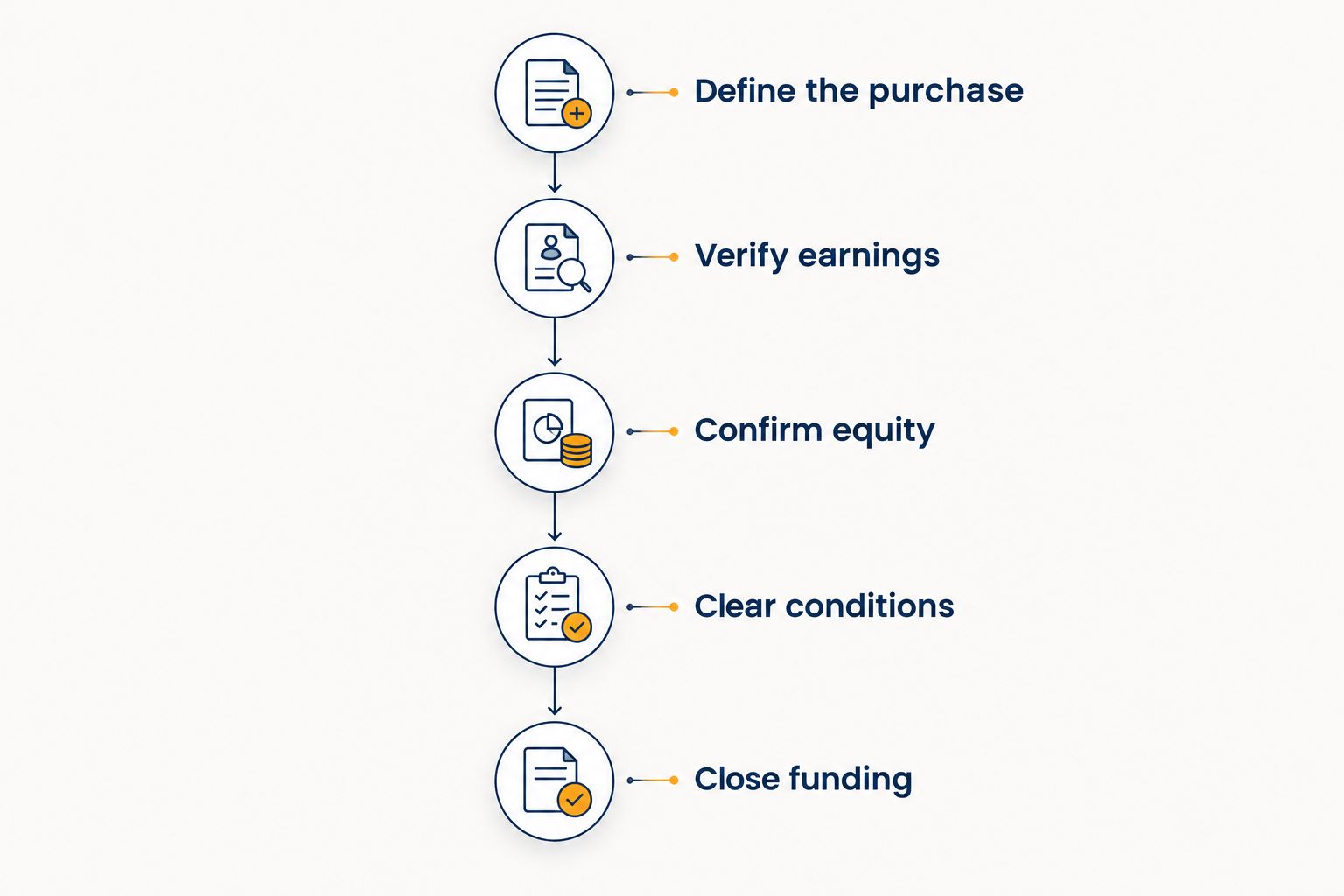
In 2026, distinguish an initial screening from final approval and completed closing. Ask which conditions remain open and who is responsible for each one; a promising conversation is not funded financing.
How should you compare the dollars and repayment burden?
Build the comparison around the proposed transaction, not an advertised rate. Ask each lender to use the same purchase assumptions and clearly identify anything excluded from its proposal.
Your comparison should show:
- Cash you must contribute at closing.
- Loan proceeds allocated to the acquisition and any approved working capital.
- Interest structure, applicable fees and outside closing expenses.
- Payment schedule and any applicable prepayment terms.
- Seller-note payments and restrictions.
- Cash remaining after closing for normal operations.
Do not confuse accounting profit with cash available for debt repayment. Buyer compensation, taxes, equipment replacement and working capital demands can consume cash that a seller's headline earnings figure does not reveal.
Choose the proposal that fits verified operating cash flow, not the proposal that leaves you with the least cash contribution. The business acquisition financing guide provides a related framework for comparing purchase structures.
When is another funding structure better?
A conventional acquisition loan deserves comparison when the buyer and transaction meet the lender's requirements. Seller financing also deserves review when the seller is willing to accept deferred payment and the senior lender approves the structure.
| Alternative | Best for | Main advantage | Main limitation |
|---|---|---|---|
| Conventional acquisition loan | A buyer who qualifies outside the SBA program | Another loan structure to compare | Lender-specific equity and collateral requirements |
| Seller financing | A purchase with a seller willing to defer part of payment | Reduces the amount due to the seller at closing | Requires compatible payment and subordination terms |
| Business line of credit | Eligible post-acquisition operating expenses | Supports recurring working capital needs | Does not automatically cover the purchase itself |
| Revenue-based financing | An operating business comparing business-purpose liquidity | A separate way to address qualifying operating needs | Repayment or remittances can constrain cash flow |
Revenue-based financing can be structured as a purchase of future receivables rather than a loan. A factor rate describes a repayment or purchased-receivables multiple; it is not APR, which expresses borrowing cost on an annualized basis.
Do not treat working capital funding as interchangeable with acquisition financing. Confirm permitted uses and disclose proposed debt or receivables obligations to the acquisition lender before accepting them.
What risks should stop you from choosing a lender yet?
Pause the financing search when the underlying deal is not ready for underwriting. A different lender cannot replace missing evidence.
- Seller earnings adjustments lack supporting records.
- The purchase assumes growth that has not occurred.
- Your equity source is undocumented or unacceptable to the lender.
- Seller-note terms conflict with the proposed senior financing.
- A critical lease, license or customer contract will not transfer as expected.
- Closing would leave the business without operating liquidity.
Credit history remains relevant alongside cash flow, experience, collateral and transaction structure. Ask about personal guarantees explicitly; an SBA guarantee is not a release of your own obligations.
What documents should you prepare before applying?
Prepare a coordinated buyer-and-seller package rather than sending disconnected files to multiple lenders. Ask for the lender's current checklist because requirements vary by transaction.
Common requests include the purchase agreement or letter of intent, target-business tax returns and financial statements, debt schedules, buyer financial information, management experience, equity-source documentation and a transition plan.
Identify unresolved issues in a short accompanying summary. Explain unusual earnings adjustments, customer concentration, seller involvement and any working capital requirement after closing.
How were these SBA lender routes ranked?
The ranking prioritizes acquisition capability, transaction fit, repayment transparency and closing coordination. Acquisition-focused lenders lead because the central task is financing an ownership change; relationship banks and authorized nonbank lenders serve distinct comparison needs.
No ranking establishes approval odds or identifies the cheapest lender for every buyer. Your 2026 decision should rest on written terms and transaction-specific underwriting.
FAQ
What's the best SBA loan for buying an existing business?
The SBA 7(a) program is the main starting point for an eligible business acquisition. Choose a participating lender that handles ownership changes and can explain equity, repayment and closing requirements.
Is my existing bank better than an acquisition-focused SBA lender?
Your existing bank is better only when its acquisition policy and written terms fit your transaction. An acquisition-focused lender deserves comparison when goodwill, seller financing or transition issues need specialized review.
How much can an SBA acquisition loan finance?
The SBA 7(a) program has a maximum loan amount of $5 million. Your approved amount depends on eligibility, repayment capacity, transaction structure and lender underwriting.
How long can you repay an SBA loan used to buy a business?
Most non-real-estate 7(a) uses generally allow terms up to 10 years, while eligible real estate financing can extend up to 25 years. The lender must confirm the applicable term for the acquisition and its use of proceeds.
Can seller financing be part of an SBA business purchase?
Seller financing can be part of an eligible acquisition when its structure meets applicable SBA and lender requirements. Have the lender confirm payment, standby, subordination and equity treatment before finalizing the seller note.
Can I get an SBA acquisition loan after a bank declines me?
A bank decline does not automatically prevent approval by another SBA lender. Identify whether the rejection concerns bank policy, SBA eligibility, repayment capacity or missing documentation before applying elsewhere.
Does Jon Lynch Financial Group lend acquisition funds directly?
Jon Lynch Financial Group is a broker, not a direct lender. Business-purpose funding is provided through third-party lenders and funders, subject to their underwriting and product terms.
Which route should you choose next?
Start with an acquisition-focused SBA lender and compare your relationship bank when it confirms transaction fit. Use an authorized nonbank lender as a targeted alternative—not as a substitute for fixing weak financial evidence.
Related guides for your purchase:
- How long does SBA loan approval take?
- Funding a franchise resale acquisition
- Insurance agency valuation and acquisition financing
Jon Lynch Financial Group serves business-purpose funding needs through third-party partners; approval, amounts, rates and timing are not guaranteed. Its primary comparison route serves U.S. business owners generating at least $35,000 per month—a brokerage audience threshold, not an SBA eligibility rule.
If your business generates below that threshold, Explore Self-Serve Funding for business-purpose liquidity, without assuming that route finances an acquisition. Otherwise, gather the seller's financial package and Compare Business Funding Options.
Compare your business funding options
Review acquisition needs and operating liquidity separately before choosing a funding structure.