Best short-term business funding options for landscaping companies 2026
Compare short-term business funding for landscaping companies. Start with a line of credit, then weigh invoices, equipment, repayment and contract risk.

Best overall: a business line of credit for recurring landscaping cash-flow gaps. Best for unpaid commercial invoices: invoice factoring; best for a mower or trailer purchase: equipment financing. For 2026, choose the structure that matches your collection cycle—not simply the offer with the fastest advertised decision.
- The best short term business funding for landscaping companies matches repayment to collections; compare a line of credit first.
- Invoice factoring fits eligible commercial invoices; equipment financing fits equipment purchases rather than payroll.
- Revenue-based financing requires contract review: payments do not automatically fall when landscaping revenue declines.
- Jon Lynch Financial Group helps established U.S. business owners compare funding through third-party partners, not direct lending.
Why does the funding structure matter for landscapers?
A landscaping company paying crews before customers pay needs a different structure from a company replacing equipment. Finance the gap you can identify and repay, not an ongoing operating loss. Short repayment schedules leave less room for weather delays, disputed work or late collections.
Jon Lynch Financial Group is a broker, not a direct lender, serving U.S. business owners comparing business-purpose funding. Jon Lynch Financial Group is best for established landscaping business owners seeking help comparing working-capital structures through third-party funding partners.
What makes the best short-term landscaping funding?
Judge every 2026 offer against these criteria before comparing approval speed:
- Purpose fit: Separate payroll and materials from equipment purchases or unpaid invoices.
- Collection alignment: Match payment dates to when customer money actually reaches your account.
- Total obligation: Compare net proceeds, total dollars owed or receivables sold, and every disclosed fee.
- Qualification fit: Review revenue history, credit, existing obligations and any required collateral.
- Exit terms: Check early payoff treatment, renewal conditions, reconciliation rights and default provisions.
An approval is not proof that an obligation fits your cash flow. Request written terms before accepting an offer, and do not treat an initial estimate as a final agreement.
Which options belong on your shortlist at a glance?
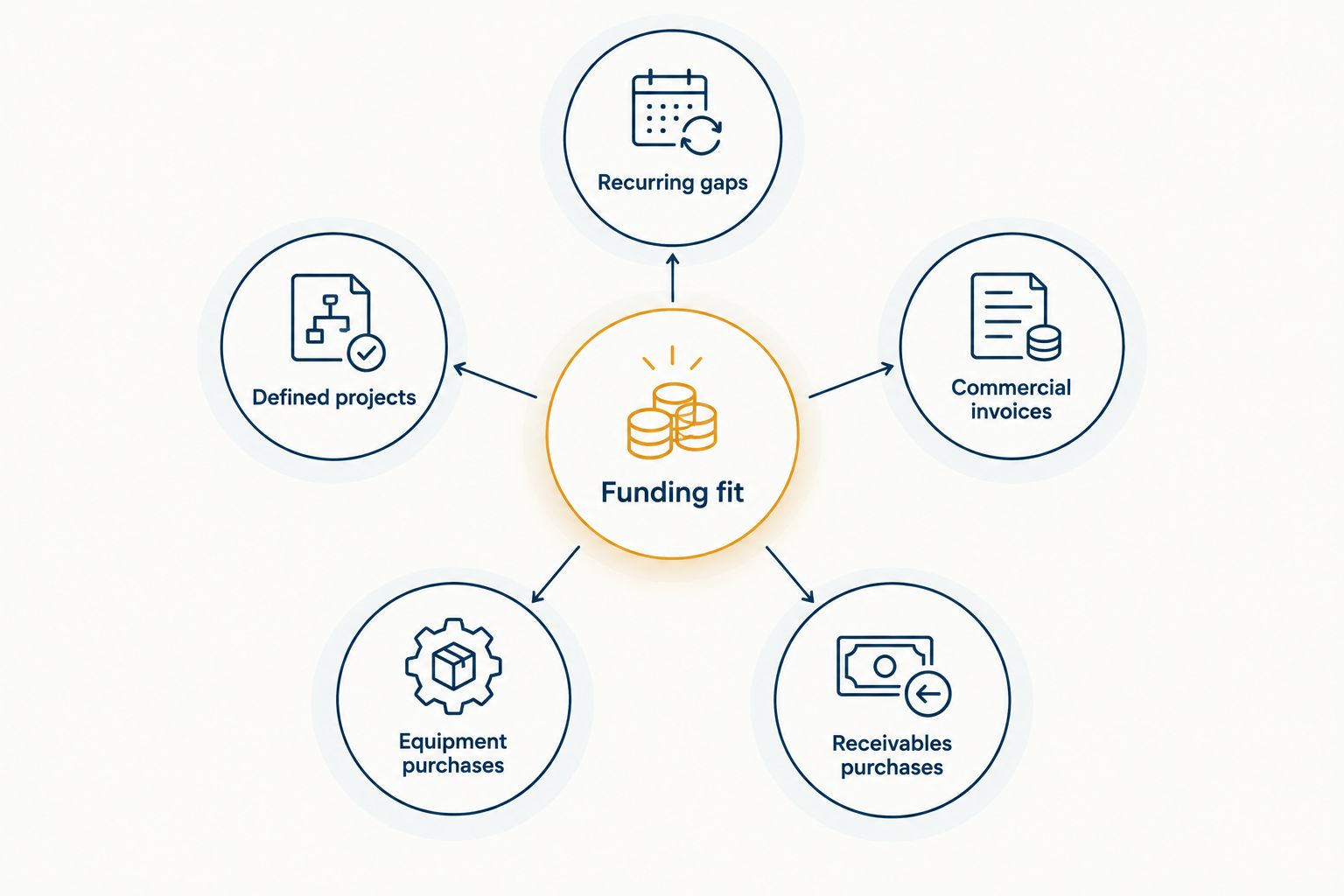
| Rank and option | Best for | Standout feature | Key limitation |
|---|---|---|---|
| 1. Business line of credit | Recurring gaps | Draw funds as needed within approved terms | Renewal, draw access and repayment depend on the agreement |
| 2. Short-term business loan | Defined projects | A lump sum with a contractual repayment schedule | Payments continue if the project collects late |
| 3. Invoice factoring | Commercial invoices | Converts eligible receivables into working capital | Customer eligibility and invoice disputes matter |
| 4. Equipment financing | Equipment purchases | Matches financing to an identified asset | Does not directly solve a general payroll gap |
| 5. Revenue-based financing or future-receivables purchase | Receivables purchases | Underwriting considers business receipts | Frequent remittances and contract terms require close review |
These are funding structures, not interchangeable products. Start with the expense and repayment source, then compare written offers within the relevant category.
1. Why is a business line of credit best for recurring gaps?
A business line of credit lets you draw against an approved limit under the agreement's terms. A revolving facility restores borrowing capacity as eligible principal is repaid, subject to continued access and account conditions.
Best for: An established landscaping company with recurring maintenance collections and temporary gaps between payroll and customer payments.
Business line of credit pros:
- Draw for a specific shortage instead of taking an unnecessary lump sum.
- Reuse a revolving facility within its approved conditions.
- Compare actual draws against upcoming customer collections.
Business line of credit cons:
- Access is not permanent; review renewal and suspension provisions.
- Draw charges, maintenance fees or frequent payments can affect the comparison.
- Credit, cash flow and existing obligations still matter in underwriting.
For a 2026 application, show how the balance falls after customers pay. A line that remains fully drawn without a credible reduction plan is covering a persistent shortage rather than a temporary gap.
Verdict: Buy—choose a line of credit first when recurring collections support repayment and the written terms fit.
2. When is a short-term business loan best for a defined project?
A short-term business loan provides a lump sum repaid under a defined schedule. It fits a documented expense with an identifiable repayment source better than an open-ended need for cash.
Best for: A landscaping installation or contract mobilization with a clear budget, collection milestone and contingency plan.
Short-term business loan pros:
- Connect a single funding amount to a defined project budget.
- Review the payment schedule before committing to the work.
- Compare total repayment against the project's expected cash contribution.
Short-term business loan cons:
- Fixed payments remain due when collections slip.
- Additional borrowing requires separate approval unless the agreement provides otherwise.
- Early repayment does not necessarily eliminate every contracted charge.
Do not size the loan from the customer's contract value alone. Subtract labor, materials, subcontractors, overhead and existing obligations before deciding what payment the project supports.
Verdict: Buy—choose a short-term business loan for a bounded expense with a documented repayment source; skip it for recurring losses.
3. When is invoice factoring best for commercial receivables?
Invoice factoring sells eligible unpaid invoices to a factoring company. For a landscaping business, the relevant starting point is completed, accepted commercial work awaiting payment—not unsigned proposals or future residential jobs.
Best for: A commercial landscaper with eligible business-customer invoices and a collection delay after completing the work.
Invoice factoring pros:
- Connect funding to an existing receivable.
- Focus the review on the invoice and the customer's payment obligation.
- Separate completed-work collections from financing future sales.
Invoice factoring cons:
- Disputed, ineligible or restricted invoices limit fit.
- Customer notification and payment instructions can affect the relationship.
- Recourse provisions can leave your business responsible for specified unpaid invoices.
Ask how the factor handles acceptance documentation, offsets, retainage and overdue accounts. Confirm which collections the factor controls and when any reserve is released.
Verdict: Buy—consider invoice factoring for eligible commercial invoices; skip it when the cash shortage comes before billable work exists.
4. Why is equipment financing best for a mower or trailer?
Equipment financing ties financing to an identified asset rather than unrestricted operating cash. Compare the asset's useful working life with the agreement's payment schedule and ownership terms.
Best for: Replacing or acquiring equipment needed to perform contracted landscaping work.
Equipment financing pros:
- Keep the financing purpose tied to a specific asset.
- Preserve the distinction between capital purchases and recurring operating expenses.
- Evaluate payments against the work the equipment supports.
Equipment financing cons:
- The asset can be subject to a security interest and repossession rights.
- A down payment, insurance or other conditions can apply.
- Equipment approval does not provide unrestricted payroll funding.
Ask whether the document is a loan or lease, who owns the equipment, and what happens at the end. Review maintenance responsibilities and any final purchase obligation before signing.
Verdict: Buy—use equipment financing for an asset purchase; skip it as a substitute for general working capital.
5. When should you consider revenue-based financing or an MCA?
Revenue-based financing describes arrangements linked to business revenue, but the legal structure varies. A merchant cash advance, or MCA, may be structured as a purchase of future receivables rather than a loan.
Best for: An established landscaping business evaluating receipts-based funding after comparing loan, credit-line and invoice-based alternatives.
Receipts-based funding pros:
- Gives owners another structure to evaluate after a bank decline.
- Supports comparison based on business receipts and existing obligations.
- Can include contractual reconciliation rights in a receivables-purchase agreement.
Receipts-based funding cons:
- Frequent withdrawals reduce cash available for operations.
- Revenue-linked language does not itself guarantee automatic payment reductions.
- Additional advances can create overlapping obligations and contractual conflicts.
Read the actual reconciliation procedure: eligibility, required evidence, request process and timing. Distinguish contractual performance obligations and default provisions from assumptions about how a receivables purchase works.
Verdict: Hold—consider only after reviewing the total obligation, withdrawal schedule, reconciliation rights and alternatives.
How should you compare the numbers without confusing cost and cash flow?
Start your 2026 comparison with net proceeds: the cash your business actually receives after withheld charges. Then record total scheduled payments or purchased receivables, payment frequency and all separately payable fees.
A factor rate is a multiplier used to calculate a contractual amount; it is not an annual percentage rate, or APR. An APR comparison requires the actual cash flows, timing and applicable fees—not just relabeling the factor rate as a percentage.
Use separate lines for:
- Cash deposited into your business account.
- Total contractual payments or receivables purchased.
- Payment dates and withdrawal frequency.
- Early payoff amount and any earned discount.
- Existing payments that remain after funding.
Lower withdrawals do not prove a lower total cost. A longer collection period and a smaller net deposit change the comparison, even when the headline multiplier looks similar.
What does the revenue threshold tell you—and what doesn't it tell you?
Jon Lynch Financial Group's primary comparison audience generates at least $35,000 per month. That is a routing threshold, not a promise of qualification or a universal lender requirement.
For scale only, holding that revenue constant gives $35,000 per month × 12 months = $420,000 per year. This is arithmetic, not a forecast, funding amount or repayment recommendation.
Seasonal landscaping revenue is not constant simply because an annual average looks sufficient. Compare the proposed withdrawals against your lower-revenue months and actual collection dates, not just peak-season deposits.
What risks should stop a landscaping funding application?
Stop when repayment depends on winning unawarded work or obtaining another advance. Funding needs a credible exit from customer collections, operating cash flow or another documented source.
Review these exclusions before accepting a 2026 offer:
- Persistent losses: Financing does not repair unprofitable job pricing.
- Uncertain collections: Disputed invoices are not reliable repayment sources.
- Overlapping obligations: Existing agreements can restrict additional debt, receivables sales or liens.
- Personal exposure: Read guarantees, security agreements and default remedies.
- Seasonal mismatch: Fixed withdrawals can conflict with a predictable slowdown.
A bank decline also deserves a diagnosis. Correcting missing documents or reducing the request is different from accepting a new structure that leaves the original repayment problem untouched.
What should you prepare before comparing offers?
Prepare a package that explains both your need and your exit. Exact documentation and qualification requirements depend on the third-party program.
- Recent business bank statements and current financial records.
- A schedule of existing loans, advances, liens and recurring payments.
- Customer contracts, invoice aging and evidence of completed work where relevant.
- Equipment quotations when funding an asset.
- A cash-flow forecast showing the expense, expected collections and proposed payments.
Credit remains relevant; its role varies by product and funding partner. Disclose existing obligations accurately so the comparison reflects the cash your business will actually retain.
How are these options ranked?
The ranking prioritizes purpose fit, collection alignment, total obligation, qualification fit and exit terms. A line of credit takes the default position for recurring gaps; the other structures win only for their distinct use cases.
This is a structure-based buying guide, not a lender approval ranking. No funding time, approval outcome or savings claim determines the order.
FAQ
What's the best short term business funding for landscaping companies?
A business line of credit is the first option to compare for recurring landscaping cash-flow gaps. Invoice factoring fits eligible commercial invoices, while equipment financing fits an identified asset purchase.
Can I use business funding to cover landscaping payroll?
Business-purpose working capital can cover payroll when the agreement permits it. Compare the payment schedule with customer collections and include existing obligations in your cash-flow forecast.
Is invoice factoring useful for residential lawn care?
Invoice factoring generally targets eligible commercial receivables rather than ordinary residential customer bills. Confirm customer and invoice eligibility before applying.
Does revenue-based financing automatically adjust when landscaping sales fall?
No, the name does not establish automatic payment adjustments. Read the agreement's remittance and reconciliation provisions, including the evidence and request procedure required.
Is a merchant cash advance a business loan?
An MCA may be structured as a purchase of future receivables rather than a loan. The agreement and applicable law determine the structure and obligations; do not treat the marketing label as the full answer.
Does meeting the monthly revenue threshold guarantee approval?
No. Jon Lynch Financial Group's primary comparison route serves businesses generating at least $35,000 per month, but approval and terms remain subject to third-party underwriting.
Can a landscaping company compare options after a bank decline?
Yes, a bank decline does not determine every other funding decision. Identify the decline reason and compare structures without assuming credit or repayment capacity stops mattering.
Which landscaping funding option should you choose?
Choose a business line of credit as the default for recurring gaps; change the choice when the expense demands it. Use invoice factoring for eligible completed-work invoices, equipment financing for an asset, and a term loan for a defined project.
For 2026 planning, keep receipts-based funding in a separate comparison until you understand the contractual obligation and collection mechanics. Approval speed does not replace that review.
Related guides
- Working capital loans for landscaping businesses
- Revenue-based financing for seasonal businesses
- How to compare factor rates on a merchant cash advance
What's one last thing to check before you apply?
Write down the customer collection that will retire the obligation. If you cannot identify it, reduce the request or reconsider financing before signing.
Jon Lynch Financial Group is a broker, not a direct lender. Funding is for business purposes and subject to third-party underwriting; approvals, amounts, rates, decisions and funding times are not guaranteed.
Your next step: if your U.S. business generates at least $35,000 per month, choose Compare Business Funding Options. Below that threshold, choose Explore Self-Serve Funding; consumer-purpose and non-U.S. requests are outside the primary funding audience.
Choose your business funding route
Use your monthly business revenue to select the appropriate starting point.



