Best unsecured business loan lenders for startups in 2026
Compare unsecured business loans for startups by revenue, repayment and risk. Choose the funding route that fits your cash flow, not an approval promise.

For unsecured business loans for startups in 2026, the best route depends on existing revenue: compare broker-arranged funding once your business generates at least $35,000 per month, assess bank loans when repayment is documented, and explore self-serve funding below that threshold. Jon Lynch Financial Group is best for established U.S. business owners comparing business-funding structures, not founders seeking guaranteed pre-revenue startup loans. The tradeoff is straightforward: an unsecured offer can still create personal liability and cash-flow pressure.
- Unsecured business loans for startups require contract review: no pledged asset does not mean no personal liability.
- Jon Lynch Financial Group fits established U.S. businesses comparing working capital and revenue-based financing.
- Bank term loans fit defined expenses; business lines of credit fit recurring cash-flow gaps.
- Purchases of future receivables are not interchangeable with loans; compare remittance terms and contractual obligations.
Why does startup status change your funding options?
A newly formed business with deposits is different from a business that has not made its first sale. Revenue, operating history, credit and existing obligations give an underwriter evidence to evaluate; a business plan alone does not demonstrate repayment capacity.
Jon Lynch Financial Group is a broker, not a direct lender. Its primary comparison route serves U.S. business owners generating at least $35,000 per month, with products supplied through third-party lenders and funders.
That threshold equals $420,000 over 12 months if monthly revenue remains constant: $35,000 × 12 = $420,000. This arithmetic describes the audience threshold, not a lender approval requirement or a forecast of your revenue.
For this 2026 guide, the ranking separates funding routes by use case rather than treating every startup as the same borrower. A comparison service, a loan and a receivables purchase perform different jobs.
What makes the best unsecured startup funding option?
Judge unsecured business loans for startups against these criteria before comparing advertisements:
- Eligibility fit: Confirm that the current program accepts your operating history, revenue, industry and requested business purpose.
- Contract structure: Identify whether the agreement is a term loan, revolving credit facility or purchase of future receivables.
- Total obligation: Compare net proceeds, all required payments or remittances, fees and early-exit terms.
- Cash-flow fit: Match the payment schedule to when customers actually pay you, not when you issue invoices.
- Legal exposure: Review personal guarantees, collateral language, liens, default provisions and enforcement rights.
- Decision timing: Separate an initial indication from underwriting approval and the actual arrival of usable funds.
A bank decline does not make the next offer suitable. Find out what caused the decline, then assess whether a different structure solves that problem without creating another.
Which funding routes fit at a glance?
This 2026 comparison ranks routes by the business problem each addresses. It does not imply that every provider within a category offers unsecured financing or accepts startups.
| Rank and option | Best for | Standout feature | Key limitation |
|---|---|---|---|
| 1. Broker-arranged comparison | Established businesses comparing different structures | Side-by-side review of third-party funding options | A broker does not control approval or final terms |
| 2. Bank term loan | A defined expense with a documented repayment source | Scheduled repayment for a specific borrowing need | Startup eligibility and security requirements must be checked |
| 3. Nonbank business line of credit | Revenue-generating businesses with recurring gaps | Draw-based access rather than one lump-sum loan | Draw rules, fees and repayment schedules differ |
| 4. Self-serve funding path | U.S. entrepreneurs below the primary revenue threshold | Automated review through securely connected bank statements | An automated application does not establish eligibility |
| 5. Purchase of future receivables | Operating businesses evaluating revenue-linked funding | Funding structured around future receivables | Not an interchangeable substitute for an unsecured loan |
1. Broker-arranged comparison: best for comparing funding structures
Jon Lynch Financial Group helps established U.S. business owners compare working capital, revenue-based financing and purchases of future receivables through third-party funding partners. The business is a broker, not a direct lender; the distinction matters because the funding partner determines underwriting and contract terms.
Best for: Businesses generating at least $35,000 per month that need to compare more than one funding structure.
Broker-arranged comparison pros:
- Lets you evaluate different structures against the same business need.
- Keeps attention on total obligation, timing, qualification and repayment.
- Provides a comparison route when the owner needs to distinguish loans from receivables purchases.
Broker-arranged comparison cons:
- Broker access does not establish approval or acceptable terms.
- Each third-party offer still requires separate contract review.
- The primary funding audience is established businesses, not every company described as a startup.
Ask who supplies the funds, which entity appears on the agreement, and what compensation or fees apply. Request the actual payment schedule before deciding.
Verdict: Hold until the written comparison identifies the funding partner, structure and complete obligation.
2. Bank term loan: best for a defined expense and repayment plan
A bank term loan provides borrowed funds under an agreement with scheduled repayment. It fits a defined business expense when you can document how operating cash flow will support the obligation.
Best for: Startup owners with operating evidence, a specific use of funds and time to evaluate bank underwriting.
Bank term loan pros:
- Connects borrowing to a defined expense.
- Provides a repayment schedule you can include in your cash-flow forecast.
- Offers a loan benchmark against which to compare alternative structures.
Bank term loan cons:
- Not every bank program accepts newly operating businesses.
- A personal guarantee or security requirement can change the apparent unsecured fit.
- Documentation and review must be completed before funding is usable.
For a 2026 application, ask the bank about current startup eligibility before submitting a full file. Do not assume an existing deposit relationship establishes credit eligibility.
If a bank provides acceptable terms and the funding date meets your need, choose the offer on its merits rather than paying for unnecessary speed elsewhere.
Verdict: Buy only when the written terms fit your repayment forecast and the security requirements are acceptable.
3. Nonbank business line of credit: best for recurring cash-flow gaps
A business line of credit lets you request draws under a credit agreement rather than borrowing one lump sum for every need. Whether repaid amounts become available again depends on the agreement and continuing eligibility.
Best for: Revenue-generating businesses that repeatedly bridge the gap between expenses and customer receipts.
Nonbank business line of credit pros:
- Supports separate draws for separate operating needs.
- Lets you compare borrowing against a specific cash-flow gap.
- Can align funding requests with inventory, payroll or customer-payment cycles.
Nonbank business line of credit cons:
- Draws can carry separate fees or repayment obligations.
- Continued access depends on the contract and provider requirements.
- An unsecured description does not resolve personal-guarantee questions.
Check whether a new draw adds another overlapping payment schedule. A credit limit is not a recommendation to use the entire facility, and recurring borrowing should not conceal a business that consistently spends more than it earns.
Verdict: Buy only when each draw has a documented repayment source; skip borrowing that perpetually funds operating losses.
4. Self-serve funding path: best for entrepreneurs below the threshold
The self-serve funding path is available to U.S.-based entrepreneurs, including businesses generating under $35,000 per month. Applicants can complete the process from home and securely connect bank statements through Plaid for an automated decision.
Best for: U.S. entrepreneurs below the primary comparison-route revenue threshold who want to explore an automated application.
Self-serve funding path pros:
- Provides a route separate from the established-business comparison audience.
- Uses securely connected bank statements in the application process.
- Can be completed from home.
Self-serve funding path cons:
- Application access does not mean approval.
- Product structure and obligations still require review.
- Verification, bank processing and product terms affect timing.
This route is not evidence that a pre-revenue company qualifies for an unsecured loan. Review the resulting product and agreement before accepting anything, especially if the business has limited operating history.
Verdict: Hold until the decision and contract establish fit; use Explore Self-Serve Funding as the next step.
5. Purchase of future receivables: best for evaluating revenue-linked funding
Revenue-based financing may be structured as a purchase of future receivables. Under that structure, the agreement concerns a purchase of future business receipts rather than a conventional loan; merchant cash advance, or MCA, is a term buyers encounter in this market.
Best for: Operating businesses evaluating whether their receivables can support the proposed remittance arrangement.
Purchase of future receivables pros:
- Provides an alternative structure to evaluate alongside loans.
- Focuses the discussion on business receipts and remittance obligations.
- Allows contract-specific assessment of revenue adjustments and reconciliation.
Purchase of future receivables cons:
- A factor rate does not communicate an annualized borrowing cost.
- Remittances can put pressure on operating cash flow.
- Reconciliation, guarantees and default provisions require close review.
Do not assume every revenue-based agreement adjusts automatically when revenue falls. Ask what the contract requires, how reconciliation works, and whether the actual collection method matches the stated structure.
Verdict: Hold until you understand the purchase amount, net proceeds, remittance mechanics and contractual risks.
How should you compare the dollars and cash-flow impact?
Use the same worksheet for every 2026 offer. A factor rate is a multiplier used to calculate a contractual amount; APR expresses annualized borrowing cost and is not interchangeable with that multiplier.
For a factor-based agreement, the basic calculation is funding amount × factor rate = contractual purchased or repayment amount, as specified in the agreement. That calculation alone does not establish APR because timing, net proceeds and payment or remittance behavior also matter.
Build your comparison around these labels:
- Net proceeds: What reaches your business after withheld amounts.
- Total obligation: What the agreement requires, including applicable fees.
- Payment schedule: When cash leaves the operating account.
- Legal exposure: Guarantees, liens and default consequences.
- Exit terms: What happens if you repay, reconcile or terminate early.
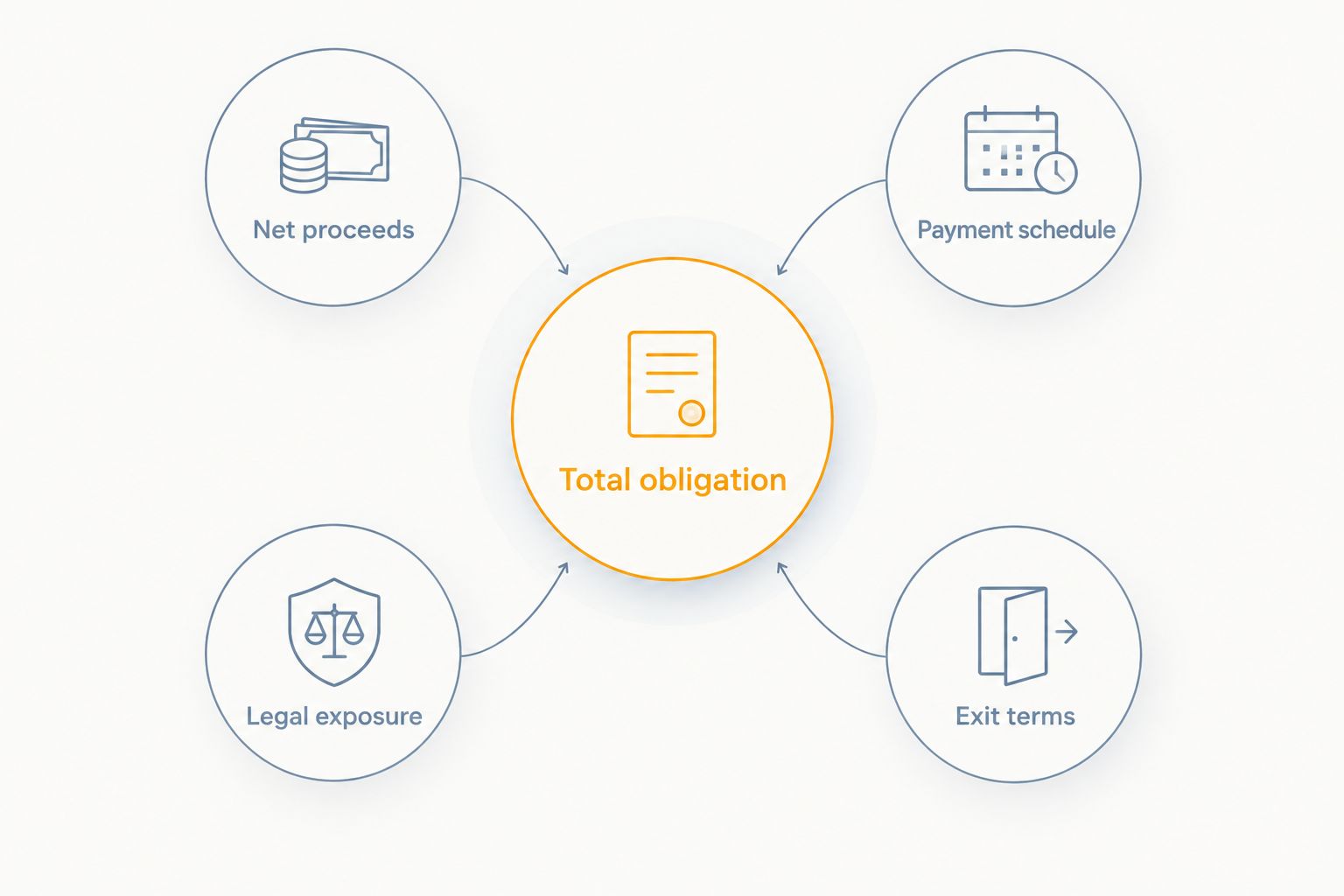
Ask for the payment schedule in writing and place it beside your cash-flow forecast. Revenue is not repayment capacity: payroll, rent, taxes, suppliers and existing obligations still need to be paid.
What risks and disqualifiers should stop an application?
Unsecured generally means no specified collateral secures the loan, but it does not mean the owner has no liability. A personal guarantee creates a separate obligation; a lien concerns a creditor's interest in assets.
Stop and clarify the offer when:
- The advertisement says unsecured but the agreement contains security language you do not understand.
- You need another financing agreement immediately to service the proposed obligation.
- The provider will not explain fees, reconciliation or default provisions.
- The product is a receivables purchase but is presented as an ordinary loan.
- Your request is consumer-purpose or outside the U.S. business-funding audience.
Credit is not irrelevant. Ask how business and personal credit affect the specific program instead of treating no-credit-check language as proof that repayment history does not matter.
What documents should you prepare before comparing offers?
Gather business bank statements, ownership details, formation records, existing financing agreements and a written use-of-funds explanation. Prepare current financial records and identify the customer receipts expected to support repayment or remittances.
Then ask each provider for its current document list. Requirements depend on the program; a generic checklist is preparation, not an underwriting promise.
Include the deadline and consequence of missing it. Contract mobilization, inventory and payroll needs require different timing assessments, even when the requested funding amount is identical.
How were these routes ranked for 2026?
The ranking follows eligibility fit, contract structure, total obligation, cash-flow impact, legal exposure and decision timing. Each route owns a different use case; placement is not a claim that one provider has the lowest cost or approves more startups.
Choose the structure that matches your repayment source before choosing the provider. When no reliable repayment source exists, borrowing is not the default next step.
FAQ
What's the best route for unsecured business loans for startups?
The best route depends on operating revenue, repayment capacity and contract terms. Compare bank loans for defined expenses, lines of credit for recurring gaps, and other structures only after identifying their obligations.
Can a startup get business funding with no revenue?
A startup should not assume that a revenue-based funding route accepts businesses with no revenue. Confirm current eligibility and identify a credible repayment source before applying.
Does unsecured mean I won't sign a personal guarantee?
No. An unsecured loan can still require a personal guarantee, so read the guarantee and security provisions separately.
Is Jon Lynch Financial Group a direct lender?
Jon Lynch Financial Group is a broker, not a direct lender. Business-purpose products are subject to third-party underwriting and the funding partner's terms.
Is a merchant cash advance the same as a business loan?
Not necessarily. Revenue-based financing or a merchant cash advance may be structured as a purchase of future receivables, which requires review of the actual agreement rather than reliance on the marketing label.
How do I compare a factor rate with APR?
A factor rate is a multiplier, while APR expresses annualized borrowing cost. Compare net proceeds, the complete obligation and the timing of payments or remittances before assessing annualized cost.
Which funding route fits a business below $35,000 per month?
U.S.-based entrepreneurs below $35,000 per month can Explore Self-Serve Funding. Applicants securely connect bank statements through Plaid for an automated decision; approval and timing are not guaranteed.
One last thing: is the startup label hiding the real issue?
A new legal entity and a pre-revenue business are not the same underwriting situation. Describe your actual operating history, deposits and ownership accurately rather than relying on the word startup.
For your 2026 comparison, ask every provider to explain the same issue: what happens to the obligation if customer receipts arrive later than expected?
Related guides
- Can a startup get business funding with no revenue yet?
- Is unsecured business funding riskier than secured loans?
- How to compare factor rates on a merchant cash advance
- Business line of credit lenders
What is your next step?
Jon Lynch Financial Group provides business-purpose funding comparisons through third-party partners. Approval, amounts, rates, decisions and funding times are never guaranteed.
Prepare your bank statements and cash-flow forecast: if your U.S. business generates at least $35,000 per month, Compare Business Funding Options; below that threshold, Explore Self-Serve Funding.



