Can a business get funding during Chapter 11 bankruptcy?
Business funding during Chapter 11 is possible with proper authority. Compare DIP financing, cash collateral rules, repayment risks and next steps.

Yes, a business can get funding during Chapter 11 bankruptcy, including debtor-in-possession financing, but the authority required depends on the financing structure and bankruptcy court orders. Secured borrowing and borrowing outside the ordinary course generally require court approval; certain ordinary-course unsecured credit has a different statutory path. A funding offer does not authorize your business to borrow, pledge assets or use restricted cash.
- Business funding during Chapter 11 is possible; borrowing authority, collateral rights and court orders determine the permitted structure.
- Debtor-in-possession financing supplies operating capital during bankruptcy, but priority rights and spending restrictions require close review.
- Cash collateral is not unrestricted cash; creditor consent or court authorization generally controls its use.
- Jon Lynch Financial Group is a business-funding broker, not a direct lender or a substitute for bankruptcy counsel.
Can a business get funding during Chapter 11 bankruptcy?
Yes. Federal bankruptcy law provides routes for obtaining credit while a business reorganizes. Your bankruptcy attorney must match the proposed transaction to the applicable authority before you sign or accept funds.
The distinction matters when comparing business-purpose funding through Jon Lynch Financial Group: a commercial funding comparison does not establish bankruptcy eligibility or court authorization.
| Funding route | Best for | Main benefit | Main constraint |
|---|---|---|---|
| Ordinary-course unsecured credit | Routine operating purchases that meet the statutory standard | Section 364(a) permits qualifying credit without a separate borrowing order unless the court orders otherwise | The transaction must actually qualify as ordinary course |
| Court-authorized unsecured borrowing | Funding needs outside ordinary-course credit | Can provide operating liquidity without a new collateral lien | Requires notice and a hearing under Section 364(b) |
| Secured or priority DIP financing | Businesses needing negotiated operating capital during reorganization | Can offer protections that support a lender's willingness to fund | Requires the applicable statutory findings and court authorization |
| Authorized receivables transaction | Businesses with collectible invoices and a legally permitted structure | Connects liquidity to customer receivables | Existing liens, estate rights and transaction characterization require review |
DIP means debtor-in-possession: a debtor that generally continues operating and managing estate property during the case. DIP financing is financing obtained in that bankruptcy setting, not a standard loan made safe by changing its name.
Why does funding authority matter more than speed?
A business in Chapter 11 operates under bankruptcy law and case-specific orders. The owner cannot assume that pre-bankruptcy authority to borrow or pledge receivables continues unchanged.
For a 2026 funding decision, separate commercial approval from legal authorization. A lender can express interest while the proposed transaction still needs a motion, notice, negotiated protections or an order.
Start with your bankruptcy attorney, not an application promising a quick deposit. Funding that conflicts with existing orders can create a legal problem instead of solving a payroll problem.
Which businesses are positioned to seek financing?
A funding request needs more than a statement that the company is reorganizing. Show how new capital supports continuing operations and where the money to repay it will come from.
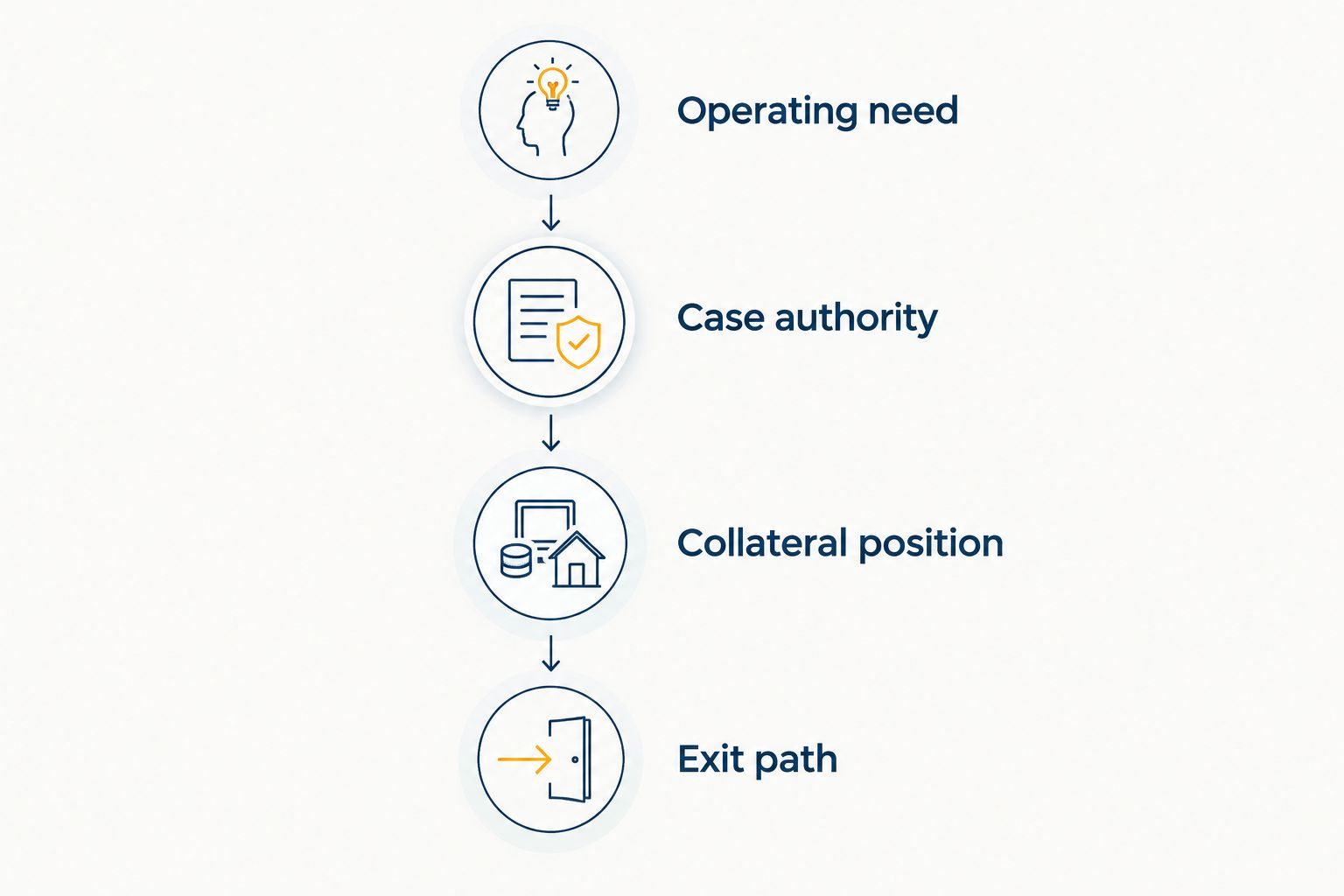
Prepare answers to these questions:
- Operating need: What specific expense will the funding cover?
- Cash generation: Which customer payments support the proposed obligations?
- Collateral position: Which assets are already pledged, and to whom?
- Case authority: Which orders permit or restrict borrowing and cash use?
- Exit path: How does the financing support a sale, refinancing or reorganization?
These are preparation criteria, not a universal lender qualification standard. Revenue, credit history, collateral, financial reporting and case circumstances remain relevant to underwriting.
A business with ongoing sales still needs a workable cash budget. Gross deposits do not show how much cash remains after payroll, taxes, suppliers and authorized bankruptcy expenses.
How does Chapter 11 financing approval work?
Section 364 of the Bankruptcy Code establishes different borrowing routes. The more protection a lender requests, the more closely counsel must examine the statutory requirements and existing creditor rights.
What does ordinary-course unsecured credit allow?
Under 11 U.S.C. Section 364(a), a debtor authorized to operate can generally obtain unsecured credit in the ordinary course, allowable as an administrative expense, unless the court orders otherwise. This is not blanket permission for every unsecured business loan.
Ask counsel whether the proposed obligation qualifies. An unfamiliar financing contract with unusual repayment controls should not be treated as routine supplier credit without legal review.
What changes for borrowing outside the ordinary course?
Section 364(b) allows the court, after notice and a hearing, to authorize unsecured credit outside the ordinary course. The application must address the actual transaction rather than rely on a general statement that the business needs cash.
The court's authorization and the funding agreement must align. Review the approved amount, permitted uses, conditions and reporting obligations together.
What changes when a lender requests liens or priority?
Section 364(c) provides potential priority or lien protections when the debtor cannot obtain qualifying administrative-expense unsecured credit. Section 364(d) addresses financing secured by a senior or equal lien on already-encumbered property, subject to additional requirements, including adequate protection of the affected lienholder.
A proposed senior lien is not automatically available because the business needs funding. Existing creditor rights remain part of the financing decision.
Why isn't cash collateral the same as new funding?
Cash collateral generally includes cash and cash equivalents in which the estate and another entity have an interest. Customer collections can fall within this category when a creditor has applicable rights in the receivables or proceeds.
Under 11 U.S.C. Section 363(c)(2), use generally requires the relevant entity's consent or court authorization. Cash appearing in your bank account is not proof that you can spend it freely.
An authorized cash-collateral arrangement can help maintain operations without a separate new advance. Its limitation is equally important: spending budgets, reporting requirements and adequate-protection terms can restrict how the business uses collections.
For your 2026 funding review, ask counsel whether the immediate problem is insufficient cash, restricted access to existing cash, or both. Those problems require different solutions.
How should you compare the cash-flow impact?
Compare net usable proceeds, total contractual obligations, payment timing and collateral consequences. A headline advance amount does not show what your business can actually spend.
Use this worksheet for every proposed transaction:
| Comparison item | What to request | Why it matters |
|---|---|---|
| Net proceeds | Gross advance minus withheld amounts and required payoffs | Shows usable operating cash |
| Total obligation | All scheduled payments and applicable charges | Shows the full contractual burden |
| Payment timing | Exact withdrawal or payment schedule | Shows pressure before customer collections arrive |
| Collateral rights | Assets, proceeds and accounts subject to liens or control | Shows which operating resources become restricted |
| Case conditions | Required orders, reporting and spending permissions | Shows whether the transaction can close and operate as proposed |
| Exit terms | Maturity, payoff treatment and termination conditions | Shows what must happen before the financing ends |
Build a 13-week cash forecast as a planning tool, not an approval threshold. Break the first 7 days into daily receipts and required payments if an immediate payroll or supplier deadline is driving the request.
For your 2026 comparison, test a delayed-collection scenario alongside the expected case. If the company needs another advance to meet the first financing obligation, the structure needs revision.
A factor rate is a repayment multiplier, not an annual percentage rate. APR incorporates the annualized effect of payment timing and relevant financing charges; a factor rate alone cannot supply that comparison.
Can factoring or revenue-based financing work during Chapter 11?
Potentially, but neither structure bypasses bankruptcy review. Counsel must examine receivable ownership, existing liens, estate interests, applicable orders and whether the proposed transaction requires authorization.
Invoice factoring generally involves selling invoices to a factor. Its practical benefit is linking liquidity to collectible customer obligations; its limitation is that disputed invoices, existing liens and contractual restrictions can obstruct the transaction.
Revenue-based financing may be structured as a purchase of future receivables rather than a loan. Calling an agreement a purchase does not settle its legal characterization or eliminate bankruptcy requirements.
A merchant cash advance also requires careful review of reconciliation provisions, collection rights, default clauses and any personal guarantee. Do not use a receivables purchase as a workaround for borrowing restrictions.
Why does access to Chapter 11 funding vary?
Access depends on the transaction and the case, not a universal bankruptcy funding score. These factors change what can be proposed and authorized:
- Borrowing authority: Ordinary-course credit and secured financing follow different statutory paths.
- Existing liens: Prior creditor rights affect the assets available for new financing.
- Cash-collateral restrictions: Existing orders can limit operating cash and repayment sources.
- Operating performance: Collections and expenses determine whether obligations fit the business.
- Creditor protections: Requested priority and lien changes affect negotiations and required findings.
- Reorganization path: Financing needs a credible purpose within the company's case strategy.
For a 2026 application, disclose the active case immediately. A generic application that omits bankruptcy status wastes review time and can produce an offer that does not fit the legal setting.
What risks should stop you from signing?
Pause when a proposed funder tells you that bankruptcy counsel does not need to review the agreement. The same applies when repayment depends on cash the business is not authorized to use.
Watch for these problems:
- A new lien conflicts with an existing creditor's rights or a court order.
- Automatic withdrawals do not fit the approved operating budget.
- Default provisions trigger consequences the owner has not evaluated.
- A personal guarantee creates exposure outside the company's payment forecast.
- Milestones require a sale or refinancing the business cannot support.
- The proposal assumes court authorization before it has been obtained.
The cheapest-looking offer is not automatically the safest. Conversely, speed does not justify financing that leaves the business unable to meet authorized operating expenses.
What documents should you prepare first?
Ask bankruptcy counsel to identify the current orders and documents a prospective financing source can review. Send a consistent package so the legal and commercial reviews address the same facts.
Include:
- Case number, filing court and counsel's contact information.
- Relevant borrowing and cash-collateral orders.
- Current financial statements and recent bank statements.
- Accounts-receivable and accounts-payable aging reports.
- Existing financing agreements, lien information and guarantees.
- Cash forecast, proposed uses of funds and repayment assumptions.
- A summary of the intended reorganization, sale or refinancing path.
Do not describe this list as a lender's fixed approval checklist. Additional documentation depends on the transaction, the case and third-party underwriting.
FAQ
Can I get a business loan while my company is in Chapter 11?
Yes, Chapter 11 permits borrowing through different statutory routes, but the required authority depends on the transaction. Have bankruptcy counsel review the structure and applicable orders before signing or accepting funds.
Does every Chapter 11 financing agreement need a separate court order?
No, qualifying ordinary-course unsecured credit has a statutory route under Section 364(a), unless the court orders otherwise. Borrowing outside that category requires analysis of the applicable authorization requirements.
Can I use customer payments to cover payroll during Chapter 11?
Customer payments are not automatically unrestricted operating cash. If collections constitute cash collateral, their use generally requires the relevant creditor's consent or court authorization.
Can a merchant cash advance avoid bankruptcy borrowing restrictions?
No, a merchant cash advance is not a safe workaround for bankruptcy restrictions. A purchase-of-future-receivables agreement still requires review of its legal structure, estate interests, creditor rights and applicable orders.
Is funding after bankruptcy the same as funding during Chapter 11?
No, an active Chapter 11 case presents different authority and estate-property issues from financing after a case ends. Disclose the exact case status before requesting a funding comparison.
Does Jon Lynch Financial Group guarantee Chapter 11 financing?
No, Jon Lynch Financial Group does not guarantee approval, amounts, rates or funding times. It is a broker, not a direct lender, and a funding inquiry does not establish that a third-party partner accepts active Chapter 11 cases.
What should I do before applying for Chapter 11 business funding?
Ask bankruptcy counsel to identify the financing structures and cash uses your case permits. Then prepare current financial records, relevant orders and a cash forecast for a targeted review.
What should you read next?
- Can you get a business loan after a recent bankruptcy?
- Is a merchant cash advance considered a loan?
- How to compare factor rates on a merchant cash advance
What disclosures apply to this 2026 guide?
This article provides general business-financing information, not legal advice. Legal references concern U.S. business bankruptcy: 11 U.S.C. Sections 363 and 364; your case orders and counsel's advice control the transaction-specific analysis.
Jon Lynch Financial Group is best for U.S. business owners comparing business-purpose funding, not for replacing bankruptcy counsel. It is a broker, not a direct lender; products are subject to third-party underwriting, and no active-bankruptcy funding eligibility is represented here.
What's the practical next step?
Get counsel's permission to explore a specific structure before seeking offers. That keeps a business funding comparison tied to what your company can legally accept and repay.
After counsel clears the inquiry, businesses generating at least $35,000 per month can choose Compare Business Funding Options. Businesses below $35,000 per month can choose Explore Self-Serve Funding, while disclosing the active case and confirming eligibility before proceeding; neither route overrides bankruptcy requirements.
Choose your business funding route
After counsel clears your inquiry, choose the route that matches your monthly business revenue.