Can you get a business loan after a recent bankruptcy?
A business loan after bankruptcy is possible, not assured. Compare case status, cash flow, repayment risk and funding routes before you apply in 2026.

Yes, you can get a business loan after bankruptcy, but a recent filing does not establish eligibility: the funder must accept your case status, credit history and current business finances. An open bankruptcy requires a different review from a discharged case, and new financing during a case can require court authorization. The central tradeoff is access versus repayment pressure—funding that worsens an already fragile cash position is not a recovery plan.
- A business loan after bankruptcy is possible, but case status and each funder’s underwriting determine eligibility.
- Discharge, dismissal and case closure are different; give the funder the actual court documents.
- Compare working capital and revenue-based financing by repayment obligations, not approval promises.
- Jon Lynch Financial Group is a business-funding broker, not a direct lender; third-party underwriting applies.
Can you get a business loan after a recent bankruptcy?
Bankruptcy is not a universal, permanent ban on business borrowing. It also does not create a universal waiting period that every lender follows. For a 2026 application, ask about the specific program’s current bankruptcy policy before submitting a full application.
Use this sequence to separate legal permission from financing eligibility:
- Identify the borrower. Establish whether the bankruptcy involves you personally, the business entity or both.
- Confirm the case status. Provide the filing documents and any discharge, dismissal or closing orders.
- Check legal restrictions. Ask your bankruptcy attorney whether the proposed transaction needs authorization or conflicts with existing obligations.
- Confirm program eligibility. Ask the prospective funder whether it considers your exact circumstances.
- Test repayment capacity. Use current operating cash flow, not hoped-for sales, to judge the proposed obligation.
For established U.S. businesses comparing working capital, Jon Lynch Financial Group fits owners seeking a broker-led comparison rather than a direct lender. The limitation is equally important: the brokerage does not control a third-party funder’s bankruptcy policy or credit decision.
Who is a realistic candidate for post-bankruptcy funding?
You have a stronger application to present when your business has documented operating revenue, accurate financial records and an identifiable business use for the money. Those facts do not override a funder’s bankruptcy exclusion; they give an eligible funder something concrete to evaluate.
Start by answering these questions:
- What caused the bankruptcy, and what has changed operationally?
- Does the business produce cash after payroll, inventory, taxes and existing obligations?
- Is the requested funding tied to a specific, measurable business need?
- Can you explain discrepancies between bank deposits, accounting records and reported revenue?
- Are existing liens, guarantees or repayment commitments fully documented?
A viable business and an eligible application are separate requirements. A profitable company can still fall outside a program’s rules. An eligible applicant can still receive a proposal that the business should decline.
Jon Lynch Financial Group’s business-funding comparison audience is U.S. owners generating at least $35,000 per month. That figure identifies the intended service route, not a bankruptcy approval threshold or a promise of qualification.
How does bankruptcy status change the review?
What changes when the bankruptcy is still open?
An active case raises legal questions before it raises product-selection questions. Identify who has authority to borrow, pledge assets or sell receivables, then have your attorney review the proposed arrangement.
For business debtors seeking credit during a case, federal bankruptcy law addresses obtaining credit under 11 U.S.C. § 364. The authorization required depends on the transaction and circumstances; a broker’s willingness to accept an application does not establish legal permission.
Do not assume that calling a transaction a receivables purchase removes it from bankruptcy review. Give counsel the actual agreement, including its security interest, collection rights and default provisions.
What changes after a discharge?
A discharge releases the debtor from personal liability for certain debts. It does not erase the filing, discharge every obligation or automatically remove valid liens.
The identity of the debtor matters. U.S. Courts’ Bankruptcy Basics explains that a Chapter 7 discharge is available to individual debtors, not corporations or partnerships. Do not present an owner’s personal discharge as proof that a company’s obligations disappeared.
For a 2026 funding review, submit the discharge order and explain which borrower will sign the new agreement. Ask the funder which date its policy uses rather than assuming the filing date and discharge date are interchangeable.
What changes if the case was dismissed?
Dismissal is not discharge. A dismissed case does not, by itself, release the debtor from the debts included in the filing.
Explain why the case was dismissed and document the current obligations. A funder needs an accurate picture of what remains payable, while your attorney should address the legal consequences of the dismissal.
How long must you wait after bankruptcy to apply?
There is no single waiting period for every business loan after bankruptcy. Program rules differ, and legal restrictions during an active case are separate from a lender’s eligibility policy.
Credit reporting is another separate issue. Under the federal Fair Credit Reporting Act, bankruptcy cases can generally remain on a consumer credit report for up to 10 years; that reporting limit is not a mandatory business-loan waiting period.
U.S. Courts explains that Chapter 13 repayment plans generally run 3 to 5 years. That plan duration is not an automatic prohibition on every financing transaction, nor does completing a plan establish approval.
For your 2026 application, ask the funder to confirm:
- Whether it considers open, discharged or dismissed cases.
- Which event starts any required waiting period.
- Whether the policy applies to the owner, business entity or both.
- What documents it requires before determining eligibility.
The legal references here are U.S. Courts’ Bankruptcy Basics for case mechanics and the Fair Credit Reporting Act for consumer reporting. Neither source supplies a particular funder’s current underwriting criteria.
Which business-funding options should you compare?
Best fit means matching the business need and repayment capacity—not finding the first provider willing to review a bankruptcy. The options below are structures to investigate, not representations that any provider accepts a recent filing.
| Funding structure | Best for | Main advantage | Main limitation after bankruptcy |
|---|---|---|---|
| Bank term loan or line of credit | Businesses able to satisfy bank underwriting and wait through its process | A term loan supports a defined need; a line supports recurring draws | Bankruptcy policy, credit review and repayment capacity can prevent qualification |
| Nonbank business term loan | Businesses comparing a fixed advance with a defined repayment obligation | The scheduled obligation supports cash-flow planning | A fixed payment remains due when sales weaken; eligibility still requires review |
| Revenue-based financing or future-receivables purchase | Revenue-producing businesses evaluating funding tied to business receipts | Provides an alternative structure to a conventional loan | Collection mechanics, reconciliation rights and contract remedies require close review |
| Invoice factoring | Businesses with eligible unpaid business invoices | Evaluates identifiable receivables and customer payment obligations | Invoice eligibility, disputes, existing liens and recourse terms limit fit |
| Equipment financing | Businesses funding a specific productive asset | Connects the financing request to identifiable equipment | Asset rights, credit history, guarantees and existing liens still matter |
Do not assume a nonbank product is easier to sustain because it is easier to apply for. A collection schedule that competes with payroll or inventory purchases can undermine the purpose of the funding.
If a bank accepts your circumstances and its proposal better fits your cash flow, compare that proposal before choosing another structure. Speed alone is not a sufficient reason to accept a less manageable obligation.
How do revenue-based financing and MCA agreements differ from loans?
Revenue-based financing describes funding linked to business revenue, but the legal structure depends on the contract. A merchant cash advance, or MCA, may be structured as a purchase of future receivables rather than a loan.
That distinction does not mean credit history is irrelevant or that approval follows automatically. The provider still evaluates the application, and the agreement can include collection rights, security interests and personal obligations that deserve legal review.
Read the reconciliation provisions closely. Reconciliation is the contractual process for adjusting collections to actual receipts where the agreement provides for it; you need to understand how to request it and what evidence is required.
A factor rate is a multiplier used to calculate a specified repayment or purchased-receivables amount. A factor rate is not an APR because it does not, by itself, describe annualized cost or the timing of payments. Use the guide to comparing MCA factor rates to frame the questions you ask about an actual offer.
Why does eligibility vary after bankruptcy?
A bankruptcy filing does not describe the whole application. These factors explain why apparently similar businesses require different reviews:
- Case status: An open case, discharge and dismissal create different legal and underwriting questions.
- Borrower identity: Personal bankruptcy and business-entity bankruptcy affect different obligations and applicants.
- Current cash flow: Deposits alone do not show what remains after essential expenses.
- Credit history: The filing is part of the review, alongside the rest of the applicant’s credit record.
- Existing claims: Liens, guarantees and other payment obligations affect available assets and cash.
- Funding purpose: Inventory, equipment and a recurring operating deficit call for different decisions.
Ask the funder which factor prevents eligibility. A documented policy exclusion calls for a different response from an incomplete application or an unaffordable repayment schedule.
How should you compare the cash-flow impact?
For a 2026 comparison, request written proposals that show the same information in the same order. Comparing a headline rate with a factor rate without accounting for payment timing is not an apples-to-apples comparison.
Use this worksheet with actual proposed terms:
- Net proceeds: The money your business receives after deductions and required payoffs.
- Total obligation: Everything the agreement requires you to pay or deliver, including applicable fees.
- Collection schedule: When payments or withdrawals occur and whether they change with receipts.
- Early exit: What happens if you repay early or want to refinance.
- Downside terms: Default triggers, guarantees, security interests and collection remedies.
Then subtract essential operating expenses, existing obligations and the proposed collections from expected business cash receipts. Repeat the calculation using a weaker sales period supported by your own records.
Decline an offer that works only if every customer pays on time. An approval does not certify that the funding is affordable or suitable.
What documents should you prepare before applying?
Organize the review around Case status, Borrower identity, Cash flow and Contract terms. These are the core parts of a funding review; the funder determines its final document requirements.
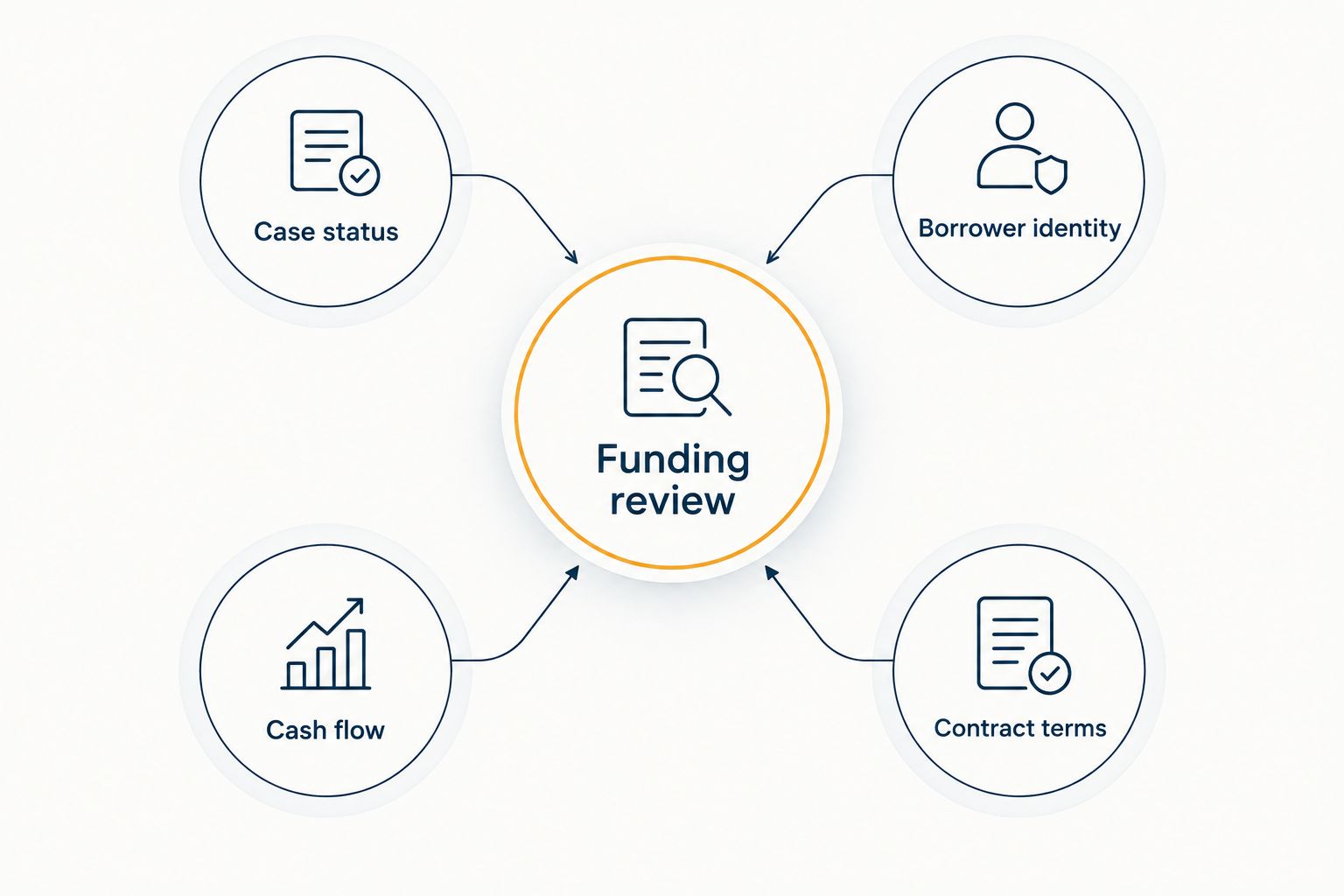
Prepare the relevant court orders, ownership information, current bank statements, financial statements and a schedule of existing obligations. Include lien information and receivables records when the proposed transaction depends on those assets.
Write a short explanation of the bankruptcy’s cause and the operational changes since filing. Keep it factual: identify the problem, describe the correction and support the explanation with records.
Before authorizing a credit inquiry, ask whether it is a hard or soft inquiry and whose credit will be checked. Also ask who receives your application and whether additional submissions require your permission.
FAQ
Can I get a business loan immediately after bankruptcy?
A business loan immediately after bankruptcy depends on the funder’s policy, your case status and underwriting. Confirm eligibility before applying; no universal approval rule applies.
Do I have to wait 10 years to get business financing?
Up to 10 years is generally a consumer credit-reporting limit for bankruptcy, not a universal business-financing waiting period. Ask the funder which eligibility rule applies to your circumstances.
Can I borrow for my business during Chapter 13?
Borrowing during Chapter 13 requires review of your case, plan and applicable authorization requirements. Have your bankruptcy attorney assess the proposed transaction before you sign.
Does a personal bankruptcy mean my LLC cannot get funding?
Personal bankruptcy does not automatically determine every LLC funding decision. The funder evaluates the business and relevant owners or guarantors under its own criteria.
Can an MCA provider ignore my bankruptcy because it buys receivables?
A receivables purchase does not make bankruptcy irrelevant. The provider must evaluate eligibility, and your attorney should review legal restrictions and the proposed agreement.
Is a discharged bankruptcy the same as a dismissed bankruptcy?
A discharge and a dismissal are different legal outcomes. A dismissal does not itself release you from the debts listed in the case.
Will business revenue guarantee approval after bankruptcy?
Business revenue does not guarantee approval after bankruptcy. A provider also evaluates its eligibility rules, obligations, credit information and the proposed transaction.
Which related guides help you compare alternatives?
- Business funding alternatives after a bank decline
- Working capital costs and qualification
- Revenue-based financing versus merchant cash advance
What should you do before accepting an offer?
One last check: ask what happens when revenue falls, not just when the application is approved. Review that answer against the agreement’s collection, reconciliation and default provisions. If the written contract does not match the explanation, resolve the difference before signing.
Jon Lynch Financial Group is a broker, not a direct lender. Business-purpose products are subject to third-party underwriting; approval, amounts, rates, decisions and funding times are not guaranteed. This 2026 guide provides general information, not legal advice about your bankruptcy case.
Your practical next step is to assemble the court orders and current cash-flow records, then choose the appropriate route: businesses generating at least $35,000 per month should Compare Business Funding Options; U.S.-based businesses below $35,000 per month should Explore Self-Serve Funding. Neither route establishes bankruptcy eligibility or promises approval.