Can declining monthly revenue disqualify you from funding?
Declining revenue business funding qualification depends on cash flow and product fit. Learn what to document, compare and check before you apply.

Yes—declining monthly revenue can disqualify you from business funding, but a decline alone does not establish whether you qualify. The decision depends on the funding program, the cause of the decline and whether your business can support the proposed repayment or remittance. Compare the obligation against current cash flow, not the revenue level your business used to generate.
- Declining revenue business funding qualification depends on current cash flow, product requirements and the explanation behind falling sales.
- Jon Lynch Financial Group is a business funding broker for U.S. owners comparing third-party options.
- Revenue-based financing can involve purchasing future receivables; inspect remittance and reconciliation terms before signing.
- The $35,000 monthly revenue threshold determines the brokerage route, not guaranteed funding eligibility.
Can declining monthly revenue disqualify you from funding?
Yes. A decline can put your business outside a particular program’s requirements or leave insufficient cash to support another obligation. There is no single decline percentage that determines qualification across all business-funding products.
Jon Lynch Financial Group helps U.S. business owners compare third-party funding options. It is a broker, not a direct lender; each lender or funder applies its own underwriting requirements.
Use this comparison to separate the cause of falling revenue from the decision you need to make:
| Revenue situation | Evidence to prepare | Main concern | Practical next move |
|---|---|---|---|
| Recurring seasonal slowdown | Comparable seasonal results and current collections | Supporting obligations during the low period | Test the proposed schedule against low-season cash flow |
| Delayed customer payments | Outstanding invoices, due dates and payment history | Cash arrives after expenses fall due | Compare receivables-based options if the invoices qualify |
| Loss of a major customer | Updated sales records and expense reductions | The old revenue base no longer exists | Rebuild the cash-flow forecast before requesting funding |
| Continuing operating losses | Current financial statements and a corrective plan | New obligations deepen the shortfall | Address the operating deficit before adding payments |
A documented timing gap is different from a business that no longer generates enough cash to meet its obligations. Neither situation guarantees approval or denial, but the distinction changes what you should compare.
Why does declining revenue matter when you need working capital?
Revenue measures sales, not the cash left after operating expenses and existing obligations. A business can retain substantial revenue while losing the room needed for additional payments.
For a 2026 funding decision, start with the money your business collects and the expenses it must pay now. An older annual total does not show whether next month’s payroll, inventory and funding obligations fit together.
Funding also needs a defined purpose. Buying inventory against documented demand is a different decision from borrowing to cover an unexplained recurring loss. Write down what the capital will accomplish and where the money to meet the obligation will come from.
Who should still compare funding after revenue falls?
You have a stronger basis for comparison when you can explain the decline, document the current position and identify a workable source of repayment or receivables. That is preparation for underwriting—not an approval rule.
Useful explanations include a seasonal sales pattern, a documented collection delay or a completed operational change. Support the explanation with records rather than describing the decline as temporary without evidence.
Jon Lynch Financial Group’s primary business funding audience is established U.S. businesses generating at least $35,000 per month. Businesses below that level have a separate self-serve route; the threshold does not establish eligibility for every third-party program.
If your recent revenue has crossed below $35,000 per month, disclose the current figure. Do not choose an older, higher month simply to fit an application route.
How do you assess qualification before applying in 2026?
Prepare a funding assessment that connects the decline to your cash position. Follow these steps before comparing offers:
- Explain the decline. Identify when it began, what changed and which records support the explanation. Separate lost sales from delayed collections.
- Reconcile deposits. Match bank activity to operating revenue. Identify transfers, owner contributions and financing proceeds separately so they do not inflate the sales picture.
- Map cash obligations. List operating expenses, taxes and existing funding payments or remittances. Use actual payment dates, not just monthly totals.
- Test the proposal. Add the proposed obligation to the current cash-flow schedule. Check whether the business can still meet essential expenses without assuming an unsupported recovery.
- Confirm requirements. Ask the lender or funder which current program requirements apply, what documentation is needed and what remains subject to verification.
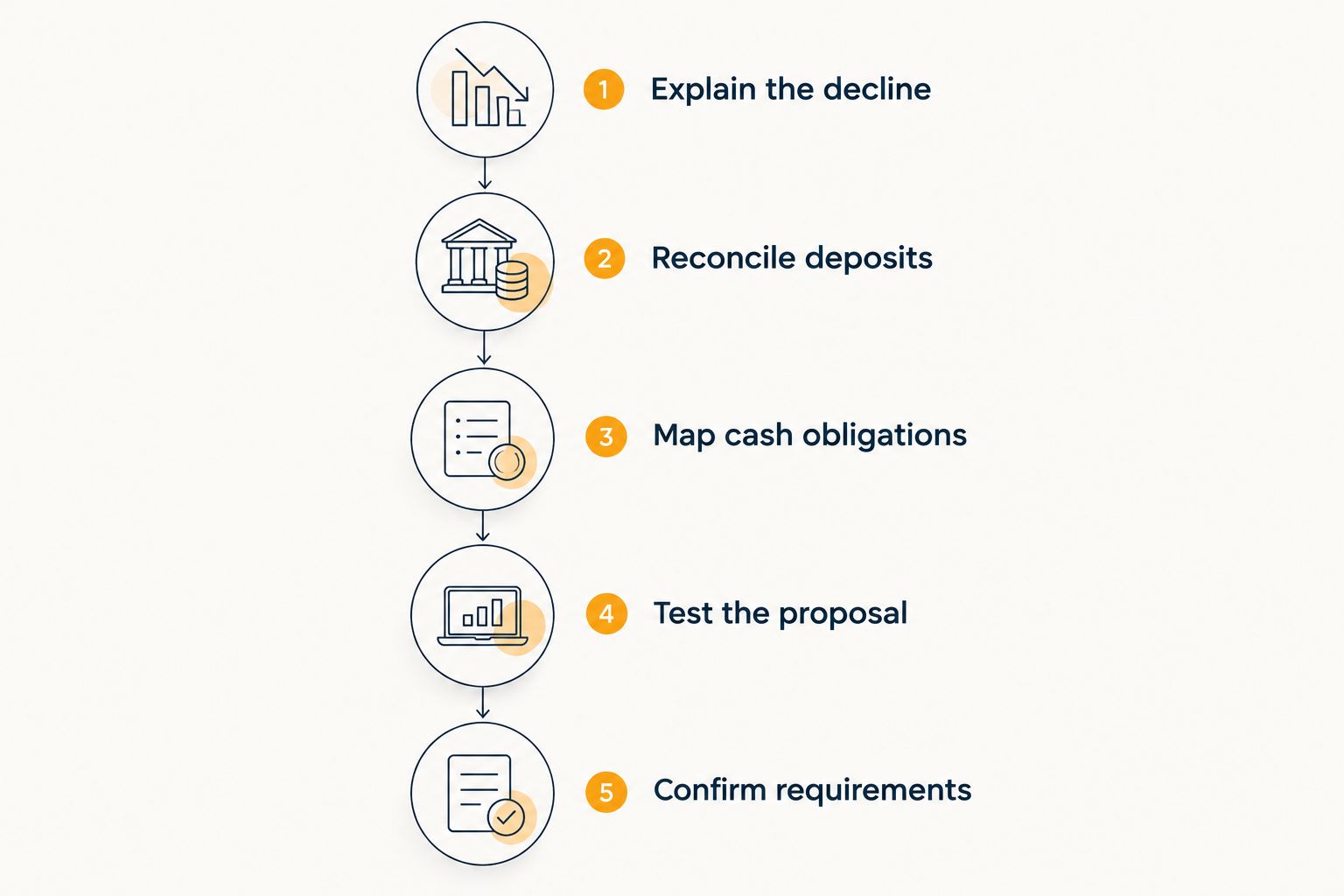
This process does not predict an underwriting decision. It helps you avoid requesting a structure that conflicts with your current cash position or submitting records that tell different stories.
What numbers should you compare when revenue is falling?
For your 2026 comparison, ask for the net amount your business receives, the total contractual obligation and the payment or remittance schedule. Compare proposals on the same basis, including any amounts withheld from proceeds.
Use these calculations with figures from your own records and written offers:
- Revenue change: current-period revenue minus prior-period revenue.
- Percentage decline: the revenue decrease divided by prior-period revenue, expressed as a percentage.
- Cash remaining: actual collections minus operating expenses and existing obligations.
- Post-funding cash remaining: cash remaining minus the proposed payment or remittance.
A positive monthly total can still hide a payment-date problem. Place withdrawals beside payroll, rent and supplier due dates to see whether cash runs short between customer payments.
Do not treat a factor rate as an APR. A factor rate is a multiplier used to calculate a contractual amount; APR is an annualized measure that accounts for financing timing and applicable costs. A factor rate alone does not show the annualized cost or whether the schedule fits your cash flow.
Which funding structures deserve comparison after a revenue decline?
Choose the structure that matches the cash-flow problem, not the one with the easiest application. These are comparison categories, not recommendations that your business qualifies.
| Option | Best for | What it does | Main limitation to examine |
|---|---|---|---|
| Business line of credit | Recurring gaps with an identifiable repayment source | Allows borrowing within an approved limit under the agreement | Draw conditions, variable costs and repayment obligations |
| Term loan | A defined business expense with a supportable repayment plan | Provides financing repaid over an agreed term | Scheduled payments continue under the contract despite weaker sales |
| Invoice factoring | Eligible business invoices awaiting customer payment | Converts qualifying receivables into cash through a sale arrangement | Customer eligibility, recourse, fees and collection terms |
| Revenue-based financing or MCA | Businesses comparing obligations tied to future business receipts | Can be structured as a purchase of future receivables | Remittance mechanics, reconciliation terms and cash-flow impact |
| Operating changes before funding | A continuing deficit without a supported repayment source | Reduces the gap through collections, expense changes or negotiated timing | Does not provide new outside capital |
For seasonal declines, compare the proposed obligation with the low season rather than the annual average. The guide to revenue-based financing for seasonal businesses addresses that specific comparison.
A slower option is better when it meets your deadline and leaves the business with a more manageable obligation. Speed does not correct an unaffordable structure.
Why does declining revenue business funding qualification vary?
These factors explain why the same revenue trend does not produce the same decision under every program. Confirm how each applies to the specific offer:
- Program requirements: A loan and a purchase of future receivables have different structures and contractual obligations.
- Cause of decline: A lost customer and a late-paying customer present different cash-flow problems.
- Remaining cash flow: Gross revenue does not account for operating expenses and existing payments.
- Existing obligations: Current debt, remittances and contractual restrictions affect what another arrangement would require.
- Supporting records: Bank activity, financial statements and receivables records need to support the application’s explanation.
- Credit and security requirements: Credit, guarantees and collateral remain relevant where the program requires them.
Do not assume revenue-based financing makes credit irrelevant. Ask what role personal credit, business credit, guarantees and security interests play in the actual program.
Does revenue-based financing automatically adjust when sales fall?
No. The label alone does not establish how remittances change when revenue declines; the agreement controls the mechanism.
Revenue-based financing, including products marketed as merchant cash advances or MCAs, may be structured as a purchase of future receivables rather than a loan. Read the actual contract instead of assuming every product with the same label works identically.
Ask whether remittances reflect actual receipts, whether reconciliation is available and how to request it. Also check required evidence, processing terms and what happens while a request is under review. Do not assume a scheduled withdrawal automatically falls when sales fall.
Can strong credit offset declining monthly revenue?
Strong credit does not establish that the business can support a new obligation. Credit history and current cash generation answer different questions.
Present both accurately. Ask the provider to explain the applicable credit requirements and how it assesses the recent revenue trend, rather than assuming one favorable measure cancels out another concern.
Should you apply immediately after a bank decline?
A bank decline is a reason to understand the decision before selecting another product. Ask for the stated reasons and distinguish documentation problems from concerns about repayment capacity.
If the issue is insufficient cash flow, another offer still needs to pass your cash-flow test. If the issue is incomplete documentation, correct the file before repeating the same application elsewhere.
What risks should stop you from signing?
Pause when an offer requires a sales rebound you cannot support with evidence. Funding should not depend on a forecast presented as though it were already collected revenue.
Other reasons to stop and clarify include:
- Payment or remittance dates conflict with essential operating expenses.
- The written agreement differs from the explanation you received.
- You cannot identify the total obligation or applicable fees.
- Existing agreements restrict additional funding.
- You do not understand a personal guarantee, security interest or default provision.
- The business needs repeated new funding simply to meet existing obligations.
In a 2026 comparison, approval is not the finish line. An offer that leaves the business unable to operate is not a workable solution, even if a provider approves it.
What documents should you prepare next?
Prepare the records requested by the actual provider. A useful starting file includes current business bank statements, financial statements, an existing-obligation schedule and a written explanation of the revenue decline.
Add receivables records when collection delays drive the gap, and supporting contracts when future work forms part of your explanation. Keep projected sales separate from completed sales and collected cash.
Ask which reporting periods and document formats the program requires. Do not assume a generic checklist replaces the provider’s current requirements.
FAQ
Can declining revenue automatically disqualify my business from funding?
Declining revenue can disqualify your business under a particular program, but there is no universal outcome across all funding structures. Current cash flow, documentation and the provider’s underwriting requirements determine the decision.
What percentage revenue decline is too much for business funding?
There is no single percentage decline that determines qualification across every business-funding program. Ask the actual lender or funder which current requirements apply and how it evaluates your revenue trend.
Can I qualify if my business still makes $35,000 per month?
Generating $35,000 per month fits Jon Lynch Financial Group’s primary brokerage audience, but it does not guarantee funding qualification. Third-party underwriting and product requirements still apply.
Is seasonal revenue decline different from losing a major customer?
Seasonal revenue decline and losing a major customer require different explanations and supporting records. Historical seasonal results can document a recurring pattern; a lost customer requires an updated assessment of the remaining revenue base.
Does an MCA payment drop automatically when sales decline?
An MCA remittance does not automatically change merely because sales decline. Review the agreement’s remittance and reconciliation provisions, including how adjustments are requested and processed.
Should I hide a recent revenue decline on my application?
No—report revenue accurately and explain the decline with supporting records. Identify financing proceeds, transfers and owner contributions separately from operating revenue.
What should I do if monthly revenue is below $35,000?
Businesses below $35,000 per month should use the Explore Self-Serve Funding route. The path is open to U.S.-based entrepreneurs, uses a secure Plaid bank connection and remains subject to eligibility and verification.
What is the one last check before choosing funding?
Reconcile sales, deposits and available cash before you compare offers. Those figures answer different questions, and confusing them can make an obligation look affordable when it is not.
For your 2026 decision, use current records and written terms. A smaller request, a different structure or waiting while you correct the deficit deserves consideration when the proposed obligation fails that check.
Related guides
- Working capital loans: costs and qualification
- How much revenue do you need for revenue-based financing?
- Revenue-based financing vs. merchant cash advance
What is your next step?
Jon Lynch Financial Group is a broker, not a direct lender. Funding is for business purposes and subject to third-party underwriting; approval, amounts, rates, decisions and funding times are not guaranteed.
Choose your route using current monthly revenue: Compare Business Funding Options if your U.S. business generates at least $35,000 per month; Explore Self-Serve Funding if it generates less.



