Can you get a business loan with an active tax lien?
A business loan with tax lien is possible, not assured. Compare lien priority, payment-plan proof, cash-flow fit and funding risks before you apply.

Yes, you can get a business loan with tax lien exposure, but approval depends on the lender’s policy, the lien’s effect on collateral and your ability to repay. An active payment agreement does not automatically remove the lien, so you must address both the tax obligation and the new funding payment before accepting financing.
- A business loan with tax lien exposure is possible; lender policy and lien priority determine the path.
- An IRS installment agreement does not automatically release a federal tax lien.
- Jon Lynch Financial Group is a broker, not a direct lender; third-party underwriting controls funding decisions.
- Compare working capital and revenue-based financing only after accounting for tax payments and existing obligations.
Can you get a business loan with an active tax lien?
An active tax lien is a financing obstacle, not a universal prohibition on borrowing. Your application needs to establish who owes the tax, which assets are affected and whether the proposed lender can accept its position behind the tax authority.
For a 2026 application, compare working capital costs and qualification alongside the lien requirements—not as separate decisions.
| Tax situation | What it means for financing | Evidence to prepare |
|---|---|---|
| Active lien without a payment agreement | The unpaid obligation and collection exposure remain unresolved | Tax notices, current balance and proposed resolution |
| Active lien with an installment agreement | Documents a repayment arrangement but does not automatically clear collateral | Agreement and payment history |
| Subordination approved | Allows a specified creditor to move ahead of the federal tax lien under the approval’s terms | Subordination certificate and transaction details |
| Specific property discharged | Removes the federal lien from particular property, not necessarily everything you own | Discharge certificate identifying the property |
| Lien released | Ends the lien covered by the release | Release document and updated tax records |
Federal and state procedures differ. Ask your tax professional to identify the authority and confirm the status before a financing application relies on any assumed resolution.
Who does financing with a tax lien fit?
Financing deserves consideration when your business can support current taxes, the existing tax arrangement and a new obligation without depending on another advance. The funding should solve an identifiable business need, such as inventory or contract mobilization, rather than conceal an ongoing operating loss.
Jon Lynch Financial Group is best for established U.S. business owners comparing third-party business funding, not owners seeking a direct lender. Its primary comparison route serves businesses generating at least $35,000 per month; that audience threshold is not a tax-lien approval standard.
Through Jon Lynch Financial Group, you can compare business-purpose options subject to third-party underwriting. Disclose the lien at the outset so the review starts with the actual financing constraints.
A different decision applies when your tax agreement is already unaffordable. Adding another payment does not fix that shortfall; establish a workable tax and operating plan before committing future cash flow.
How does a tax lien affect your business assets?
A federal tax lien is the government’s legal claim against property for unpaid tax debt. A levy is different: it involves taking property to satisfy the debt.
Under Internal Revenue Code Section 6321, the federal lien can reach the taxpayer’s property and rights to property. Identifying the taxpayer matters: an owner’s personal obligation and a company’s obligation are not interchangeable, and business structure affects the analysis.
A Notice of Federal Tax Lien publicly alerts creditors to the government’s claim. Priority—the order in which creditors have rights to assets or proceeds—depends on the applicable law, filing facts and any approved changes.
For your 2026 financing review, give the lender the actual notice rather than a verbal summary. A tax professional or attorney should explain the legal effect; the lender should explain whether that effect is acceptable under its program.
Does an IRS payment plan make you eligible?
An IRS installment agreement does not automatically make you eligible for business financing. It establishes a payment arrangement, but the lender still evaluates its policy, your repayment capacity and any collateral conflict.
Prepare the signed agreement, evidence of payments and a current balance. Also distinguish an accepted agreement from an application that is still pending.
Do not describe the lien as “resolved” merely because payments have started. Use precise language: the agreement is active, payments are current if documented, and the lien remains in place unless a separate action changes it.
Ask each prospective lender:
- Does this program consider applicants with this type of active lien?
- Is an accepted installment agreement required?
- What payment history must the applicant document?
- Is subordination, discharge or release required before closing?
- Must any proceeds go directly toward the tax obligation?
Get transaction-specific answers. Another business owner’s approval does not establish your eligibility.
Can subordination or discharge help you borrow?
Federal tax-lien subordination and discharge address different problems. Neither is an automatic approval, and neither should be treated as a promise that financing will close.
| Action | What it changes | Best for | Limitation |
|---|---|---|---|
| Installment agreement | Establishes a tax-payment arrangement | Organizing repayment of the tax balance | Does not automatically remove the lien |
| Subordination | Permits a specified creditor to move ahead of the federal lien | A transaction requiring an acceptable creditor position | Does not eliminate the tax debt |
| Discharge | Removes the lien from specified property | A transaction involving particular property | Does not necessarily remove the lien from other assets |
| Release | Ends the lien covered by the release | Documenting that the lien has ended | Requires a qualifying basis; an application alone changes nothing |
The IRS addresses discharge and subordination under Internal Revenue Code Section 6325. Its Understanding a Federal Tax Lien guidance also distinguishes release from withdrawal: withdrawing a public notice does not itself mean the tax debt disappears.
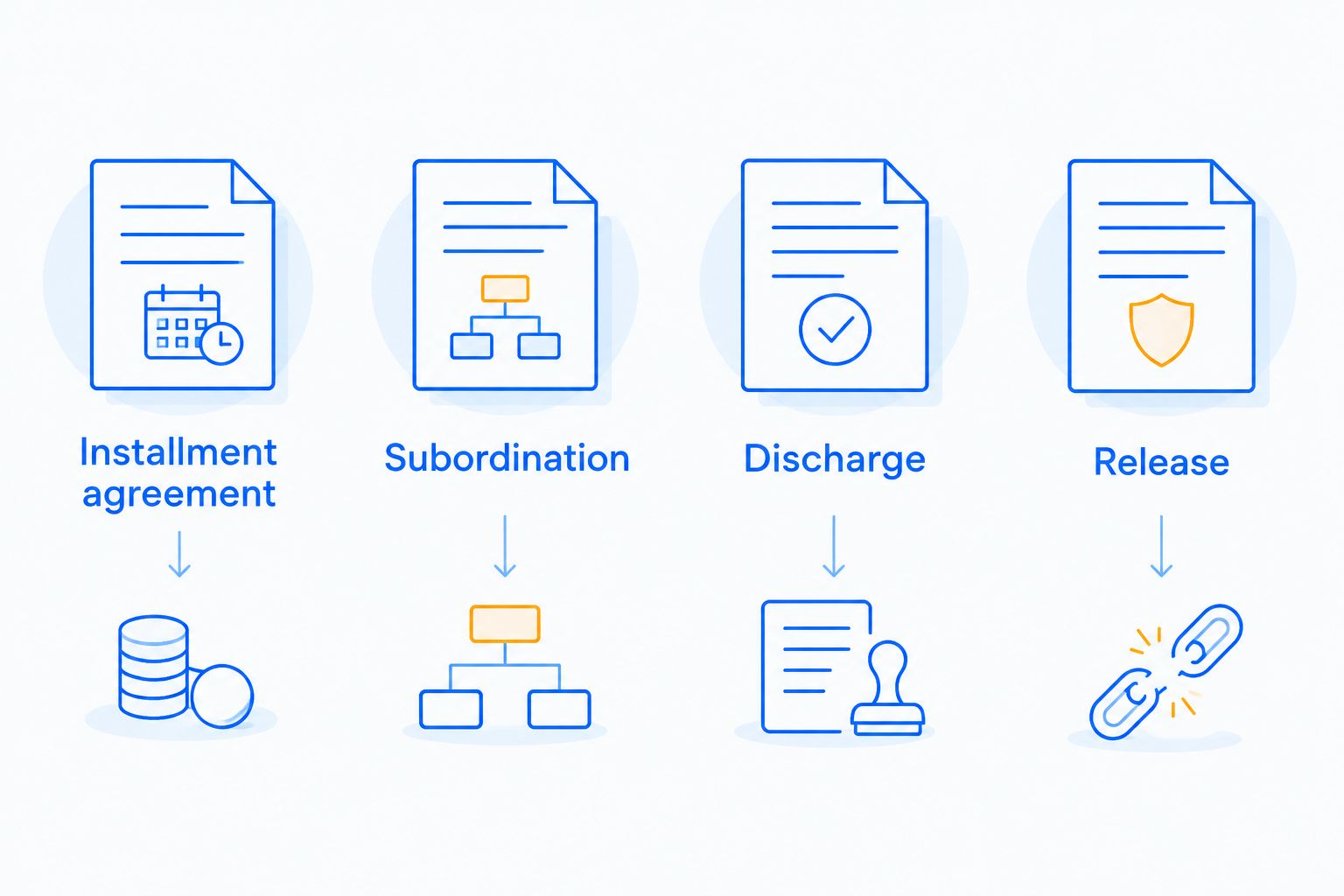
Ask the lender which action the transaction actually requires before requesting it from the tax authority. Otherwise, you risk pursuing paperwork that does not satisfy the financing condition.
Which funding options should you compare?
Compare structures by repayment source and lien compatibility—not by which application sounds easiest. No category below establishes that a particular provider accepts active tax liens.
| Option | Best for | Potential advantage | Main limitation with a tax lien |
|---|---|---|---|
| Business term loan | A defined business expense with a repayment plan | Scheduled payments support budgeting | Lender policy and collateral priority can prevent approval |
| Business line of credit | Recurring working-capital gaps | Draws can match changing needs | Availability remains subject to underwriting and agreement terms |
| Invoice factoring | Businesses with eligible customer invoices | Connects funding to receivables | The factor must evaluate competing claims to those receivables |
| Equipment financing | A specific equipment purchase | Financing relates to an identifiable asset | Existing claims and the required security position still matter |
| Revenue-based financing | Businesses evaluating funding against future revenue | Adds another structure to the comparison | Remittances can strain cash flow; liens still require review |
Revenue-based financing may be structured as a purchase of future receivables rather than a loan. A merchant cash advance, or MCA, commonly uses that purchase structure; the contract determines the obligations, reconciliation provisions and remedies.
A receivables purchase does not make a tax lien irrelevant. The funder still needs to evaluate claims affecting the purchased receivables and the business’s ability to perform under the agreement.
For a 2026 comparison, request the net proceeds, total contractual payment or purchased amount, payment frequency, fees, security terms and default provisions. Do not compare a factor rate directly with an annual percentage rate: a factor rate is a multiplier, while APR expresses annualized borrowing cost using timing and other applicable inputs.
Why do tax-lien financing decisions vary?
Financing decisions vary because the lien and the proposed transaction must work together. Review these factors before submitting applications:
- Tax authority: Federal and state liens follow different procedures and rules.
- Taxpayer identity: Confirm whether the obligation belongs to the company, an owner or both.
- Affected assets: Identify whether the proposed collateral or receivables are subject to the claim.
- Payment status: Separate an accepted, current agreement from missed payments or a pending request.
- Available cash flow: Include taxes, existing financing, operating expenses and the proposed payment.
- Program requirements: Confirm the actual lender’s lien policy and closing conditions.
Credit still matters where the program evaluates it. Strong revenue does not erase a lien, and a favorable credit profile does not establish acceptable collateral priority.
How should you calculate repayment capacity?
Start with collected business cash, not gross sales or unpaid invoices. Subtract essential operating outflows, current tax obligations, the tax-plan payment and existing financing payments before testing the proposed obligation.
Cash available for new payments = collected cash − operating outflows − current taxes − tax-plan payments − existing financing payments. Use one consistent period so monthly obligations are not accidentally compared with weekly collections.
Also separate past-due tax debt from current tax compliance. Where estimated payments apply, exposure to penalties for underpaying quarterly taxes belongs in the cash-flow review; servicing an old balance does not satisfy new estimated-tax obligations.
Run the same calculation against a weaker collection period drawn from your actual records. If the proposed payment leaves payroll or current taxes dependent on another financing transaction, the structure does not solve the underlying gap.
For 2026 planning, build this comparison from current statements and the actual proposed terms. A deposit total alone does not show what remains available to pay creditors.
What can delay or stop the application?
A lender can decline an otherwise viable business because the lien conflicts with program requirements. Identify these issues before paying transaction expenses or committing to a purchase:
- Missing tax filings or uncertainty about the amount owed.
- An installment agreement that is pending, unaffordable or not current.
- A required lien-priority change that has not been approved.
- Existing financing contracts that restrict additional obligations.
- Insufficient cash after operating costs, taxes and existing payments.
- Collection activity requiring immediate professional attention.
Never withhold the lien or submit an outdated release as evidence of a different obligation’s status. Accurate disclosure lets the reviewer evaluate the right facts and prevents decisions based on an incomplete file.
What documents should you prepare before applying?
Build one consistent file for the tax professional and the financing reviewer. Ask the prospective provider which periods and document versions it requires rather than assuming a universal checklist.
Prepare:
- The lien notice identifying the taxpayer and tax authority.
- Current tax-account information and outstanding balances.
- Any accepted payment agreement and payment evidence.
- Relevant filed returns and financial statements.
- Business bank statements and existing financing schedules.
- Details of proposed collateral or receivables.
- Any release, discharge or subordination documents.
- A written business use for the proceeds and repayment analysis.
If the tax balance has been fully paid, obtain the release documentation. The IRS states in Understanding a Federal Tax Lien that it releases the lien within 30 days after full payment; that federal process is not a lender approval or funding deadline.
FAQ
Can I get a business loan with a tax lien if I am on a payment plan?
A business loan with a tax lien is possible while you are on a payment plan, but eligibility depends on the lender’s requirements. An accepted installment agreement does not automatically release the lien or resolve collateral priority.
Does an active tax lien automatically disqualify my business?
An active tax lien is not a universal prohibition on business borrowing. A particular lender can still decline the application because of its policy, repayment concerns or the lien’s effect on assets.
Can I get revenue-based financing with an IRS lien?
Revenue-based financing requires a provider-specific review when an IRS lien is active. A purchase of future receivables does not remove competing claims or eliminate underwriting.
Does paying off my tax debt immediately remove the lien?
The IRS states that it releases a federal tax lien within 30 days after full payment. Obtain the release document and confirm what the financing provider needs before treating a closing condition as satisfied.
Will a lender ignore my credit because my revenue is strong?
Strong revenue does not make credit irrelevant. Each program determines how it evaluates credit, cash flow, existing obligations and the tax lien.
Is tax-lien subordination the same as paying off the debt?
Tax-lien subordination is not a payoff. It permits a specified creditor to move ahead of the federal lien under the approved terms while the tax obligation remains.
Can a broker guarantee funding with an active tax lien?
A broker cannot guarantee approval, terms or funding with an active tax lien. The third-party provider makes the underwriting decision and sets any conditions for closing.
What should you understand before choosing a route?
Jon Lynch Financial Group is a broker, not a direct lender. Business-purpose products are subject to third-party underwriting; approval, amounts, rates, decisions and funding times are not guaranteed.
This article provides general financing information, not individualized tax or legal advice. Have a qualified professional confirm the lien’s legal effect and any proposed resolution.
Related guides
- Compare alternatives after a bank decline
- Understand revenue-based financing versus merchant cash advances
- Compare factor rates on a merchant cash advance
What is your next step?
Ask whether the provider accepts your specific lien situation before completing a full application. Supply the notice, current balance and payment status so the answer addresses your transaction.
For U.S. businesses generating at least $35,000 per month: Compare Business Funding Options. Below $35,000 per month: Explore Self-Serve Funding. Neither route establishes eligibility or promises an outcome.



