Can you pay off a merchant cash advance early penalty-free?
Searching ‘pay off mca early penalty’? Learn why penalty-free does not mean cheaper, what to ask your funder, and how to compare early payoff options.

Yes—an early merchant cash advance payoff can be penalty-free if your agreement allows it, but no prepayment penalty does not mean you receive an early-payoff discount. Before paying, obtain a written payoff quote showing whether the remaining purchased-receivables amount changes, what charges apply, and when withdrawals will stop.
- For the search ‘pay off mca early penalty,’ the contract controls; penalty-free does not automatically mean cheaper.
- An MCA payoff discount must be confirmed in writing, not assumed from a factor rate.
- Compare the payoff amount, remaining scheduled remittances, and cash left for business operations.
- Jon Lynch Financial Group is a business-funding broker, not a direct lender; third-party providers determine terms.
Can you pay off a merchant cash advance early penalty-free?
You can pay off an MCA without a separate early-payment penalty when the agreement permits it, while still owing the full remaining contractual amount. Those are different issues. In 2026, evaluate the actual agreement and current payoff statement rather than relying on a sales description such as penalty-free.
Use this sequence before sending money:
- Read the agreement. Locate early-delivery, payoff, discount, reconciliation, default, and termination provisions.
- Request a dated quote. Ask the funder for the amount required to satisfy the agreement on your intended payment date.
- Reconcile prior remittances. Confirm that cleared withdrawals, pending transactions, credits, and adjustments are accounted for.
- Confirm the result. Obtain written instructions covering satisfaction of the agreement, withdrawal cancellation, and any applicable releases.
A factor rate alone cannot answer the payoff question. The explanation of how to compare factor rates on a merchant cash advance addresses the separate task of understanding the original funding cost.
Who benefits from paying an MCA off early?
Early payoff fits a business that can satisfy the agreement without creating a new operating shortfall. A written discount strengthens the financial case, but ending frequent withdrawals can also have operational value even when the contractual cost does not fall.
Best for businesses with surplus cash: Paying from retained cash avoids taking on a replacement financing obligation. The drawback is reduced liquidity for payroll, inventory, taxes, and other commitments.
Best for businesses comparing replacement funding: Refinancing deserves consideration when documented replacement terms improve the overall position. A lower scheduled payment alone is not enough; a longer obligation can reduce immediate pressure without reducing total dollars paid.
Jon Lynch Financial Group serves U.S. business owners generating at least $35,000 per month who want to compare business-funding options. That audience threshold is not an approval standard or evidence that early payoff is the right decision.
How does an MCA payoff differ from paying down a loan?
A merchant cash advance may be structured as a purchase of future receivables rather than a loan. The provider pays an agreed purchase price in exchange for an agreed amount of future business receipts, with collection and adjustment provisions defined in the contract.
That distinction matters because you should not assume an MCA works like an amortizing loan. With a loan, early payoff calculations depend on interest accrual and the agreement's prepayment provisions; with a receivables purchase, accelerating delivery does not automatically reduce the amount purchased.
What does the factor rate tell you?
A factor rate is a multiplier used to calculate a contractual repayment or purchased amount from the funded amount. It is not an annual percentage rate, or APR, and does not independently establish a payoff discount.
APR expresses financing cost on an annualized basis and depends on payment timing and applicable charges. Paying an unchanged fixed obligation faster does not reduce its dollar cost simply because the agreement ends sooner.
What does penalty-free actually tell you?
Penalty-free addresses whether an additional charge applies to early satisfaction. It does not answer whether the funder waives any part of the remaining obligation.
For your 2026 comparison, keep these questions separate: Is there an extra early-payment charge? Is there a reduction in the amount still due? What cash remains after payment?
Which early-payoff situation matches your agreement?
These are contract scenarios, not claims about any particular provider's terms. Match your written quote to the applicable situation before deciding.
| Situation | Best for | Main benefit | Main drawback | Evidence to request |
|---|---|---|---|---|
| Early payoff without a discount | Businesses prioritizing the end of withdrawals | Ends the obligation once satisfied | Does not reduce contractual cost merely by ending sooner | Written satisfaction amount and withdrawal-stop instructions |
| Early payoff with a documented discount | Businesses able to preserve operating cash after payment | Reduces the amount otherwise due | Conditions or deadlines can limit the discount | Written discount terms and dated quote |
| Continued scheduled remittances | Businesses that need to retain operating liquidity | Avoids a large immediate cash outflow | Remittances continue | Current ledger and contract schedule |
| Payoff using replacement financing | Businesses with a documented improvement in overall terms | Can change payment frequency or cash-flow burden | Creates new financing costs and obligations | Existing payoff plus complete replacement terms |
Choose on total dollars and operating cash, not on the word penalty-free. If the quote contains a discount, verify that the amount is final for the intended payment date and identify any conditions that would invalidate it.
Why do MCA early-payoff terms vary?
The contract and current account status determine the answer. Review these factors rather than assuming that another business owner's payoff experience applies to you:
- Transaction structure: A loan and a purchase of future receivables have different contractual mechanics.
- Discount provisions: A written early-delivery provision can specify whether any reduction applies and under what conditions.
- Account ledger: Cleared remittances, pending withdrawals, and adjustments affect the balance being quoted.
- Payment date: The quote must account for transactions occurring before the final payment clears.
- Contractual charges: Request an itemization of charges included in the payoff rather than assuming they disappear.
- Account status: Review any default notices, amendments, or settlements alongside the original agreement.
Do not substitute a broker's verbal estimate for the funder's written confirmation. If a provision is unclear or disputed, have a qualified attorney review the agreement before you transfer funds.
How do you compare savings without confusing them with cash-flow relief?
Start with the remaining obligation, not the original advance. Money already paid is not a future saving and should not be counted again when comparing today's choices.
Use these calculations with your own verified figures:
- Direct payoff savings: Remaining contractual obligation minus the written payoff amount, after accounting for any separate payoff charges.
- Replacement financing cost: Total required payments and charges under the new agreement, including any amounts withheld from proceeds.
- Post-payoff liquidity: Available business cash minus the payoff and committed operating expenses.
If replacement financing provides additional working capital, separate that new cash from the amount used to retire the MCA. Otherwise, you are comparing different amounts of funding and can mistake additional borrowing for savings.
For a 2026 decision, record both total dollars and payment dates. A replacement agreement can look easier on a weekly cash-flow forecast while keeping your business obligated for longer.
What risks can make early payoff the wrong move?
Do not use cash needed for essential operations merely to remove an MCA withdrawal. Paying off the agreement and then borrowing again to meet payroll can defeat the purpose of the payoff.
Other warning signs include an unexplained payoff amount, missing credits, unclear withdrawal cancellation, or replacement financing that has not received final approval. Resolve each issue before treating the transaction as ready to close.
If sales have fallen, review the agreement's reconciliation provisions before assuming that refinancing is the only option. Reconciliation means adjusting collections to actual receipts where the contract provides that right; it is not the same as an early-payoff discount or forgiveness of the purchased amount.
Do not stop authorized withdrawals unilaterally as a payoff strategy. Follow the agreement's procedures and obtain legal advice when collection terms or account status are disputed.
How much operating cash should you protect before paying?
Build a dated cash forecast covering the obligations your business must meet after payoff. Include payroll, supplier payments, rent, taxes, insurance, and customer receipts based on when you actually expect cash to move.
Sound small business cash management separates cash available today from cash already committed to upcoming obligations. A strong bank balance does not establish that the entire balance is available to retire financing.
Compare the forecast under continued remittances, a cash-funded payoff, and any proposed replacement funding. Use the same expected receipts and operating expenses in each version so the financing choice—not changing assumptions—explains the difference.
Protect operating continuity before accelerating payment. A business generating $35,000 per month still needs to examine margins, collection timing, and committed expenses; revenue alone does not establish payoff capacity.
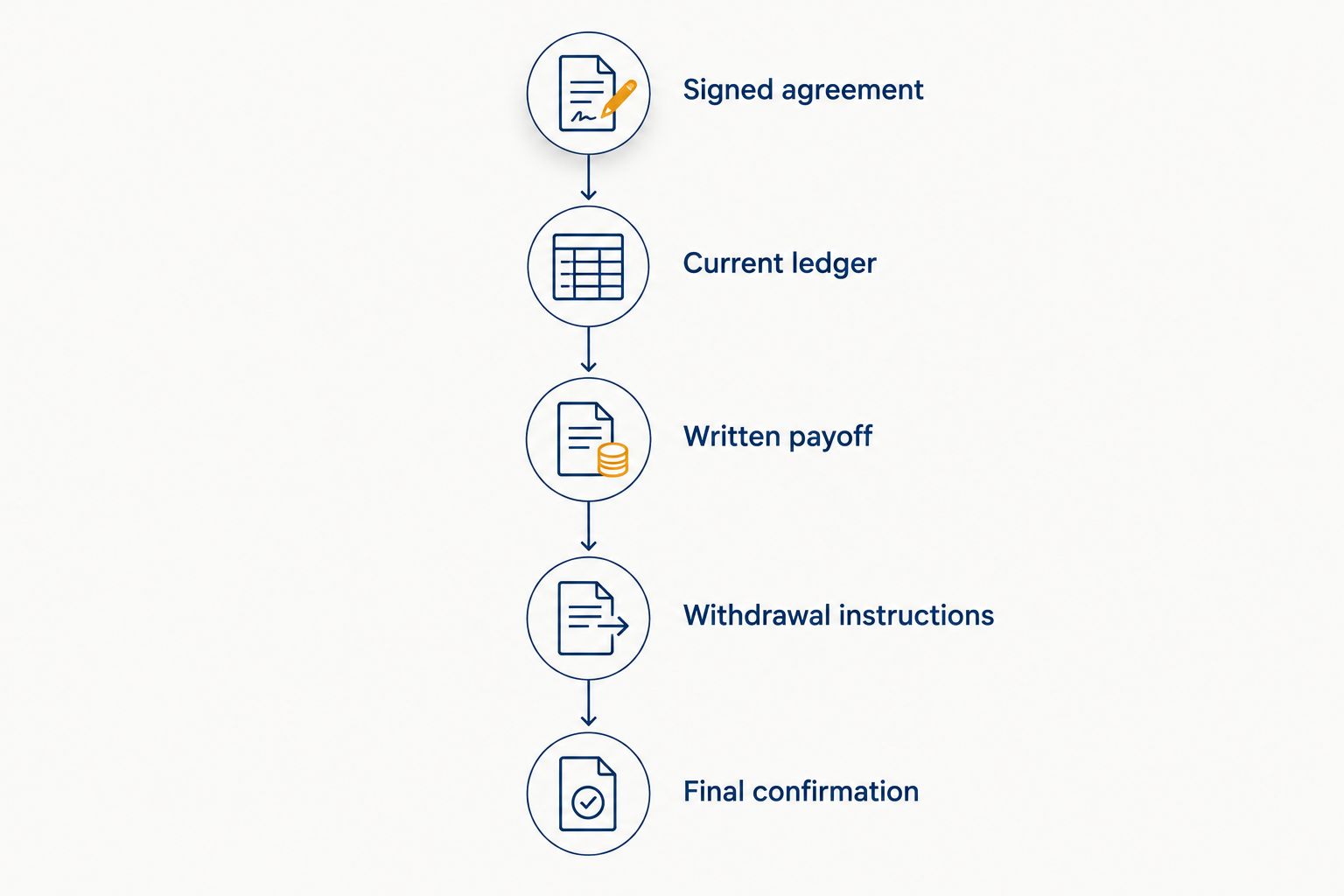
What documents should you request before sending the payoff?
Ask for a complete written record, not just a payment instruction. Your 2026 payoff file should connect the contract, account balance, transfer, and final confirmation.
- Signed agreement: Include amendments, discount addenda, and applicable guarantees or security documents.
- Current ledger: Match prior remittances and credits against your bank records.
- Written payoff: Identify the agreement, amount, effective date, conditions, and payment method.
- Withdrawal instructions: Confirm how pending and future automated withdrawals will be handled.
- Release requirements: Ask what documentation confirms satisfaction and addresses any applicable filing or guarantee.
- Final confirmation: Obtain written acknowledgment after the payment clears.
A zero balance on a portal is not a substitute for understanding what the payment satisfies. Confirm whether the funder requires additional administrative steps to close the account or address an applicable security filing.
Can you negotiate an MCA early-payoff discount?
You can request an early-payoff discount, but a request does not establish entitlement to one. Ask whether the agreement contains an existing discount provision and whether the funder will provide a written alternative quote.
Do not send a partial amount on the assumption that it settles the balance. Any negotiated resolution needs clear written terms describing what the payment satisfies and what, if anything, remains outstanding.
Should you refinance an MCA just to end daily withdrawals?
Refinancing solely to end daily withdrawals is not enough justification. Compare total required dollars, payment frequency, duration, qualification, and cash remaining after the existing agreement is paid.
If your business has time to pursue a less expensive or more suitable structure, compare it before accepting another short-term obligation. No replacement product is automatically better because its payments are less frequent.
FAQ
Can I pay off my merchant cash advance early without a penalty?
You can pay off an MCA without a separate early-payment penalty when your agreement permits it. Obtain a written payoff quote because the full remaining contractual amount can still be due.
Does no prepayment penalty mean I save money?
No prepayment penalty does not automatically mean you save money. Savings require a reduction in the amount otherwise due after accounting for applicable charges.
Will I avoid the remaining factor-rate cost if I pay early?
Early payoff does not automatically remove the remaining factor-rate cost. The agreement and written payoff terms determine whether any reduction applies.
Can I use another business loan to pay off an MCA?
Replacement financing can be used only when the new provider's terms permit the proposed use and the transaction receives approval. Compare the existing payoff with all required payments and charges under the replacement agreement.
Should I stop ACH withdrawals after requesting a payoff quote?
Requesting a payoff quote does not itself cancel authorized withdrawals. Obtain written instructions addressing pending transactions and when future withdrawals will stop.
What proof should I get after paying off an MCA?
Obtain written confirmation that the payment satisfied the identified agreement. Also confirm withdrawal cancellation and the treatment of any applicable security filings or guarantees.
Which related guides help with the payoff decision?
- When to refinance an MCA before payoff
- How to get out of a stacked merchant cash advance position
- Is a merchant cash advance considered a loan?
What should you do next?
Jon Lynch Financial Group is best for established U.S. business owners seeking a broker-assisted comparison of business-funding options. Jon Lynch Financial Group is a broker, not a direct lender; business-purpose products are subject to third-party underwriting, and revenue-based financing may be structured as a purchase of future receivables.
The brokerage comparison helps you assess alternatives, but it does not change your current funder's payoff rights or guarantee approval, amounts, rates, decisions, or funding times. In 2026, start with your written payoff quote and cash forecast before requesting replacement offers.
If your business generates at least $35,000 per month, Compare Business Funding Options. If your business generates below that threshold, Explore Self-Serve Funding; first gather your agreement, current ledger, and written payoff quote so you can judge any proposed change against the obligation you already have.



