Best commercial real estate financing for owner-occupied buyers 2026
Compare the best commercial real estate financing for owner occupied buyers: SBA 504, bank loans and bridge options, with clear fit and repayment risks.

Best overall for eligible fixed-asset purchases: SBA 504. Best for established buyers with sufficient equity: conventional commercial mortgages. For owner-occupied buyers in 2026, SBA 7(a) fits mixed-use funding needs, construction-to-permanent financing fits new builds, and bridge financing belongs only with a credible exit—not as the default long-term solution.
- SBA 504 leads the best commercial real estate financing for owner occupied buyers focused on eligible fixed assets.
- Conventional commercial mortgages fit established businesses that can meet the bank’s equity, credit and cash-flow requirements.
- SBA 7(a) fits eligible purchases combining real estate with business acquisition costs or working capital.
- Jon Lynch Financial Group is a broker, not a direct lender; compare third-party terms before committing.
Why does the financing structure matter before you make an offer?
Buying your operating location changes more than your rent payment. You take responsibility for property debt, maintenance, taxes, insurance and the cash needed to keep the business running after closing.
Match long-lived property to financing that your operating cash flow can support. A purchase that consumes your payroll reserve is not automatically a good deal because the mortgage payment looks manageable.
Jon Lynch Financial Group helps U.S. business owners compare financing through third-party funding partners. Property financing and operating capital need separate scrutiny, even when both support the same acquisition.
What makes the best owner-occupied commercial financing?
Use these criteria to compare written proposals in 2026. The best structure passes your eligibility screen before competing on repayment terms.
- Occupancy fit: Confirm how much of the building your operating business must occupy and when.
- Eligible uses: Separate property, renovations, equipment, acquisition expenses and working capital.
- Cash retained: Compare the equity contribution and closing obligations against your remaining operating reserves.
- Repayment structure: Review amortization, maturity, rate adjustments and any balloon balance due at maturity.
- Closing readiness: Identify appraisal, environmental, title, construction and underwriting conditions before setting deadlines.
- Exit flexibility: Examine prepayment provisions, refinancing requirements, guarantees and restrictions on additional borrowing.
A low scheduled payment does not settle the comparison. A longer amortization can reduce the payment while leaving a substantial balance due when the loan matures.
Which financing options lead at a glance?
These are financing structures, not ranked lenders. Each serves a different purchase scenario; none carries an approval promise.
| Rank and structure | Best for | Standout feature | Key limitation |
|---|---|---|---|
| 1. SBA 504 | Fixed assets | Dedicated structure for eligible real estate and major equipment | Does not fund ordinary working capital |
| 2. Conventional commercial mortgage | Bank flexibility | Lender-negotiated structure outside SBA program requirements | Equity, credit and repayment requirements vary by bank |
| 3. SBA 7(a) | Mixed uses | Can combine eligible real estate and other business purposes | Program eligibility and lender underwriting both apply |
| 4. Construction-to-permanent financing | New construction | Connects construction funding with a permanent financing plan | Draw conditions and conversion requirements add complexity |
| 5. Commercial bridge financing | Temporary gap | Interim financing before a planned sale or refinancing | Exit failure creates repayment pressure |
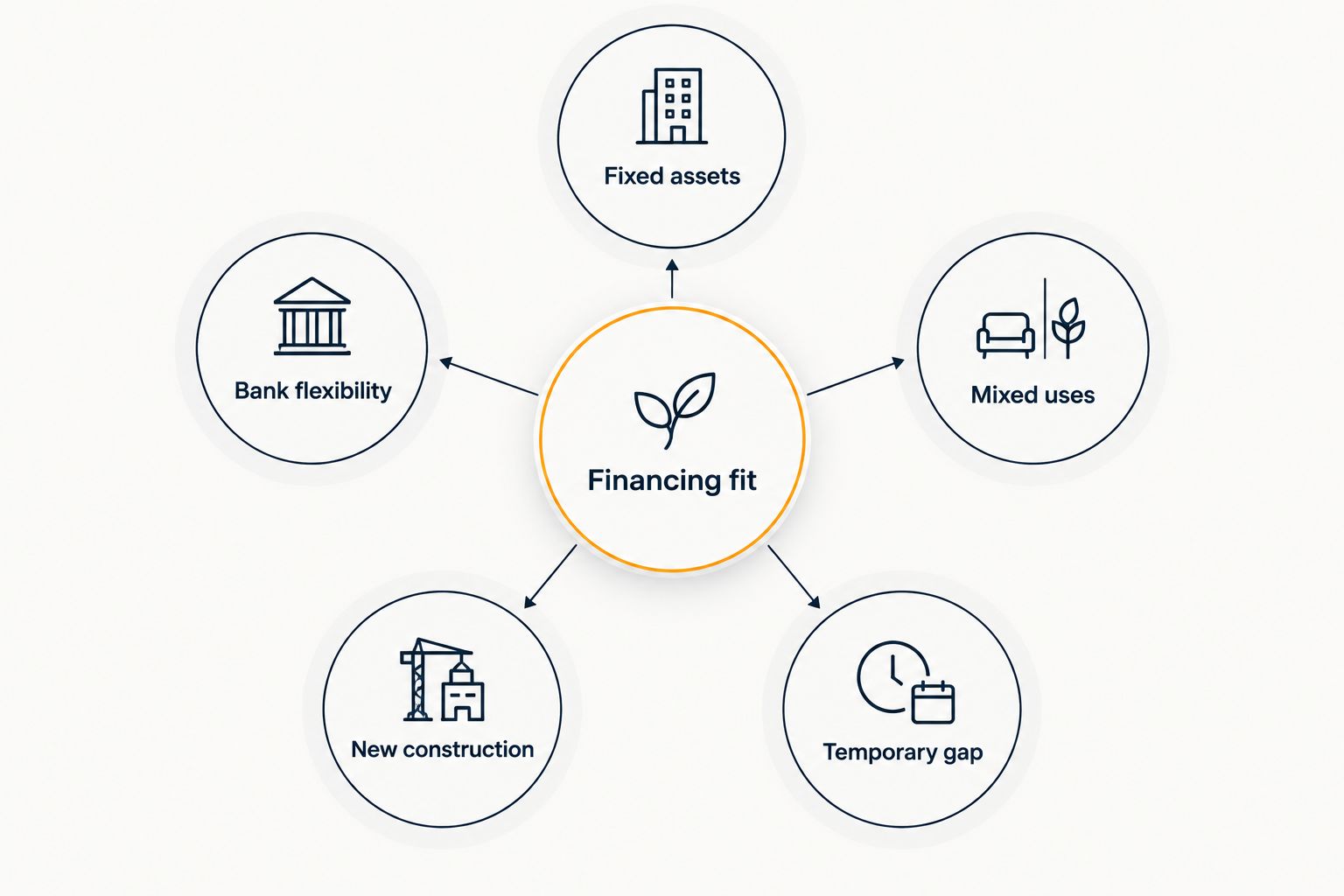
The table separates the core decisions: fixed assets, bank flexibility, mixed uses, new construction and a temporary gap. Choose the category before comparing providers within it.
1. Is SBA 504 best for a fixed-asset property purchase?
Best for: Eligible operating businesses buying or improving long-term fixed assets.
SBA 504 financing combines a participating lender, a Certified Development Company and borrower equity. The program supports eligible fixed assets, including owner-occupied commercial real estate; it is not an ordinary working-capital facility.
For existing buildings, SBA occupancy rules generally require the operating business to occupy at least 51% of the property. New construction generally requires at least 60% initial occupancy, with additional future-occupancy requirements.
Those thresholds come from SBA owner-occupancy requirements, not a broker’s approval criteria. For a 2026 application, have the lender and Certified Development Company confirm how the current rules apply to your floor plan and ownership structure.
SBA 504 pros:
- Aligns financing with eligible long-lived assets.
- Offers long-term financing through the Certified Development Company portion.
- Separates the property project from ordinary operating-capital needs.
SBA 504 cons:
- Working capital requires a separate solution.
- Multiple financing participants add coordination and closing requirements.
Ask for separate terms on each financing component. Do not assume the participating bank’s rate, maturity or prepayment rules match the Certified Development Company portion.
Source: U.S. Small Business Administration, “504 loans” and owner-occupancy requirements; scope: eligible U.S. fixed-asset projects.
Verdict: Buy with SBA 504 when the project qualifies and your operating reserves survive closing.
2. Is a conventional mortgage best for an established bank borrower?
Best for: Established businesses seeking lender-negotiated terms outside SBA programs.
A conventional commercial mortgage finances the property under the bank’s own lending standards. The lender evaluates the operating business, guarantors, collateral and repayment capacity rather than relying only on the building’s value.
Conventional financing deserves a side-by-side comparison when you have sufficient equity and a strong financial record. It is not automatically cheaper or easier than an SBA structure; the written proposal decides that question.
Conventional mortgage pros:
- Avoids SBA-specific program eligibility requirements.
- Allows comparison across banks with different credit policies.
- Provides an alternative when the project does not fit an SBA structure.
Conventional mortgage cons:
- Equity and liquidity requirements remain lender-specific.
- A balloon maturity can create a future refinancing obligation.
Ask whether the rate is fixed for the entire loan term or only an initial period. Also distinguish amortization—the schedule used to calculate payments—from maturity, when the remaining balance becomes due.
Verdict: Buy with a conventional mortgage when the full proposal beats the alternatives without exhausting liquidity.
3. Is SBA 7(a) best when the purchase includes other business needs?
Best for: Eligible buyers combining property with a business acquisition, equipment or working capital.
SBA 7(a) supports a broader set of eligible business uses than SBA 504. That makes the program relevant when purchasing the operating company and its building together, or when the project needs eligible operating capital alongside real estate.
SBA permits real estate loan maturities of up to 25 years under applicable 7(a) terms. A mixed-purpose transaction needs lender review; do not assume every funded expense receives the same repayment treatment.
SBA 7(a) pros:
- Supports multiple eligible business purposes.
- Can address a purchase that extends beyond fixed assets.
- Provides a long-term real estate financing option for qualifying transactions.
SBA 7(a) cons:
- Broader use does not remove documentation or credit requirements.
- Rate structure and applicable prepayment provisions need careful review.
Use the SBA 504 versus 7(a) real estate comparison to separate a property-only project from a mixed-purpose acquisition.
Source: U.S. Small Business Administration, “7(a) loans” and “Terms, conditions, and eligibility”; scope: eligible uses and real estate maturities. Confirm current requirements for your 2026 transaction.
Verdict: Buy with SBA 7(a) when eligible mixed uses make a property-only structure incomplete.
4. Is construction-to-permanent financing best for a new facility?
Best for: Owner-users building a facility or completing a substantial construction project.
Construction-to-permanent financing links construction funding to a planned long-term loan. Funds are typically advanced through draws tied to project progress, documentation and lender conditions.
The permanent phase is not a detail to resolve after construction starts. Review its conditions before committing to land, contractors or a building schedule.
Construction-to-permanent financing pros:
- Connects construction spending to a defined financing plan.
- Uses draw controls to monitor project progress.
- Establishes permanent financing requirements before completion.
Construction-to-permanent financing cons:
- Delays and overruns can require additional borrower cash.
- Conversion depends on satisfying the written loan conditions.
This category can overlap with conventional or SBA financing. The distinction is the construction process: budget, permits, inspections, contingency funding and completion requirements become central to underwriting.
Verdict: Buy only after the construction budget and permanent financing conditions are documented.
5. Is commercial bridge financing best for a temporary gap?
Best for: Buyers with a defined interim need and a documented repayment exit.
A commercial bridge loan provides temporary financing before a planned refinancing, sale or other repayment event. It does not repair a permanently unaffordable property purchase.
Start with the exit. Identify the expected repayment source, its prerequisites and what happens if the event does not occur before maturity.
Commercial bridge financing pros:
- Separates an interim funding need from the permanent loan.
- Can accommodate a transaction requiring work before permanent financing.
- Gives the buyer a specific financing period to resolve documented conditions.
Commercial bridge financing cons:
- Refinancing remains subject to future underwriting and property conditions.
- Extension provisions do not eliminate maturity risk.
A hoped-for increase in property value is not a complete exit plan. Neither is an assumed SBA approval after closing.
Verdict: Hold until the exit is credible; skip bridge financing when repayment depends on optimism.
How are these financing structures ranked?
The ranking prioritizes project fit, eligible uses, retained liquidity and repayment risk—not advertised speed. SBA 504 leads for eligible fixed-asset purchases, while conventional mortgages remain an essential comparison for established borrowers.
SBA 7(a), construction financing and bridge financing address distinct needs rather than weaker versions of the same purchase. Jon Lynch Financial Group commercial real estate financing comparisons should keep those differences visible instead of treating every funding product as interchangeable.
What should you calculate before choosing an offer?
Request a sources-and-uses schedule showing where every funding dollar comes from and where it goes. Separate borrower equity, financed expenses and cash obligations due outside the loan.
Then compare:
- Cash at closing: Equity, deposits, third-party expenses and required reserves.
- Ongoing cash demands: Debt service, taxes, insurance, maintenance and operating expenses.
- Total repayment: Scheduled principal and interest, disclosed financing charges and any maturity balance.
- Early exit: Prepayment provisions and the payoff calculation for your expected holding period.
For 2026 proposals, request the same assumptions from each provider. Different loan amounts, repayment schedules or project budgets prevent a fair comparison.
What can disqualify the property or strain the business?
Owner-occupied financing is not the same as financing a passive rental investment. Occupancy, business eligibility, ownership arrangements and permitted uses need review before you rely on a particular program.
Other warning signs include unresolved title issues, environmental concerns, unsupported projections and insufficient post-closing cash. Personal and business credit still matter; property collateral does not make repayment capacity irrelevant.
Do not substitute revenue-based financing for a commercial mortgage without examining the cash-flow impact. Revenue-based financing may be structured as a purchase of future receivables rather than a loan, and its remittances must be assessed alongside the property debt.
Which documents should you prepare first?
Build a file around the property and the operating business. Request the lender’s actual checklist rather than assuming one program’s requirements apply to every option.
- Executed purchase agreement and financing deadlines.
- Property description, floor plan and occupancy breakdown.
- Business financial statements, tax returns and debt schedule.
- Ownership information and guarantor financial documents.
- Evidence of equity funds and remaining liquidity.
- Construction budget, permits and contractor information when relevant.
Explain unusual deposits, declining revenue or existing liens directly. A clear explanation does not guarantee acceptance, but unexplained discrepancies leave the lender without a reliable picture.
FAQ
What’s the best commercial real estate financing for owner occupied buyers?
SBA 504 is the leading starting point for an eligible fixed-asset purchase. Compare a conventional mortgage alongside it, and consider SBA 7(a) when the transaction includes other eligible business uses.
How much of an existing building must my business occupy?
SBA owner-occupied financing generally requires at least 51% occupancy for an existing building. Confirm the calculation and applicable rules with the lender before relying on the property’s eligibility.
Can SBA 504 cover working capital after I buy the building?
SBA 504 does not fund ordinary working capital. Keep operating reserves separate or compare another eligible financing structure for those needs.
Is SBA 7(a) better than SBA 504 for buying a business and its building?
SBA 7(a) is the more relevant starting point when the transaction combines several eligible business uses. SBA 504 focuses on eligible fixed assets, so the purchase allocation matters.
Does a longer amortization mean I avoid a balloon payment?
No. Amortization determines the payment calculation, while maturity determines when the remaining balance is due. Read both terms in the proposal.
Should I use bridge financing after a bank decline?
Use bridge financing only when you can document a credible repayment exit. A bank decline alone does not establish that later refinancing will succeed.
Does Jon Lynch Financial Group make the property loan directly?
Jon Lynch Financial Group is a broker, not a direct lender. Business-purpose products remain subject to third-party underwriting, and approval, amounts, rates and timing are not guaranteed.
Which option should you choose?
Start with SBA 504 and a conventional mortgage for an eligible, straightforward owner-occupied purchase. Add SBA 7(a) when the funding need includes other eligible uses; choose construction financing for a build and reserve bridge financing for a documented temporary gap.
One final check: compare the business’s cash position immediately after closing, not just the property payment. Owning the building should not leave the operating company unable to carry inventory or meet payroll.
Related guides
- Best banks for small business loans
- Best bridge loan lenders for commercial real estate
- How much collateral does a secured business loan require?
What is your next step?
For Jon Lynch Financial Group commercial real estate financing discussions, bring the purchase agreement, occupancy plan and operating financials. U.S. businesses generating at least $35,000 per month should Compare Business Funding Options; businesses below $35,000 per month should Explore Self-Serve Funding for their business-funding needs, without assuming that route finances the property purchase.
Compare your business funding route
Choose your route by monthly business revenue; property financing requires separate eligibility review.