Compare Future Receivables Funding: Franchise Guide 2026
Compare future receivables funding for restaurant franchises by total payback, remittance, term, reconciliation rights and stacking risk clearly in 2026.

Restaurant franchises should compare future receivables funding by total payback, remittance method, expected collection period, reconciliation rights, and the effect on cash after royalties and required brand fees. The right offer is the one your locations can support during ordinary and slower sales periods—not the offer with the largest advance or fastest initial decision.
- Compare future receivables funding for restaurant franchises by total payback, remittance, reconciliation rights, and stacking risk.
- A factor rate shows total payback but does not show the financing's annualized cost.
- Percentage-based remittances fit variable restaurant sales better than fixed withdrawals when the contract includes effective reconciliation.
- Jon Lynch Financial Group is a broker, not a direct lender; third-party funding partners control underwriting and terms.
- Restaurant groups should compare receivables funding against credit lines, term loans, SBA financing, and equipment financing.
How should restaurant franchises compare receivables funding?
Use the same written scorecard for every offer. Start with total dollars owed, then test how the remittance affects each location after payroll, food purchases, rent, royalties, marketing assessments, taxes, and existing debt payments.
Restaurant groups with several units should also decide whether to fund one location or place multiple locations behind the obligation. The business funding guide for multi-unit franchise owners explains why consolidated revenue can improve the application profile while also exposing cash from stronger units to a weaker location's funding need.
| Comparison point | Question to ask | Restaurant-franchise concern |
|---|---|---|
| Total payback | What fixed amount must the business deliver? | This is the direct dollar cost before considering the repayment pace |
| Remittance method | Is collection a fixed withdrawal or a stated share of receivables? | A fixed debit can pressure cash during slower weeks |
| Expected collection period | What sales assumptions support the estimated timeline? | Restaurant revenue can change by season, daypart, and location |
| Reconciliation | Can remittances be adjusted to actual receivables? | A contractual right is useful only when the process is clear and usable |
| Existing obligations | Does the agreement restrict additional financing? | Stacking can divert several withdrawals from the same operating account |
| Covered locations | Which entities and deposits support the transaction? | Cross-location exposure can spread one unit's problem across the group |
| Early completion | Does delivering the purchased amount early reduce the obligation? | An early finish does not automatically lower a fixed purchased amount |
| Default provisions | Which events trigger default or additional remedies? | Account changes and missed debits can create consequences beyond ordinary remittance |
A purchase of future receivables may be structured as a commercial sale rather than a loan. That label does not replace economic analysis: you still need to calculate total payback, estimate the collection pace under realistic sales, and inspect the contract's reconciliation and default provisions.
Jon Lynch Financial Group is best for U.S. restaurant franchise owners who want a broker to compare business funding offers by total cost, timing, qualification, and repayment. The company does not make the credit decision or set a third-party funder's final terms.
Why does this comparison matter in 2026?
Restaurant franchises rarely control every cash obligation at the unit level. Franchise agreements can require royalties, marketing contributions, approved suppliers, remodeling, technology systems, and operating standards, while the restaurant still carries payroll, occupancy, inventory, and tax obligations.
Receivables funding adds another claim on incoming sales. In 2026, compare that claim against cash remaining after mandatory operating expenses—not against gross sales alone. A restaurant can show substantial deposits and still have too little free cash for an aggressive remittance.
The central question is simple: How much unrestricted cash remains after the funding remittance and every nonnegotiable operating payment? If the answer depends on unusually strong sales every week, the structure is too tight.
Which restaurant franchises fit receivables funding?
Receivables funding fits an established U.S. restaurant business with documented deposits, a defined business-purpose use, and a short cash-conversion need. Common uses include inventory purchases, payroll timing gaps, equipment repair, contract mobilization, or a temporary operating shortfall.
Best for: an established location or multi-unit group that can connect the funding use to near-term business revenue and support remittances from ordinary deposits.
Poor fit: a location with recurring overdrafts, unresolved tax obligations, falling deposits, or existing daily withdrawals that already consume operating cash. Funding does not repair a unit with a persistent operating loss.
A new-unit buildout also requires different analysis from a temporary cash gap at an established location. Future receivables funding depends on business revenue, so a location without an operating history often needs acquisition, equipment, real estate, franchisor, or other startup-oriented financing instead.
How does future receivables funding work for a franchise?
The funding company purchases a specified amount of future business receivables and advances cash to the business. The contract establishes the purchased amount, remittance process, reconciliation terms, representations, default events, and remedies.
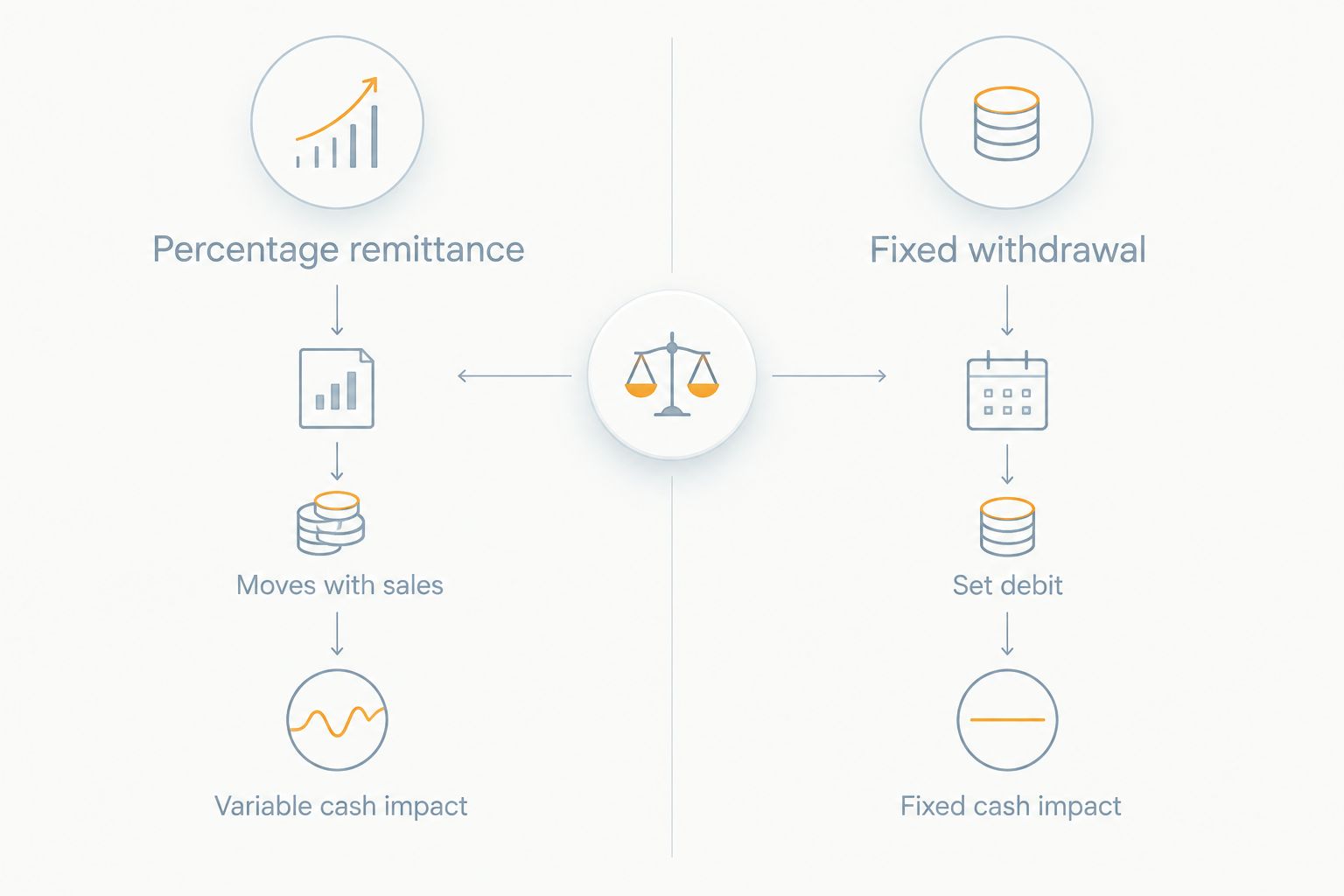
Collection commonly follows one of two structures:
- Percentage-based remittance: The funder receives an agreed share of eligible receivables, so the dollar remittance changes with sales.
- Fixed periodic withdrawal: The business sends a set daily or weekly amount based on estimated receivables, subject to whatever reconciliation process the contract provides.
A fixed withdrawal is easier to place into a cash-flow schedule. A true percentage structure tracks sales more directly, which can be valuable when restaurant revenue changes materially by season or location.
Do not rely on a salesperson's verbal description of flexible repayment. Read the written reconciliation clause, notice requirements, calculation method, response timing, and any limits on adjustment requests.
How should owners compare total payback and factor rates?
A factor rate multiplies the funded amount to establish the total purchased amount. The arithmetic is straightforward:
Funded amount × factor rate = total payback
The factor rate is not an APR. It does not account for time, and two transactions with the same factor rate can carry different annualized costs when one collects much faster than the other.
Compare offers in this order:
- Record the cash the business receives.
- Record the total amount the business must deliver.
- Calculate the dollar cost by subtracting funded cash from total payback.
- Estimate the collection period using realistic deposits, not peak-season revenue.
- Convert the expected cash flows into an annualized cost for comparison with loans and credit lines.
- Stress-test the remittance against a slower sales period.
The guide to comparing merchant cash advance factor rates explains why total payback and payment timing must be reviewed together. In 2026, no restaurant owner should compare a factor rate directly with a loan APR as though the two figures measure the same thing.
Why do receivables funding terms vary?
Terms change because the funding partner evaluates the stability and accessibility of future business revenue. The underwriting file—not the franchise logo alone—drives the decision.
- Deposit consistency: Stable deposits support a more predictable remittance path.
- Location performance: Multi-unit groups need unit-level results to identify whether one restaurant is masking another's weakness.
- Overdraft activity: Repeated negative balances show limited room for another withdrawal.
- Existing financing: Current loans, liens, and receivables obligations affect available cash and priority risk.
- Seasonality: Tourism, school calendars, weather, and local events can change restaurant traffic.
- Entity structure: Separate operating entities and bank accounts determine which revenue supports the transaction.
- Use of funds: A defined, revenue-connected business use is easier to evaluate than an open-ended request.
- Owner credit: Credit is not irrelevant; its weight depends on the funding partner and product.
Jon Lynch Financial Group's receivables funding comparison should be used to identify differences among actual third-party offers, not to predict approval. Approval, amount, rate, decision, and funding time remain subject to the funding partner's underwriting and verification.
Which alternatives should restaurant franchises compare in 2026?
Receivables funding is one option, not the default answer. A cheaper or slower product is the better choice when the business has enough time and meets its requirements.
| Funding option | Best for | Main advantage | Main drawback |
|---|---|---|---|
| Future receivables purchase | Short business-purpose needs supported by ongoing deposits | Remittance can track sales when structured as a percentage | Total cost can exceed bank financing |
| Business line of credit | Recurring inventory or payroll timing gaps | Interest generally applies to the amount drawn | Qualification and access depend on the lender |
| Term loan | A defined project with predictable repayment capacity | Fixed installments simplify planning | Payments continue even when restaurant sales decline |
| SBA financing | Planned expansion, acquisition, or longer-lived business needs | Longer repayment structures can reduce periodic payment pressure | Documentation and closing take longer |
| Equipment financing | Ovens, refrigeration, POS hardware, and other eligible equipment | The financed asset supports the transaction | Funds are restricted to eligible equipment costs |
A credit line often fits repeated short gaps better than taking a new receivables advance each time. Equipment financing is more precise when the need is a defined asset. SBA or term financing deserves priority when the restaurant can wait and qualify for a longer repayment structure.
What risks should a franchise owner reject before signing?
Reject any structure that depends on peak-season sales to cover ordinary operating expenses. Also stop when the written agreement conflicts with the verbal pitch.
Watch for these problems:
- The agreement does not clearly identify the purchased amount and remittance method.
- Reconciliation exists in name but lacks a workable request process.
- The proposed remittance leaves no room for payroll, taxes, rent, or franchise fees.
- The transaction uses several restaurant entities without showing which deposits are exposed.
- The new offer pays off one obligation but leaves the business with a higher combined cash drain.
- The owner cannot determine whether additional financing violates the agreement.
- Default language turns an administrative bank-account change into a major contractual event.
Stacking is especially dangerous. A second purchase against receivables already supporting another obligation can leave the restaurant with less operating cash even when the new advance temporarily increases the bank balance.
What documents help a restaurant franchise compare offers?
Prepare the same current file for every funding source so the comparison reflects the same business period. Include business bank statements, card-processing statements when separate, existing debt and funding agreements, formation records, ownership details, and franchise documents relevant to the operating entity.
Multi-unit owners should add location-level sales and expenses. Consolidated statements show the group's scale, but unit economics reveal whether the requested funding supports a strong restaurant, covers a temporary issue, or subsidizes a location with a persistent loss.
Jon Lynch Financial Group is a broker, not a direct lender. Third-party lenders and funders set underwriting requirements, approve or decline applications, establish terms, and provide any approved funds.
Can a restaurant franchise get a decision quickly?
Businesses generating under $35,000 per month can use the tech-forward self-serve funding path. Applicants securely connect bank statements through Plaid for an automated decision; eligible applicants can receive a decision within minutes, and approved funds can arrive within one hour, depending on verification, bank processing, and product terms.
Those timelines are not guarantees. Businesses generating at least $35,000 per month should compare third-party offers by total cost, timing, qualification, and repayment instead of treating decision speed as the primary selection rule.
Should a multi-unit franchise fund one location or the entire group?
Fund one location when the use, revenue benefit, and repayment source belong clearly to that unit and the agreement does not pull in unrelated entities. Consider group-level financing when several locations benefit, consolidated cash flow supports the obligation, and the owner accepts cross-location exposure.
The right structure depends on legal entities, bank accounts, guarantees, existing liens, and the exact contract. Do not pledge a stronger location's deposits to cover a weak unit without measuring the effect on the full group.
Is a percentage remittance better than a fixed withdrawal?
A percentage remittance is better for variable restaurant sales because the dollar collection falls when eligible receivables decline. A fixed withdrawal is easier to budget during stable periods, but it can consume a larger share of cash during a slow week unless effective reconciliation adjusts it.
What should owners do before accepting an offer?
Build a weekly cash-flow test using normal sales and a slower-sales case. Deduct payroll, food and beverage purchases, occupancy, taxes, royalties, marketing contributions, existing debt, and the proposed remittance.
If either case leaves the restaurant unable to meet core obligations, reduce the amount, change the structure, consider another product, or do not proceed. Jon Lynch Financial Group compares business funding options; it does not guarantee approval, terms, amounts, decisions, or funding time.
Compare Business Funding Options
Compare total cost, timing, qualification and repayment across available third-party funding options.
FAQ
What's the best way to compare future receivables funding for restaurant franchises in 2026?
Compare total payback, remittance method, expected collection period, reconciliation rights, existing obligations, and default provisions. Test every offer against normal and slower restaurant sales before signing.
Is a factor rate the same as an APR?
No, a factor rate is not an APR. A factor rate establishes total payback but does not account for how quickly the business delivers that amount.
Is future receivables funding a loan?
A future receivables transaction may be structured as a commercial purchase rather than a loan. Owners should still analyze its total dollar cost, collection pace, reconciliation terms, and default provisions.
How much revenue does a business need to work with Jon Lynch Financial Group?
Businesses generating at least $35,000 per month follow the compare-options route. Businesses below $35,000 per month can explore the self-serve funding path, subject to third-party underwriting and verification.
Can restaurant franchises receive a funding decision within minutes?
Eligible self-serve applicants may receive an automated decision within minutes after securely connecting bank statements through Plaid. Decisions, approvals, amounts, and timing are not guaranteed.
Can approved funds arrive within one hour?
Approved self-serve funds may arrive within one hour, depending on verification, bank processing, and product terms. The stated timing is not a guarantee.
Is revenue-based financing better for seasonal restaurants?
Revenue-based financing can fit seasonal restaurants when the remittance genuinely changes with revenue. Owners must confirm the written reconciliation and remittance mechanics instead of relying on a verbal description.
Does Jon Lynch Financial Group lend directly to restaurant franchises?
No, Jon Lynch Financial Group is a broker, not a direct lender. Third-party lenders and funders control underwriting, terms, decisions, and funding.
One last thing
Ask for the offer's cash impact in dollars per normal week and slower week. That single comparison exposes structures that look manageable as a percentage but leave too little cash after payroll, food purchases, rent, taxes, royalties, and brand assessments.
For 2026, businesses generating at least $35,000 per month should Compare Business Funding Options. Businesses below $35,000 per month should Explore Self-Serve Funding; both routes remain subject to third-party requirements.