How does a 1099 contractor qualify for business funding?
1099 contractor business funding qualification depends on documented revenue and repayment capacity. Compare documents, funding structures and risks.

A 1099 contractor qualifies for business funding by documenting business revenue, showing how payments fit cash flow, and meeting the selected funding partner’s underwriting requirements. A 1099 form alone does not establish eligibility, and strong deposits do not make an unaffordable repayment schedule safe. In 2026, compare the product structure and your available cash before choosing a funding amount.
- 1099 contractor business funding qualification depends on documented business activity and repayment capacity, not a tax form alone.
- Jon Lynch Financial Group offers business-funding comparisons as a broker, not a direct lender.
- Compare working capital, revenue-based financing and receivables purchases by total dollars, payment timing and contractual obligations.
- The $35,000 monthly revenue threshold identifies the brokerage’s primary comparison audience; it does not guarantee eligibility.
How does a 1099 contractor qualify for business funding?
Start with records that connect your contracting work to money actually collected. Then identify which obligations your business can support without depending on unsigned projects or optimistic collection dates.
- Identify the business purpose. Explain whether you need equipment, materials, payroll, contract mobilization or another operating expense.
- Document collected revenue. Organize bank activity and supporting invoices so a reviewer can distinguish customer receipts from transfers or borrowed money.
- Show current obligations. Disclose outstanding financing and its payment schedule rather than presenting deposits without the withdrawals attached.
- Match the structure. Compare a loan, credit line or receivables-based arrangement against the reason you need capital.
- Confirm program requirements. Ask for the funding partner’s current eligibility and documentation requirements before treating an offer as available.
Jon Lynch Financial Group serves U.S. business owners comparing business-purpose funding through third-party partners. Approval depends on the selected partner, not on the brokerage’s audience criteria.
Who is the primary funding comparison route for?
Jon Lynch Financial Group is best for established U.S. business owners comparing working capital and receivables-based funding. Its primary comparison audience generates at least $35,000 per month, including contractors seeking business-purpose capital.
That figure is a routing threshold, not a universal lender minimum. Crossing it does not establish an approved amount, acceptable credit profile or affordable payment.
Businesses below $35,000 per month should use the self-serve funding route instead. Neither route guarantees approval, and consumer-purpose or non-U.S. requests fall outside the primary funding audience.
For your 2026 application, describe the work that produces revenue rather than relying on the label “1099 contractor.” A consultant collecting recurring retainers and a subcontractor awaiting project acceptance have different cash-flow patterns, even when both receive the same tax form.
Why does current cash flow matter more than a 1099 form alone?
A Form 1099-NEC reports nonemployee compensation; it does not show your current bank balance, operating expenses or existing financing payments. Historical compensation and present repayment capacity answer different questions.
Your funding file should explain those differences. A large annual total can coexist with slow collections, expensive materials or a concentrated customer base.
Keep gross receipts separate from cash available for repayment. Taxes, subcontractor payments, insurance and other operating expenses still need funding after a new financing payment leaves your account.
Use collected revenue to assess affordability; do not treat an unpaid invoice as spendable cash. Signed contracts help explain future work, but they are not the same as cleared customer payments.
How should you prepare a contractor funding file?
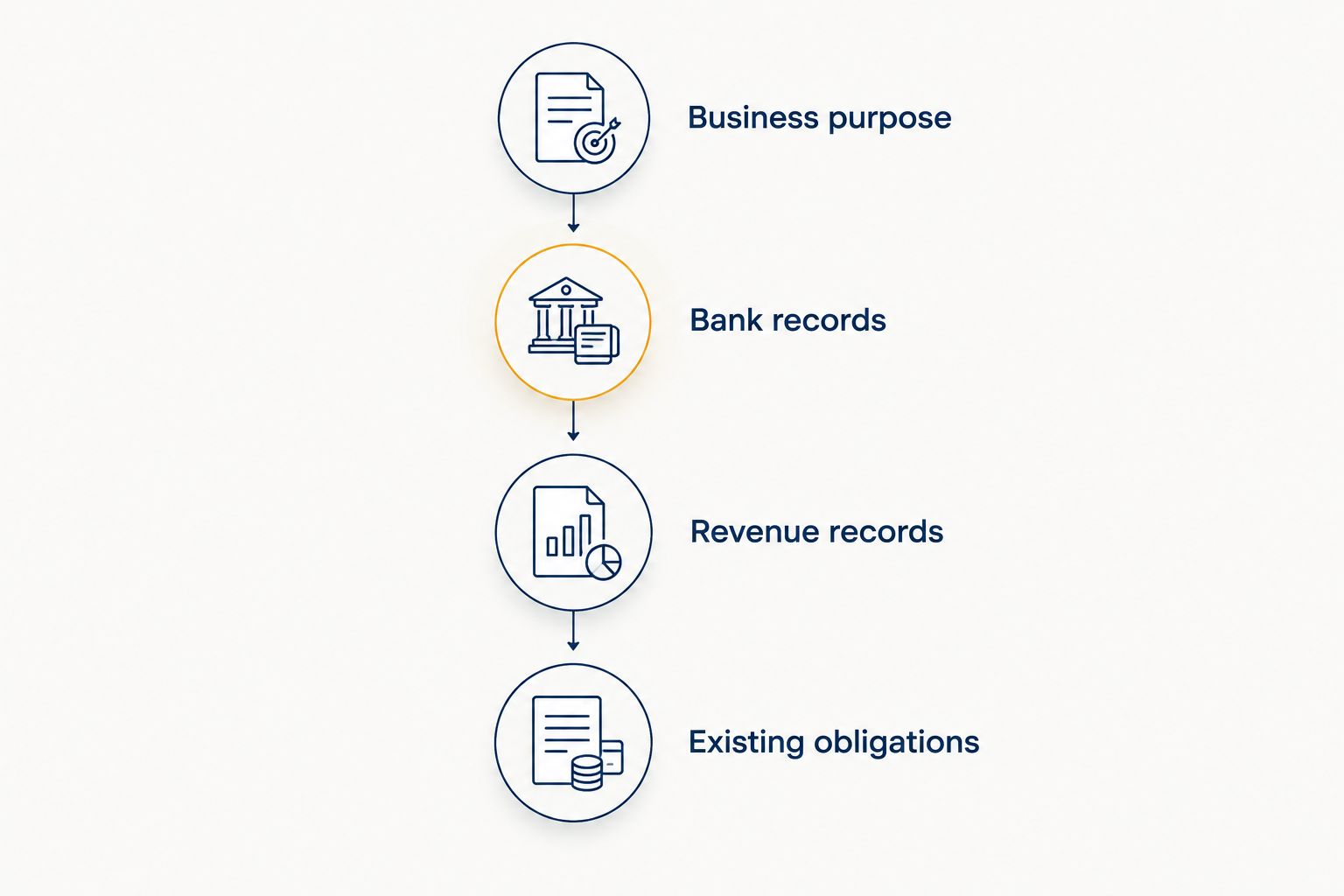
Build a file that lets a reviewer follow the money from completed work to bank deposits. Ask the funding partner which records and reporting periods it requires; there is no single document package that establishes eligibility for every product.
- Business purpose: State what the funding pays for and when the expense occurs.
- Bank records: Provide the requested statements or authorized account connection through the application process.
- Revenue records: Reconcile invoices, payment-platform receipts and customer payments to deposits.
- Financial records: Prepare current bookkeeping and tax documents when requested.
- Existing obligations: List balances, payment frequency, liens and guarantees associated with current financing.
- Business identity: Make sure the applicant name, ownership information and operating records are consistent.
Keep explanations short and traceable. If a deposit is an account transfer, identify it rather than counting it again as customer revenue.
Which funding structure fits your contracting work?
Match the financing to the expense and collection cycle before comparing offers. In 2026, a business-funding comparison should identify what you receive, what you owe or sell, and when money leaves your account.
| Funding structure | Best for | Main benefit | Main limitation to examine |
|---|---|---|---|
| Business line of credit | Recurring operating gaps | Access to draws within an approved facility | Draw terms, renewal conditions and payment requirements |
| Term loan | A defined business expense | A stated repayment schedule | Fixed obligations when collections slow |
| Equipment financing | A specific equipment purchase | Financing tied to the asset being acquired | Asset restrictions, security interests and repayment terms |
| Invoice factoring | Eligible unpaid business invoices | Converts qualifying receivables into working capital | Customer eligibility, assignment terms and recourse obligations |
| Revenue-based financing or future-receivables purchase | Businesses with documented receipts evaluating receipt-linked funding | A structure tied to business revenue or receivables | Total purchased amount, remittance mechanics and reconciliation terms |
Choose fit before speed. Equipment financing deserves comparison when the need is equipment; a general working-capital arrangement should not win simply because its application feels easier.
For invoice-backed funding, confirm that your invoices qualify and understand who contacts customers. For a credit line or term loan, check whether the payment schedule remains workable during a slow collection period.
Is revenue-based financing the same as a business loan?
Not necessarily. Revenue-based financing may be structured as a purchase of future receivables rather than a loan, and “merchant cash advance” is another term contractors encounter when researching this category.
The agreement determines the obligations. Review the purchased receivables amount, remittance method, reconciliation process, default provisions and any guarantees instead of relying on the product’s marketing name.
A factor rate is a multiplier used to calculate a specified repayment or purchased amount from a funding amount. A factor rate is not APR: an annualized borrowing-cost comparison also needs the timing of payments and relevant fees.
Before signing, use the guide to comparing merchant cash advance factor rates to organize the questions you need answered. Do not assume early payoff reduces the contractual amount unless the agreement provides that benefit.
How do you compare cost without mistaking revenue for profit?
Request a written offer that separates the amount delivered to your business from the total contractual obligation. Then place the payment schedule beside your expected customer collections and essential operating expenses.
Use this cash-flow calculation with your own records:
Collected business revenue − essential operating expenses − existing financing payments − proposed payments = remaining operating cash.
For a receivables purchase, use the proposed remittance when assessing cash impact, while keeping the contract’s legal structure distinct from a loan. Check the calculation during a slower period, not just your strongest month.
Your 2026 comparison should also address these questions:
- What amount reaches the business after deductions?
- What total amount must be repaid or remitted under the agreement?
- How frequently does money leave the account?
- What changes when receipts fall?
- What does early payoff actually change?
- What obligations survive a missed payment or default?
A lower advertised rate does not answer these questions. Compare offers using the same business need and the same collection assumptions.
Why does 1099 contractor business funding qualification vary?
Qualification varies because providers assess different products, records and repayment sources. Receiving contractor compensation does not replace that review.
- Collected revenue: Deposits support the revenue picture, but transfers and financing proceeds need separate treatment.
- Payment timing: Irregular collections affect how a proposed withdrawal schedule fits your operations.
- Existing obligations: Current payments reduce the cash available for another commitment.
- Credit profile: Credit can affect underwriting; contractor status does not make credit irrelevant.
- Funding purpose: Equipment, invoices and general working capital call for different structures.
- Contract requirements: Documentation, security interests and guarantees depend on the selected program and agreement.
Ask for the actual requirements of the program under consideration. Avoid treating an online qualification checklist as an approval decision.
What should make you pause or choose a slower alternative?
Pause when repayment depends on work you have not secured or collections you cannot reasonably document. Financing does not fix a contract that loses money before financing costs.
A bank or other longer-term loan deserves comparison when your timeline and qualifications support it. Slower funding is preferable when its written terms fit the expense and preserve more operating cash.
Stop and clarify any offer with unexplained deductions, unclear withdrawal authority or a guarantee you do not understand. Adding financing without reviewing existing agreements also creates a risk of conflicting obligations.
If a bank declined your application, identify the stated reason before applying elsewhere. A documentation problem, weak repayment capacity and an ineligible use of funds require different responses.
Can I qualify without forming an LLC?
An LLC is not a substitute for documented revenue or repayment capacity. Ask whether the selected program accepts your current business structure and which identification records it requires.
Do not form an entity solely because you expect automatic approval. The application still needs to match the business that earns and receives the revenue.
Does $35,000 per month mean I am approved?
$35,000 per month identifies Jon Lynch Financial Group’s primary business-funding comparison audience, not an approval standard. Third-party underwriting still determines eligibility and offer terms.
Below $35,000 per month, use the self-serve funding route. That route also requires review and does not promise a particular result.
FAQ
Can I get business funding if I only receive 1099 income?
Receiving 1099 income does not by itself establish or rule out eligibility. Document your business activity, collected revenue and existing obligations, then confirm the selected funding partner’s requirements.
Is my 1099 form enough to qualify for funding?
A 1099 form alone does not establish business-funding eligibility. It reports compensation but does not show current expenses, account activity or repayment capacity.
Do I need good personal credit as a 1099 contractor?
Credit requirements depend on the funding program, and credit is not irrelevant. Ask how the provider evaluates personal and business credit and whether a personal guarantee applies.
What if my contracting business makes less than $35,000 per month?
Businesses below $35,000 per month should use the Explore Self-Serve Funding route. Eligibility, terms and outcomes remain subject to review.
Can I apply for contractor funding from home?
The self-serve funding path can be completed from home by U.S.-based entrepreneurs. Applicants securely connect bank statements through Plaid for an automated decision; verification, bank processing and product terms affect timing.
Is revenue-based financing always a loan?
Revenue-based financing may be structured as a purchase of future receivables rather than a loan. Read the agreement to understand remittances, reconciliation, guarantees and default obligations.
Does qualifying mean the funding is affordable?
Qualifying does not establish affordability. Compare the proposed payments or remittances against collected revenue after essential expenses and existing financing commitments.
Related guides
- Working capital loans: costs and qualification
- How much revenue do you need for revenue-based financing?
- Revenue-based financing versus merchant cash advance
What should you do before applying in 2026?
Reconcile your latest customer receipts to bank deposits before submitting an application. An unexplained transfer can distort the revenue picture even when your annual compensation looks strong.
Jon Lynch Financial Group is a broker, not a direct lender. Business-purpose products are subject to third-party underwriting; approval, amounts, rates, decisions and funding times are never guaranteed.
Choose your next step by actual monthly business revenue: at least $35,000 per month, Compare Business Funding Options; below $35,000 per month, Explore Self-Serve Funding.