How much does a business bridge loan typically cost?
Compare business bridge loan cost by total charges, net proceeds and repayment timing. Check fees, early payoff terms and exit risks before signing.

Judge business bridge loan cost by total financing charges, usable proceeds and the payment schedule—not the advertised rate alone. There is no single typical cost that applies across working-capital bridges and property-backed bridge loans in 2026. Fees deducted before funding, early-payoff terms and extension charges can change the comparison materially.
- Compare business bridge loan cost using net proceeds, total payments and the expected payoff date.
- A working capital bridge needs a documented repayment source, not an assumed refinance.
- Jon Lynch Financial Group is a broker, not a direct lender; third-party underwriting determines funding terms.
- Compare loan interest with receivables-purchase charges carefully: a factor rate is not APR.
How much does a business bridge loan typically cost?
Your business bridge loan cost is the financing charge attached to your actual cash-flow schedule. To compare written offers, identify what reaches your bank account, what leaves it afterward and when the balance must be cleared.
For business-funding comparisons, Jon Lynch Financial Group serves U.S. business owners seeking business-purpose capital through third-party funding partners. Start the comparison with the transaction documents, not a verbal estimate.
| Cost component | What to obtain in writing | Why it changes your decision |
|---|---|---|
| Interest or financing charge | Calculation method and payment schedule | Determines the charge for using the funds |
| Upfront deductions | Itemized deductions from proceeds | Reduces the cash available for your expense |
| Separately paid fees | Required charges outside scheduled payments | Adds to your cash outlay |
| Early payoff | Payoff calculation and any discount or penalty | Determines whether paying sooner saves money |
| Extension terms | Conditions and charges for extending maturity | Changes the outcome if your exit is late |
| Closing requirements | Applicable legal, valuation or recording expenses | Matters especially for property-backed transactions |
Not every offer includes every charge. Ask the provider to mark each item as applicable or not applicable rather than leaving blanks.
Why does the headline rate matter less than the cash-flow schedule?
A rate does not tell you how much usable cash you receive or whether payments arrive before your customer pays. A bridge that closes a funding gap can create another gap if its withdrawals conflict with payroll, inventory or taxes.
For a 2026 comparison, use the same requested net proceeds and expected payoff date across offers. Otherwise, you are comparing different transactions.
Who does a business bridge loan fit?
A business bridge fits a temporary funding gap with an identifiable repayment source. Examples include an expected customer payment, a documented asset sale or a longer-term financing transaction that is progressing toward completion.
An expected event is not the same as a reliable exit. Review the conditions that must happen before the money becomes available, including customer acceptance, closing requirements or remaining underwriting.
A bridge is a poor fit when ordinary operating cash flow cannot support the interim payments and the only exit is another unapproved borrowing request. Additional financing does not resolve a recurring operating loss by itself.
Separate the business purpose from the financing label:
- Payroll or inventory: Match withdrawals to the timing of operating collections.
- Contract mobilization: Confirm when work becomes billable and when payment becomes collectible.
- Property acquisition: Match the maturity date to the sale or permanent-financing process.
- Refinancing an existing obligation: Compare the entire replacement transaction, including payoff and closing requirements.
How do you calculate the total cost of a bridge offer?
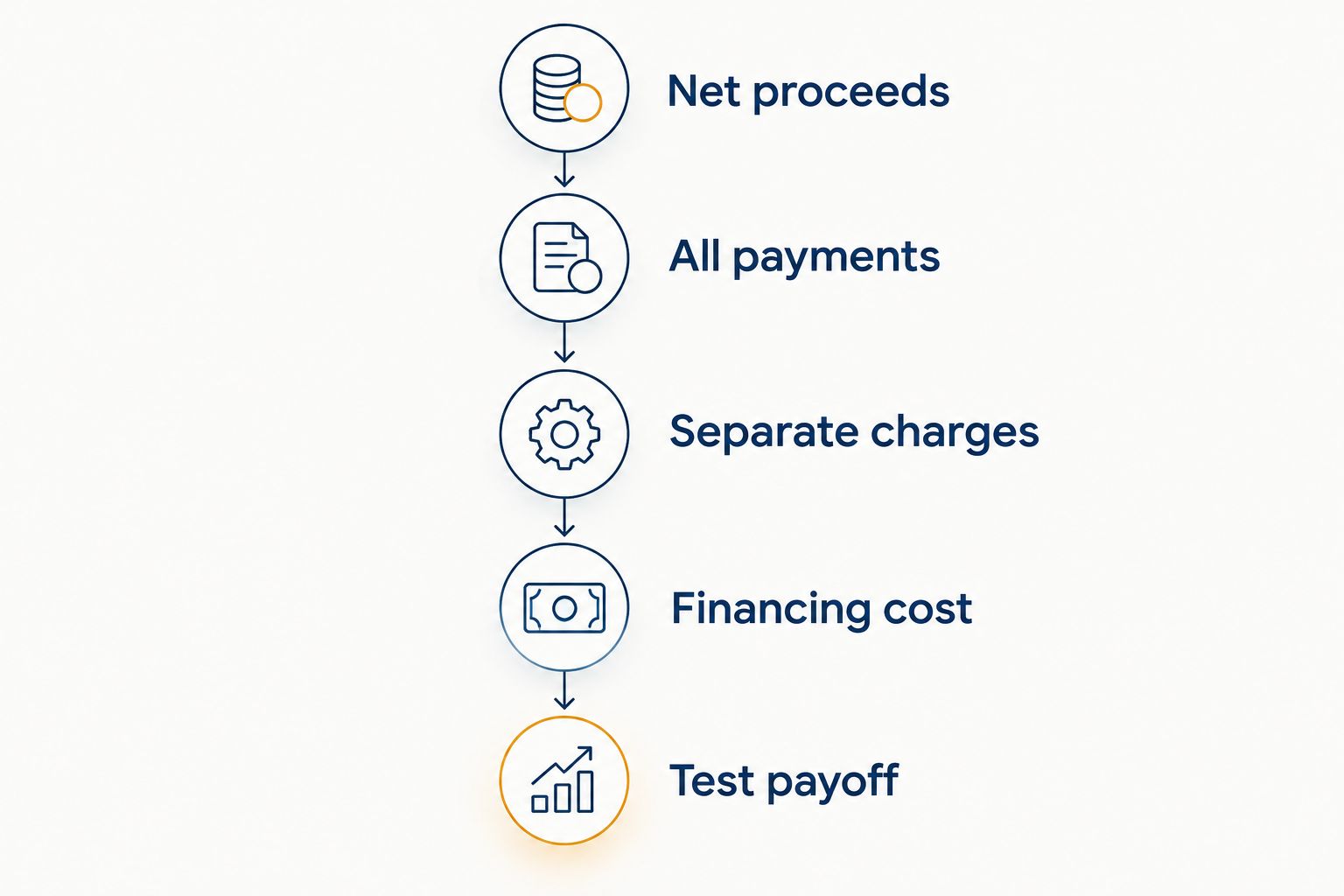
Build a cash-flow worksheet before deciding whether an offer is affordable. Use the final written terms, then update the worksheet if the structure changes before closing.
- Record net proceeds. Write down the amount that will actually reach your business account after deductions.
- List all payments. Include scheduled payments and any remaining principal due at maturity.
- Add separate charges. Include required amounts paid outside those payments, without counting a charge twice.
- Calculate financing cost. Subtract net proceeds from total subsequent payments plus separately paid required charges.
- Test the payoff. Request a written payoff calculation for your expected exit date and a later exit date.
The arithmetic is:
Financing cost = total subsequent payments + separately paid required charges − net proceeds received.
This cash-flow calculation captures upfront deductions because those deductions reduce net proceeds. Do not add them again if the formula already accounts for them.
How should you compare payment burden?
Place the proposed payments beside your existing obligations on the same cash-flow calendar. Include payroll, rent, taxes, supplier payments and current financing withdrawals.
Do not compare a daily payment directly with a monthly payment without translating both into the periods covered by your forecast. Ask how weekends, holidays and payment-processing dates affect actual withdrawals.
Annual percentage rate, or APR, expresses financing cost on an annualized basis. It helps compare offers, but you still need total dollars and payment timing to judge whether your business can carry the obligation.
Which financing structure are you actually comparing?
“Bridge” describes the temporary funding purpose; it does not establish the legal structure. In 2026, confirm whether the proposed agreement is a loan, a credit facility or a purchase of receivables before comparing its cost.
| Structure | Best for | Main advantage | Main limitation |
|---|---|---|---|
| Working-capital bridge loan | A defined operating gap with a repayment source | Connects a current expense to an expected inflow | Interim payments can strain operating cash |
| Property-backed bridge loan | A property transaction with a documented exit | Connects acquisition or transition funding to a later transaction | Collateral and closing requirements add risk and complexity |
| Business line of credit | Recurring funding gaps with available borrowing capacity | Allows draws under an established facility | Availability, draw terms and renewal conditions need review |
| Invoice factoring | Businesses with eligible unpaid customer invoices | Turns qualifying receivables into working capital | Invoice eligibility, customer payment and recourse terms matter |
| Purchase of future receivables | Businesses evaluating funding against future business receipts | Provides a different structure from a conventional loan | Purchased amount and remittance obligations need careful review |
How does a working-capital bridge differ from a property bridge?
A working-capital bridge addresses operating expenses and collections. A property bridge ties the financing decision to a property transaction, collateral and its exit requirements.
Neither label establishes the payment schedule or overall cost. Ask whether principal amortizes during the term or remains due at maturity as a balloon payment—a larger final payment.
Is revenue-based financing the same as a bridge loan?
Revenue-based financing may be structured as a purchase of future receivables rather than a loan. A merchant cash advance, or MCA, also requires a close reading of the agreement rather than assumptions based on its name.
A factor rate is a multiplier used to calculate a contractual amount; it is not APR. Review the guide to comparing MCA factor rates before comparing a factor-rate offer with an interest-bearing loan.
Why does business bridge loan cost vary?
The agreement and underwriting determine the quoted terms. These are the main variables to resolve when comparing offers:
- Funding structure: Interest-bearing debt and receivables purchases use different mechanics. Compare the actual obligations, not just the labels.
- Time outstanding: Interest accrual, minimum charges and early-payoff provisions determine how duration affects cost.
- Collateral and guarantees: Review pledged assets, lien priority and any personal guarantee alongside the financing charge.
- Business cash flow and credit: Revenue history, existing obligations and credit review inform third-party underwriting. Credit is not irrelevant.
- Upfront and closing charges: Deductions and separately paid expenses change usable proceeds and total cash outlay.
- Exit uncertainty: Extension conditions and default provisions matter when a customer payment, sale or refinance arrives late.
Compare the same business need, not merely the same face amount. An offer with larger deductions supplies less usable cash even when its stated funding amount matches another offer.
Is paying off a bridge loan early cheaper?
Early payoff saves money only when the agreement's payoff calculation reduces the remaining financing charge. Accruing-interest arrangements, minimum-interest provisions and fixed-charge structures do not produce the same result.
Request a dated payoff statement rather than assuming the outstanding principal is the settlement amount. Check accrued interest, prepayment charges and any requirements for releasing collateral or guarantees.
For a 2026 offer, ask the provider to explain the difference between paying on your expected exit date and holding the financing to maturity. That comparison exposes whether the proposed bridge rewards the short holding period you actually expect.
What happens if the bridge exit is delayed?
A delayed exit does not automatically extend the agreement. Your contract determines what happens at maturity and whether an extension requires consent, additional documentation or a charge.
Review these questions before accepting funding:
- Can operating cash cover payments if the expected inflow arrives late?
- Is an extension contractual, discretionary or unavailable?
- What obligations remain if the planned refinance is declined?
- Which assets or guarantees support the agreement?
- Does a replacement financing transaction require the current provider's consent?
Reject a repayment plan that depends entirely on financing you have not secured. A bank decline does not make every faster alternative suitable; the replacement still needs a workable exit.
What documents should you prepare before comparing offers?
Prepare a current picture of the business and the event expected to repay the bridge. Exact requirements depend on the product and third-party underwriting.
Useful comparison materials include:
- Business bank statements showing deposits and existing withdrawals.
- Current financial statements and an operating cash-flow forecast.
- A schedule of existing loans, receivables purchases and other obligations.
- Contracts, invoices or closing documents supporting the expected exit.
- Details of relevant collateral, liens and guarantees.
- The written offer, payment schedule and itemized charges.
Explain irregular deposits and transfers rather than treating every bank credit as sales revenue. Your forecast should distinguish cash already available from money that depends on future performance or approval.
FAQ
What's the typical business bridge loan cost in 2026?
Business bridge loan cost depends on the written financing charge, required fees, net proceeds and payment schedule. Compare offers for the same usable funding amount and expected payoff date rather than relying on a single market estimate.
Is the lowest advertised bridge loan rate the cheapest offer?
The lowest advertised rate does not establish the lowest total cost. Upfront deductions, separate fees, payment timing and payoff provisions can change the result.
Does paying off a business bridge loan early save money?
Early payoff saves money only when the contractual payoff calculation reduces the remaining charge. Request a dated payoff statement and check minimum-interest or prepayment provisions.
Is a merchant cash advance a business bridge loan?
A merchant cash advance may be structured as a purchase of future receivables rather than a loan. Review the agreement, purchased amount and remittance obligations before comparing it with loan financing.
Can I use a bridge loan while waiting for another loan?
A bridge can address a temporary gap, but an anticipated approval is not a secured repayment source. Test how your business would repay if the later loan is delayed or declined.
Does Jon Lynch Financial Group directly lend bridge funds?
Jon Lynch Financial Group is a broker, not a direct lender. Business-purpose financing is subject to third-party underwriting and the applicable provider's terms.
What if my business generates less than $35,000 per month?
Businesses generating less than $35,000 per month can Explore Self-Serve Funding. Approval, amounts, terms and funding times are not guaranteed.
What is the easiest cost mistake to miss?
A smaller periodic payment can conceal a larger final balance. Check the maturity payment before judging affordability from the recurring withdrawal.
For your final 2026 comparison, write the expected exit beside the contractual maturity date. If those dates leave no room for a delay, resolve the repayment risk before signing.
Related guides
- How much does a small business term loan cost?
- Business line of credit lenders
- Bridge loan lenders for commercial real estate
How should you take the next step?
Jon Lynch Financial Group is best suited to established U.S. business owners comparing business-purpose funding through a broker. Products are subject to third-party underwriting; approval, amounts, rates, decisions and funding times are not guaranteed.
Bring your cash-flow forecast, existing obligations and written repayment plan. For businesses generating at least $35,000 per month, Compare Business Funding Options; below $35,000 per month, Explore Self-Serve Funding.



