How to Fund a Self-Storage Facility Purchase (2026)
Fund a self-storage facility purchase in 2026: compare SBA 504, SBA 7(a), conventional CRE loans, bridge loans and seller financing by down payment and speed.
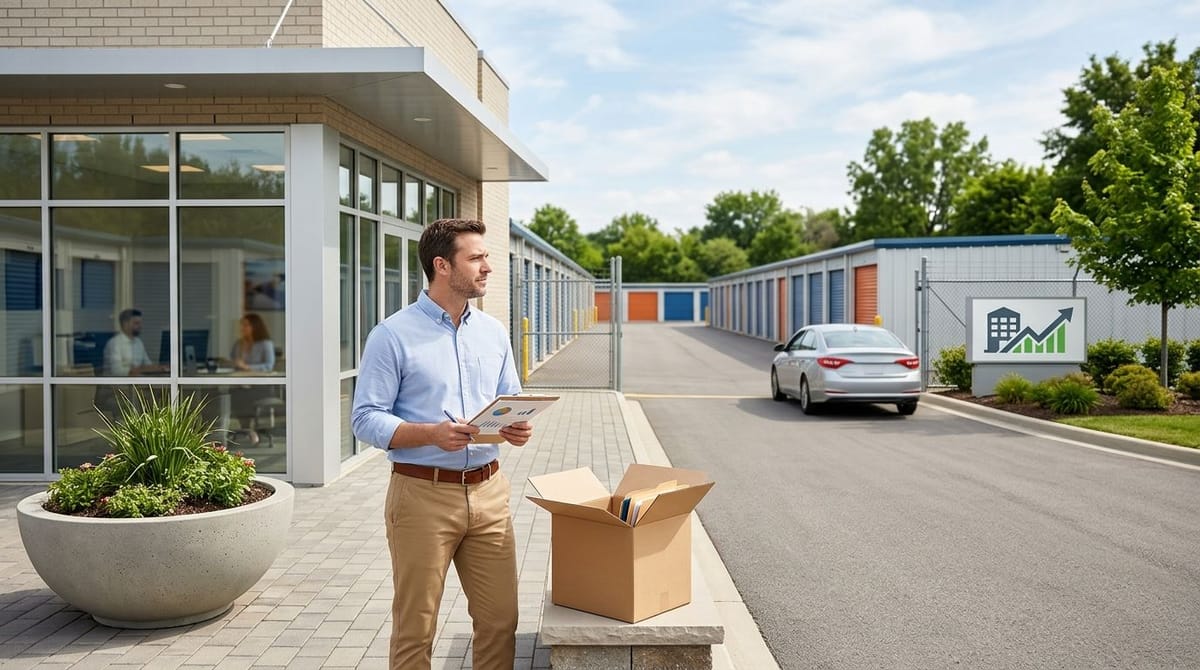
You fund a self-storage facility purchase by combining an SBA 504 or 7(a) loan, a conventional commercial real estate loan, a bridge loan, or seller financing — most buyers stack two of these together rather than covering the full price with one loan. SBA 504 loans typically require 10% down on a standard project, rising to 15% when the property is classified special-purpose, which self-storage often is. The cost buyers underestimate: closing fast with a bridge loan solves a timeline problem today but creates a second closing, with its own fees, when you refinance into permanent debt a year or two later.
- SBA 504 loans require 10-15% down on a self-storage purchase in 2026; conventional CRE loans require 25-30%.
- SBA 7(a) loans finance the same purchase but cap total borrowing at $5 million.
- Bridge loans close in 2-4 weeks but carry 6-24 month terms before a refinance is due.
- Seller financing fills the gap between the senior loan and the buyer's cash, common on smaller independent deals.
- Jon Lynch Financial Group is a broker, not a direct lender, and compares funding paths across third-party partners.
Why This Matters
Self-storage is one of the more financeable commercial real estate categories, and self-storage facility financing options span SBA, conventional and bridge structures because occupancy data is easy to verify and cash flow is predictable month to month.
That doesn't mean every lender treats a storage facility the same way it treats an apartment building or a warehouse. Whether the property is classified standard or special-purpose, whether you're an owner-operator or a passive investor, and how much cash you can put down all change the structure in 2026.
Getting it wrong adds cost you don't see until the closing statement — a bridge loan you didn't need, or a conventional loan that required more equity than an SBA structure would have. As a broker, not a direct lender, Jon Lynch Financial Group matches business owners with third-party funding partners across each of these structures based on down payment, timeline and creditworthiness.
How Do You Fund a Self-Storage Facility Purchase?
The short answer to how to fund a self-storage facility purchase in 2026 comes down to four paths: SBA loans, conventional commercial real estate loans, bridge loans and seller financing. Here's how they compare on cash required, timeline and fit.
| Financing Type | Typical Down Payment | Typical Timeline to Close | Best For |
|---|---|---|---|
| SBA 504 Loan | 10-15% | 45-75 days | Owner-operators running the facility themselves |
| SBA 7(a) Loan | ~10%, capped at $5 million total loan | 30-60 days | Buyers bundling working capital with the real estate loan |
| Conventional CRE Loan | 25-30% | 45-90 days | Buyers with strong cash flow history and stabilized occupancy |
| Bridge Loan | 10-25% | 2-4 weeks | Time-sensitive closings ahead of permanent financing |
| Seller Financing | Negotiated, junior to senior debt | Varies by seller | Filling the equity gap on smaller, independent deals |
Down payment ranges and timelines reflect typical program terms. Actual approval, amount and closing time depend on the funder's underwriting and are never guaranteed.
SBA 504 Loans: 15% Down for Special-Purpose Self-Storage Deals
SBA 504 loans typically require 10% down for a standard owner-occupied purchase, but self-storage is often classified as a special-purpose property, which pushes the requirement to 15%. A first-time business owner buying the facility can face another 5% on top of that, for 20% total, under SBA guidelines.
On a $2,000,000 self-storage purchase, a 15% down payment means bringing $300,000 in cash to closing, with the remaining $1,700,000 split between a bank-funded first mortgage and a CDC-funded second mortgage — an illustrative example, not a quote. SBA loan lenders for first-time borrowers differ on how they treat special-purpose collateral, so getting more than one term sheet matters before you sign a purchase contract.
Verdict: SBA 504 is worth the paperwork if you plan to operate the facility yourself and can document two to three years of consistent occupancy data.
SBA 7(a) Loans: Financing Capped at $5 Million
SBA 7(a) loans can finance a self-storage purchase and let you roll working capital or renovation costs into the same loan, but the program caps total borrowing at $5 million. That ceiling makes 7(a) a better fit for smaller or mid-size facilities than for large portfolios.
Down payment requirements run close to what 504 requires, and approval still depends on the lender's underwriting of your personal credit and the facility's cash flow. Bundling renovation dollars into the loan reduces the need for a separate line of credit right after closing.
Verdict: use 7(a) when you need renovation dollars bundled with the purchase price, not when the deal size pushes past the $5 million cap.
Conventional CRE Loans: 25-30% Down for Stabilized Facilities
Conventional commercial real estate loans usually require 25% to 30% down and reward buyers who can show a longer, stabilized occupancy history than SBA underwriting typically demands. On that same $2,000,000 facility, a 30% down payment means $600,000 in cash instead of $300,000 under SBA 504 — an illustrative comparison, not a specific quote.
In exchange, conventional loans often move faster for buyers who already have banking relationships and don't need SBA's additional paperwork. They also skip some of the use restrictions SBA financing attaches to the property.
Verdict: worth it if you have the equity and want to avoid SBA's use restrictions and personal guarantee requirements on the government-backed piece.
Bridge Loans: 2- to 4-Week Closings, 6- to 24-Month Terms
Bridge loans close in as little as two to four weeks, which matters when a seller won't wait 60-90 days for SBA or conventional underwriting. The tradeoff is term length: bridge financing typically runs 6 to 24 months and is priced to be refinanced, not held long term.
Buyers who use a bridge loan to win a deal still need a permanent-financing plan lined up before the bridge matures, or they're refinancing under pressure instead of on their own timeline. Bridge loans for commercial property acquisitions work best as a tool to win the deal, not as a long-term hold.
Verdict: use a bridge loan only when you already have a credible exit into SBA or conventional debt.
Seller Financing: Closing the Gap Senior Debt Won't Cover
Seller financing means the seller carries a note for part of the purchase price, usually in a junior position behind the primary loan, closing the gap between what the senior lender approves and what the buyer can put down in cash. It's more common on smaller, independently owned self-storage facilities than on institutional portfolio deals, because independent sellers have more flexibility to negotiate terms directly.
A capital stack that blends senior debt, seller financing and buyer equity needs to be sequenced correctly, which is where capital stack structuring for a commercial acquisition work happens before the letter of intent, not after.
Verdict: worth negotiating for whenever the seller is motivated and the senior lender's loan-to-value falls short of the full purchase price.
Every one of these structures gets underwritten against the same physical asset — the facility itself, its unit mix, and its condition.
Why Self-Storage Financing Terms Vary
Two buyers can look at the same $2,000,000 facility and land completely different terms. The factors that move the numbers:
- Property classification — standard vs. special-purpose changes SBA down payment requirements
- Occupancy and stabilization history — two to three years of consistent occupancy data lowers perceived risk
- Borrower experience — first-time self-storage owners often face higher down payment requirements than repeat operators
- Personal credit and business financials — underwriting still weighs the buyer's credit profile, even on SBA-backed deals
- Loan-to-value target — the gap between what the senior lender approves and the purchase price determines whether seller financing or bridge debt fills the rest
- Timeline to close — a seller demanding a fast close narrows the field to bridge lenders and cash buyers
“A self-storage purchase rarely closes on one loan alone — it closes on a capital stack sequenced correctly before the letter of intent is signed.”
Compare Business Funding Options
See funding paths matched to your down payment, timeline and credit profile.
Can You Buy a Self-Storage Facility With No Money Down?
No money down is rare on a self-storage purchase. Even SBA 504 loans require at least 10% down, and special-purpose classification usually pushes that to 15%. Seller financing can reduce the cash a buyer needs at closing, but it still sits behind a senior loan that expects meaningful borrower equity, and structures marketed as zero-cash typically shift the cost into a higher rate or a personal guarantee elsewhere in the deal.
Do You Need Self-Storage Experience to Qualify for Financing?
Experience isn't always a hard requirement, but first-time self-storage buyers commonly face higher down payment requirements and closer scrutiny of the facility's occupancy history than repeat operators do. Lenders underwriting SBA 504 deals add a startup surcharge to the down payment when the buyer has been in business under two years. Partnering with an experienced operator or property manager can offset some of that gap in a lender's eyes.
Is Seller Financing Common in Self-Storage Deals?
Seller financing shows up often on smaller, independently owned self-storage facilities, less often on institutional portfolio sales in 2026. It works as a junior note behind the primary loan, closing the gap between what the senior lender approves and what the buyer brings in cash. Sellers who are motivated to exit quickly are usually the ones willing to carry paper.
FAQ
What credit score do you need to buy a self-storage facility?
Lenders weigh personal credit alongside the facility's cash flow and the buyer's experience rather than applying one fixed cutoff. A stronger credit profile generally improves pricing and loan-to-value on both SBA and conventional structures.
How much cash do you need to buy a self-storage facility in 2026?
Cash needed typically ranges from 10% of the purchase price under SBA 504 to 30% under a conventional CRE loan, plus closing costs and any reserves the lender requires. The exact figure depends on property classification, borrower experience and the lender's underwriting.
Can an SBA loan be used to purchase a self-storage facility?
Yes, both SBA 504 and SBA 7(a) loans can finance a self-storage facility purchase, with 504 favoring owner-operators and 7(a) capped at $5 million in total borrowing. Special-purpose classification usually raises the down payment requirement to 15% under 504.
What is a capital stack in commercial real estate financing?
A capital stack is the combination of senior debt, secondary debt like seller financing or a bridge loan, and buyer equity that together fund a purchase. Sequencing each layer correctly before closing determines whether the deal is financeable at all.
How long does it take to close on a self-storage facility loan?
Closing timelines run roughly 30-60 days for SBA 7(a), 45-75 days for SBA 504, 45-90 days for conventional CRE loans, and as fast as 2-4 weeks for a bridge loan. Actual timing depends on the lender, the property's documentation and how quickly the buyer supplies bank statements and financials.
Is a bridge loan more expensive than an SBA loan?
Bridge loans are generally priced higher than SBA loans because they're structured for a 6- to 24-month hold rather than a multi-year amortization. The tradeoff is speed: a bridge loan can close in weeks when an SBA or conventional loan would take months.
Can you get 100% financing for a self-storage facility?
100% financing is uncommon. Most structures require the buyer to bring at least 10% in cash under an SBA loan, more under conventional debt, and seller financing can lower the cash needed at closing but rarely eliminates it entirely.
One Last Thing
The mistake that costs buyers the most isn't the down payment size — it's lining up a bridge loan or seller note without a confirmed takeout loan waiting on the other side. A bridge loan that matures before permanent financing is approved forces a refinance under pressure in 2026, usually at worse terms than if the SBA or conventional application had started on day one.