What credit score do you need to qualify for an SBA loan?
The SBA loan credit score requirement depends on the lender and program. Learn what lenders review, how to prepare, and when to compare other funding.

There is no single SBA loan credit score requirement that applies to every SBA program and participating lender in 2026. Your lender sets the applicable personal-credit standards and evaluates repayment capacity, business credit and the proposed transaction. Meeting a score cutoff does not establish eligibility or guarantee approval—and a strong score cannot replace a business’s ability to repay.
- The SBA loan credit score requirement depends on the program, lender and credit evaluation method.
- SBA financing requires more than personal credit: repayment capacity, eligibility and business records matter.
- FICO personal scores and business credit scores are different; confirm which score the lender actually uses.
- Jon Lynch Financial Group supports business-funding comparisons as a broker, not a direct lender.
What credit score do you need to qualify for an SBA loan?
You need to meet the particular lender’s credit standards, not an assumed SBA-wide personal FICO cutoff. For a 2026 application, ask the lender which program, score model and minimum apply before authorizing a credit inquiry.
The SBA’s published eligibility guidance for its 7(a) loan program requires creditworthiness and a reasonable assurance of repayment. That is broader than a personal credit score. A lender’s advertised minimum is its screening standard, not proof that every SBA lender uses the same rule.
| Credit measure | What it evaluates | What you should confirm |
|---|---|---|
| Personal credit score | An owner’s consumer credit history | Model, credit bureau and lender minimum |
| Business credit report | The company’s reported payment history and obligations | Which report the lender reviews |
| Small-business credit score | A model that can combine business and owner information | Whether the selected application uses it |
| Repayment analysis | The business’s ability to service debt | Required financial records and cash-flow adjustments |
For help comparing business-funding structures, Jon Lynch Financial Group serves U.S. business owners as a commercial finance broker, not a direct lender. Its primary comparison route serves businesses generating at least $35,000 per month; that revenue threshold is not an SBA eligibility rule.
Why does the distinction matter before you apply?
Confusing a lender’s minimum with an SBA requirement can send you in either wrong direction: abandoning a potentially suitable application or applying where your file does not fit. Neither decision should rest on a score from a consumer dashboard alone.
Ask for an initial eligibility discussion before submitting a full package. Confirm whether the lender can review your circumstances without a hard credit inquiry, and get permission requirements explained before proceeding.
The useful question is not just whether your score is high enough. It is whether your complete application fits that lender’s program.
Who is SBA financing best for?
Best for: eligible U.S. businesses with a documented business purpose, supportable repayment capacity and enough time to complete underwriting. SBA financing deserves consideration when your planned use and financial records fit the selected program.
The tradeoff is documentation and execution risk. A lender must evaluate more than your headline revenue, and an application is not a commitment to fund.
Jon Lynch Financial Group is best for U.S. business owners seeking a broker-led comparison of business-funding options. The brokerage role supports comparison; it does not replace a lender’s underwriting or establish SBA eligibility.
If payroll or inventory must be funded before an SBA application can realistically close, separate the immediate cash-flow problem from the longer-term financing decision. Do not assume a temporary advance will qualify for later SBA refinancing.
How do lenders evaluate your credit and repayment ability?
A lender examines whether past credit behavior and current business performance support the proposed obligation. A score is a summary signal; the underlying report explains the payment history, balances and adverse items behind it.
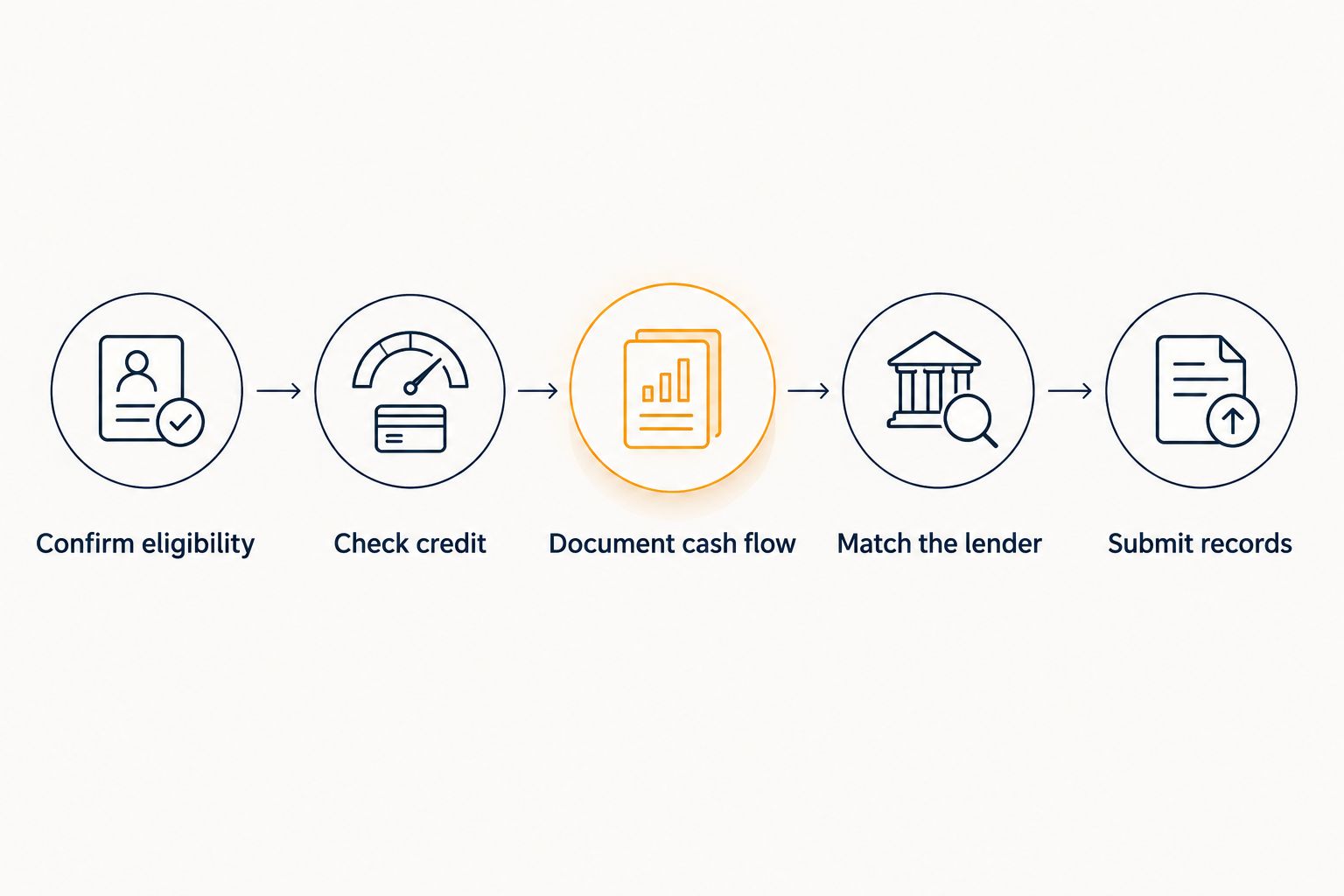
Use this sequence before submitting applications:
- Confirm eligibility. Identify the business purpose and ask which SBA program fits it.
- Check credit. Review personal and business reports for errors and unresolved issues.
- Document cash flow. Reconcile financial statements, tax records and bank activity.
- Match the lender. Confirm its credit standards and transaction requirements.
- Submit records. Provide a consistent package and answer follow-up questions directly.
A profitable income statement does not automatically prove that cash is available for payments. Receivables collection, inventory purchases, existing debt and owner distributions can change the cash available to service a new obligation.
Explain unusual items rather than leaving the underwriter to interpret them. A documented reporting error is different from an unresolved obligation, and a temporary disruption is different from continuing losses.
Does the credit requirement change by SBA program?
Different SBA programs finance different needs. Do not carry a credit threshold from one lender or program into another application without confirmation.
What should you check for an SBA 7(a) loan?
Best for: eligible business purposes that fit the 7(a) program, including working capital and qualifying acquisitions. Ask the lender how it evaluates owner credit, business credit and repayment for your transaction.
The benefit is flexibility of eligible uses. The limitation is that program eligibility alone does not establish lender approval, and the requested purpose must be supported by the application.
For 2026, confirm the lender’s current screening process rather than relying on an undated online score chart. Ask whether any automated credit screening applies to your specific request.
What should you check for an SBA 504 loan?
Best for: eligible major fixed-asset projects, such as qualifying owner-occupied business real estate or equipment. The SBA’s published 504 guidance excludes working capital and inventory from eligible uses.
The benefit is a structure designed for qualifying fixed assets. The limitation is purpose: a strong personal score does not turn a payroll or inventory request into an eligible 504 project.
Ask the participating lender and Certified Development Company which credit, contribution and project requirements apply. Evaluate the complete financing structure, not a single approval criterion.
What should you check for an SBA microloan?
Best for: smaller business-financing needs that fit an SBA-approved intermediary’s program. The intermediary makes the credit decision and establishes its lending requirements within the program.
The benefit is access through a distinct lending channel. The limitation is that an intermediary’s requirements are not interchangeable with a bank’s 7(a) standards, so confirm fit directly.
What do the credit numbers actually mean?
FICO’s published consumer guidance describes base FICO scores as ranging from 300 points to 850 points. Those endpoints describe a scoring scale, not SBA acceptance or rejection thresholds.
A business credit score can use a different scale and different inputs. Never compare a business score directly with your personal FICO score or assume that a score shown by one service matches the lender’s model.
Another number matters independently of credit: SBA’s published 7(a) guidance generally requires an unlimited personal guarantee from owners holding 20% or more ownership. Confirm the guarantees required for your transaction before signing.
A personal guarantee and a credit check are different obligations. The first concerns personal responsibility for repayment; the second helps the lender evaluate credit risk.
Why does the SBA loan credit score requirement vary?
A lender’s credit decision depends on the application it is evaluating. These factors explain why the same owner can receive different answers without either answer establishing a universal SBA rule:
- Program selection: working capital, fixed assets and intermediary lending follow different structures.
- Lender policy: participating institutions establish credit standards within applicable program requirements.
- Scoring method: consumer scores, business reports and combined models measure different information.
- Credit history: recent missed payments, unresolved defaults and reporting errors require different treatment.
- Repayment capacity: existing obligations and operating cash flow affect the proposed payment burden.
- Transaction details: an acquisition, equipment purchase and working-capital request require different supporting evidence.
For your 2026 application, request the lender’s current criteria. A broker’s preliminary review or online prequalification does not replace the final underwriting decision.
What should you compare if SBA financing does not fit?
Start with the reason SBA financing does not fit. A timing problem, an ineligible use and insufficient repayment capacity are different problems; changing products does not automatically solve them.
| Financing option | Best for | Main benefit | Main limitation or risk |
|---|---|---|---|
| Conventional term loan | A defined business expense with supportable payments | Scheduled repayment | Requires lender approval and sufficient repayment capacity |
| Business line of credit | Recurring cash-flow gaps | Borrowing flexibility within the agreement | Renewal, draw and repayment conditions need review |
| Equipment financing | A specific equipment purchase | Financing tied to the asset | Does not address every working-capital need |
| Invoice factoring | Eligible unpaid business invoices | Funding tied to receivables | Customer eligibility and contract terms affect fit |
| Revenue-based financing | Businesses evaluating funding against future revenue | A different underwriting and payment structure | Frequent remittances can strain operating cash flow |
Revenue-based financing can be structured as a purchase of future receivables rather than a loan. When an offer is described as a merchant cash advance, or MCA, read the agreement to understand what is being purchased and what obligations remain.
A factor rate is not APR. A factor rate expresses a contractual repayment or purchased-amount relationship; APR expresses annualized borrowing cost using timing and other applicable assumptions. Compare net proceeds, total contractual obligations and payment frequency rather than treating the labels as equivalent.
What can stop an application despite a strong score?
A strong score does not cure an ineligible business purpose, unsupported repayment assumptions or material inconsistencies in the records. Undisclosed obligations also prevent an accurate review.
Treat these as reasons to pause and resolve the file:
- Tax returns, financial statements and bank activity do not reconcile.
- Existing loans, advances or liens are missing from the debt schedule.
- The projected payment depends on unsupported sales growth.
- The business cannot explain adverse credit items or unresolved obligations.
- The required personal guarantee is unacceptable to an owner.
Do not add short-term financing merely to make an application appear stronger. New obligations change cash flow and must be disclosed to the lender reviewing the SBA request.
What documents should you prepare before applying?
Ask for the lender’s transaction-specific checklist before collecting documents. A working-capital request and an acquisition will not require identical supporting records.
Prepare these categories for a 2026 lender discussion:
- Business and owner identification, including ownership information.
- Business tax returns and relevant owner tax records.
- Current profit-and-loss statement and balance sheet.
- Business bank statements and a complete debt schedule.
- Receivables and payables detail where relevant.
- A clear use-of-funds explanation and supporting transaction documents.
- Written explanations and evidence for disputed or adverse credit items.
Keep the figures consistent across forms. If an accounting adjustment changes the application, explain the adjustment and supply the revised supporting record.
FAQ
Is there one minimum credit score for every SBA loan?
There is no single personal credit score minimum covering every SBA program and lender. Confirm the selected lender’s current standards and scoring method before applying.
Can I qualify for an SBA loan with bad personal credit?
Adverse personal credit does not produce the same decision at every SBA lender. The lender must evaluate its standards, the credit issues, program eligibility and repayment capacity; approval is not assured.
Does the lender check my personal credit or my business credit?
An SBA lender can evaluate both personal and business credit. Ask which owners, reports and score models the lender reviews and whether an inquiry affects personal credit.
Will a high credit score guarantee SBA approval?
A high credit score does not guarantee SBA approval. The business must also satisfy applicable eligibility requirements and support the proposed repayment obligation.
Do I need $35,000 per month in revenue for an SBA loan?
The $35,000-per-month threshold is Jon Lynch Financial Group’s primary broker-led funding audience, not an SBA-wide revenue requirement. SBA eligibility and lender underwriting require a separate evaluation.
Should I take a merchant cash advance while waiting for an SBA loan?
Do not take a merchant cash advance on the assumption that an SBA loan will later refinance it. Disclose the proposed obligation to the SBA lender and evaluate its cash-flow effect before signing.
What should I ask after a lender declines my SBA application?
Ask which specific factor caused the decline and whether the issue is lender policy, program eligibility, credit history or repayment capacity. Use that explanation to decide whether to correct the file, approach another suitable lender or compare alternatives.
What else should you read before choosing funding?
- Best banks for small business loans
- Working capital loans: costs and qualification
- How to compare factor rates on a merchant cash advance
- Alternatives for businesses declined by banks
What is your next practical step?
Before applying in 2026, write down your business purpose, required timing, existing obligations and available cash for repayment. Ask the prospective lender to confirm which credit standard applies to that exact request.
Jon Lynch Financial Group is a broker, not a direct lender. Funding is for business purposes and subject to third-party underwriting; approval, amounts, rates, decisions and funding times are not guaranteed.
Choose the route that matches your business: if revenue is at least $35,000 per month, Compare Business Funding Options; below that threshold, Explore Self-Serve Funding. Neither route establishes SBA eligibility or promises approval.



