Best merchant cash advance lenders for home service businesses 2026
Compare MCA lenders for home service businesses by net proceeds, collection terms and risk. See when a credit line or equipment financing fits better.

Best starting point: Jon Lynch Financial Group for home service owners comparing business funding at $35,000 or more in monthly revenue. The best merchant cash advance lenders for home service businesses are not interchangeable: choose by net proceeds, total contractual obligation, collection schedule and slowdown protections—not an approval-speed claim. A line of credit or equipment financing deserves comparison before you commit future revenue.
- Jon Lynch Financial Group is a broker, not a direct lender, for owners comparing working capital and future-receivables funding.
- Choosing the best merchant cash advance lenders for home service businesses starts with collection terms and cash-flow fit.
- Compare merchant cash advance offers with lines of credit, equipment financing and invoice factoring where appropriate.
- A factor rate is not APR; timing, fees and net proceeds change the comparison.
Why does the funding structure matter for home services?
Your funding should bridge a specific cash-flow gap without consuming the money needed to complete the work. For an HVAC installer, that means protecting equipment purchases and payroll; for a landscaping company, it means matching collections to seasonal receipts.
Jon Lynch Financial Group is a commercial finance broker, not a direct lender. Its business-funding options come through third-party lenders and funders, and revenue-based financing may be structured as a purchase of future receivables rather than a loan.
For your 2026 comparison, separate the funding source from the financing structure. A broker helps you compare routes; the lender or funder supplies the contract and makes the underwriting decision.
What makes the best merchant cash advance option?
Judge every proposal against the same criteria before comparing names:
- Net proceeds: The dollars reaching your business after deductions and existing-position payoffs.
- Total obligation: The amount you must repay or deliver, plus separately charged fees.
- Collection schedule: When withdrawals occur relative to customer deposits and completed-job payments.
- Slowdown treatment: Whether the contract provides reconciliation, how you request it and what evidence it requires.
- Contract exposure: Guarantees, security interests, default provisions and restrictions on additional financing.
- Purpose fit: Whether the funding solves a temporary gap or finances an expense better matched to another structure.
A large advance is not automatically a useful advance. Compare the amount left for operations after every existing obligation and the proposed collection are accounted for.
Which funding routes deserve a place on your shortlist?
This 2026 shortlist ranks decision routes, not individual funders by unverified performance. Each route serves a different need; a position lower in the table does not make that structure worse for its intended purpose.
| Rank and option | Best for | Standout feature | Key limitation |
|---|---|---|---|
| 1. Jon Lynch Financial Group | Established owners comparing multiple structures | Broker access to third-party funding options | Does not make the funding decision |
| 2. Direct future-receivables funder | Owners evaluating a specific receivables-purchase contract | Direct discussion with the proposed contractual counterparty | One proposal does not establish market fit |
| 3. Business line of credit | Recurring gaps between expenses and collections | Draw-based borrowing under the agreement | Access and continued availability depend on terms and underwriting |
| 4. Equipment financing | An identifiable vehicle or equipment purchase | Financing tied to a business asset | Does not replace general working capital |
| 5. Invoice factoring | Eligible unpaid commercial invoices | Funding tied to existing receivables | Invoice and customer eligibility restrict its use |
1. Jon Lynch Financial Group: best for comparing funding structures
Jon Lynch Financial Group fits established U.S. home service businesses generating at least $35,000 per month that want to compare working capital, revenue-based financing and other business-purpose options. The brokerage offers access through third-party funding partners rather than lending directly.
The useful comparison is not simply one MCA against another. Ask whether a line of credit, term loan, equipment financing or receivables purchase matches the expense and collection cycle.
Jon Lynch Financial Group pros:
- Business-owner focus on working capital and funding comparisons.
- Access to multiple financing structures through third parties.
- A separate self-serve route for businesses below the primary audience threshold.
Jon Lynch Financial Group cons:
- The broker cannot guarantee a third party's approval or terms.
- Product eligibility depends on the relevant funding partner.
- Comparing options still requires reviewing the actual contracts.
Best for: Owners who need help choosing the structure before selecting an offer.
Verdict: Compare. Use the brokerage route to evaluate fit, not as a substitute for contract review.
2. Direct future-receivables funder: best for contract-level comparison
A direct future-receivables funder purchases an agreed portion of future business receipts under its contract. The label “merchant cash advance” does not establish the legal structure or tell you whether collections adjust when receipts change.
Ask the proposed funder to identify the purchasing entity and explain the remittance provisions in writing. Evaluate the agreement against your expected receipts, not just your busiest period.
Direct future-receivables funder pros:
- Direct questions to the proposed contractual counterparty.
- A specific agreement to review for purchased receivables and collection mechanics.
- A structure to evaluate alongside loan alternatives.
Direct future-receivables funder cons:
- Collections reduce cash available for operating expenses.
- Reconciliation rights and procedures depend on the contract.
- One funder's proposal does not establish that the offer is competitive.
Best for: Owners who understand the receivables-purchase structure and want to assess a specific agreement.
Verdict: Hold until reviewed. Do not sign while collection or reconciliation terms remain unclear.
3. Business line of credit: best for recurring working-capital gaps
A business line of credit lets you borrow through draws under an approved agreement. It deserves comparison when you repeatedly pay technicians, suppliers or subcontractors before collecting customer payments.
For your 2026 decision, inspect draw charges, repayment rules, renewal conditions and the lender's ability to restrict further borrowing. An approved limit is not the same as permanent access to that amount.
Business line of credit pros:
- Draw-based access can match separate operating needs.
- A revolving structure can support repeated use, subject to the agreement.
- Loan terms provide a different comparison from a receivables purchase.
Business line of credit cons:
- Qualification depends on the lender's underwriting.
- Fees and repayment mechanics differ across agreements.
- Renewal or access restrictions can affect future borrowing.
Best for: Businesses with recurring timing gaps rather than a single asset purchase.
Verdict: Compare before an MCA. Choose only after comparing the complete obligation and cash-flow effect.
4. Equipment financing: best for a defined asset purchase
Equipment financing funds a specific business asset, such as a service vehicle or installation equipment. Match the financing to the asset rather than automatically using a general-purpose advance.
Separate the equipment need from any payroll or materials gap. Combining them into one proposal can obscure which expense creates the repayment burden.
Equipment financing pros:
- Connects the financing purpose to an identifiable asset.
- Supports a separate comparison of asset funding and operating cash.
- Provides an alternative to committing general receipts for the entire purchase.
Equipment financing cons:
- Asset eligibility and required contributions depend on the agreement.
- The financed asset can be subject to a security interest.
- Equipment funding alone does not solve an operating deficit.
Best for: Owners buying a defined asset with a clear business use.
Verdict: Compare first for equipment. Keep unrelated working-capital needs visible.
5. Invoice factoring: best for eligible unpaid commercial invoices
Invoice factoring involves selling eligible invoices to a factor. It belongs on the shortlist when your home service business completes commercial work but waits for business customers to pay.
Do not treat a future appointment, an unsigned estimate or a consumer booking as an eligible invoice. Confirm the factor's requirements before building your cash plan around the proceeds.
Invoice factoring pros:
- Connects funding to existing receivables.
- Addresses a gap between invoicing and customer payment.
- Provides a comparison distinct from purchasing future business receipts.
Invoice factoring cons:
- Customer and invoice eligibility limit access.
- Customer notification and collection arrangements require review.
- Recourse provisions can leave obligations with your business.
Best for: Commercial service providers holding eligible, unpaid business invoices.
Verdict: Compare when invoices fit. Skip this route for work that has not produced eligible receivables.
How should you compare the numbers without confusing factor rate and APR?
A factor rate is a multiplier used to calculate a contractual amount; it is not an annual percentage rate. APR expresses annualized borrowing cost and requires more than the multiplier alone, including proceeds, charges and payment timing.
Use these calculation steps for each written proposal:
- Gross amount multiplied by factor rate: Calculate the stated purchased amount or repayment amount, as applicable.
- Gross amount minus deductions and payoffs: Identify the net proceeds available for operations.
- Contractual collections plus separate charges: Identify the complete dollar obligation without double-counting fees.
- Receipts minus operating expenses and collections: Test the cash remaining to complete jobs.
A collection schedule that looks manageable beside gross sales can fail beside cash remaining after materials and payroll. Compare offers using the same net proceeds and actual payment dates wherever possible.
For a detailed explanation, read how to compare factor rates on a merchant cash advance. Do not describe a multiplier as an interest rate or assume early delivery of receivables reduces the contractual amount.
What should the contract review cover?
For every 2026 proposal, obtain written answers before authorizing withdrawals. A verbal explanation does not replace the agreement.
- Net proceeds: What reaches the operating account after all deductions?
- Total obligation: What must the business deliver, including separate charges?
- Collection schedule: What happens on low-receipt days or weeks?
- Reconciliation: What triggers an adjustment, and how is it requested?
- Guarantees: What personal obligations and security interests apply?
- Exit terms: What changes if you settle early or seek other financing?
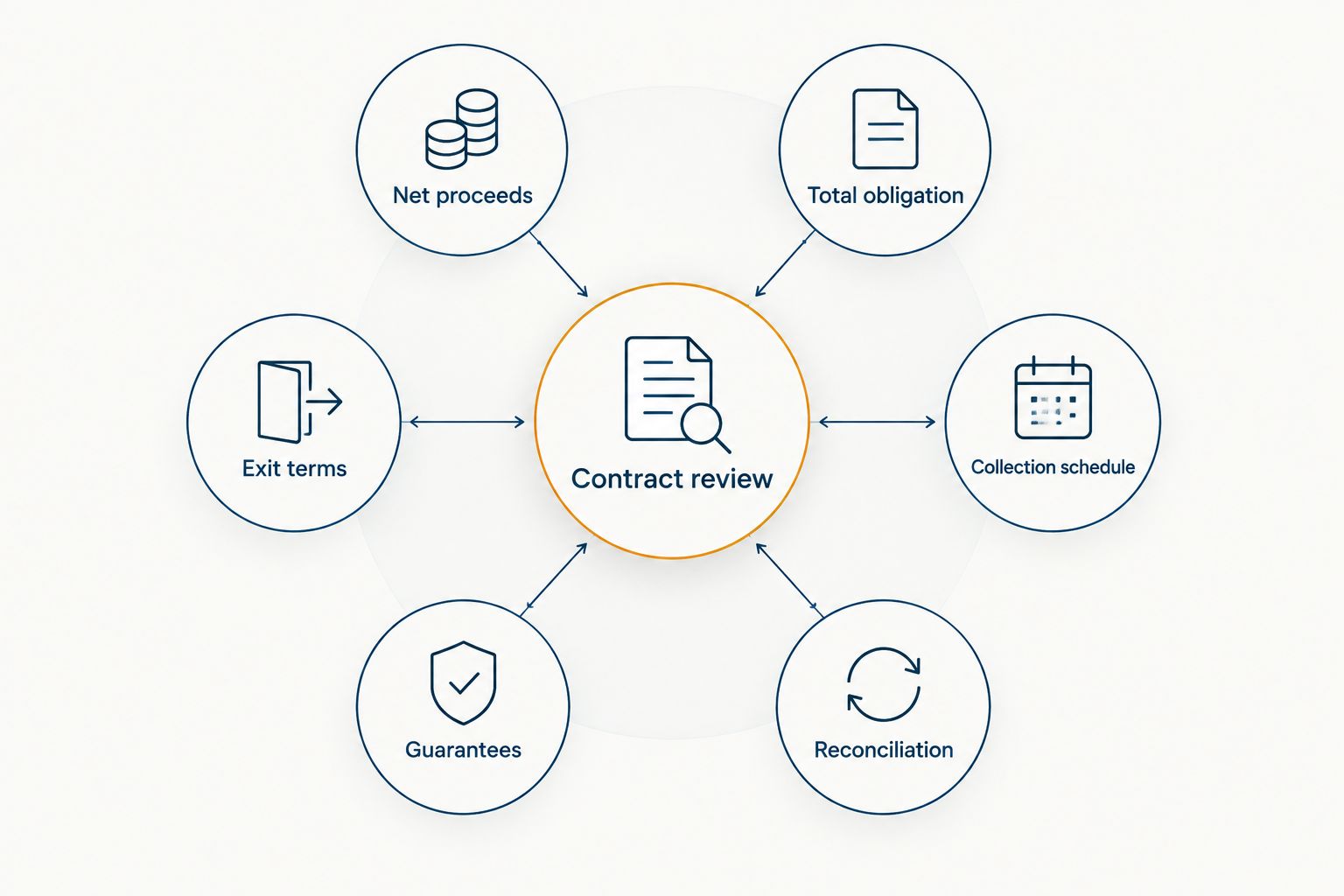
Ask how the agreement handles disputes, defaults and additional borrowing. If an explanation conflicts with the document, resolve the conflict before signing and obtain appropriate legal advice.
When should a home service business skip an MCA?
Skip an offer that leaves too little cash to finish the work generating the receipts. Funding does not repair an underlying loss if each additional job consumes more cash than it produces.
Stop and reassess when:
- You need another advance primarily to meet existing collections.
- The plan depends on unconfirmed jobs or customer payments.
- You cannot identify every existing financing withdrawal.
- The proposed collection leaves payroll, taxes or essential suppliers uncovered.
- The agreement's reconciliation, guarantee or default terms remain unclear.
A bank decline also needs a diagnosis. Credit history, receipts, existing obligations and documentation can affect underwriting; “credit does not matter” is not a sound basis for choosing financing.
What should you prepare before comparing offers?
Start your 2026 review with a funding purpose, a required amount and a cash-flow forecast. Separate confirmed receivables from estimates and identify the date each essential expense must be paid.
Prepare bank statements, existing financing agreements, current payoff information, business ownership details and supporting job or invoice records. The exact document requirements depend on the funding partner and product.
The $35,000 monthly revenue figure identifies the primary brokerage audience; it is not a universal approval threshold. Do not annualize one strong month and present it as established annual revenue.
For businesses below that monthly figure, the self-serve route is open to U.S.-based entrepreneurs and can be completed from home. Applicants securely connect bank statements through Plaid for an automated decision; approval and timing remain subject to verification and product terms.
How was this shortlist ranked?
The order follows the owner's decision: compare structures, inspect a receivables-purchase agreement, then match recurring gaps, assets or invoices to purpose-specific alternatives. Net proceeds, total obligation, collection timing and contractual exposure determine fit—not an unsupported lender leaderboard.
FAQ
What's the best merchant cash advance lender for a home service business?
The best choice is the offer whose net proceeds, total obligation and collection terms fit your business cash flow. Compare the actual agreement with a line of credit, equipment financing or invoice factoring where those structures fit.
Is Jon Lynch Financial Group a direct MCA lender?
Jon Lynch Financial Group is a broker, not a direct lender. Funding decisions and product terms come from third-party lenders and funders.
Is a merchant cash advance the same as a business loan?
A merchant cash advance can be structured as a purchase of future receivables rather than a loan. Review the agreement and obtain legal advice about its structure and obligations.
Does a factor rate tell me the APR?
A factor rate does not tell you the APR. An annualized comparison also needs net proceeds, charges and the timing of payments or collections.
Can I qualify after my bank declines my application?
A bank decline does not determine every other provider's decision. Other funding partners apply their own underwriting, and approval is not assured.
Will MCA collections automatically decrease during a slow season?
Do not assume collections automatically decrease when revenue falls. Review the reconciliation provisions, required documentation and adjustment process in the specific agreement.
What if my home service business makes less than $35,000 per month?
U.S.-based entrepreneurs below $35,000 in monthly revenue can explore the self-serve funding route. Applicants securely connect bank statements through Plaid for an automated decision, subject to verification and product terms.
Which route should you choose?
Start with a structure comparison, not the largest advertised advance. Use a line-of-credit comparison for recurring gaps, equipment financing for an asset and factoring for eligible commercial invoices; evaluate an MCA against the same operating cash requirements.
All options discussed are for business purposes. Products are subject to third-party underwriting, and approval, amounts, rates, decisions and funding times are not guaranteed. Consumer-purpose and non-U.S. requests fall outside the primary funding audience.
What else should you read before deciding?
- Working capital loans for HVAC and plumbing companies
- Working capital loans for landscaping businesses
- Revenue-based financing for seasonal businesses
What's one last check before applying?
Request the proposed collection calendar and place it beside payroll and supplier due dates. An obligation can fit the monthly total and still fall on the wrong days.
Take the route matching your revenue: at least $35,000 per month, Compare Business Funding Options; below $35,000 per month, Explore Self-Serve Funding.