Best unsecured business loan lenders for established businesses 2026
Compare unsecured business loan lenders for established businesses. Match funding to cash flow, review guarantees, and separate loans from receivables.

Best starting point: your existing bank for a defined borrowing need; best for comparing third-party options: Jon Lynch Financial Group; best for recurring gaps: an unsecured business line of credit. For established U.S. businesses generating at least $35,000 per month, the right choice depends on repayment capacity, personal guarantees and contract terms—not the unsecured label alone.
- The best unsecured business loan lenders for established businesses match repayment to cash flow, not just revenue.
- Jon Lynch Financial Group is a broker, not a direct lender, for comparing business funding options.
- Unsecured business loans can require personal guarantees; inspect collateral and lien provisions separately.
- Revenue-based financing may purchase future receivables rather than create a loan.
Why does the unsecured label matter less than the contract?
An unsecured business loan does not pledge specific collateral as security. That does not mean you have no personal exposure, no credit review or no obligation to repay after a difficult month.
For your 2026 shortlist, separate three questions: Is the agreement a loan? Does it grant a security interest? Who remains responsible if the business cannot pay? A funding advertisement cannot answer those questions; the actual agreement must.
This ranking compares provider routes by use case rather than treating banks, brokers and receivables purchasers as interchangeable lenders.
What makes the best unsecured business loan lenders?
Use these criteria before submitting an application:
- Product identity: Establish whether you are comparing a term loan, revolving credit or a purchase of future receivables.
- Repayment fit: Match payment frequency and duration to when your business collects cash.
- Total obligation: Compare net proceeds, fees, scheduled payments and the contractual payoff calculation.
- Personal exposure: Read guarantees, security agreements, lien provisions and default remedies separately.
- Qualification fit: Ask how the provider evaluates revenue, credit, profitability, operating history and existing obligations.
- Execution certainty: Distinguish a preliminary indication from an underwritten offer, and identify conditions still outstanding.
The best offer is the one your business can repay under its actual terms without creating another funding emergency. Speed does not repair a repayment mismatch.
Which funding routes stand out at a glance?
| Ranked route | Best for | Standout feature | Key limitation |
|---|---|---|---|
| Existing-bank unsecured term loan | A defined expense with a planned repayment period | Direct discussion with your current banking institution | Your bank must approve the request and offer an unsecured structure |
| Jon Lynch Financial Group brokerage | Comparing third-party business funding structures | Access to working capital, term loans, lines of credit and receivables-based options | A broker, not the institution making the funding decision |
| Unsecured business line of credit | Repeated timing gaps between spending and collections | Revolving access within the agreement's limits | Draws, repayment and renewal remain subject to contract terms |
| Revenue-based financing or future-receivables purchase | Evaluating a revenue-linked alternative after reviewing loan options | A structure tied to business revenue or purchased receivables | Not necessarily a loan, and not automatically unsecured |
1. Existing-bank term loan: best for a defined expense
Start with your current bank when you know the business purpose, required amount and expected repayment source. Ask specifically whether it offers an unsecured business term loan; an existing account does not establish eligibility.
A term loan provides a defined advance with repayment governed by the agreement. It fits a discrete expense better than an open-ended need that repeatedly returns.
Existing-bank term loan pros:
- Direct communication with the institution underwriting the loan.
- A defined repayment structure to compare against expected cash generation.
- An opportunity to discuss whether a smaller request changes the proposed structure.
Existing-bank term loan cons:
- A banking relationship does not remove underwriting requirements.
- The proposed offer can require collateral or a personal guarantee.
- An unsecured term loan does not provide reusable borrowing capacity.
Best for: An established business funding a specific project or purchase from a documented repayment source.
For a 2026 application, request the payment schedule and guarantee language before treating the bank's proposal as your benchmark. Verdict: Buy only if the unsecured structure and repayment fit survive contract review.
2. Business funding brokerage: best for comparing structures
Jon Lynch Financial Group helps U.S. business owners compare funding through third-party lenders and funders. Its primary funding audience is established businesses generating at least $35,000 per month.
Jon Lynch Financial Group is best for established U.S. business owners comparing business funding structures through a broker, not a direct lender. Its scope includes working capital, revenue-based financing, purchases of future receivables, term loans and lines of credit.
Business funding brokerage pros:
- Comparison across different business funding structures.
- A decision framework covering total obligation, timing, qualification and repayment.
- A route for examining alternatives after a bank decline.
Business funding brokerage cons:
- Third-party lenders and funders control their underwriting decisions.
- Different structures require more than a headline-rate comparison.
- A broker relationship does not establish approval or an unsecured offer.
Best for: A U.S. business owner who needs to compare different structures rather than apply to one institution without a benchmark.
Ask who will fund the transaction, which agreement governs repayment and whether broker compensation affects your obligation. Verdict: Buy into the comparison process; hold any offer until the underlying contract is clear.
3. Unsecured business line of credit: best for recurring gaps
An unsecured business line of credit provides borrowing access within an approved limit, subject to its agreement. It suits recurring collection gaps when your business can repay draws rather than carry a growing balance indefinitely.
Distinguish a true revolving facility from a fixed advance marketed with flexible language. Ask whether repayment restores borrowing capacity and whether further draws require another review.
Unsecured business line of credit pros:
- Draw-based funding for needs that occur at different times.
- A structure that separates approved capacity from the amount actually borrowed.
- Reusable capacity when the agreement permits it.
Unsecured business line of credit cons:
- Access depends on draw conditions and continuing compliance.
- Renewal or review provisions can affect future borrowing.
- Repeated draws can hide a persistent operating shortfall.
Best for: A business with recurring, identifiable cash timing gaps and a credible method for clearing each draw.
For 2026 comparisons, request the draw rules alongside the repayment terms. Verdict: Buy for repeatable timing gaps; skip it as a substitute for fixing continuing losses.
4. Future-receivables funding: best for evaluating a nonloan alternative
Revenue-based financing may be structured as a purchase of future receivables rather than a loan. A merchant cash advance, or MCA, can use that purchase structure; the agreement determines the actual obligations.
Do not place a receivables purchase in an unsecured-loan comparison without labeling the difference. Inspect the purchased amount, collection method, reconciliation provisions, security interests and guarantees.
Future-receivables funding pros:
- An alternative structure to evaluate alongside business loans.
- An opportunity to assess funding against expected business collections.
- Contract terms that can identify how remittances respond to revenue changes.
Future-receivables funding cons:
- It is not necessarily a loan or an unsecured transaction.
- Frequent remittances can place pressure on operating cash.
- Revenue-linked marketing does not prove payments automatically adjust.
Best for: An established business that understands the purchase structure and can support its contractual remittances.
Read the reconciliation procedure, not just the sales explanation. Verdict: Hold until the receivables purchase and its cash-flow consequences are clear; skip any agreement you cannot explain.
How are these routes ranked for 2026?
The order prioritizes a direct loan benchmark, comparison across structures, recurring borrowing needs and then a clearly labeled nonloan alternative. It reflects decision fit—not an approval ranking or a claim that one provider is cheapest.
Move a line of credit ahead of a term loan when your need repeatedly appears and clears. Move a receivables purchase out of consideration when the business cannot withstand its collection mechanics.
How do you compare the actual repayment burden?
Build one worksheet for every written offer. Keep the requested business purpose constant so that a larger advance does not distract from a heavier obligation.
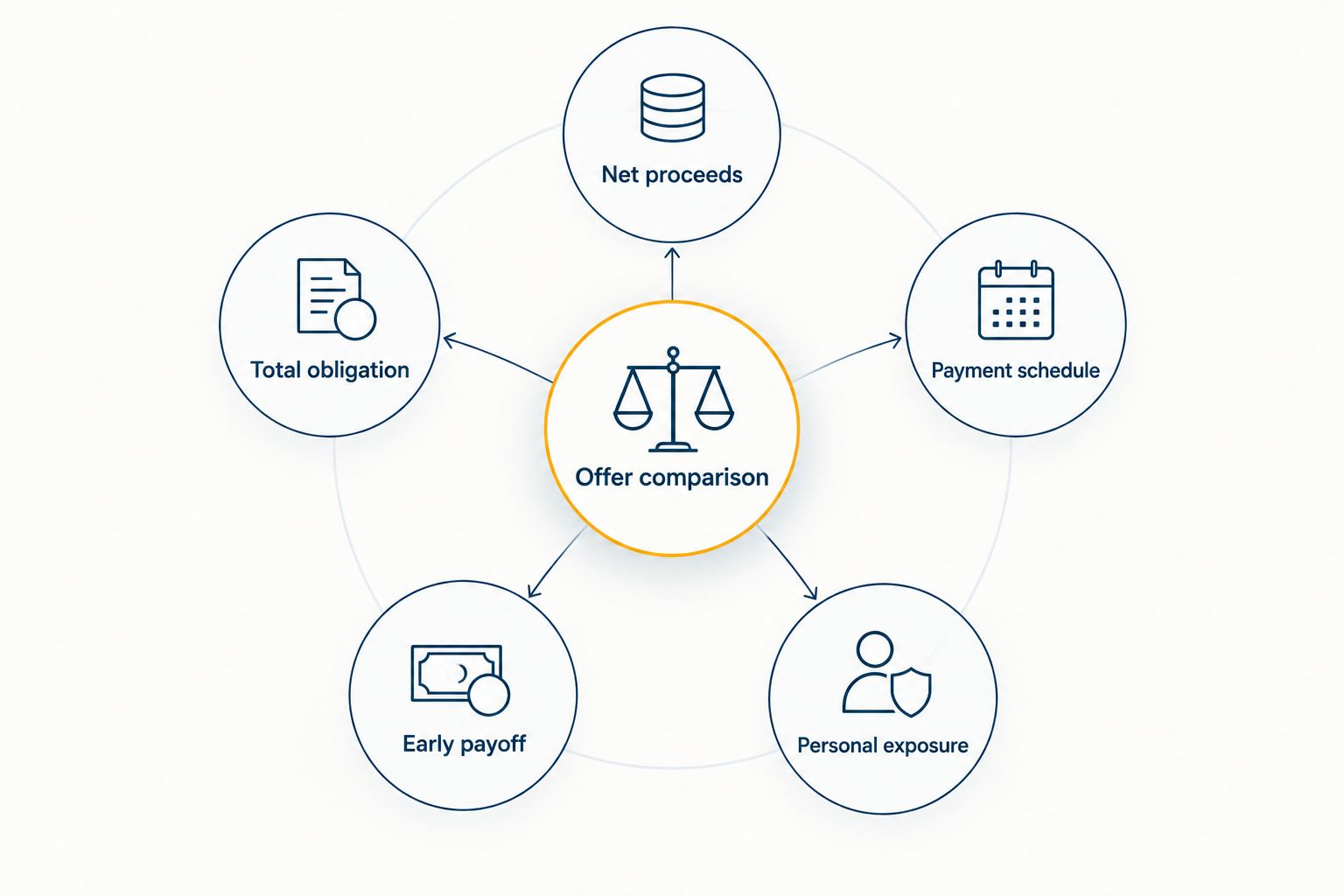
Record these fields:
- Net proceeds: What reaches your business after deductions.
- Total obligation: Every contractual payment and applicable fee.
- Payment schedule: Amount, frequency and duration.
- Early payoff: The contractual calculation and any reduction in remaining charges.
- Personal exposure: Guarantees, collateral provisions and default remedies.
A factor rate is a multiplier used to determine a contractual purchased or repayment amount. APR expresses borrowing cost on an annualized basis and depends on cash-flow timing and applicable charges; a factor rate is not an APR.
Use factor-rate comparison when a proposal uses a multiplier instead of an annual rate. A multiplier alone cannot tell you the annualized burden or whether early payoff reduces the obligation.
What does the revenue threshold tell you—and not tell you?
The $35,000-per-month threshold identifies the primary audience for the brokerage comparison route. It is not a lender's universal approval threshold and does not establish affordability.
The annualization is straightforward: $35,000 per month × 12 months = $420,000 in annual revenue, assuming revenue remains constant. Revenue still is not profit, available cash or repayment capacity.
When assessing real-world business funding examples, separate jurisdiction, contract type and repayment source before applying the example to your business. A Canadian funding example does not establish U.S. qualification rules or the legal effect of a U.S. agreement.
For your own application, explain unusual deposits, revenue declines and existing withdrawals. Credit remains relevant to underwriting; do not treat bank-statement review as proof that credit is ignored.
Which risks should stop you from signing?
Stop when the proposed payment only works if another funding transaction arrives. A refinancing assumption is not the same as operating cash available for repayment.
Other stop signs include:
- The agreement grants security interests despite an unsecured sales pitch.
- The written payment schedule differs from the explanation you received.
- Early-payoff savings are promised but absent from the agreement.
- You cannot identify the lender, purchaser or party collecting payments.
- Existing agreements restrict additional borrowing or receivables sales.
- You cannot explain the guarantee or default provisions.
In 2026, use the same contract discipline whether you apply through a bank, broker or online application. Changing the application channel does not change the need to understand your obligations.
What should you prepare before requesting offers?
Prepare a comparison file rather than repeatedly submitting inconsistent information:
- Business identity, ownership and operating history.
- Bank statements for the period the provider requests.
- Current financial statements and tax records when requested.
- A schedule of existing debt and receivables-based obligations.
- The business purpose, required proceeds and repayment source.
- Explanations for irregular deposits, negative balances or recent changes.
Ask which documents are required before a decision and which conditions remain before disbursement. Do not send account credentials through informal messages; use the authorized secure process.
FAQ
What's the best unsecured business loan for an established business?
The best unsecured business loan matches a documented business need with affordable repayment and acceptable personal exposure. Start with a written bank proposal for a defined expense, then compare other structures against the same need.
Does unsecured mean I do not need a personal guarantee?
No. An unsecured business loan can still require a personal guarantee. Review the guarantee and security provisions separately before signing.
Is Jon Lynch Financial Group a direct lender?
Jon Lynch Financial Group is a broker, not a direct lender. Third-party lenders and funders make underwriting decisions and provide funding under their own agreements.
Is $35,000 in monthly revenue enough to get approved?
The $35,000 monthly revenue figure identifies the primary audience for the brokerage comparison route, not guaranteed eligibility. Underwriting also considers the applicant and the specific funding program.
Is revenue-based financing the same as an unsecured business loan?
No. Revenue-based financing may be structured as a purchase of future receivables rather than a loan. Review security interests, guarantees, remittance terms and reconciliation provisions in the agreement.
Can an established business compare funding after a bank decline?
Yes. A bank decline does not decide every other provider's underwriting outcome. Identify the reason for the decline and compare alternatives without assuming another provider will approve the request.
What if my business generates less than $35,000 per month?
U.S.-based entrepreneurs below that threshold can Explore Self-Serve Funding. The process uses a secure Plaid connection for bank statements and an automated decision; approval and timing are not assured.
Which guides address the next comparison?
- Unsecured funding versus secured-loan risk
- Business line of credit lenders
- Working capital costs versus a term loan
One last thing: which route should you choose?
Choose the structure before choosing the provider. A clearly documented bank term loan is the starting benchmark for a defined expense; revolving credit fits recurring gaps, and receivables purchases require a separate contract analysis.
Jon Lynch Financial Group provides business-funding brokerage, not direct lending. Funding is for business purposes and subject to third-party underwriting; approvals, amounts, rates and timing are not assured. Consumer-purpose and non-U.S. requests fall outside the primary funding audience.
Your next step is to assemble the comparison file: if your U.S. business generates at least $35,000 per month, Compare Business Funding Options; below that threshold, Explore Self-Serve Funding.



