Best working capital loan providers for trucking companies in 2026
Best working capital loans for trucking companies: match funding to cash flow. Compare credit lines, factoring, term loans and repayment risks in 2026.

Best for comparing funding structures: Jon Lynch Financial Group. Best for recurring fuel and payroll gaps: a bank line of credit. Best for unpaid freight invoices: a freight factoring company. The best working capital loans for trucking companies in 2026 match repayment to collected cash—not gross freight revenue—and invoice factoring is an alternative to a loan, not the same product.
- Jon Lynch Financial Group is best for comparing trucking working capital structures through third-party funding partners.
- The best working capital loans for trucking companies match payments to collected revenue after operating expenses.
- Bank lines of credit fit recurring gaps; freight factoring fits eligible unpaid invoices.
- Compare working capital and revenue-based financing by net proceeds, total obligations, payment frequency and contract risk.
Why does the funding structure matter more than the provider name?
A trucking company pays for fuel, drivers, maintenance and insurance while freight payments remain outstanding. Financing must cover that timing gap without creating another shortage when payments begin.
A funding offer is unsuitable if its payment schedule consumes the cash needed to keep trucks operating. Approval alone does not establish affordability.
This 2026 comparison ranks provider categories by the problem they solve. It does not assign unsupported ratings to individual lenders or treat every funding product as a working capital loan.
What makes the best working capital loans for trucking companies?
Use these criteria before comparing offers:
- Purpose fit: Separate recurring operating gaps, unpaid invoices, equipment purchases and persistent operating losses.
- Cash-flow fit: Match scheduled payments or remittances to collected revenue after essential expenses.
- Total obligation: Compare net proceeds with every required payment, fee and contractual charge.
- Qualification fit: Ask how credit, operating history, bank activity, existing obligations and receivables affect review.
- Timing certainty: Distinguish an initial decision from completed verification and usable funds.
- Contract risk: Examine guarantees, collateral, receivables assignments, reconciliation rights and default provisions.
Do not choose an offer because its advertised payment looks small. A frequent debit can create more pressure than a larger payment aligned with collections.
Which provider categories fit trucking companies at a glance?
| Rank and provider category | Best for | Standout feature | Key limitation |
|---|---|---|---|
| Jon Lynch Financial Group | Comparing different funding structures | Brokerage access to third-party funding partners | Does not make the final underwriting decision |
| Banks offering business lines of credit | Recurring operating gaps | Reusable borrowing capacity under the agreement | Requires qualification and compliance with line terms |
| Freight factoring companies | Cash tied up in freight invoices | Funding tied to eligible receivables | Invoice eligibility, customer credit and contract restrictions matter |
| Banks offering business term loans | A defined, repayable operating project | A scheduled repayment structure | Payments continue even if the project underperforms |
| Equipment finance providers | A truck or equipment purchase | Financing tied to the equipment | Does not necessarily address general operating cash needs |
| Revenue-based financing funders | Comparing a receivables-based alternative | Review centered on business revenue and product requirements | Remittances can constrain operating cash; structure varies |
1. Jon Lynch Financial Group: best for comparing funding structures
Jon Lynch Financial Group helps U.S. business owners compare working capital, revenue-based financing and purchases of future receivables through third-party funding partners. It is a broker, not a direct lender.
Jon Lynch Financial Group is best for trucking owners who need to compare funding structures rather than assume a loan is the right answer. Its primary funding audience generates at least $35,000 per month; that threshold identifies the service route, not a guaranteed qualification standard.
Pros:
- Access to comparisons across several business-funding structures.
- A route for evaluating alternatives after a bank decline.
- Business-purpose options that include lines of credit, term loans, equipment financing and invoice factoring through third parties.
Cons:
- Third-party lenders and funders control underwriting and product terms.
- Brokerage access does not establish that a particular offer is affordable or suitable.
Best for: Established trucking businesses deciding between operating credit, invoice-based funding and other business-purpose structures.
Verdict: Compare. Ask for the actual provider, product structure, net proceeds, total obligation and payment schedule before accepting an offer.
2. Banks offering business lines of credit: best for recurring gaps
A business line of credit lets you draw against an approved limit under the agreement’s terms. It fits a repeatable gap between paying operating expenses and collecting freight revenue.
For a 2026 funding decision, ask whether repaid principal becomes available again, what triggers renewal review and whether unused capacity carries charges. Do not assume every product called a line works identically.
Pros:
- Supports repeated draws rather than a separate application for every expense.
- Lets you match borrowing to an identified operating need.
- Can separate short operating gaps from longer equipment obligations.
Cons:
- Credit approval and ongoing account requirements apply.
- A lender’s contractual rights can limit access when your circumstances change.
Best for: Carriers with recurring collection gaps and enough cash after operating expenses to service drawn balances.
Verdict: Compare first when the need repeats and the business can support the agreement. Skip using a revolving balance to conceal continuing losses.
3. Freight factoring companies: best for unpaid freight invoices
Factoring converts eligible invoices into cash through a receivables transaction. The factoring company evaluates the invoices and account debtors—the customers responsible for paying them—alongside its other requirements.
Factoring differs from borrowing against general business revenue. Its suitability depends on the freight already billed, invoice documentation, customer payment risk and the agreement’s allocation of responsibility.
Pros:
- Connects funding to an identifiable receivable.
- Addresses collection delays rather than financing unrelated spending.
- Gives you an invoice-level basis for comparing proceeds and deductions.
Cons:
- Disputed, ineligible or already-assigned invoices create obstacles.
- Recourse, reserves, minimums and termination provisions require careful review.
Best for: Carriers whose main shortage comes from waiting for payment on completed, properly documented loads.
Verdict: Compare when eligible invoices explain the cash gap. Skip assuming that “non-recourse” transfers every possible nonpayment risk; read the exclusions.
4. Banks offering business term loans: best for a defined operating project
A term loan advances a principal amount with repayment governed by a schedule. It fits a defined business use with an identifiable repayment source rather than an open-ended need for cash.
For trucking, separate a temporary contract-mobilization expense from a permanent shortfall in route profitability. A loan can finance the former without fixing the latter.
Pros:
- Establishes a repayment schedule you can include in a forecast.
- Keeps a defined project separate from revolving operating credit.
- Supports comparison using principal, interest, fees and scheduled payments.
Cons:
- Scheduled payments remain due when revenue disappoints.
- Guarantees, collateral and financial requirements depend on the agreement.
Best for: A carrier funding a defined operating initiative with a documented repayment source.
Verdict: Compare when the project’s cash generation supports the schedule. Wait if repayment depends entirely on unconfirmed freight volume.
5. Equipment finance providers: best for truck and equipment purchases
Equipment financing addresses an asset purchase rather than general operating liquidity. The equipment and transaction structure affect the provider’s review and contractual security.
Keep the asset decision separate from fuel and payroll financing. Buying another truck without funding its operating cycle can leave the business with equipment but insufficient cash to use it.
Pros:
- Matches the financing purpose to a specific asset.
- Makes the equipment obligation visible in your operating forecast.
- Lets you compare an asset purchase separately from working capital offers.
Cons:
- Equipment financing does not automatically cover unrestricted operating expenses.
- Default can put the financed asset at risk under the contract.
Best for: Carriers buying equipment with an operating plan that also covers insurance, drivers, maintenance and fuel.
Verdict: Compare for the asset itself. Skip treating equipment financing as a substitute for an operating reserve.
6. Revenue-based financing funders: best for evaluating a receivables alternative
Revenue-based financing uses business revenue in its funding structure or underwriting. Depending on the agreement, it may be a loan or a purchase of future receivables; a merchant cash advance, or MCA, commonly uses the latter structure.
Do not assume remittances automatically fall when revenue falls. Confirm the contractual reconciliation process, required evidence and treatment of interrupted collections.
Pros:
- Creates an alternative structure to evaluate alongside conventional borrowing.
- Connects the funding review to business revenue and program requirements.
- Can address business-purpose working capital when the offered terms fit actual collections.
Cons:
- Frequent remittances can squeeze fuel and payroll cash.
- A factor rate alone does not describe annualized cost or contractual risk.
Best for: Owners evaluating a receivables-based option after checking loan and invoice-funding alternatives.
Verdict: Wait until the agreement’s total obligation, reconciliation provisions and cash-flow impact are clear. Skip an offer that leaves essential expenses unfunded.
How should you compare the actual dollars in each offer?
For your 2026 comparison, put competing offers on the same worksheet. Use the written offer rather than a headline rate or an estimated deposit.
- Net proceeds: Funds received after deductions and any required payoff of existing obligations.
- Total obligation: All required payments or purchased receivables, plus applicable contractual charges.
- Payment schedule: The amount, frequency and expected duration of payments or remittances.
- Operating cushion: Cash remaining after essential expenses and all funding obligations.
For a factor-rate agreement, the arithmetic is advance amount multiplied by factor rate equals the stated purchased amount, before separately assessed charges. The difference between that amount and the advance is not an APR: annualized cost also depends on cash-flow timing and net proceeds.
For factoring, evaluate freight factoring costs alongside reserve releases, customer payment timing, recourse and termination terms; the initial advance alone does not show the transaction’s full economics.
Compare offers using the same cash need and collection forecast. Otherwise, a larger advance or a different payment schedule can obscure the actual tradeoff.
What risks should stop you from accepting funding?
Stop when repayment requires another unapproved advance. That is not an identified repayment source.
Other warning signs include overlapping claims on the same receivables, unexplained deductions, inconsistent contract descriptions and payment obligations that the forecast cannot support. A bank decline is a reason to understand the weakness, not to ignore it.
Ask whether the problem is late collection, customer concentration, weak margins, excessive existing payments or missing records. Each points to a different response.
Credit remains relevant. Its role varies by product and provider, and neither strong deposits nor invoice volume eliminates the need to examine existing obligations and underwriting requirements.
What documents and steps make a comparison useful?
Prepare a consistent file before submitting applications in 2026. Ask each provider for its current requirements rather than treating this checklist as a universal approval standard.
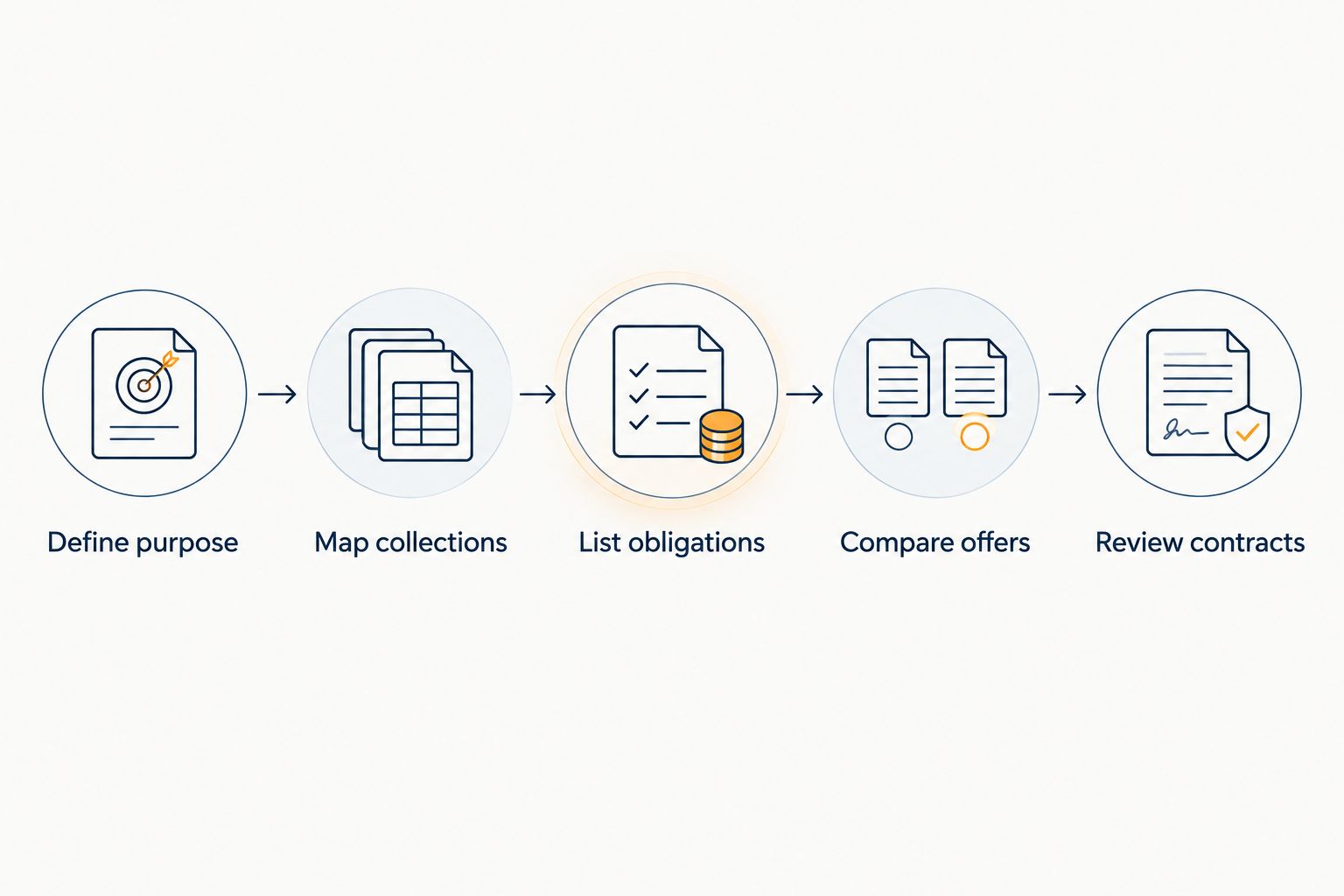
- Define purpose: Identify the expense and the event that replenishes cash.
- Map collections: Prepare receivables aging, customer concentrations and expected collection dates.
- List obligations: Include truck payments, credit balances, factoring arrangements and existing advances.
- Compare offers: Request written terms and check total obligations against the same forecast.
- Review contracts: Resolve questions about guarantees, liens, defaults, reconciliation and early termination.
Useful supporting records include business bank statements, financial statements, ownership information and relevant freight documentation. Invoice funding review can also require evidence supporting completed deliveries and customer obligations.
Do not send inconsistent revenue figures to different providers. Reconcile financial records first, and ask who receives your application and whether a credit inquiry requires authorization.
How are these funding routes ranked?
The ranking prioritizes purpose fit, payment alignment, total obligation, qualification, timing and contract risk. The brokerage route comes first for owners who need a cross-structure comparison; the other categories each address a distinct funding need.
This is not a tested lender leaderboard or a claim that any category always wins on cost. Written offers determine the final choice.
FAQ
What's the best working capital loan for a trucking company?
The best working capital loan matches the carrier’s cash gap and repayment capacity. A line of credit fits recurring gaps, while a term loan fits a defined business use; eligible unpaid invoices also justify comparing factoring.
Is Jon Lynch Financial Group a direct trucking lender?
Jon Lynch Financial Group is a broker, not a direct lender. It helps business owners compare options through third-party lenders and funders, which control underwriting and product terms.
Is freight factoring better than a working capital loan?
Freight factoring fits a cash gap caused by eligible unpaid invoices; a working capital loan addresses a borrowing need under its loan terms. Compare total obligations, customer restrictions, recourse and payment timing before choosing.
Can I get trucking business funding after a bank decline?
A bank decline does not establish whether another provider will approve funding. Identify the decline reason, then compare alternatives against current third-party underwriting requirements and your repayment capacity.
Is a merchant cash advance the same as a trucking loan?
A merchant cash advance may be structured as a purchase of future receivables rather than a loan. Read the agreement for the actual structure, remittance terms, reconciliation rights and default provisions.
Does meeting the monthly revenue threshold guarantee approval?
No. The $35,000 monthly revenue threshold identifies the primary comparison audience, not an approval promise. Products remain subject to third-party underwriting and business-purpose requirements.
What route is available below the monthly revenue threshold?
U.S.-based entrepreneurs generating below $35,000 per month can Explore Self-Serve Funding. Applicants securely connect bank statements through Plaid for an automated decision, with outcomes and timing subject to verification, bank processing and product terms.
Which funding route should you choose?
Start with a line of credit for recurring operating gaps and factoring for eligible unpaid invoices. Use a term loan for a defined project and equipment financing for an asset purchase; compare revenue-based financing only after understanding its structure and remittance burden.
One final check changes the decision: remove the new funding deposit from your cash forecast and examine the repayment period alone. If operations cannot support the obligation without another advance, revise the funding amount, structure or business plan before signing.
Related guides
- Invoice factoring companies for trucking carriers
- Business line of credit lenders
- Working capital costs versus a term loan
These products are for business purposes. Approval, amounts, rates, decisions and funding times are not guaranteed; final terms depend on the third-party provider and agreement.
Your next step: Put your monthly revenue, cash need, receivables and existing obligations on one page. If your U.S. business generates at least $35,000 per month, Compare Business Funding Options. Below $35,000 per month, Explore Self-Serve Funding.



