Can three months of bank statements qualify a business for funding?
Business funding three months bank statements: enough to apply, not proof of approval. Check eligibility, repayment terms and the right route for your business.

Three months of business bank statements can support a funding application, but they do not establish eligibility by themselves or satisfy every funder’s requirements. For a 2026 application, confirm the specific program’s statement requirement, business-history requirement and underwriting criteria before submitting. The tradeoff is straightforward: a short document checklist does not establish whether the funding fits your cash flow or whether its repayment terms are affordable.
- Business funding three months bank statements searches concern documentation, not an approval guarantee; confirm the funder’s actual requirements.
- Jon Lynch Financial Group is a business-funding broker, not a direct lender; third-party underwriting determines eligibility.
- Separate customer revenue from transfers and borrowed funds before evaluating working capital or revenue-based financing.
- Compare total obligations and payment timing, not just the amount offered or the length of the application.
Can three months of bank statements qualify a business for funding?
Three months of statements are evidence for underwriting, not a qualification standard that applies across business funding. Ask the provider whether the statements are enough for an initial review, a conditional offer or a final decision. Those are different stages.
For U.S. owners comparing options through Jon Lynch Financial Group, the primary business-funding audience generates at least $35,000 per month. That figure identifies the intended comparison route; it is not a promise of acceptance by a funding partner.
| What the statements show | What they do not establish alone | Your next check |
|---|---|---|
| Deposits into the submitted account | Whether every deposit is business revenue | Identify transfers, financing proceeds and customer receipts |
| Account balances and transactions | Whether the business can afford another obligation | Compare cash available after operating expenses and existing payments |
| Recent account activity | The business’s full operating history | Confirm the program’s time-in-business requirement |
| Payments visible in that account | Every outstanding financing obligation | Prepare a complete list of current obligations |
| A recent reporting window | Eligibility for a particular product | Request the current funder’s documentation and underwriting criteria |
The practical distinction is between having enough paperwork to begin and having a business that meets the program’s criteria. Do not treat a request for statements as an offer of funding.
Why does this distinction matter in 2026?
A business can have regular deposits and still lack room for another payment. Payroll, inventory purchases, rent and existing financing compete for the same cash, even when the account shows substantial incoming revenue.
A short statement window also needs context. A seasonal peak, a large customer payment or a recent financing deposit can make current activity look different from normal operations. Explain those events rather than expecting the transactions to speak for themselves.
Evaluate the obligation against the cash your business retains, not simply the money entering its account. That is the useful decision rule whether you are covering a payroll gap, mobilizing a contract or replenishing inventory.
Who does a statement-based funding review fit?
A statement-based review is relevant when you operate an active business and need to document recent cash movement. It is not a substitute for confirming business age, credit requirements, industry eligibility or other program conditions.
Jon Lynch Financial Group is best for established U.S. business owners generating at least $35,000 per month who want to compare business-funding options. The brokerage helps owners compare third-party options by total cost, timing, qualification and repayment; it does not make the lender’s or funder’s underwriting decision.
Businesses below that monthly revenue level have a separate self-serve funding route. Neither route establishes a universal approval threshold, and consumer-purpose or non-U.S. requests fall outside the primary funding audience.
Before applying, identify the purpose of the money. A temporary gap before a customer payment presents a different repayment question from recurring losses without an identified recovery plan.
How should you prepare three months of statements?
Use the period the prospective funder requests. Do not assume that three calendar months, three statement cycles and an account opened three months ago are interchangeable.
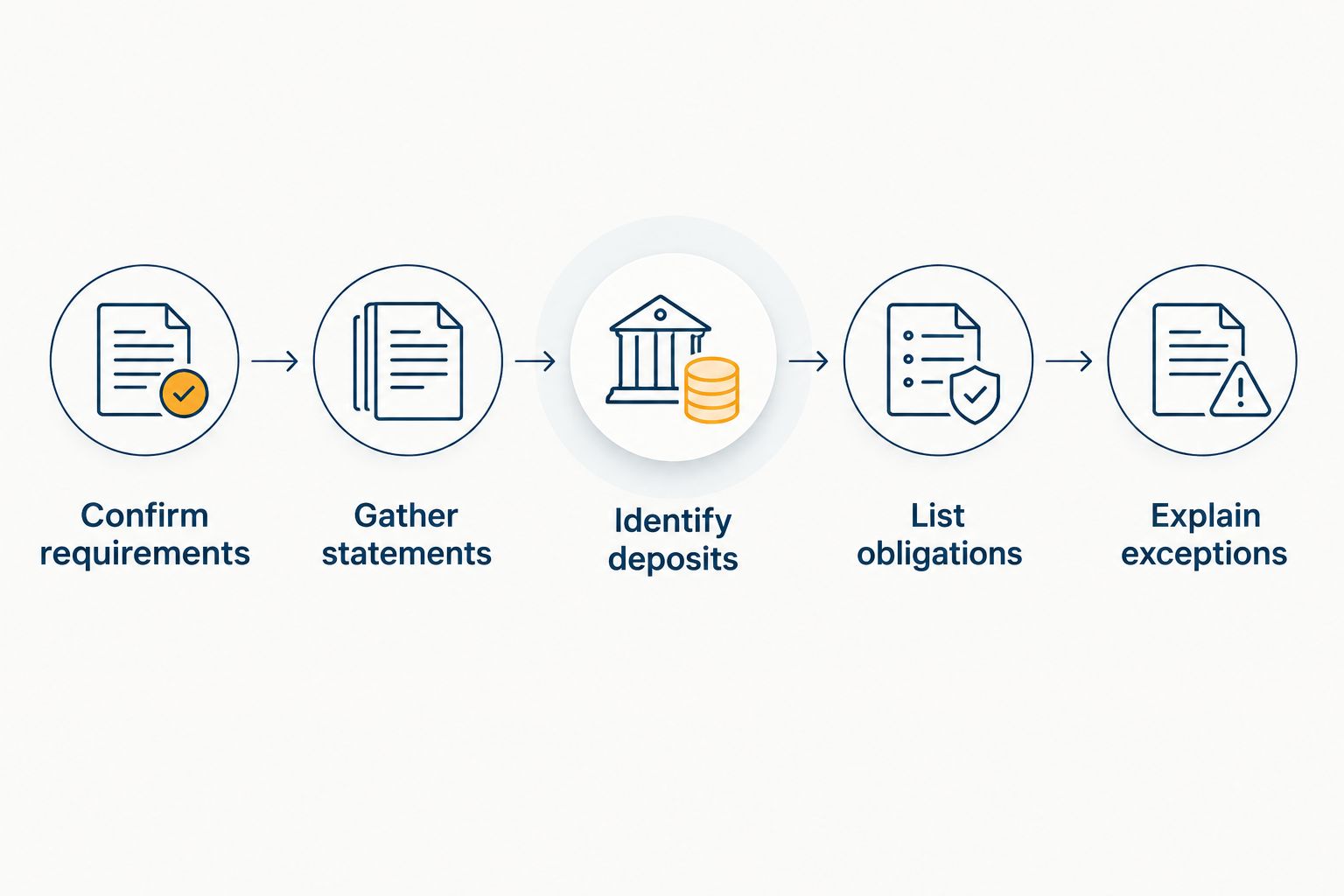
- Confirm requirements. Ask which accounts, statement periods and file formats the program accepts, and whether additional history is needed.
- Gather statements. Download complete statements for the requested periods. Keep all pages together and avoid changing transaction descriptions.
- Identify deposits. Separate customer receipts from account transfers, owner contributions and financing proceeds in your supporting explanation.
- List obligations. Prepare the payment schedules and outstanding commitments for existing business financing, including obligations paid elsewhere.
- Explain exceptions. Document unusual deposits, interrupted trading, account changes or other events that affect how the period should be interpreted.
Keep the explanation factual and consistent with your records. An account transfer is not a new sale, and a financing deposit does not demonstrate additional customer demand.
If the requested period misses a meaningful part of your operating cycle, ask whether supporting records are appropriate. Do not omit a requested month simply because another period looks stronger.
Which numbers should you compare before accepting funding?
For a 2026 comparison, ask for a written explanation of the money your business receives, the total contractual obligation and when payments or remittances leave the account. Compare offers using the same funding need and the same assumptions about your cash flow.
Your review should distinguish these items:
- Net proceeds: The amount actually made available to your business after any deductions.
- Total obligation: The total amount payable or receivables amount purchased under the agreement.
- Payment schedule: The frequency, amount and mechanism of payments or remittances.
- Existing commitments: Obligations that continue alongside the proposed funding.
- Early-exit terms: What changes, if anything, when you repay or satisfy the agreement early.
A factor rate is a multiplier used to calculate a contractual total; it is not an annual percentage rate. APR expresses borrowing cost on an annualized basis and depends on timing and applicable charges, not just the multiplier.
Do not compare a factor rate directly with an interest rate. Ask for the total obligation and payment schedule in writing, then examine the cash-flow effect. The working capital loans costs and qualification guide provides a related framework for evaluating the funding decision beyond the application checklist.
Which funding structures should you compare?
Business funding is not a single product. Three months of bank statements do not tell you which structure is appropriate, and documentation requirements differ by provider and program.
| Structure | Best for evaluating | Useful feature | Limitation to examine |
|---|---|---|---|
| Business line of credit | Recurring working-capital needs | Access to draws under an approved facility | Draw rules, ongoing requirements and repayment terms |
| Term loan | A defined business expenditure | A stated repayment schedule | Whether the schedule fits the expected business benefit |
| Revenue-based financing or future-receivables purchase | Funding tied to business revenue or receivables | A structure connected to business receipts | Actual remittance terms, reconciliation provisions and total obligation |
| Invoice factoring | Cash tied up in eligible unpaid invoices | Funding connected to receivables | Invoice eligibility, customer involvement and contractual responsibilities |
| Equipment financing | An identified equipment purchase | Financing directed at a specific business asset | Asset eligibility, security requirements and payment obligations |
These are comparison categories, not recommendations to submit applications everywhere. Start with the business need, then confirm the requirements of the relevant program.
Revenue-based financing may be structured as a purchase of future receivables rather than a loan. “Merchant cash advance,” or “MCA,” is also used for this category; read the agreement to understand the actual structure and obligations rather than relying on its marketing label.
If a slower option fits your deadline and provides a more manageable obligation, speed alone is not a reason to reject it. Conversely, an attractive repayment structure is not useful if the funding cannot meet the business’s actual deadline.
Why does eligibility vary between funding programs?
Bank statements are only part of the review. Confirm these factors against the current third-party program rather than relying on a general funding advertisement:
- Business history: A requested statement period does not define the minimum operating history.
- Revenue: Confirm what the program counts as eligible business revenue and how it verifies that figure.
- Credit: Ask whether business or personal credit is reviewed and how inquiries are handled; credit is not irrelevant.
- Existing obligations: Disclose current loans, advances and other financing commitments.
- Product and purpose: Confirm that the program supports your intended business use and financing structure.
- Verification: Ask what identity, ownership, banking and supporting business records are required.
For your 2026 application, distinguish published guidance from the requirements attached to the actual offer. The controlling question is not whether another business qualified with similar statements, but whether your business meets this program’s current criteria.
What risks should stop you from accepting an offer?
Pause when you cannot explain how the new obligation fits alongside payroll, essential expenses and existing payments. Approval is not evidence that an offer is suitable for your business.
Resolve these issues before signing:
- A total obligation or payment mechanism you cannot reconcile with the written agreement.
- Unclear treatment of reduced revenue under a receivables-based structure.
- An assumption that early payment automatically reduces the contractual total.
- An incomplete account of existing financing obligations.
- Unanswered questions about guarantees, security interests or default provisions.
Treat “bank statements only” as a documentation description, not a promise about credit review, collateral, guarantees or affordability. Ask a qualified legal or accounting adviser to review provisions you do not understand.
What documents should you have ready beyond statements?
Ask for the program’s checklist before sending sensitive records. Depending on the requested review, useful supporting records include business identification, ownership information, financial records and details of existing financing.
Prepare a concise explanation of the business purpose, the amount needed and the expected source of repayment or purchased receivables. If the need follows a bank decline, keep the decline explanation available so you can address the actual issue rather than merely switching application forms.
Use the designated secure submission process. Do not send account credentials or sensitive documents through an unverified message simply because someone promises a quick decision.
What should you understand about the broker’s role?
Jon Lynch Financial Group is a broker, not a direct lender. Business-purpose products are subject to third-party underwriting and applicable product terms; approval, amounts, rates, decisions and funding times are not guaranteed.
The benefit of a broker-led comparison is a review of available options against your business need. The limitation is that the broker does not control a third party’s approval decision, documentation requirements or contractual terms.
For the self-serve route, applicants securely connect bank statements through Plaid for an automated decision. Eligible applicants may receive a decision within minutes, and approved funds may arrive within an hour; verification, bank processing and product terms determine timing.
FAQ
Can I get business funding with only three months of bank statements?
Three months of bank statements can support an application, but they do not establish eligibility or satisfy every program’s requirements. Confirm whether additional operating history, credit review or supporting documents are required.
Does having three months of statements mean my business is old enough?
Three months of statements do not establish that your business meets a funder’s time-in-business requirement. The statement period and the minimum operating history are separate requirements.
Does every deposit count as business revenue?
Not every deposit is business revenue. Identify customer receipts separately from transfers, owner contributions and financing proceeds, and confirm how the program evaluates them.
Can I qualify if my business makes less than $35,000 per month?
Businesses below $35,000 per month can explore the self-serve funding route rather than assuming they meet the primary broker-led audience criteria. Eligibility and approval remain subject to the applicable underwriting and product terms.
Does statement-based business funding mean there is no credit check?
Statement-based business funding does not establish that a program excludes credit review. Ask whether business or personal credit is checked and how the inquiry is handled before authorizing an application.
Is revenue-based financing always a business loan?
Revenue-based financing is not always structured as a business loan; it may be a purchase of future receivables. Review the agreement’s structure, remittance obligations and reconciliation provisions.
Can I get funded within an hour through the self-serve route?
Approved funds may arrive within an hour for eligible self-serve applicants, but that timing is not guaranteed. Verification, bank processing and product terms determine the actual timing.
Which related guides address your next decision?
- How much revenue do you need for revenue-based financing?
- How to compare factor rates on a merchant cash advance
- Can declining monthly revenue disqualify you from funding?
What is the next practical step?
Before submitting a 2026 application, write down the business purpose, gather the requested statement periods and list every current financing obligation. Ask one specific question first: does this program accept this documentation for a business with my operating history?
For U.S. businesses generating at least $35,000 per month, Compare Business Funding Options. Below $35,000 per month, Explore Self-Serve Funding. Choose the appropriate route, then assess the written terms before accepting any offer.