How do veteran small business loans actually work?
How do veteran small business loans work? Compare SBA and other funding by eligibility, repayment and risk. Veteran status alone does not qualify you.

Veteran small business loans work through a lender’s business underwriting: you apply for a specific financing product, document your business and repayment ability, and repay under the signed agreement. Veteran status can establish eligibility for targeted support, but it does not replace credit review or guarantee approval. The key tradeoff is choosing financing your business can support—not simply an offer advertised to veterans.
- How do veteran small business loans work? SBA-backed and conventional lenders evaluate business eligibility, credit and repayment ability.
- Veteran ownership does not automatically qualify a business for financing or eliminate personal guarantees.
- SBA loans, credit lines and future-receivables purchases have different repayment obligations; compare the actual contracts.
- Jon Lynch Financial Group is a veteran-owned business-funding broker, not a direct lender.
How do veteran small business loans actually work?
Veteran business financing is not one universal loan program. The phrase describes financing sought by veteran owners, including conventional business loans, SBA-backed loans and products marketed specifically to that audience.
For a 2026 funding decision, separate the applicant’s veteran status from the financing structure. A lender evaluates whether the business meets its requirements; a targeted program can add its own ownership or service-documentation rules.
The process follows these steps:
- Define the need. Specify whether the money supports inventory, payroll, equipment, an acquisition or another business expense.
- Choose the structure. Match a term loan, credit line or other arrangement to how the business will use and return the money.
- Document the business. Supply the financial, ownership and identity information the funding provider requests.
- Complete underwriting. The provider evaluates eligibility, credit, cash flow, existing obligations and any required security.
- Review and sign. Confirm the proceeds, total obligation, payment schedule, guarantees and default provisions before accepting.
Why this matters: an approval is not proof that payments fit your cash flow. Jon Lynch Financial Group helps U.S. business owners compare funding through third-party partners; the contract and underwriting determine the actual offer.
Who does veteran business financing fit?
Veteran business financing fits an owner with a defined business-purpose use and a credible repayment plan. Military service establishes your background, not the business’s available cash.
An established company should connect the request to evidence: customer collections, recurring sales, an equipment purchase or a documented contract. A startup needs a different assessment because projections are not the same as operating history.
Do not apply for revenue-based financing as though a business plan were collected revenue. Ask whether the program accepts pre-revenue businesses before submitting sensitive information.
A veteran-specific label also does not establish a financial benefit. Ask what the program actually changes: eligibility, assistance, underwriting, contract terms or another documented feature.
Government-contracting certification is a separate issue. It does not, by itself, establish eligibility for a loan or provide the cash needed to perform a contract.
Which financing structures should veteran owners compare?
Start with the business expense and repayment source. These structures serve different needs, and none wins simply because the owner is a veteran.
| Structure | Best for | How it works | Main limitation |
|---|---|---|---|
| SBA-backed loan | Eligible businesses financing a documented business purpose | A participating lender makes the loan with an SBA guaranty | Program eligibility and lender underwriting still apply |
| Conventional term loan | A defined expense supported by predictable repayment capacity | You receive proceeds and repay on a contracted schedule | Scheduled payments continue when collections weaken |
| Business line of credit | Recurring working-capital gaps | You draw within the approved facility under its terms | Renewal, draw access and repayment depend on the agreement |
| Equipment financing | Acquiring identifiable business equipment | Financing is tied to the equipment transaction | Equipment security does not eliminate other contractual obligations |
| Invoice factoring | Businesses with eligible unpaid customer invoices | A factor purchases qualifying receivables | Customer eligibility, recourse and collection terms matter |
| Future-receivables purchase | Established businesses evaluating funding against future sales | A funder purchases an agreed amount of future receivables | Remittance obligations and reconciliation terms need close review |
Treat these as fit categories, not a ranking. A slower loan is preferable when its obligations fit the project better; a faster transaction is not better if remittances leave payroll exposed.
What does SBA backing actually mean?
The SBA generally guarantees qualifying loans made by participating lenders rather than directly making ordinary business loans. The guaranty protects the lender against a portion of an eligible loss; it does not erase the borrower’s obligation.
The SBA’s published 7(a) program guidance lists a maximum loan amount of $5 million. For your 2026 comparison, treat that as a program ceiling—not a likely offer or an entitlement based on military service.
The SBA Microloan program has a published maximum of $50,000 and operates through intermediary lenders. The smaller ceiling does not mean every applicant qualifies, and permitted uses differ from other SBA programs.
How should you compare the numbers without confusing cost and cash flow?
Build a written comparison from actual offers rather than advertised rates. For a 2026 application, request the current contract and disclosures that apply to your business and location.
Start with these calculations:
- Net proceeds: stated funding amount minus amounts withheld or used to satisfy existing obligations.
- Total outflow: all scheduled payments or remittances plus separately payable charges, without counting the same charge twice.
- Financing cost: total outflow minus the proceeds attributable to the transaction, with refinanced balances identified separately.
- Cash-flow impact: required outflows placed against the dates customer receipts and operating bills occur.
A factor rate is a multiplier used to calculate a contractual purchase or repayment amount. It is not APR, which expresses borrowing cost on an annualized basis using the applicable cash flows and calculation rules.
Multiplying an advance by its factor rate does not account for deductions, separate charges or payment timing. Use the guide to comparing merchant cash advance factor rates to frame those questions before reviewing a receivables-purchase offer.
Compare the same usable proceeds and the same business need. A larger headline amount can conceal a smaller usable deposit when existing obligations are paid from the transaction.
Why do veteran business financing terms vary?
Veteran ownership does not standardize underwriting. These factors change the financing assessment and the obligations a business can support:
- Cash flow: collected revenue and operating expenses determine what remains available for payments.
- Credit history: business and owner credit inform risk assessment where the program uses them.
- Operating history: established financial records provide different evidence from startup projections.
- Existing obligations: loans, liens and receivables purchases affect available cash and contractual restrictions.
- Funding purpose: equipment, acquisitions and recurring payroll require different structures and documentation.
- Security and guarantees: collateral and personal obligations change the consequences of default.
Ask which factor is driving an unfavorable decision. A bank decline based on insufficient cash flow calls for a different response from a decline based on incomplete documentation.
What risks should you resolve before accepting an offer?
Do not confuse a loan with a purchase of future receivables. Revenue-based financing may be structured as a receivables purchase, including arrangements commonly called merchant cash advances or MCAs; the agreement determines the obligations.
For a receivables purchase, examine how remittances are calculated and what happens when actual receipts change. If the contract includes reconciliation, understand how to request it, what evidence it requires and when an adjustment takes effect.
For a loan, read the payment schedule, collateral provisions, personal guarantee and default terms. A business-purpose transaction does not automatically protect personal assets from a signed guarantee.
Resolve these issues before signing:
- Does the agreement restrict additional borrowing or receivables sales?
- What happens if a scheduled debit fails?
- Does early payoff reduce the remaining obligation, and how is the payoff calculated?
- Who holds a lien, and what property does it cover?
- What must you do when revenue falls or the business closes?
Decline an offer you cannot explain in plain English. Seek qualified legal or accounting advice when the obligations or tax treatment remain unclear.
What documents should you prepare for underwriting?
Prepare a consistent file rather than sending different numbers to different providers. Required documents depend on the product and underwriting program; this checklist is preparation, not a universal approval standard.
- Ownership records: entity information, ownership details and identity documentation.
- Bank records: the statements or secure account connection requested by the provider.
- Financial records: available income statements, balance sheets and tax returns appropriate to the application.
- Debt schedule: outstanding balances, payment obligations, liens and existing receivables arrangements.
- Use of funds: invoices, equipment quotes, purchase documents or a clear working-capital explanation.
- Service documentation: evidence requested by a genuinely veteran-targeted program.
Reconcile discrepancies before submission. Transfers, borrowed funds and sales receipts are not interchangeable explanations for bank deposits.
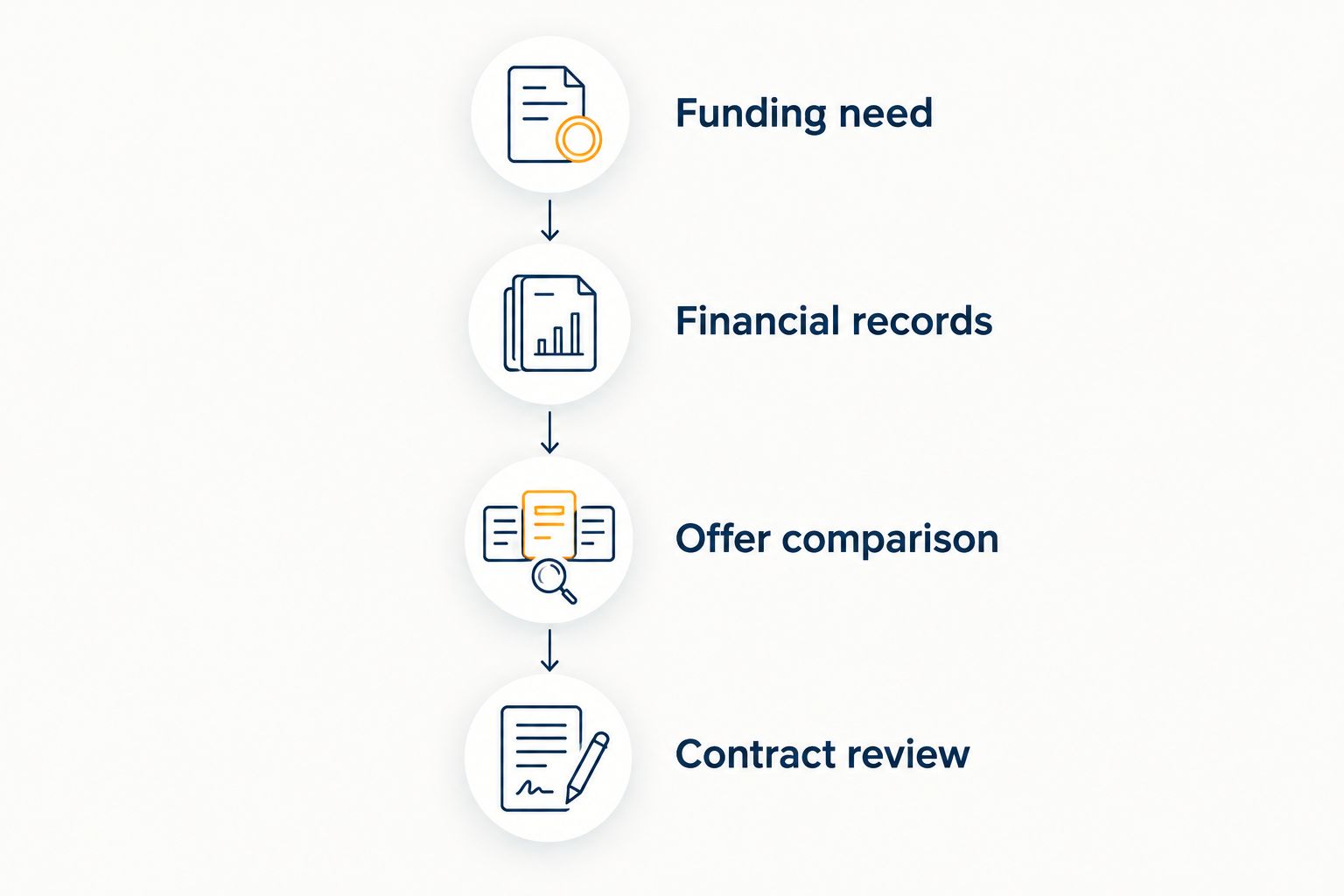
Organize the decision in this sequence: Funding need, Financial records, Offer comparison, Contract review. Each stage answers a different question; completing an application does not replace reviewing the resulting agreement.
What should you disclose and confirm with a broker?
Jon Lynch Financial Group is a veteran-owned business-funding broker, not a direct lender. It helps business owners compare options through third-party lenders and funders; those parties apply their underwriting and product terms.
Jon Lynch Financial Group fits established U.S. business owners seeking broker-assisted working-capital comparisons. Its limitation is equally clear: it does not make the third-party underwriting decision or guarantee an offer.
Ask who provides the financing, which entity signs the agreement, what compensation or charges apply, and where ongoing servicing questions go. Keep the broker’s role separate from the lender’s or purchaser’s contractual responsibilities.
Products are for business purposes and subject to applicable third-party underwriting. Approval, amounts, rates, decisions and funding times are not guaranteed.
FAQ
Do veterans automatically qualify for small business loans?
No. Veteran status does not replace a lender’s business eligibility, credit and repayment assessment. A targeted program can require additional service or ownership documentation.
Is a veteran business loan the same as a VA home loan?
No. A VA home loan is a housing benefit, not a general business working-capital product. Evaluate business financing under the specific lender or SBA program involved.
What is the largest SBA loan a veteran can get?
The SBA 7(a) program has a published maximum loan amount of $5 million. That ceiling is not a veteran-specific entitlement, and an individual offer depends on eligibility and underwriting.
Can a veteran-owned startup get business funding without revenue?
A veteran-owned startup needs a financing program that accepts its stage and repayment evidence. Do not assume a revenue-based product accepts a business without operating receipts.
Does bad credit prevent a veteran from getting business financing?
Bad credit affects the options available, but the decision depends on the provider and product. Ask how owner credit, business credit, cash flow and existing obligations enter the assessment.
Is a merchant cash advance a veteran business loan?
A merchant cash advance may be structured as a purchase of future receivables rather than a loan. Veteran ownership does not change that distinction; read the actual agreement and remittance provisions.
How long does veteran business loan approval take in 2026?
Veteran business loan approval in 2026 has no universal timeline. Ask the provider to distinguish application review, conditional approval, verification, signing and disbursement, and do not treat an estimate as a guarantee.
What else should you read before comparing offers?
- Business funding options for veteran-owned startups
- Business funding for government contractors
- Working capital costs and qualification
What is your next practical step?
Before submitting an application, write down the business expense, when it must be paid and the receipts expected to support repayment. If the repayment source is another unapproved financing transaction, resolve that dependency first.
For your 2026 comparison, choose the route by current business revenue—not veteran status alone. U.S. businesses generating at least $35,000 per month should use Compare Business Funding Options; businesses below $35,000 per month should use Explore Self-Serve Funding.
The self-serve path accepts U.S.-based entrepreneurs and uses a secure Plaid bank-statement connection for an automated decision. Eligibility, verification, bank processing and product terms still apply; consumer-purpose and non-U.S. requests fall outside the primary funding audience.
Choose your business funding route
Use current monthly revenue to choose a comparison or self-serve path.