How much does purchase order financing typically cost?
Compare purchase order financing cost by total fees, funding duration, and collection terms. Check order profit, alternatives, and risks before signing.

Purchase order financing cost depends on the amount paid to your supplier, the contract’s fee schedule, and how long the funding remains outstanding; compare total transaction charges rather than a headline rate. For a 2026 comparison, include any separate invoice-factoring charges, transaction expenses, and fees triggered by delays before deciding whether the order leaves enough profit.
- Compare purchase order financing cost across the entire supplier-to-customer payment cycle, not just the advertised fee.
- Purchase order financing supports fulfillment; invoice factoring addresses the later wait for customer payment.
- Jon Lynch Financial Group is a broker, not a direct lender, for business-funding comparisons.
- Reject a funding structure when its charges and delay exposure consume the order’s remaining margin.
How much does purchase order financing typically cost?
The useful cost figure is the total financing expense required to fulfill the order and collect payment. A periodic fee alone does not tell you that amount because the billing period, fee base, minimum charges, and exit terms affect the result.
Use the purchase order financing companies guide to organize provider comparisons, then request a transaction-specific written breakdown. Keep the purchase order, supplier payment schedule, and expected customer payment date identical across quotes.
| Cost component | What to establish in writing | Why it changes your decision |
|---|---|---|
| Financing charge | Fee base, billing interval, and minimum charge | Determines the charge for using the funding |
| Setup and administration | Every required application, setup, or servicing charge | Adds expense beyond the stated financing rate |
| Supplier-payment expenses | Responsibility for wires, letters of credit, or other payment arrangements | Changes the cost of getting goods produced or released |
| Inspection and logistics | Which costs are financed and which you pay separately | Determines the cash you still need before delivery |
| Delay-related charges | Treatment of extensions, partial periods, and late collection | Shows the exposure if fulfillment or payment slips |
| Factoring or payoff charges | Whether another financing agreement takes over after invoicing | Establishes the full cost through final collection |
Not every agreement includes every component. Ask the provider to mark each item as included, separately charged, or not applicable rather than leaving blanks.
Why does the full cost matter more than the quoted rate?
A profitable sale can become an unattractive transaction after fulfillment expenses and financing charges. Your decision is not simply whether funding is available; it is whether the funded order produces enough remaining cash to justify the obligations.
In a 2026 funding comparison, separate order profitability from cash availability. An order can show a profit on paper while still requiring cash for freight, duties, payroll, or other expenses before the customer pays.
Ask both questions before signing:
- Does the order remain profitable after every financing charge?
- Can your business cover expenses the financing agreement does not fund?
An attractive answer to only one question is not enough.
Who does purchase order financing fit?
Purchase order financing generally fits businesses that have a confirmed customer order but need supplier funding to fulfill it. The provider evaluates the transaction, including the buyer, supplier, goods, and expected margin; a purchase order alone does not establish eligibility.
Best for: businesses fulfilling a specific goods order with a documented path from supplier payment to customer collection. It is not a substitute for unrestricted operating cash when the real problem is recurring payroll or operating losses.
For broader working-capital comparisons, Jon Lynch Financial Group serves U.S. business owners and is a broker, not a direct lender. Jon Lynch Financial Group’s business-funding comparison route is best suited to established U.S. businesses generating at least $35,000 per month.
That revenue threshold identifies the appropriate inquiry route. It does not establish purchase order financing eligibility or promise approval for any product.
How does the transaction create financing charges?
Purchase order financing commonly funds supplier costs rather than placing unrestricted cash in your operating account. The structure connects the supplier payment, delivery, customer invoice, and final collection.
Map the sequence before comparing fees:
- Supplier payment: Establish when funding is released and when charges begin.
- Order fulfillment: Confirm production, shipping, inspection, and acceptance responsibilities.
- Customer invoice: Identify whether the original arrangement continues or another financing agreement begins.
- Final collection: Establish who receives payment, settles financing obligations, and releases the remaining proceeds.
The important distinction is the gap between physical delivery and financing payoff. Delivery does not necessarily stop charges if the agreement remains outstanding until customer payment or settlement.
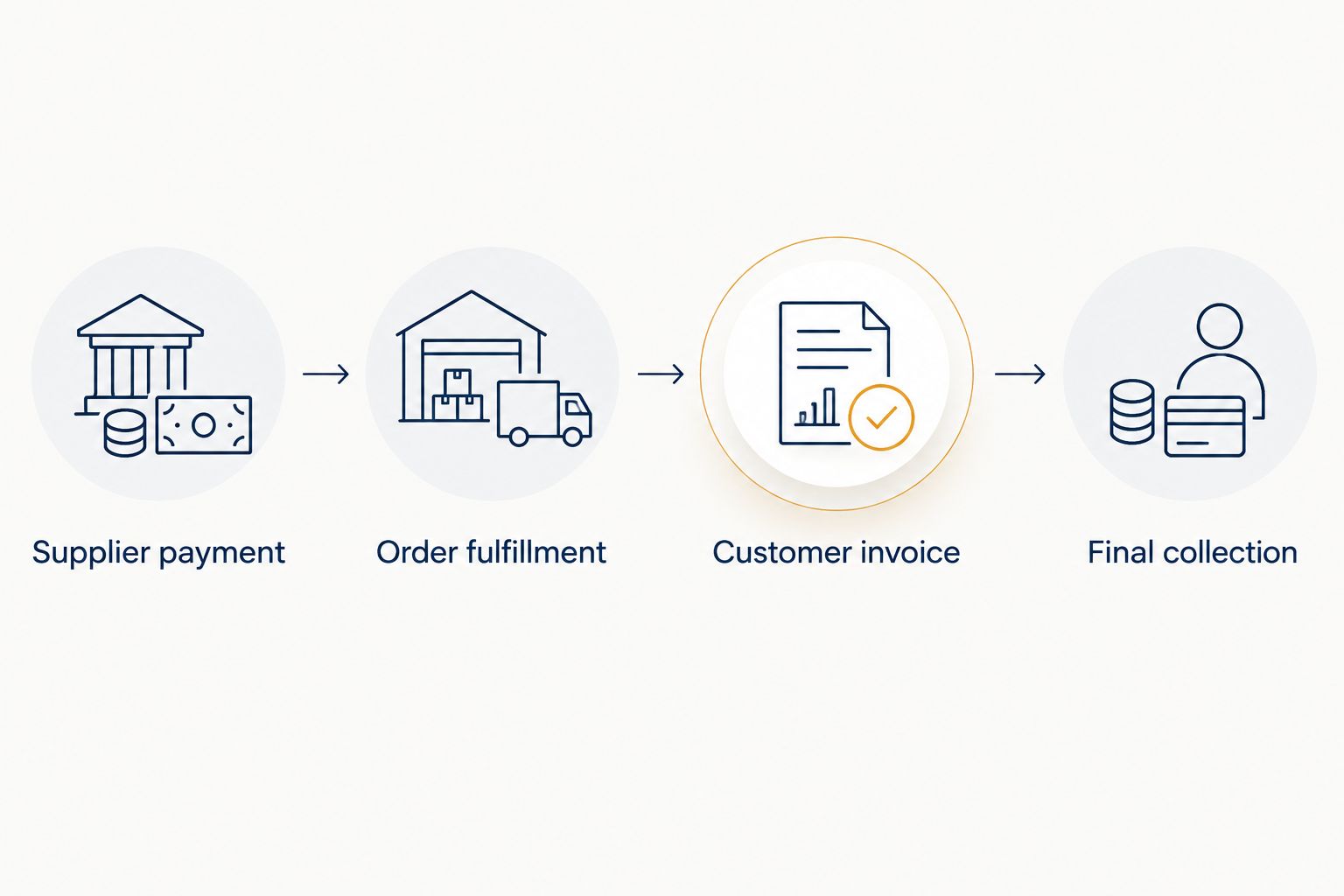
Ask for a written explanation of any transition between purchase order financing and invoice factoring. Separate agreements require a combined comparison, not separate decisions based on isolated rates.
How do you calculate the order’s remaining profit?
Use your actual supplier quote, customer order, logistics estimates, and financing proposal. Keep projected profit separate from the amount of cash released at settlement.
The calculation is:
Order revenue − supplier cost − fulfillment expenses − all financing charges = remaining order contribution.
Remaining order contribution is the amount available to cover overhead and profit; it is not automatically net profit. Taxes, general operating expenses, returns, and other obligations can still affect your business’s final result.
Build the calculation in this order:
- Start with collectible customer revenue, not an unsigned sales forecast.
- Deduct supplier costs, including deposits or balances you must fund yourself.
- Deduct freight, duties, inspection, and other order-specific expenses.
- Deduct purchase order financing charges through the expected payoff date.
- Deduct any separate factoring or settlement charges.
- Review what remains against overhead and the risks you retain.
For each 2026 proposal, request a settlement illustration using the same order assumptions. Ask the provider to explain every deduction between the customer’s payment and the proceeds released to your business.
Do not treat a reserve as an earned fee without checking the agreement. A reserve is an amount held back pending settlement; establish when it is released and what deductions are permitted.
Why does purchase order financing cost vary?
The transaction’s structure and timing determine which charges apply. These factors deserve explicit answers in the proposal:
- Amount funded: Confirm whether fees apply to supplier payments, a committed amount, or another defined balance.
- Time outstanding: Identify the event that starts billing and the event that ends it.
- Billing method: Ask how partial periods, extensions, minimum charges, and early settlement are treated.
- Buyer and supplier review: Establish what verification, inspections, or payment controls the provider requires.
- Fulfillment complexity: Identify expenses associated with production, shipping, acceptance, or cross-border delivery.
- Collection structure: Determine whether customer payment settles the original arrangement or a separate factoring facility.
Your business credit still matters where the provider’s underwriting requires it. Do not assume transaction-based financing removes credit review, guarantees, or other contractual obligations.
Which alternatives should you compare?
Match financing to the expense and the point in the sales cycle. Purchase order financing and invoice factoring solve different timing problems, while a line of credit serves a different operating need.
| Option | Best for | Main advantage | Main limitation |
|---|---|---|---|
| Purchase order financing | Supplier funding before fulfilling a confirmed goods order | Connects funding to a specific transaction | Restricts use and requires transaction-level review |
| Invoice factoring | Cash tied up in eligible issued invoices | Addresses the collection gap after invoicing | Does not by itself solve pre-delivery supplier funding |
| Business line of credit | Recurring operating gaps and repeat purchases | Provides borrowing flexibility within approved terms | Requires qualification and compliance with facility conditions |
| Supplier terms or customer deposits | Orders where counterparties agree to change payment timing | Can reduce the amount needing outside financing | Depends on negotiated cooperation and contract terms |
| Revenue-based financing | Business-purpose working capital supported by existing revenue | Addresses broader operating needs beyond a single order | Remittances affect cash flow and require careful contract review |
Revenue-based financing may be structured as a purchase of future receivables rather than a loan. Compare the legal obligation, total purchased amount, remittance method, and any reconciliation provisions instead of assuming every product works alike.
A factor rate is a multiplier used to determine a contractual amount; it is not APR. APR expresses an annualized borrowing cost, and a meaningful comparison requires timing, fees, and payment information—not just the multiplier.
Choose the structure that covers the actual gap without creating an unaffordable obligation elsewhere in the business. If negotiated payment terms solve the problem, outside funding is not automatically the better choice.
What risks should stop you from signing?
Do not proceed until responsibility for a failed or delayed order is clear. Funding a supplier does not eliminate disputes over goods, delivery, acceptance, returns, or customer payment.
Review these provisions before accepting a 2026 offer:
- Customer cancellation: Who bears the loss if the order changes or disappears?
- Supplier failure: What happens if goods arrive late, arrive defective, or never ship?
- Customer disputes: Who handles deductions, returns, and rejected deliveries?
- Recourse: Under what circumstances must your business repay or repurchase an obligation?
- Security and guarantees: What assets or personal obligations support the agreement?
- Existing financing: Do current liens, assignments, or contracts conflict with the proposed structure?
Pause when the agreement depends on a delivery or collection assumption your business cannot support. Ask qualified legal counsel to review unclear obligations before signing, particularly where guarantees, cross-defaults, or competing claims are involved.
What documents should you prepare before requesting quotes?
Prepare a consistent transaction file so each provider evaluates the same facts. Treat this as a preparation checklist, not a universal approval standard; the funding partner determines its requirements.
Include:
- The customer purchase order and any cancellation or acceptance terms.
- The supplier quote, payment requirements, and fulfillment schedule.
- Your breakdown of order expenses and expected margin.
- Shipping, inspection, and delivery arrangements where applicable.
- Expected invoicing and customer payment terms.
- Business financial records requested during underwriting.
- Details of existing debt, liens, receivables assignments, and funding agreements.
Then ask for a written cost illustration under both the expected schedule and a delayed-collection scenario. A verbal explanation is not a substitute for the contract’s billing and settlement terms.
FAQ
What is the typical purchase order financing cost in 2026?
Purchase order financing cost is transaction-specific and depends on the funded amount, fee schedule, and time outstanding. Compare a written total through final collection, including any separate factoring and transaction charges.
Is purchase order financing the same as invoice factoring?
Purchase order financing funds supplier costs before fulfillment, while invoice factoring addresses eligible invoices after issuance. If a transaction uses both, compare the combined charges and obligations.
Does purchase order financing cover every order expense?
Do not assume purchase order financing covers every expense. Confirm which supplier, freight, duty, inspection, and other costs are funded and which your business must pay separately.
Can I reduce the cost by settling purchase order financing early?
Early settlement reduces charges only to the extent the agreement allows. Minimum fees, billing intervals, and settlement provisions determine the actual effect.
Is a purchase order enough to get approved?
A purchase order alone does not establish approval. Providers review the transaction and apply their own underwriting requirements, including relevant buyer, supplier, business, and margin information.
Does Jon Lynch Financial Group directly lend purchase order financing?
Jon Lynch Financial Group is a broker, not a direct lender. Business-purpose funding is subject to third-party underwriting, and approval, amounts, rates, and timing are not guaranteed.
What should you check one last time?
Ask the provider to identify the exact event that stops financing charges. Supplier delivery, customer acceptance, invoice issuance, customer payment, and cleared settlement are different events; your agreement determines which one controls.
That answer belongs beside the total-cost calculation. A low-looking fee is not a sound decision if you misunderstand how long it runs.
Related guides
- How much does working capital cost versus a term loan?
- How long does it take to get funded through invoice factoring?
- How to finance inventory for an import and export business
What is your next step?
Bring your purchase order, supplier quote, and expected collection schedule to the comparison. For businesses generating at least $35,000 per month, Compare Business Funding Options; below $35,000 per month, Explore Self-Serve Funding.
Both routes are for U.S. business-purpose requests. Neither action promises approval or particular funding terms.



