How much down payment does an SBA acquisition loan require?
The SBA loan down payment to buy a business generally starts at 10%. Understand seller financing, equity sources and cash needed beyond closing.

A complete business acquisition financed through an SBA 7(a) loan generally requires an equity injection of at least 10% of total project costs, not just the amount paid to the seller. Your cash requirement also depends on eligible seller financing, lender requirements, closing expenses and the money you need to keep operating after the purchase. For a 2026 acquisition, get the lender’s written calculation before treating 10% as your final cash-to-close requirement.
- The SBA loan down payment to buy a business generally starts at 10% of total project costs for a complete acquisition.
- Qualifying seller financing can cover part of the required injection; ordinary seller debt does not automatically qualify.
- Keep operating reserves separate from your acquisition equity calculation.
- Jon Lynch Financial Group helps U.S. business owners compare third-party business funding; it is a broker, not a direct lender.
How much down payment does an SBA acquisition loan require?
For a complete change of ownership under SBA 7(a), the general minimum equity injection is 10% of total project costs. Equity injection means the qualifying contribution toward the transaction that does not come from the SBA-backed acquisition loan.
The governing reference is the U.S. Small Business Administration’s Standard Operating Procedure 50 10, which covers lender requirements for SBA business loans. For your 2026 application, have the lender identify the applicable version and any subsequent notices in its written financing structure.
The distinction between project costs and purchase consideration matters. An acquisition budget can include eligible working capital and transaction expenses alongside the business purchase; the lender determines which items enter the financing calculation.
Start with these steps:
- Build the project budget. Separate the business purchase, eligible transaction expenses and working capital.
- Confirm the equity requirement. Ask the lender for both the required percentage and the dollar contribution calculated from your budget.
- Identify acceptable sources. Document buyer cash and any proposed seller contribution separately.
- Calculate remaining liquidity. Show what stays available after closing, rather than treating every available dollar as acquisition equity.
For the broader transaction structure, see business acquisition loans for buying an existing company.
Why does this distinction matter?
A minimum down payment is not a complete acquisition budget. A transaction can satisfy an equity percentage and still leave you short of payroll, inventory or essential repairs.
Ask for a sources-and-uses schedule: a document showing where every funding dollar comes from and where it goes. That schedule connects the down payment, financing proceeds and operating cash instead of treating them as unrelated decisions.
Who does the 10% acquisition structure fit?
An SBA-backed acquisition fits a buyer purchasing an eligible operating business with supportable repayment capacity, documented equity and enough time for underwriting. Meeting the down payment requirement does not establish eligibility or approval.
The lender also evaluates the business’s financial performance, your credit, management capability and transaction structure. A larger cash contribution does not repair unreliable financial statements or make unsupported earnings dependable.
Jon Lynch Financial Group is best suited to U.S. business owners comparing third-party business funding. Its commercial finance brokerage role supports comparing funding structures; the third-party lender determines whether an acquisition qualifies and on what terms.
For an acquisition, distinguish the target business’s revenue from revenue your current business already generates. Do not assume a working-capital application for an existing company is interchangeable with acquisition underwriting.
Buyer-funded injection: at least 10% of project costs
The straightforward structure is a qualifying buyer contribution covering the full required injection. Best for: buyers who can document their contribution without exhausting operating reserves.
The benefit is a simpler equity-source structure: there is no need to rely on the seller accepting special standby terms. The drawback is the amount of buyer liquidity committed at closing.
Traceability matters as much as the account balance. Expect to document where the money originated, how it moved and how it was applied to the transaction.
For a 2026 purchase, ask the lender when funds must be documented and what evidence it needs at closing. Avoid moving money between accounts unnecessarily once underwriting begins; extra transfers create additional records to reconcile.
Qualifying seller contribution: potentially 5% buyer cash
Under the SBA’s complete-change-of-ownership framework, qualifying seller debt can count toward no more than 50% of the required equity injection when it meets the applicable full-standby requirements. If the required injection is 10%, that can produce a structure with 5% buyer cash and 5% qualifying seller debt.
The arithmetic is 10% required injection × 50% maximum seller share = 5% of project costs. This describes a permitted structure, not an entitlement to financing.
Best for: buyers whose seller accepts the required standby terms and whose lender approves the arrangement. The advantage is less buyer cash applied to the injection; the limitation is that the seller must accept restrictions that ordinary seller financing does not carry.
Full standby means the qualifying seller note does not receive principal or interest payments during the SBA loan term. The note and standby documentation must satisfy the lender’s requirements; simply labeling an obligation seller financing does not make it equity.
Do not negotiate a seller payment schedule first and assume it will qualify later. Have the lender review the proposed terms before you rely on them in your acquisition budget.
How do the acquisition funding structures compare?
These structures address different problems. Buyer equity supports the acquisition, qualifying seller debt can support the injection calculation, and separately financed seller debt remains a repayment obligation.
| Structure | Best for | Main benefit | Main limitation |
|---|---|---|---|
| Buyer-funded injection | Buyers preserving adequate cash after contributing equity | Simpler contribution structure | Uses more buyer liquidity |
| Qualifying standby seller debt | Buyers with a seller willing to defer payments under required terms | Can satisfy part of the required injection | Requires compliant standby documents and lender acceptance |
| Seller debt outside the injection | Transactions needing additional seller participation | Can help bridge the financing structure | Does not automatically count as equity and adds obligations |
| Conventional acquisition financing | Buyers whose transaction fits a bank’s non-SBA criteria | Provides an alternative underwriting route | Equity, collateral and repayment requirements are lender-specific |
Compare the complete repayment structure, not just the cash needed on closing day. Seller debt that reduces the immediate financing gap can still reduce future cash available to operate the business.
Why does the SBA acquisition down payment vary?
The general minimum does not settle every transaction. These factors change the required contribution or the amount you actually need available:
- Ownership structure. A complete acquisition, partial ownership transfer and qualifying business expansion do not automatically follow identical injection rules.
- Project scope. Eligible working capital and transaction expenses affect the total budget used for the calculation.
- Lender requirements. A lender can require more equity than the SBA program minimum based on its underwriting.
- Seller-note eligibility. The seller’s willingness to provide financing is different from that financing qualifying toward the injection.
- Valuation support. A negotiated purchase amount still needs adequate valuation support; do not assume unsupported value will be financed.
- Remaining liquidity. Your ability to fund operations after closing affects whether the proposed structure is workable.
Ask each lender to distinguish a program rule from its own credit requirement. That distinction makes a 2026 comparison useful: you can identify whether another lender offers a different structure or whether the transaction itself needs revision.
Can you borrow the SBA acquisition down payment?
Borrowed funds are not automatically acceptable acquisition equity. The lender must assess the source, applicable SBA requirements and how the separate debt will be repaid.
A personal borrowing arrangement introduces another payment obligation. If repayment depends on cash withdrawn from the acquired business, the structure needs particular scrutiny rather than being treated as a workaround.
Do not take new debt before the acquisition lender reviews it. Disclose the proposed borrowing, payment schedule, security and repayment source so the lender can evaluate the whole transaction.
Does a 10% down payment guarantee SBA approval?
A 10% down payment does not guarantee SBA approval. The contribution addresses one part of underwriting, not the business’s ability to repay or the buyer’s eligibility.
Credit remains relevant. So do verifiable earnings, management experience, ownership details, business eligibility and the accuracy of the transaction documents.
A bank decline deserves a specific diagnosis. Ask whether the issue is insufficient equity, unsupported cash flow, valuation, eligibility or lender policy before replacing an acquisition loan with shorter-term funding.
What risks should you resolve before committing cash?
The largest practical risk is confusing available cash with spendable cash. A buyer can meet the injection requirement while leaving too little money for ordinary expenses immediately after ownership changes.
Review these issues before removing financing contingencies or making nonrefundable commitments:
- Operating reserves. Identify payroll, inventory, insurance and other obligations that continue after closing.
- Seller dependence. Explain who retains customer relationships, licenses and operational knowledge after the seller exits.
- Debt obligations. Include approved seller payments and other business debt in the cash-flow review.
- Personal exposure. Review guarantees and collateral requirements rather than assuming the SBA guarantee protects the borrower.
- Financing mismatch. Do not use short-term working-capital funding as an assumed substitute for lender-approved acquisition equity.
Revenue-based financing can be structured as a purchase of future receivables rather than a loan. That distinction does not make it qualifying SBA equity, and its cash-flow demands require separate review.
What documents should you prepare for the lender?
Prepare a package that connects the acquisition budget to verified funding sources and business performance. Ask the lender for its transaction-specific checklist before ordering reports or assembling duplicate records.
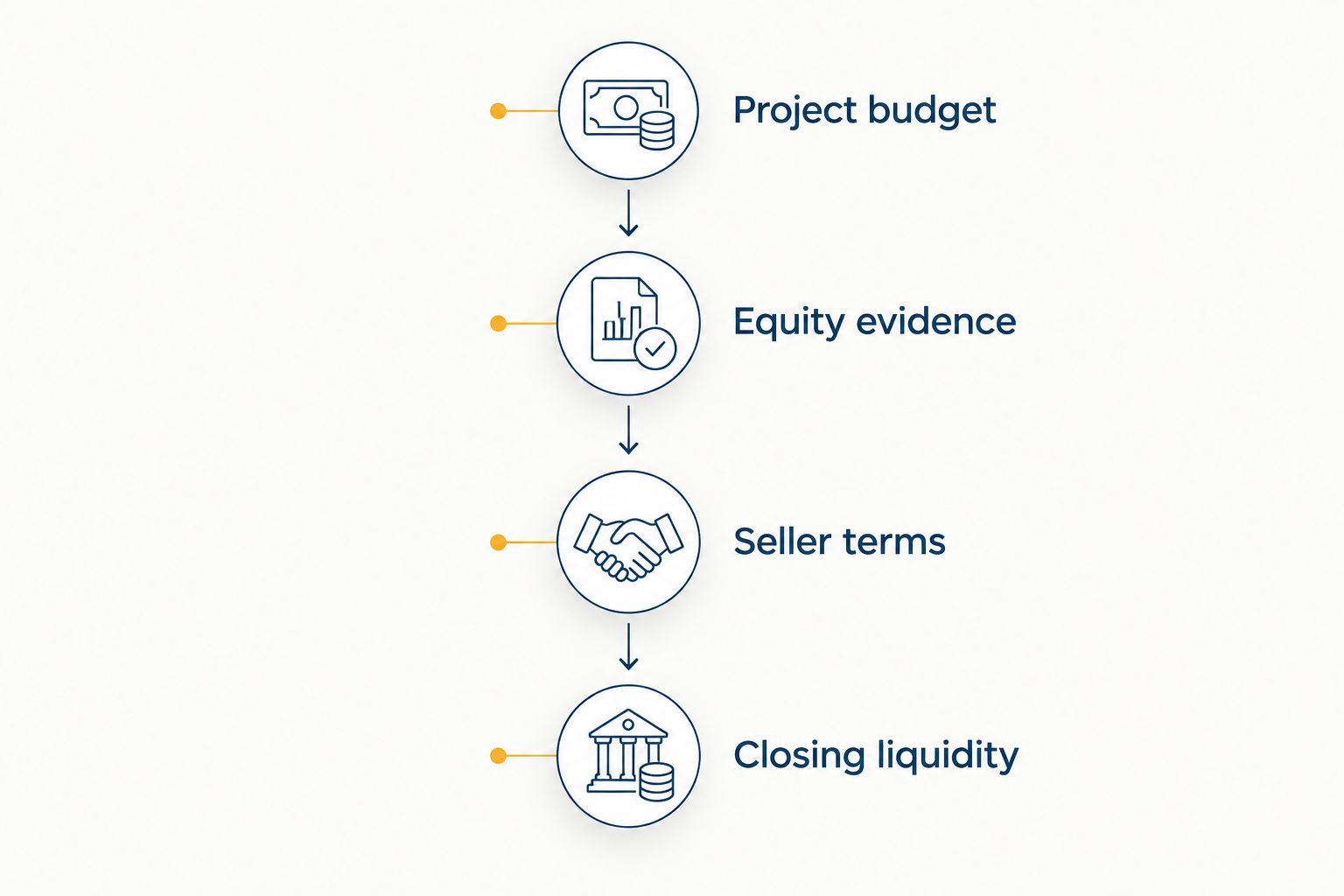
A useful starting package includes:
- Project budget: proposed purchase terms, transaction expenses and working-capital needs.
- Equity evidence: account statements and records supporting the source and movement of funds.
- Seller terms: proposed note, payment terms and any required standby agreement.
- Business records: tax returns, financial statements and current operating results requested by the lender.
- Buyer records: ownership details, financial information and relevant management experience.
- Closing liquidity: a clear account of cash remaining after the contribution and other closing obligations.
Ask the lender to reconcile the documents against one sources-and-uses schedule. In 2026, a written transaction-specific answer is more useful than a general statement that an acquisition needs money down.
FAQ
What's the usual SBA loan down payment to buy a business?
A complete business acquisition under SBA 7(a) generally requires at least 10% of total project costs as an equity injection. The lender can require more, and your total cash requirement also depends on the transaction structure and remaining operating needs.
Can I buy a business with 5% down using an SBA loan?
A 5% buyer-cash contribution can fit a structure with a 10% required injection when qualifying seller debt supplies the remaining 5%. The seller debt must meet applicable standby requirements, and the lender must approve the structure.
Does any seller financing count toward my SBA down payment?
No, seller financing does not automatically count toward the required equity injection. The note must satisfy applicable SBA requirements, including the required standby treatment when used for this purpose.
Is the down payment based only on what I pay the seller?
The general complete-acquisition injection requirement is based on total project costs, not only the business purchase consideration. Have the lender identify which working-capital and transaction expenses enter that calculation.
Can I use borrowed money for the SBA down payment?
Borrowed money requires lender review before it can be treated as an acceptable injection source. Disclose the debt and repayment source before taking the borrowing or relying on it in your budget.
Does the SBA guarantee mean I cannot lose my down payment?
No, the SBA guarantee does not protect your down payment from business losses. Review your equity exposure, guarantees and collateral obligations before signing.
Does Jon Lynch Financial Group directly approve SBA acquisition loans?
Jon Lynch Financial Group is a broker, not a direct lender. Business-purpose financing is subject to third-party underwriting, and approval, amounts, rates and funding times are not guaranteed.
What is the one last thing to check?
Ask what cash remains the morning after closing. A lower contribution is not a better structure if it creates repayment pressure or leaves the acquired business unable to operate.
Before choosing a lender, request the required injection, acceptable funding sources, seller-note treatment, closing obligations and remaining liquidity in writing. That is the acquisition decision sheet to use in 2026.
Related guides
- SBA lenders for buying an existing business
- How long does SBA loan approval take?
- Acquisition valuation and financing for insurance agencies
How should you take the next step?
Bring your project budget and documented equity sources to Jon Lynch Financial Group. For U.S. business owners generating at least $35,000 per month, Compare Business Funding Options; for businesses below $35,000 per month, Explore Self-Serve Funding. Identify the request as an acquisition so the funding route is assessed against the transaction rather than assumed to qualify.