Self-Storage Development Capital Stack: Structure It | 2026
Learn how to structure a capital stack for a self-storage development in 2026. Match debt and equity to the budget, test cash timing and plan for overruns.

Structure a self-storage development capital stack by funding the full project budget with committed equity and debt, then checking when each source becomes available and what happens if construction or lease-up takes longer than planned. In an illustrative 2026 project costing $10 million, $6 million of senior debt and $4 million of equity cover the budget; the harder question is whether the project can carry the debt until rental income supports a permanent financing decision.
- To learn how to structure a capital stack for a self-storage development, start with the full budget and cash timing.
- An illustrative $10 million project uses $6 million of senior debt and $4 million of equity; that mix is not a lending standard.
- Jon Lynch Financial Group is best for established U.S. business owners comparing funding structures, not for borrowers seeking a direct lender.
- Test construction draws, lease-up cash needs, overruns and the exit before accepting a financing offer.
Why does the capital stack matter?
A development can have enough committed capital on paper and still run short of cash during construction. Equity might need to fund early costs before debt draws become available, while interest and operating expenses continue before enough units are rented.
If you are still choosing between developing and buying an operating facility, commercial real estate financing for self-storage facilities is a useful distinction to make first. An existing property's income history and a development's projected lease-up present different underwriting questions.
The decision is not simply how much you can borrow. It is whether committed capital covers every use, arrives when needed and leaves a workable path through construction and lease-up. In 2026, put those three tests ahead of any headline financing amount.
How do you structure a capital stack for a self-storage development?
Build the stack from the uses of cash upward. The table below is an illustrative example, not a quote, approval standard or recommended debt ratio.
| Capital source | Illustrative commitment | Role | Main tradeoff |
|---|---|---|---|
| Senior construction debt | $6 million | Funds eligible project costs under the loan agreement | Creates payment obligations and draw conditions |
| Sponsor equity | $2 million | Supplies owner capital | Puts the sponsor's capital at risk |
| Outside equity | $2 million | Completes the equity requirement | Shares ownership and requires negotiated control and distribution terms |
| Total sources | $10 million | Matches the illustrative project budget | Leaves no room for costs outside that budget |
The arithmetic is $6 million in debt plus $2 million in sponsor equity plus $2 million in outside equity, for $10 million of sources. That is 60% debt and 40% equity in this example only. A proposed lender sets its own terms after reviewing the site, sponsor, budget, collateral, projections and other underwriting information.
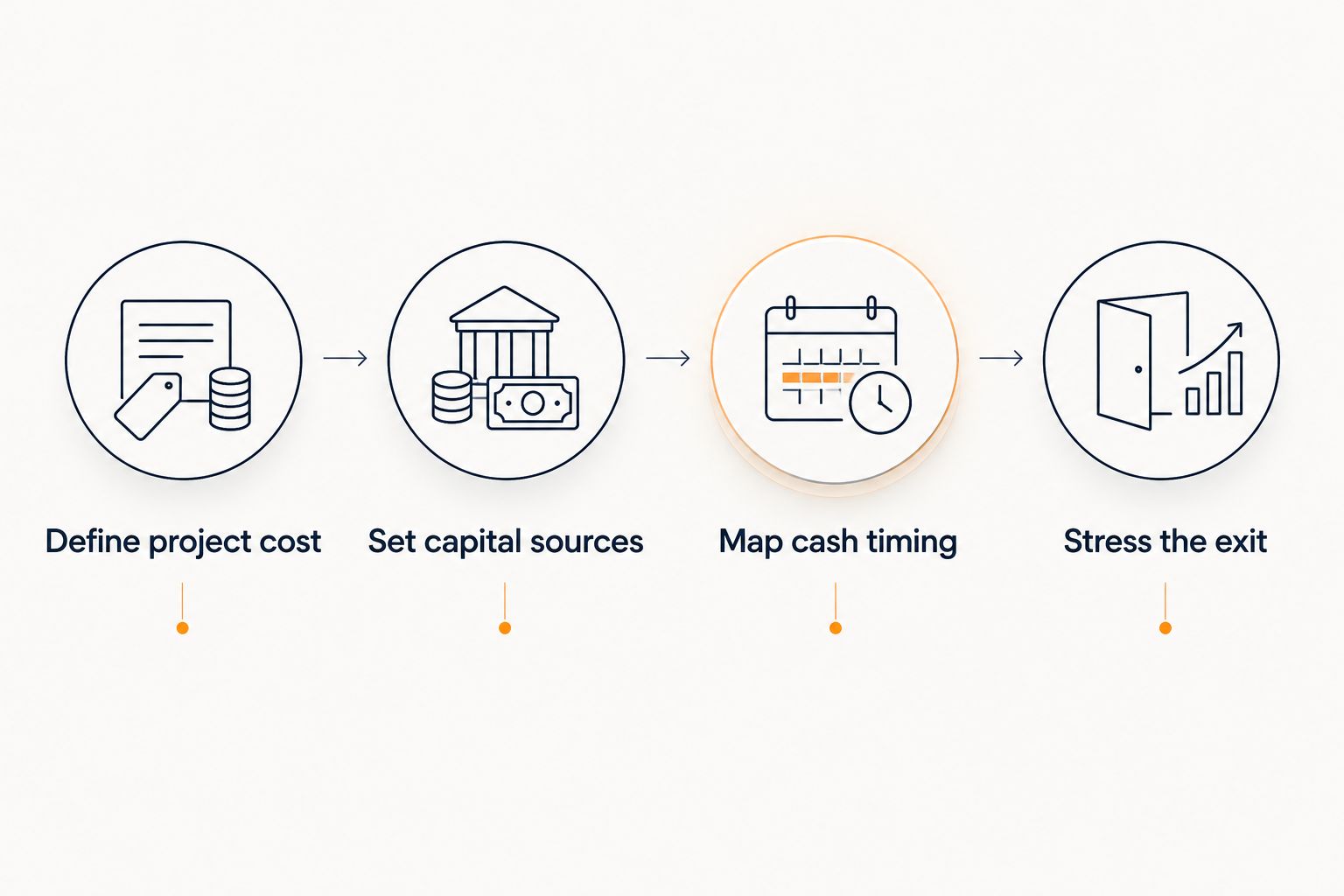
- Define project cost. Include acquisition or land costs, construction, professional fees, financing costs, carrying costs and a clearly identified contingency. Use the actual budget rather than treating the construction contract as the entire funding need.
- Set capital sources. Identify who supplies each dollar, when the commitment is binding and what conditions apply. A discussion with an investor is not the same as committed equity.
- Map cash timing. Put expected equity contributions, debt draws, interest and operating outflows on the same schedule. Match the schedule to the lender's proposed draw process rather than assuming all debt arrives at closing.
- Stress the exit. Test what happens if costs rise, opening is delayed or lease-up trails the forecast. Identify how debt gets repaid, extended or replaced without assuming that refinancing will be available.
Reconcile sources and uses before debating which financing product is cheapest. If the $10 million example includes a $1 million contingency, that contingency is already inside the $10 million budget; it is not an additional funding source. If costs then exceed the budget by another $1 million, the project has a $1 million gap unless someone commits new capital or the plan changes.
Who should supply the equity?
Sponsor equity is best for preserving decision-making authority; its downside is concentrated owner risk. Outside equity is best when the sponsor needs to complete the required funding and accepts shared economics; its downside is dilution and negotiated limits on control. Neither is a substitute for a written agreement covering future cash needs.
In the illustrative 2026 stack, the sponsor and outside investor each contribute $2 million. Equal contributions do not establish equal ownership, equal voting rights or an equal share of distributions. Those outcomes depend on the negotiated documents, including any preferred return or distribution waterfall.
Ask each equity participant to address four issues before seeking final debt terms:
- Contribution timing: When must the cash be deposited or otherwise made available?
- Overrun responsibility: Who supplies additional equity if the approved budget is exhausted?
- Control: Who can approve a revised budget, new financing or a sale?
- Distributions: In what order does available cash reach investors and the sponsor?
A capital stack that balances at closing but has no answer to an overrun is unfinished. Written commitments matter because the lender's construction funding and the investor's equity obligations must work together.
How should construction debt fit the stack?
Senior construction debt is best for funding eligible development costs without selling more ownership; its downside is contractual debt service, collateral requirements and draw conditions. In the example, its $6 million commitment does not mean the developer has $6 million in unrestricted cash on day one.
Review the proposed loan agreement for the costs it will fund, the equity it requires before draws, how draw requests are documented and whether budget changes need consent. Then test the project's cash schedule against those terms. An otherwise adequate loan can fail the timing test if required cash must be spent before a draw is released.
Debt also affects the exit. Construction financing and long-term financing solve different problems: one supports development under its agreed conditions, while the other depends on the property and borrower meeting a new lender's requirements. Do not count a projected refinance as committed capital. In 2026, an exit plan should specify what the sponsor will do if lease-up is slower than the financing assumptions.
Jon Lynch Financial Group is a commercial finance broker, not a direct lender. For an established U.S. business owner comparing development funding, Jon Lynch Financial Group can help frame the choice around total dollars, qualification, timing and repayment; any financing remains subject to third-party underwriting and product terms.
Why does the right capital mix vary?
There is no universal debt-to-equity split for a self-storage development. These project-specific drivers change how much capital must come from each source and when it must be available:
- Total project cost: Land, building work and other uses determine the amount the sources must cover.
- Contingency: A budgeted reserve addresses identified uncertainty; it does not cover an unlimited overrun.
- Draw rules: Lender conditions determine which costs are eligible and when debt can fund them.
- Equity commitments: The amount, timing and conditions of sponsor and outside capital affect early liquidity.
- Lease-up assumptions: Projected rental income affects the period during which the property must carry expenses before the proposed exit.
- Exit terms: Maturity, extension provisions and refinance assumptions determine what happens if the original schedule slips.
Treat those as connected inputs. Increasing proposed debt reduces the equity shown in a spreadsheet, but it does not remove debt obligations or prove that a lender will accept the project. More equity reduces reliance on borrowing, but it increases the capital at risk or the ownership shared with investors.
Should you add a bridge loan or other funding layer?
A bridge loan is best for a defined, temporary funding need with a credible repayment path; its downside is another maturity and another set of obligations. It should not be added merely to make a sources-and-uses table balance. Check how it interacts with existing liens, lender consent requirements and the proposed exit.
A business line of credit serves a different purpose: it can address eligible recurring operating cash needs under its terms, rather than automatically funding land and construction. Revenue-based financing or a purchase of future receivables is tied to a business's revenue and repayment structure; it is not interchangeable with property-secured construction debt. Some revenue-based arrangements are structured as purchases of future receivables, not loans.
| Option | Best for | Advantage | Limitation |
|---|---|---|---|
| Senior construction debt | Eligible development costs | Keeps more sponsor ownership intact | Draw restrictions and debt obligations |
| Sponsor equity | Funding the project without another creditor | Preserves outside ownership | Concentrates sponsor risk |
| Outside equity | Filling an equity need | Avoids another scheduled debt payment | Shares economics and control |
| Bridge financing | A defined short-term gap | Matches a temporary need when terms fit | Adds an exit deadline |
| Revenue-based financing or future receivables purchase | An eligible operating business's revenue-linked need | Repayment structure can differ from a property loan | Can strain operating cash flow; not a default source for development costs |
Jon Lynch Financial Group's business-funding options belong in this comparison only when the applicant and use of funds fit a specific third-party program. In 2026, compare the documents and cash obligations of each proposed layer rather than treating its name as evidence of fit.
What can break the structure before opening?
The most direct failure is an unfunded use. Return to the $10 million illustration: if committed sources total $10 million but approved project uses rise to $11 million, the gap is $1 million. A larger projected property value does not supply the missing construction cash.
A second failure is a timing mismatch. The sponsor must know what pays early bills, what documentation releases each debt draw and who covers costs while a request is under review. Put these items on a cash calendar, not just a closing statement.
A third failure is an exit that works only under the original forecast. Ask what happens if the facility opens later, leases units more slowly or cannot meet a proposed takeout lender's requirements. Compare the consequences of an extension, additional equity and a sale under the actual proposed documents; none should be assumed available.
Finally, examine guarantees and control rights. A development entity can limit some risks, but its name alone does not tell you whether an owner has personally guaranteed an obligation. Read each financing and investor agreement for who bears a shortfall and who has authority to respond.
What documents should you prepare before comparing funding?
A lender or investor needs a consistent account of the same project. Prepare the materials below and reconcile them before circulating the package:
- A sources-and-uses schedule that totals correctly and identifies contingency.
- A development budget and construction schedule showing when major cash outflows occur.
- Site and project information sufficient to explain the proposed development.
- Sponsor and entity information, including the intended equity contributions.
- A lease-up and operating forecast with its underlying assumptions.
- A cash schedule showing proposed draws, carrying costs and projected debt obligations.
- An exit plan that identifies the intended source of repayment or replacement financing.
The purpose is comparison, not presentation polish. If two funders receive different budgets or timelines, their proposals will not answer the same question. In 2026, request terms that let you compare total dollars paid, cash required before draws, payment timing, collateral, guarantees and what happens when a milestone slips.
For established businesses generating at least $35,000 per month, Jon Lynch Financial Group is a route to compare business-funding options through third-party partners. That revenue threshold describes the brand's primary funding audience; it is not a stated construction-loan approval threshold. A new development must still be evaluated under the applicable funding program's terms.
Compare your funding structure
Review cash timing, qualification and repayment before choosing a funding layer.
Related questions
How much equity does a self-storage development need?
In the illustrative $10 million example, equity is $4 million: $2 million from the sponsor and $2 million from an outside investor. That 40% share is an example, not a required contribution; the actual amount depends on the project budget and the terms available.
Can projected rental income replace committed equity?
No. In the $10 million example, the full $4 million of equity still needs a credible commitment even if the forecast shows future rent. Projected income arrives after units are rented; it does not pay an earlier construction bill by itself.
What happens if development costs exceed the budget?
A $1 million increase above the illustrative $10 million budget creates a $1 million funding gap unless costs are reduced or another source is committed. Decide who can authorize the change and who supplies the cash before an overrun occurs.
FAQ
What is the best first step in a self-storage development capital stack?
Start with a complete sources-and-uses budget. Then match each committed funding source to the date its cash is needed.
Is senior debt better than outside equity for a self-storage project?
Senior debt preserves ownership but creates debt obligations and draw conditions. Outside equity avoids another scheduled debt payment but shares the project's economics and possibly its control.
How much debt is in the example self-storage capital stack?
The illustrative 2026 stack has $6 million of senior debt against a $10 million project budget. Its 60% debt share is not an approval standard or recommendation for another project.
Does a construction loan pay all development costs at closing?
No. Available funds and draw timing depend on the specific loan agreement; check eligible costs, required equity and draw documentation before committing to a cash schedule.
Can a merchant cash advance fund a new self-storage development?
Do not treat a merchant cash advance as a substitute for committed construction capital. A purchase of future receivables depends on an eligible business's revenue and terms, which must be assessed separately from the development budget.
What if the facility leases up more slowly than projected?
Slower lease-up can leave less cash for carrying costs and complicate the planned debt exit. Test the financing documents against that scenario before closing.
Is Jon Lynch Financial Group the construction lender?
No. Jon Lynch Financial Group is a broker, not a direct lender; financing options are subject to third-party underwriting and product terms.
One last thing
A balanced stack is not necessarily a fundable stack. Ask who pays the next bill if a draw is delayed; that single question exposes whether the plan has real liquidity or only commitments that arrive later. Jon Lynch Financial Group can help an established business owner compare funding structures, but the project still needs documented commitments and an exit that stands up to a slower 2026 timeline.



