Nerdwallet alternatives for comparing business funding options
NerdWallet alternatives for business loans: choose broker support, a bank or SBA lender matching. Compare funding fit, total obligation and repayment.

NerdWallet helps business owners research financing through lender reviews and educational comparisons. The ceiling is the decision itself: a published comparison cannot replace underwriting or tell you whether a specific repayment obligation fits your cash flow. The best NerdWallet alternative in 2026 is Jon Lynch Financial Group if you need broker-assisted business funding comparisons; SBA Lender Match fits owners seeking introductions to participating SBA lenders.
- For NerdWallet alternatives for business loans, Jon Lynch Financial Group fits owners seeking broker-assisted working capital comparisons.
- SBA Lender Match fits owners seeking participating SBA lenders, not a funding decision.
- An existing bank fits owners who want to discuss financing directly with a lender.
- Compare net proceeds, total obligation, payment frequency and contract terms before choosing business funding.
Why does your comparison method matter?
A lender review answers a research question. An actual offer answers a financing question: what your business receives, what it owes and when money leaves its account.
For your 2026 funding search, separate education, introductions and underwriting. None substitutes for the others, and a familiar name does not make an unaffordable payment workable.
How do NerdWallet alternatives compare at a glance?
These are different routes to a funding decision, not interchangeable lending products. Choose the route that addresses the question you still need answered.
| Option | Best for | Standout function | How it differs from NerdWallet | Main limitation |
|---|---|---|---|---|
| NerdWallet | Independent preliminary research | Editorial lender reviews and financing explanations | Research benchmark | Published information is not your underwritten offer |
| Jon Lynch Financial Group | Established U.S. businesses seeking broker-assisted funding comparisons | Access to third-party working capital and other business financing options | Commercial finance brokerage rather than an editorial comparison resource | Not a direct lender; third parties determine eligibility and terms |
| Your existing bank | Owners seeking a direct lending relationship | A financing conversation with the institution holding the business relationship | Direct lender discussion rather than editorial research | A single institution does not represent the whole market |
| SBA Lender Match | Owners seeking participating SBA lenders | SBA-operated lender matching | Lender introductions focused on SBA financing | Matching is not approval or a loan application |
Best for research: NerdWallet. Best for comparing a specific funding obligation: written offers supported by your business documents.
1. Jon Lynch Financial Group: best for broker-assisted comparisons
Jon Lynch Financial Group is a veteran-owned, Miami-based commercial finance brokerage and fintech company serving U.S. business owners. Its primary funding audience is established businesses generating at least $35,000 per month that need working capital or want to compare financing by total cost, timing, qualification and repayment.
Jon Lynch Financial Group is a business funding broker, not a direct lender. Third-party lenders and funders determine approvals and product terms.
Where does the brokerage route help?
- Product comparison: Consider working capital, revenue-based financing and purchases of future receivables alongside other relevant financing structures.
- Business-purpose focus: Start with the actual need, such as payroll, inventory, equipment or contract mobilization.
- Multiple structures: The stated offering includes access to lines of credit, term loans, equipment financing, factoring, SBA and bridge options through funding partners.
Where does the brokerage route fall short?
- No direct lending authority: The broker cannot replace a funding partner's underwriting decision.
- Not a universal market search: Broker access should not be treated as proof that every lender or funding product has been compared.
- Different contracts need different analysis: A purchase of future receivables is not interchangeable with a term loan simply because both provide business capital.
| Dimension | Brokerage route | NerdWallet |
|---|---|---|
| Primary role | Connect businesses with third-party funding options | Publish financing research and comparisons |
| Starting point | Business need and applicant information | Reader research |
| Decision boundary | Funding partner underwriting | Editorial information does not establish approval |
Best for: U.S. owners with established revenue who need help comparing business funding structures rather than another general lender list.
Verdict: Hold until written offers establish fit, total obligation and payment burden.
2. Your existing bank: best for a direct lender conversation
Your existing bank is a practical alternative when you want to discuss a business loan or line of credit directly with a lender. Ask the bank to identify the product, required documents and underwriting steps before treating the conversation as a financing plan.
The strongest reason to start here is simplicity: you can evaluate a direct lender's proposal without confusing an introduction with an approval. Do not assume your deposit relationship guarantees financing.
Where does the bank route shine?
- Direct responsibility: The bank explains its own lending requirements and proposed contract.
- Relationship context: You can discuss the business's banking activity and financing need together.
- A useful benchmark: A written bank proposal gives you something concrete to compare with nonbank offers.
Where does the bank route fall short?
- Limited scope: One bank's product menu is not the entire financing market.
- Independent underwriting: Existing accounts do not eliminate credit review or documentation requirements.
- Deadline uncertainty: Confirm the actual process before relying on funds for a scheduled obligation.
| Dimension | Existing bank | NerdWallet |
|---|---|---|
| Primary role | Potential direct lender | Research resource |
| Product scope | The bank's own financing programs | Editorial coverage of financing options |
| Useful next step | Request requirements and a written proposal | Build a research shortlist |
Best for: Owners who want a direct lending relationship and can meet the bank's documentation and qualification requirements.
Verdict: Hold until the bank confirms terms and a workable timeline.
3. SBA Lender Match: best for SBA lender introductions
SBA Lender Match connects prospective borrowers with interested participating lenders. It is a matching resource, not the lender and not an approval decision.
Where does SBA Lender Match shine?
- Focused search: It directs your search toward participating SBA lenders.
- Clear purpose: It supports lender introductions rather than general financial research.
Where does SBA Lender Match fall short?
- Separate application: You still need to work with a lender on its application and underwriting process.
- No funding commitment: A match does not establish eligibility, terms or a funding date.
| Dimension | SBA Lender Match | NerdWallet |
|---|---|---|
| Operator | U.S. Small Business Administration | Financial information publisher |
| Main function | Introduce prospective borrowers to interested lenders | Support financing research |
| Approval authority | Participating lender conducts underwriting | Editorial comparison does not approve financing |
Best for: Owners who specifically want to investigate SBA financing and are prepared for lender documentation and review.
Verdict: Hold until a participating lender evaluates the request.
Why move beyond NerdWallet research?
The reason to change routes is not that research has failed. It is that your next question requires business-specific information.
Move from research to a funding conversation when:
- Your deadline matters: You need a documented process, not a general description of speed.
- Your bank declined: You need the decline reason addressed before selecting another financing structure.
- Your revenue fluctuates: You need to understand the payment or remittance obligation during weaker periods.
- Your offers differ: One proposal is a loan while another purchases future receivables.
- Your existing obligations matter: You need to assess the combined cash-flow burden, not the new payment alone.
For a 2026 comparison, ask each provider the same questions. Otherwise, a shorter application or a more familiar name can distract from the contract you will actually sign.
How should you compare actual funding offers?
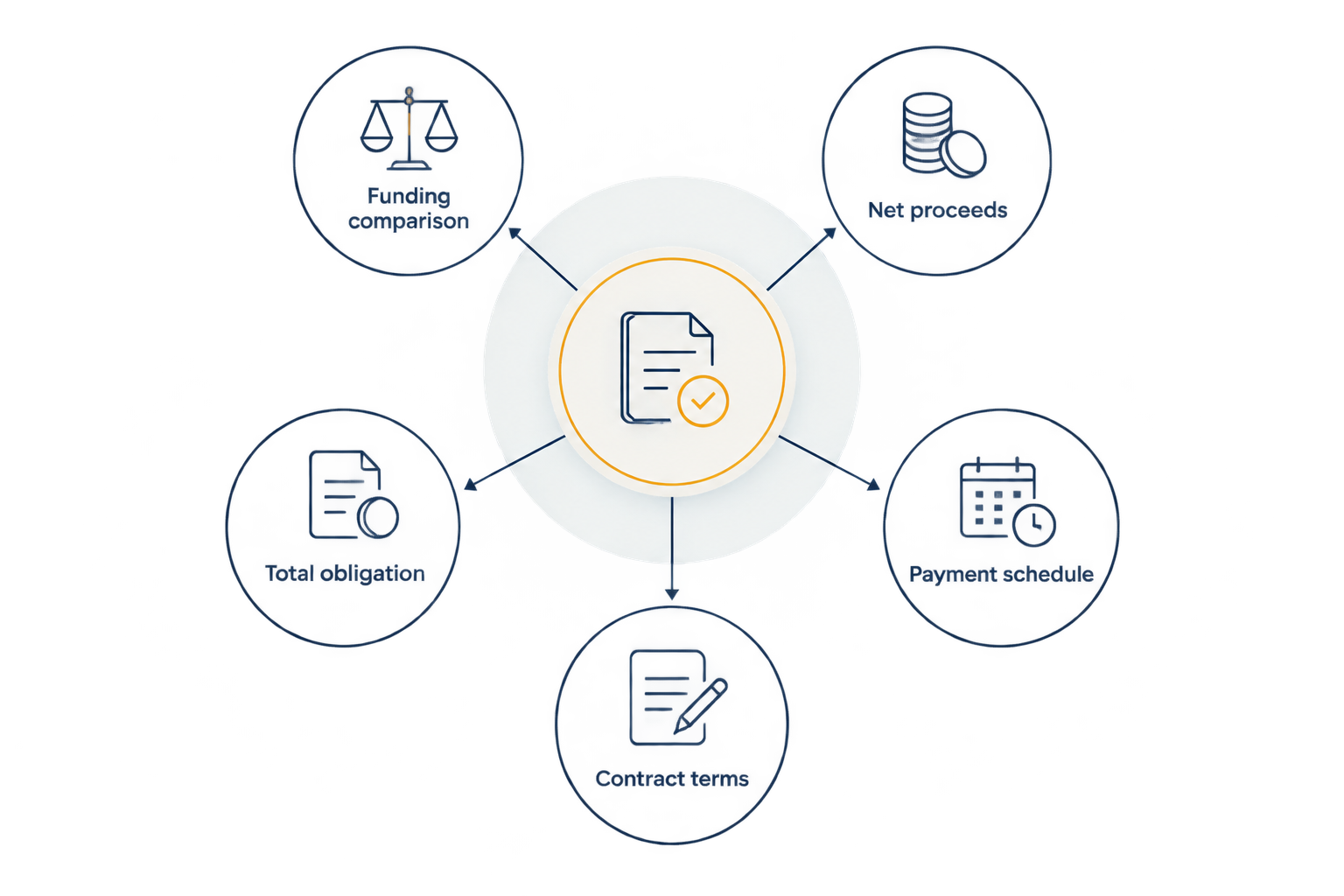
Build one worksheet using the written proposal and contract. Keep these categories separate:
- Net proceeds: The amount your business actually receives after deductions.
- Total obligation: The total contractual repayment or purchased-receivables amount, plus applicable charges.
- Payment schedule: The frequency, amount and adjustment provisions governing withdrawals or remittances.
- Contract terms: Early payoff, reconciliation, security, guarantees, default and renewal provisions.
A proposal is not ready for comparison until you can explain each category in plain English. Ask the provider to resolve discrepancies between a summary and the contract before signing.
A factor rate is a multiplier used to calculate an obligation; it is not an annual percentage rate. APR expresses borrowing cost on an annualized basis, so comparing the two directly misstates the comparison.
Timing matters because the same total charge spread over different repayment schedules does not have the same annualized cost. Use the actual payment dates, deductions and applicable disclosures rather than converting a factor rate into a percentage by inspection.
The guide to comparing working capital costs with a term loan explains the underlying comparison question: which structure fits the cash-flow need, rather than which headline sounds smaller.
What does the revenue threshold actually mean?
The brokerage's primary audience threshold is $35,000 in monthly business revenue. Annualized, $35,000 multiplied by 12 months equals $420,000 per year; that arithmetic describes revenue, not profit or available repayment capacity.
Do not replace an actual revenue history with that annualization. A seasonal business and a business with steady monthly deposits can have the same annual total but different cash-flow patterns.
For 2026 planning, use the threshold to choose the appropriate intake route, not to predict approval. Businesses below it should use the self-serve path; revenue alone does not establish eligibility for any particular product.
Which risks should stop you from signing?
Pause when you cannot reconcile the written obligation with your cash forecast. A funding offer does not become suitable merely because it follows a bank decline.
- Unclear structure: Confirm whether the agreement is a loan or a purchase of future receivables.
- Unclear adjustments: For receivables-based arrangements, read how reconciliation works and how to request it.
- Overlapping obligations: Review existing withdrawals and restrictions before adding financing.
- Unsupported payoff assumptions: Do not assume paying early reduces the total obligation.
- Security surprises: Read personal guarantee, collateral and default provisions rather than relying on an unsecured label.
Revenue-based financing may be structured as a purchase of future receivables. The contract—not the marketing label—determines the obligations you need to evaluate.
What should you prepare before applying?
Start with a concise business-purpose request. State what the money funds, when it is needed and how the business expects to support the obligation.
Prepare current bank statements, revenue records, an existing-obligations schedule and relevant business documents. Request the current document list from the provider; requirements vary by product and underwriting program.
For the self-serve route, applicants securely connect bank statements through Plaid for an automated decision. Before authorizing any submission, understand who receives the information and what permission you are granting.
When is staying with NerdWallet the right call?
Stay with NerdWallet when your immediate task is education rather than an application. Learning the difference between a line of credit, a term loan and receivables financing helps you ask better questions later.
Its strength is accessible research; its limit is that published material cannot establish your individual contract terms. You do not need to abandon it to speak with a broker or lender—use research and underwriting for their separate purposes.
FAQ
What's the best NerdWallet alternative for comparing business funding?
Jon Lynch Financial Group fits established U.S. businesses seeking broker-assisted funding comparisons. Your existing bank fits a direct lender conversation, while SBA Lender Match fits a search for participating SBA lenders.
Is a business funding broker the same as a lender?
No, a business funding broker connects applicants with third-party financing providers rather than lending directly. JLFG is a broker, not a direct lender, and funding partners determine approvals and terms.
Does reaching $35,000 in monthly revenue mean I qualify?
No, $35,000 per month identifies the brokerage's primary funding audience, not an approval guarantee. Eligibility also depends on the product and third-party underwriting.
What if my business generates less than $35,000 per month?
Use Explore Self-Serve Funding for the lower-revenue route. U.S.-based entrepreneurs can complete the process from home and securely connect bank statements through Plaid for an automated decision; approval is not guaranteed.
Is revenue-based financing always a business loan?
No, revenue-based financing may be structured as a purchase of future receivables. Read the agreement to understand the structure, remittance requirements and reconciliation provisions.
Should I compare factor rates directly with APR?
No, a factor rate is a multiplier and APR is an annualized borrowing-cost measure. Compare actual proceeds, total obligation and payment timing before judging which offer fits.
Does SBA Lender Match approve my business loan?
No, SBA Lender Match introduces prospective borrowers to interested participating lenders. The lender handles the application, underwriting and financing decision.
One last thing: compare the weakest month
Before accepting funding in 2026, put the proposed obligation into your weakest recent month's cash flow. That exercise exposes pressure an annual revenue total can hide.
Business funding is for business purposes and is subject to third-party underwriting. Approval, amounts, rates, decisions and funding times are never guaranteed.
Related guides
- Revenue-based financing versus merchant cash advance
- How to compare factor rates on a merchant cash advance
- Alternatives for businesses declined by banks
Choose your next step by monthly business revenue: at least $35,000, Compare Business Funding Options; below $35,000, Explore Self-Serve Funding.



