Can a franchise owner get funding before opening?
Franchise funding before opening is possible with startup-suitable financing. Compare loan fit, owner cash, repayment timing and pre-opening risks.

Yes, a franchise owner can get funding before opening when the financing program accepts startups and the application supports repayment without an operating history. Match pre-opening costs to startup-suitable financing, not a funding product that requires existing sales. The tradeoff is that lenders must assess projected cash flow, owner finances and the project itself instead of relying on deposits from the unopened location.
- Franchise funding before opening requires a startup-suitable program; projected sales are not an operating history.
- SBA startup loans and equipment financing deserve review, but neither guarantees eligibility or funding.
- Jon Lynch Financial Group is best suited to established U.S. businesses comparing business-purpose funding through a broker.
- Protect opening reserves: compare payment start dates, permitted uses and obligations if the opening slips.
Can a franchise owner get funding before opening?
Yes. The central question is which borrower, assets and repayment source the lender will evaluate. A first-time owner opening a first location presents a different application from an established franchise operator adding another unit.
For your 2026 funding search, use the comparison below to separate those situations. Jon Lynch Financial Group is a broker, not a direct lender; its primary funding audience is established U.S. businesses generating at least $35,000 per month.
| Funding route | Best for | Main advantage | Main limitation before opening |
|---|---|---|---|
| Startup-suitable bank or SBA loan | Owners seeking financing for an eligible opening project | Can address multiple eligible business uses | Requires underwriting of the startup plan and repayment ability |
| Equipment financing | Owners purchasing identifiable business equipment | Connects financing to a specific asset | Does not automatically cover payroll, inventory or the entire buildout |
| Financing supported by an existing business | Established operators adding a location | Gives the lender operating records to evaluate | Can expose the existing business to expansion obligations |
| Franchisor-related financing | Owners whose franchise system identifies a financing arrangement | Provides a route to investigate alongside the franchise purchase | Terms, coverage and lender independence require review |
| Revenue-based financing or future-receivables purchase | Operating businesses with documented revenue | Uses operating revenue in the funding assessment | Does not turn unsupported startup projections into verified sales |
Treat these as routes to investigate, not offers. Product eligibility, permitted uses and underwriting requirements depend on the lender or funder.
Why does the opening date matter to your funding decision?
Before opening, you spend cash without the location producing normal operating receipts. After opening, customer receipts still need to support rent, payroll, supplies, franchise obligations and financing payments.
That creates two separate questions: can you finish the project, and can you operate after finishing it? A financing package that completes construction but leaves no operating reserve does not solve the full funding problem.
For a 2026 opening, put the first required financing payment beside the expected opening date. Ask what happens if permits, equipment installation or site work push that date back.
Who is the strongest fit for pre-opening franchise financing?
Are you opening your first business?
For a first location, prepare to explain your relevant experience, available owner funds, personal financial position and projected business cash flow. A recognizable franchise name does not replace the lender’s assessment of the borrower.
Separate documented facts from assumptions. A signed equipment quote is evidence of an expense; a sales forecast is an estimate that needs an explanation.
Do you already operate another location?
An established operator can present existing financial statements and bank activity alongside the new location’s budget. The lender still needs to determine which entity borrows and which operations support repayment.
Read the obligations carefully before committing existing assets or cash flow. The guide to business funding for multi-unit franchise owners addresses the operating-business side of that decision.
Are you buying an operating franchise instead?
Buying a location with operating records is different from opening a new location. Existing sales, expenses, lease terms and transfer requirements become part of the acquisition review.
Do not submit an acquisition budget as though it were a ground-up opening. Identify whether the transaction includes equipment, inventory, business assets or ownership interests, then ask the lender which structure its program accepts.
How do you build a financeable opening plan?
Start with the project, not the application. A lender needs a clear use of funds and a credible explanation of how the business will meet its obligations.
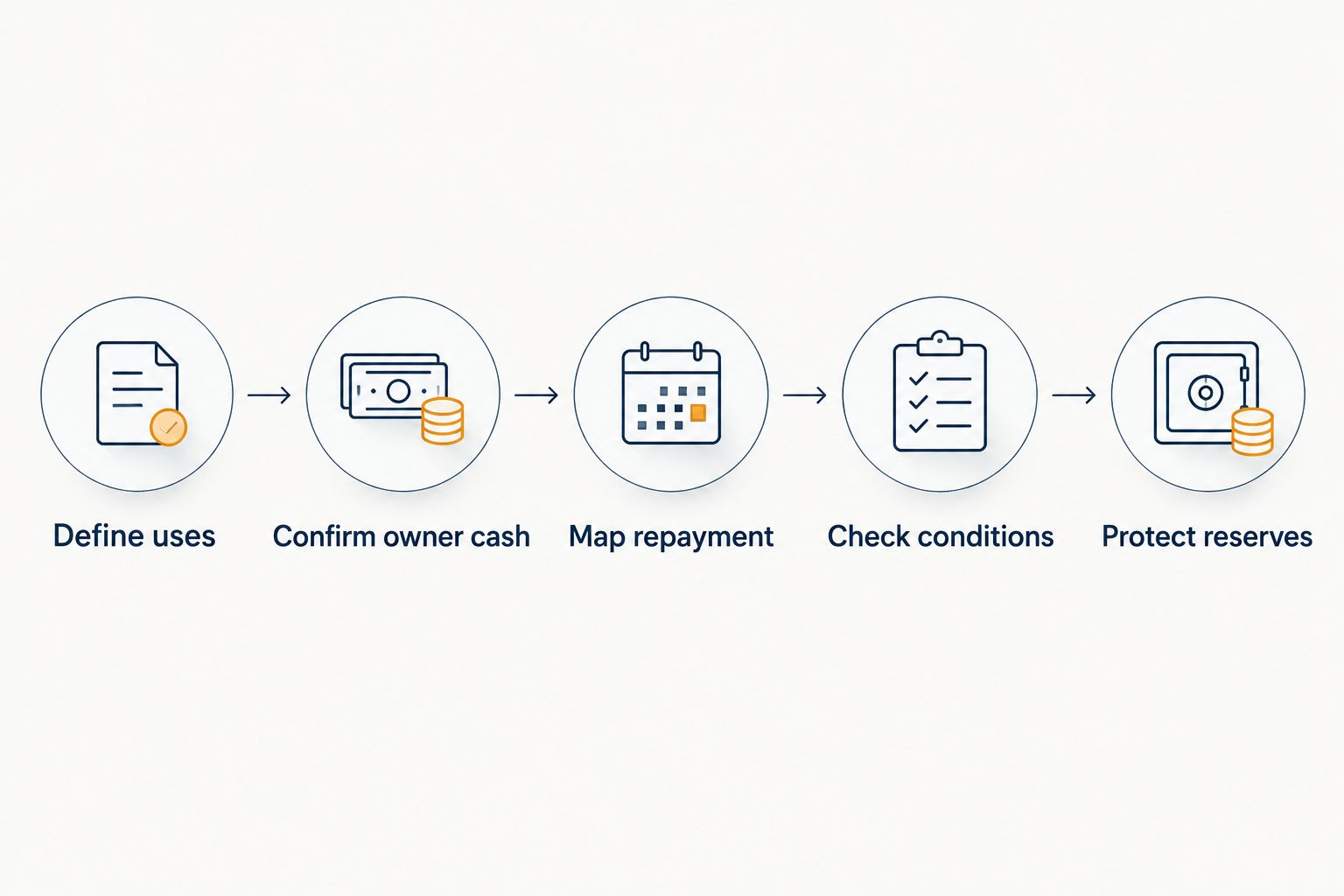
- Define uses. List franchise-related payments, site work, equipment, inventory, professional expenses and opening reserves separately.
- Confirm owner cash. Document funds available for the project and identify any restrictions or borrowing behind them.
- Map repayment. Show when payments begin and which cash source supports them before and after opening.
- Check conditions. Ask which approvals, documents and project milestones must be satisfied before disbursement.
- Protect reserves. Keep operating needs visible rather than treating every available dollar as construction money.
The sequence matters. You cannot compare offers accurately if one covers equipment alone and another includes eligible working capital.
What numbers should you review before signing?
For a 2026 franchise review, begin with the Franchise Disclosure Document, or FDD. Under the Federal Trade Commission’s Franchise Rule, the FDD contains 23 disclosure items and generally must be provided at least 14 calendar days before you sign a binding agreement or pay the franchisor or its affiliate in connection with the proposed franchise sale.
That disclosure period is not a financing approval period. Do not treat receiving the FDD as confirmation that a lender will finance the project.
What does the FDD tell you about the investment?
Review Item 7, the estimated initial investment, against your actual location budget. Review Item 10 for financing arrangements described by the franchisor, and examine the underlying terms rather than assuming the franchisor provides the money directly.
The FTC’s Franchise Rule governs these disclosures; it does not certify that a particular franchise investment is suitable for you. Ask your attorney and accountant to review the documents within their respective areas.
How should you compare cash flow without relying on a headline rate?
For a loan, request the amount financed, net proceeds, total scheduled payments, payment frequency and first payment date. Identify charges deducted before disbursement and obligations not included in the quoted payment.
For a purchase of future receivables, request the purchase amount, purchased receivables amount, remittance terms and any reconciliation provisions. Revenue-based financing may use this structure rather than a loan.
A factor rate is a multiplier used to calculate a contracted amount; it is not APR, an annualized measure of borrowing cost. Do not compare a factor rate directly with a loan’s APR.
Why does eligibility for franchise funding before opening vary?
Pre-opening funding varies because applications present different evidence and obligations. Review these factors before interpreting an initial conversation as a likely approval:
- Operating history: An unopened location lacks its own sales record; an existing operator has records a lender can examine.
- Owner contribution: Available owner funds affect how much outside financing the project needs and how much cash remains afterward.
- Credit and obligations: Personal and business credit, existing debts and payment history remain relevant to underwriting.
- Use of funds: Equipment, construction, acquisition expenses and working capital require different documentation and program checks.
- Repayment support: Projections, existing-business cash flow and other permitted repayment support are not interchangeable.
- Project readiness: Lease arrangements, bids, franchise documents and outstanding approvals affect whether the project is ready to finance.
Ask each lender to identify its current requirements for your transaction. There is no single franchise-wide credit score, owner contribution or approval timeline that applies to every funding product.
Can an SBA loan fund a franchise before it opens?
Yes, an eligible startup franchise can be considered for SBA-backed financing through a participating lender. An SBA guarantee does not eliminate underwriting or make every franchise project eligible.
Ask whether the lender accepts startup franchise applications, which proposed expenses qualify and what must happen before closing or disbursement. Also ask how the lender evaluates the franchise relationship under current program requirements.
Review this route when the project needs financing across several eligible business uses and your schedule allows the required review. The limitation is that a complete project still needs to satisfy lender and program conditions.
Can you use revenue-based financing before the franchise has sales?
Do not assume a revenue-based product accepts a location with no operating revenue. A forecast of future franchise sales is not the same evidence as bank statements showing business receipts.
For an established owner, ask whether a funder will evaluate the existing business and whether the proposed use is permitted. Identify exactly which entity signs and which receivables, accounts or assets the agreement concerns.
Merchant cash advance, or MCA, is a common search term for business funding that may be structured as a purchase of future receivables. Read the contract rather than treating the label as proof of how payments change when revenue changes.
What risks should stop you from signing immediately?
A financing offer needs further review when the obligation is clearer than the repayment source. Pause when the plan depends on opening exactly on schedule or reaching projected sales immediately.
Check these issues before accepting:
- Payments begin before the location has a practical source of operating cash.
- The approved use of funds does not match the expenses you intend to pay.
- Personal guarantees or liens affect assets you did not expect to commit.
- Existing loan documents restrict additional debt or transfers between businesses.
- The budget excludes operating reserves or unfinished project costs.
- The financing depends on a later refinance that has not been approved.
For your 2026 comparison, ask for written terms and resolve differences between the sales explanation and contract language. An approval with conditions is not the same as money available for every project expense.
What documents should you prepare next?
Build one consistent application file. Start with the following checklist, then obtain the lender’s transaction-specific requirements:
- Business formation and ownership information.
- Franchise Disclosure Document and relevant franchise agreements.
- Detailed project budget with supporting quotes or contracts.
- Lease documents or proposed site terms.
- Evidence of owner funds and their source.
- Personal financial information and requested tax records.
- Cash-flow projections with written assumptions.
- Existing-business financial statements, bank statements and debt schedule, when applicable.
Keep projections consistent across documents. If rent, opening dates or construction costs change, update the budget and repayment plan together.
What should you know about Jon Lynch Financial Group’s role?
Jon Lynch Financial Group is best for established U.S. business owners comparing business-purpose funding through a broker. Its primary funding route serves businesses generating at least $35,000 per month; that is an audience threshold, not an approval promise.
Jon Lynch Financial Group is a broker, not a direct lender, and funding is subject to third-party underwriting and product terms. A first-time franchise owner with no revenue should not interpret that established-business focus as confirmation of startup eligibility.
For businesses below $35,000 per month, the self-serve path is available to U.S.-based entrepreneurs, with bank statements connected securely through Plaid for an automated decision. Access to that path does not establish that a pre-revenue franchise qualifies.
FAQ
Can I get franchise funding before opening my first location?
Yes, if the financing program accepts startups and your application satisfies its underwriting requirements. Prepare a documented opening budget, owner financial information and a repayment plan.
Does a franchise brand guarantee that I can get a loan?
No, a franchise brand does not guarantee loan approval. The lender evaluates the borrower, project, repayment ability and applicable program requirements.
Can I get an MCA for a franchise with no sales yet?
Do not assume an MCA program accepts a franchise with no operating sales. Ask the funder what revenue evidence it requires and which business would sign the agreement.
Can equipment financing pay for my entire franchise opening?
Equipment financing does not automatically cover an entire franchise opening. Confirm eligible equipment and separately plan for expenses such as inventory, payroll and site work.
How early should I receive the franchise disclosure document?
The FTC Franchise Rule generally requires delivery at least 14 calendar days before signing a binding agreement or paying the franchisor or its affiliate in connection with the proposed sale. This disclosure period is separate from lender underwriting.
Is the $35,000 monthly revenue threshold a guarantee of funding?
No, $35,000 per month identifies the primary funding audience for Jon Lynch Financial Group, not guaranteed eligibility. Products remain subject to third-party underwriting and terms.
What should I compare besides the financing rate?
Compare net proceeds, total contractual payments, payment timing, permitted uses and guarantees or liens. For receivables purchases, also review remittance and reconciliation provisions.
Which related guides match your franchise plan?
- Can a startup get business funding with no revenue yet?
- How to raise capital for a gym or fitness franchise buildout
- How to get funding for a franchise resale acquisition
What is the next practical step?
Before submitting your 2026 application, write down which business will repay the financing if the new location opens late. That answer separates a supported expansion plan from a project dependent entirely on forecasts.
Then choose the route that matches your current business revenue: Compare Business Funding Options if you generate at least $35,000 per month, or Explore Self-Serve Funding if you generate less. Confirm pre-opening eligibility before making a financing-dependent commitment.