How much can a business borrow through asset-based lending?
Your asset based lending borrowing amount depends on eligible collateral, reserves and existing draws. Learn how to calculate usable cash before signing.

Your business can borrow only up to the amount supported by eligible collateral and the lender’s approved facility limit—not the full value of its assets. In 2026, the practical limit is the lower of the approved commitment or the borrowing base after reserves, with existing advances deducted to determine what remains available. Appraisals, lien payoffs and contractual deductions can reduce the cash you actually receive.
- Your asset based lending borrowing amount depends on eligible collateral, advance rates, reserves and existing draws.
- A facility commitment is not the same as cash available to withdraw.
- Jon Lynch Financial Group is a broker, not a direct lender; third-party underwriting determines funding terms.
- Compare net usable proceeds and repayment obligations, not just the advertised facility size.
How much can a business borrow through asset-based lending?
Your borrowing capacity is determined by accepted collateral, not your balance-sheet asset total. A borrowing base is the amount a lender calculates from eligible assets after applying its contractual advance rates and deductions.
Use this sequence when reviewing an asset-based lending proposal:
- Eligible collateral: Identify which receivables, inventory or other assets the lender accepts.
- Advance rates: Apply the lender’s agreed percentage to each eligible asset category.
- Reserves: Deduct amounts the lender withholds against specified risks or obligations.
- Facility limit: Compare the resulting borrowing base with the approved commitment and use the lower amount.
- Outstanding advances: Subtract what you already owe under the facility to calculate remaining availability.
In simplified form:
Available to draw = lower of the facility limit or borrowing base after reserves, minus outstanding advances.
Your agreement controls the actual calculation, including any sublimits, availability blocks or additional restrictions. For broader business-funding comparisons, Jon Lynch Financial Group serves U.S. business owners as a broker, not a direct lender.
Why does available cash matter more than the approved limit?
An approved commitment sets a ceiling. It does not mean the lender will let you withdraw that entire amount immediately—or keep it outstanding regardless of changes in collateral.
A business can have unused room under its facility commitment but no additional borrowing availability. That happens when the borrowing base, rather than the commitment, is the binding constraint.
For your 2026 funding decision, separate these amounts:
- Commitment: The maximum facility size stated in the agreement.
- Borrowing base: The collateral-supported amount calculated under the agreement.
- Remaining availability: The amount left after outstanding advances and applicable restrictions.
- Net proceeds: The cash reaching your business after closing deductions and required payoffs.
Plan payroll, inventory purchases and supplier payments around usable cash—not the headline limit. A larger commitment adds little immediate value if the assets supporting it are ineligible.
Who does asset-based lending fit best?
Asset-based lending fits businesses with assets a lender can verify, value and monitor. It is especially relevant when working capital is tied up in receivables or inventory rather than sitting in the bank.
The benefit is a funding structure connected to qualifying assets. The tradeoff is ongoing reporting, collateral controls and availability that changes with the borrowing base.
| Collateral category | Best for | What supports borrowing | Main limitation |
|---|---|---|---|
| Accounts receivable | Businesses waiting for customers to pay completed invoices | Eligible, collectible customer balances | Aging, disputes and customer concentration can reduce eligibility |
| Inventory | Businesses holding saleable goods | Inventory accepted under the lender’s valuation method | Obsolete, specialized or difficult-to-sell goods can receive reduced value or be excluded |
| Equipment | Businesses with identifiable operating machinery | Accepted equipment value and lien position | Book value does not establish lending value; existing liens affect proceeds |
Equipment-backed borrowing can sit in a separate term facility rather than a revolving borrowing base. Confirm the structure before assuming every asset contributes to the same pool of availability.
Asset-based lending is a poor fit when your business needs more cash than its eligible assets support. Strong sales alone do not repair a collateral shortfall.
How do receivables affect the borrowing amount?
An accounts receivable ledger shows what customers owe. The lender’s eligible receivables calculation shows which balances count toward borrowing capacity.
Those are different totals. Lenders assess collectibility and apply the exclusions stated in their agreements.
Ask how the lender treats:
- Overdue invoices and balances owed by customers with other overdue accounts.
- Disputed invoices, returns, credits and customer deductions.
- Receivables owed by related businesses.
- Heavy dependence on a single customer.
- Invoices tied to unfinished work or unmet payment conditions.
An invoice can be valid for accounting purposes yet fail the lender’s eligibility rules. Before accepting a proposal, request an eligibility calculation using your actual receivables aging report.
How do inventory and equipment affect the borrowing amount?
Inventory cost does not automatically equal collateral value. A lender evaluates whether the goods are eligible and what valuation method applies under the proposed facility.
Finished goods, raw materials and work in progress can receive different treatment. Location, ownership, obsolescence and the ability to sell the goods also affect the analysis.
Equipment requires a separate review of value, ownership and existing security interests. A machine already securing another obligation does not automatically provide fresh borrowing capacity.
For a 2026 proposal, ask whether valuations come from accounting records, an appraisal or another specified method. Get the valuation basis in writing before comparing borrowing amounts. Otherwise, competing offers can appear different simply because they measure different things.
Why does the asset based lending borrowing amount vary?
The same balance sheet can produce different borrowing capacity under different agreements. Compare these drivers rather than assuming a lender’s headline advance rate tells the whole story:
- Eligibility rules: Assets excluded from the borrowing base contribute no availability, regardless of their accounting value.
- Advance rates: The contractual percentage determines how much accepted collateral supports borrowing.
- Reserves: Deductions reduce availability for risks or obligations specified in the agreement.
- Valuation method: Inventory and equipment values depend on the accepted valuation basis.
- Existing liens: Prior security interests and required payoffs affect collateral access and net proceeds.
- Facility restrictions: Commitments, sublimits, covenants and draw conditions can limit borrowing even when assets exist.
A higher advance rate does not necessarily produce more usable cash. Broader exclusions or larger reserves can offset it.
How should you calculate the amount you actually need?
Start with the business obligation you must fund, not the largest facility you can request. Match the amount and repayment structure to the cash-flow gap.
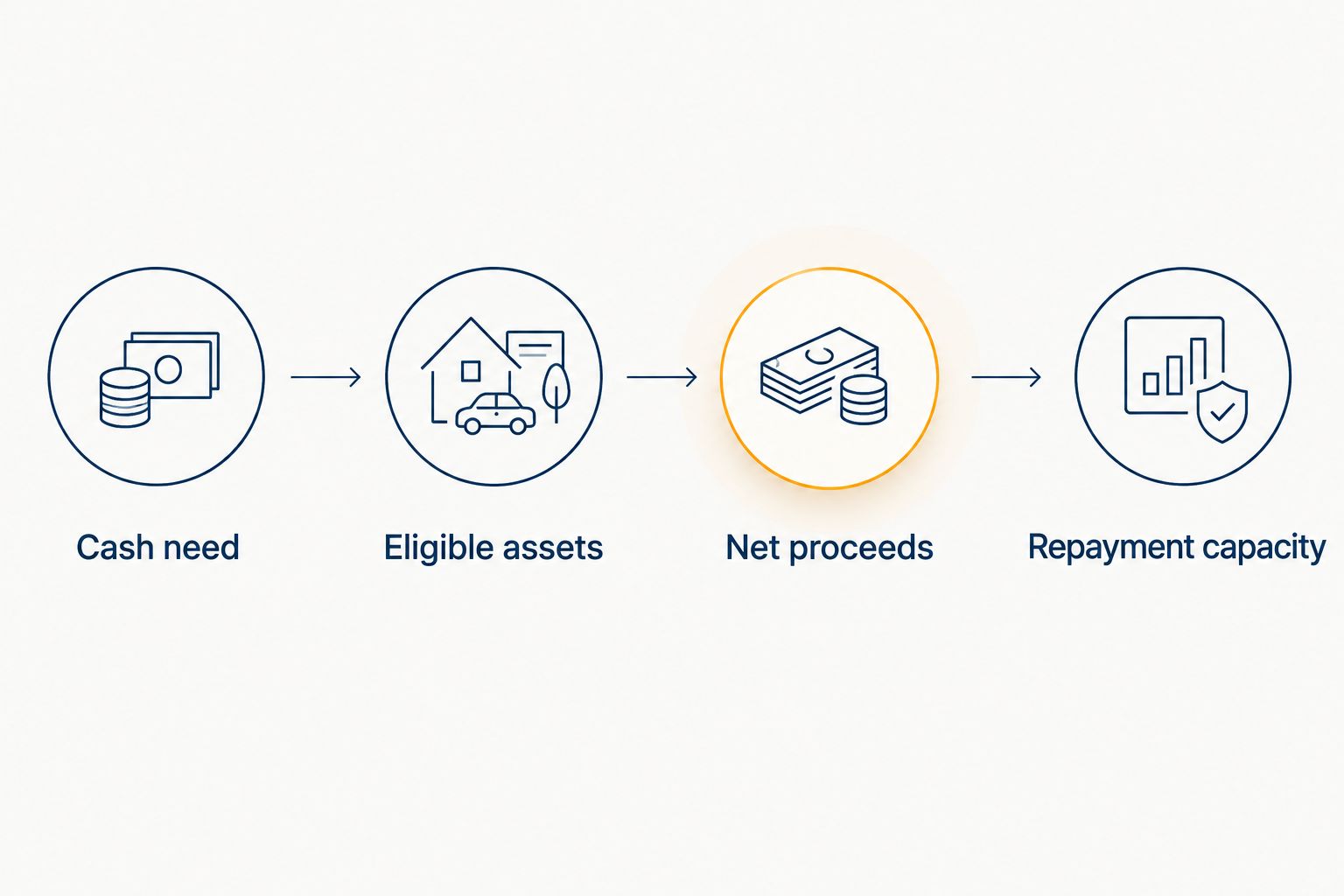
Build your request around this sequence:
- Cash need: Identify the payments the funding must cover and their due dates.
- Eligible assets: Separate qualifying collateral from total assets.
- Net proceeds: Account for required payoffs and closing deductions.
- Repayment capacity: Check what remains for operations after contractual payments.
These steps connect the borrowing request to an operating need. They also expose a mismatch early: a facility that supports inventory purchases might not support a long-term expansion project on suitable terms.
Which alternatives should you compare before pledging assets?
Choose the structure that matches how your business generates cash. Asset-based lending is not automatically the right answer after a bank decline.
| Structure | Best for | Main advantage | Main tradeoff |
|---|---|---|---|
| Asset-based lending | Businesses with eligible collateral and repeat working-capital needs | Availability linked to accepted assets | Reporting obligations and changing collateral availability |
| Invoice factoring | Businesses seeking funding against eligible customer invoices | Focus on specific receivables | Customer-payment arrangements and recourse terms require review |
| Business term loan | Businesses funding a defined expense with a repayment plan | A stated repayment structure | Scheduled payments continue when business cash flow weakens |
| Revenue-based financing | Businesses comparing funding against revenue or future receipts | Assessment linked to business revenue | Remittance obligations and total contractual cost require close review |
Revenue-based financing can be structured as a purchase of future receivables rather than a loan. Read the agreement to establish what is being purchased, how remittances work and whether reconciliation applies.
When comparing these structures in 2026, request the same information for each: net funds received, total contractual payment or remittance obligation, payment frequency, security interests and exit terms. A factor rate is a multiplier, not an APR; annualized cost depends on cash-flow timing and the applicable calculation.
Can better receivables management increase borrowing availability?
Better records and collections can help preserve collateral eligibility, but they do not override underwriting. The relevant question is whether invoices meet the agreement’s rules when the borrowing base is calculated.
Effective accounts receivable management connects invoice accuracy, dispute resolution and collection follow-up; those processes help you identify balances at risk of aging out of eligibility.
Separate credit notes from open invoices, document customer disputes and reconcile collections promptly. Your borrowing-base certificate should reflect the same underlying records as your accounting system.
Do not treat collections as automatically increasing unused availability. When a financed invoice is paid, the receipt can reduce outstanding advances while the invoice leaves the borrowing base; the net effect depends on the facility mechanics.
What risks can reduce availability after closing?
Collateral-backed funding does not create a permanent cash cushion. A change in eligible assets can reduce borrowing availability while your operating expenses remain unchanged.
Review these risks before signing:
- Aging receivables: Invoices that cross an eligibility cutoff can leave the borrowing base.
- Customer concentration: Dependence on a large customer can limit how much of that customer’s balance counts.
- Inventory deterioration: Unsaleable or obsolete goods can lose collateral value.
- Reporting failures: Late or inaccurate certificates can affect access to draws under the agreement.
- Overadvances: An outstanding balance above permitted availability can trigger a repayment requirement or other contractual remedy.
Also review default provisions, guarantees, collection-account controls and restrictions on additional financing. Never assume another lender can take a junior lien without the existing lender’s consent.
What documents should you prepare before requesting a limit?
Prepare records that let a lender trace ownership, value, collectibility and existing obligations. Ask for the current document checklist rather than assuming every program requires the same package.
A useful starting file includes:
- Current accounts receivable and accounts payable aging reports.
- Financial statements and business bank statements.
- Inventory reports showing categories, locations and ownership.
- Equipment schedules and available valuation records.
- Existing financing agreements and payoff information.
- Details of disputes, liens and material customer concentrations.
For a 2026 comparison, require a written bridge from total assets to eligible assets, then from eligible assets to availability. Ask separately what cash reaches your account after deductions.
What should the written offer disclose?
The offer should make the borrowing-base calculation understandable without relying on a sales explanation. Request the advance rates, exclusions, reserves, sublimits, reporting schedule and conditions for additional draws.
Also request a schedule of charges and an explanation of how repayment, collateral releases and termination work. If the agreement gives the lender discretion to change reserves or eligibility treatment, understand that discretion before committing.
Jon Lynch Financial Group is best for established U.S. business owners comparing business-purpose funding by total cost, timing, qualification and repayment. It is a broker, not a direct lender; products and terms remain subject to third-party underwriting.
FAQ
What determines how much my business can borrow through asset-based lending?
Your borrowing amount depends on eligible collateral, contractual advance rates, reserves and the facility limit. Outstanding advances reduce what remains available to draw.
Can my business borrow the full value of its assets?
No—total asset value is not the same as borrowing capacity. Lenders apply eligibility rules, valuation methods, advance rates and deductions before determining availability.
Is an approved asset-based credit limit the amount I can withdraw?
No—an approved commitment is a ceiling, not an unconditional withdrawal amount. Your current borrowing base, outstanding advances and contractual restrictions determine available draws.
Can asset-based lending availability decrease after approval?
Yes—availability can decrease when eligible collateral falls or contractual deductions increase. Review how the agreement handles a balance that exceeds permitted availability.
Is asset-based lending the same as invoice factoring?
No—asset-based lending is lending secured by eligible assets, while invoice factoring involves the sale or assignment of receivables under a factoring agreement. Review collection arrangements, recourse and security terms before comparing them.
Does strong collateral mean my credit history does not matter?
No—strong collateral does not make credit irrelevant. Lenders assess repayment risk, financial condition and other underwriting factors alongside the assets offered.
Does monthly revenue determine my asset-based lending limit?
Monthly revenue alone does not determine an asset-based lending limit. The $35,000 per month threshold identifies Jon Lynch Financial Group’s primary business-funding audience; it is not an asset-based lending approval requirement.
What is the last question to ask before signing?
Ask the lender to recalculate availability after removing your largest customer’s receivables or excluding slow-moving inventory. This stress test reveals whether the facility still supports your operating plan when collateral weakens.
A facility is useful only if its availability holds up when you need it.
Related guides
- How much collateral does a secured business loan require?
- Best asset-based lending companies
- Is unsecured business funding riskier than secured loans?
What is your next step?
For your 2026 funding comparison, assemble your current receivables aging, inventory records and existing financing balances. If your U.S. business generates at least $35,000 per month, Compare Business Funding Options; below $35,000 per month, Explore Self-Serve Funding. Both routes are for business purposes, with no promise of approval, amount, rate or funding time.



