How much does a hard money loan cost versus a bank loan?
Hard money loan cost vs bank loan: compare total interest, fees, payoff terms and exit risk. Choose the structure that fits your property and cash flow.

A hard money loan generally carries higher interest and upfront financing charges than a bank loan, but the cheaper choice depends on your actual payoff date and both written offers. For a 2026 comparison, measure total financing dollars over the same holding period—not just the advertised rate. Include closing charges, minimum-interest requirements, extension fees and the cost of refinancing before deciding.
- For hard money loan cost vs bank loan, compare total financing dollars over the same holding period.
- Bank financing fits borrowers whose property, documentation and closing deadline satisfy the bank's requirements.
- Hard money fits a defined property bridge only when the repayment exit withstands delays.
- Jon Lynch Financial Group helps U.S. business owners compare business funding as a broker, not a direct lender.
How much does a hard money loan cost versus a bank loan?
A bank loan is the stronger starting point when you qualify and its closing schedule works; hard money needs a specific reason to justify its additional expense. Neither label tells you the final cost. The signed terms, cash received and payoff calculation do.
Hard money is property-secured financing that emphasizes the collateral and transaction. Bank underwriting also evaluates the property, but financial statements, repayment capacity and borrower qualifications remain central to the decision.
If you are evaluating providers, compare hard money lenders for business real estate against an actual bank proposal rather than an advertised rate.
| Decision factor | Hard money loan | Bank loan |
|---|---|---|
| Best for | A property-backed bridge with a defined sale or refinance exit | An eligible borrower seeking financing aligned with a longer operating plan |
| Main advantage | A collateral-focused structure for transactions outside a bank's current criteria | A financing structure that can avoid repeated short-term refinancing |
| Main drawback | Upfront charges and a short maturity can make delays expensive | Underwriting requirements and closing conditions can conflict with the transaction |
| Cost comparison | Include interest, points, fees and any extension or exit charges | Include interest, origination charges, closing expenses and any prepayment charges |
| Cash-flow question | Can you service payments while preserving cash for the property? | Can the business support the required payments and covenants? |
| Exit question | What repays the balance if the planned refinance fails? | Does the repayment schedule fit the asset's income and useful life? |
Why does the cost difference matter to your business?
A property closing can consume cash that your business also needs for payroll, inventory and operating reserves. Financing that closes the acquisition but leaves the operating business short of cash has not solved the full funding problem.
Your 2026 comparison should separate financing expense, required equity and operating cash needs. A down payment is not a lender fee, and principal repayment is not interest expense, but both affect how much cash you must provide.
Prepare separate totals for cash needed at closing, cash required during ownership and cash needed to exit. That prevents a lower monthly payment from hiding a large maturity balance.
When does a bank loan fit better?
Best for: an eligible borrower with enough time to complete the bank's underwriting and closing conditions. Start here when your business can document repayment capacity and the property meets the lender's requirements.
A bank proposal deserves priority when it supports the intended holding period without relying on an immediate refinance. Its advantage disappears if approval conditions remain unresolved past your contractual closing deadline.
Ask the bank to identify outstanding conditions in writing. An encouraging conversation is not the same as an executable commitment.
Before relying on the proposal, confirm:
- Whether the quoted rate is fixed or variable.
- Whether the payment amortizes principal or leaves a balloon balance.
- Which property reports and borrower documents remain outstanding.
- Whether early payoff triggers a charge.
- Whether guarantees, liens or financial covenants affect your other business financing.
Choose the bank route when the complete terms and deadline work—not simply because the headline rate looks lower.
When does hard money justify the extra expense?
Best for: a property-backed transaction with a defined bridge purpose and a credible repayment exit. The justification must come from the deal: a closing constraint, a property condition issue or another documented obstacle to the intended long-term financing.
Hard money is not a substitute for proving that the transaction works. A lender's willingness to fund against collateral does not establish that your renovation budget, operating forecast or resale assumption is sound.
Ask what changes between closing and payoff. If the answer is “the property becomes eligible for refinancing,” identify the exact improvements, occupancy, income documentation or other conditions the prospective refinance lender requires.
The principal drawback is exit dependence. If a sale or refinance slips, you still face the original maturity and whatever extension terms the contract permits.
Use a bridge to cross a defined gap; do not use it to postpone an unresolved repayment problem.
How do you calculate the all-in cost correctly?
For your 2026 worksheet, use the same property, usable proceeds and expected payoff date for both proposals. Comparing different borrowing amounts or holding periods produces a misleading answer.
What counts as financing expense?
Use this framework:
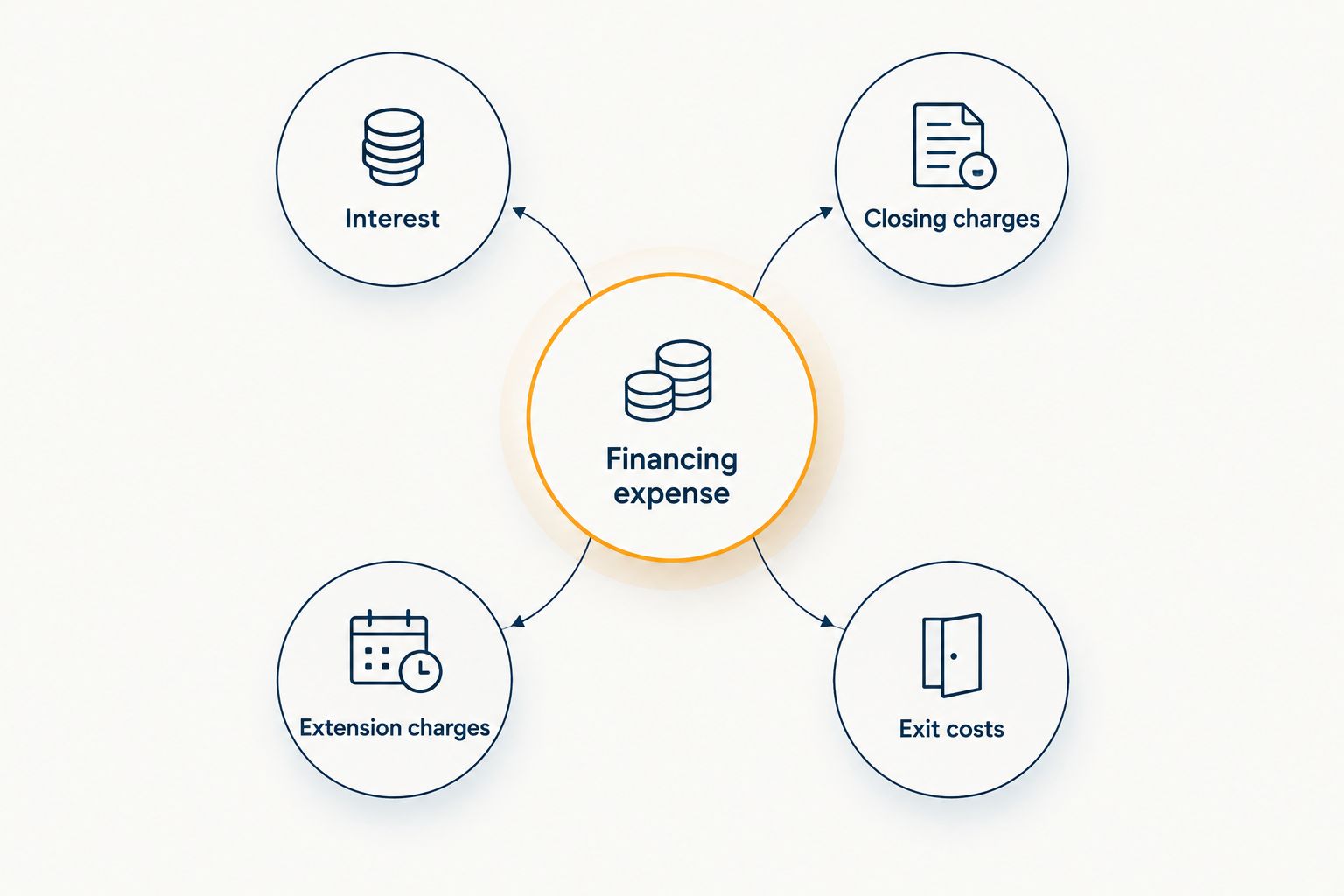
Financing expense = interest through payoff + origination and broker charges + required closing charges + applicable prepayment, extension and exit charges.
Keep operating expenses and property acquisition costs visible in a separate column. They matter to the project budget, but mixing them into only one financing proposal distorts the comparison.
How do points affect the calculation?
One point equals 1% of the loan amount. Points describe a charge against principal; they do not describe an annual interest rate or the complete cost of borrowing.
Ask whether a charge is deducted from proceeds, paid separately at closing or added to the financed balance. The same stated loan amount can leave you with different amounts of usable cash.
How do you compare interest over the holding period?
For a simple-interest, interest-only illustration using an annual rate and a monthly convention:
Interest = outstanding principal × annual interest rate × months outstanding ÷ 12.
The divisor reflects 12 months in a year; it is not a lender's promised calculation method. Actual contracts can use daily accrual, different day-count conventions, changing balances or minimum-interest provisions, so use the lender's payoff calculation for the final decision.
For an amortizing bank loan, separate principal from interest in the payment schedule. Principal reduces what you owe; treating the entire payment as financing expense overstates borrowing cost.
What should the final worksheet show?
Use these fields for each proposal:
- Usable proceeds: cash delivered after deductions.
- Closing cash: equity, prepaid items and separately paid charges.
- Scheduled payments: required cash outflow during ownership.
- Financing expense: interest and applicable financing charges.
- Payoff balance: principal and other amounts required to release the loan.
- Exit costs: charges associated with repayment or replacement financing.
A larger loan does not necessarily provide more usable capital. Reconcile the settlement statement with the amount your business actually receives.
Why does hard money loan cost versus bank loan vary?
The useful question is which terms change your cash outflow. Ask each lender to explain these drivers rather than accepting a rate without context:
- Holding period: upfront charges are spread over the time you actually use the financing.
- Payment structure: interest-only payments and amortizing payments leave different balances at payoff.
- Property condition: repairs, occupancy and valuation affect how a lender evaluates the collateral.
- Borrower profile: credit, liquidity, existing obligations and documented repayment capacity influence underwriting.
- Exit terms: minimum interest, prepayment provisions and extension conditions change early or delayed payoff costs.
- Required reports: appraisal, title, legal and other closing requirements add charges that need to appear in the comparison.
Do not assume a larger equity contribution automatically produces a better total result. It also reduces the cash your business retains for operations and contingencies.
What happens if the appraisal changes the deal?
Property value affects more than the collateral description. A valuation below the amount assumed in your financing plan can change the proposed advance, increase your required equity or prevent the transaction from closing under the original structure.
Include commercial appraisal costs in the closing budget, and ask whether a later refinance requires a separate valuation. Paying for a report does not guarantee that either lender will accept its conclusions or reuse it.
Confirm the valuation basis before ordering work. Current condition, completed improvements and stabilized operations describe different assumptions; your acquisition lender and intended refinance lender need not evaluate the property on the same basis.
Your 2026 exit plan should also identify who bears the cost of additional reports. A bridge budget that covers acquisition closing but ignores refinance requirements understates the cash needed to finish the transaction.
What if you need working capital rather than property financing?
Match the financing to the use of funds before putting real estate at risk. A payroll gap, inventory purchase or contract mobilization need does not automatically justify a property-secured bridge.
A business line of credit is worth evaluating for recurring operating needs; its limitation is that access remains subject to the facility's underwriting, limits and terms. A term loan fits a defined business expenditure, but scheduled debt service must remain affordable throughout the term.
Revenue-based financing requires a different comparison. It may be structured as a purchase of future receivables rather than a loan, so review the purchased amount, remittance mechanics, reconciliation rights and contractual obligations instead of assuming it behaves like bank debt.
A factor rate is a multiplier used to determine a contractual amount; APR expresses borrowing cost on an annualized basis using payment timing and applicable charges. A factor rate is not an APR.
Jon Lynch Financial Group is best for U.S. business owners who want to compare business funding through a broker, not a direct lender. The comparison should address the actual business need, not force every borrower into a property-backed product.
What risks should stop you from proceeding?
Pause when the repayment plan depends entirely on an unapproved refinance. A future lender can require documentation, property performance or borrower qualifications that you have not yet established.
Other reasons to stop and resolve the issue include:
- A maturity date that leaves no room for the project's documented schedule.
- Extension rights that are discretionary rather than contractually available.
- A personal guarantee you have not reviewed with counsel.
- Fees that do not reconcile between the proposal and closing documents.
- A payment obligation that consumes cash needed for essential business operations.
- Existing liens or debt restrictions that conflict with the new financing.
Property-secured financing exposes the collateral to enforcement after default under the applicable documents and law. A personal guarantee can create additional exposure; do not treat the property's value as the limit of your responsibility.
Which documents should you collect before comparing offers?
Build a decision file for your 2026 financing review. Ask each prospective lender which documents apply rather than treating this list as a universal approval checklist:
- Purchase agreement, ownership information and intended use of funds.
- Property income records, leases and operating expenses, where applicable.
- Repair scope, contractor estimates and project schedule.
- Business financial statements, bank statements and tax documents requested by underwriting.
- Existing debt balances, lien information and payoff statements.
- Written proposals showing fees, payment obligations, maturity and exit provisions.
- Support for the planned sale, refinance or operating-cash-flow repayment source.
Request a scheduled-payoff scenario and a delayed-payoff scenario from each lender. The difference shows which charges become relevant when the original plan changes.
FAQ
Is a hard money loan always more expensive than a bank loan?
Hard money generally carries higher interest and upfront financing charges, but total dollars depend on the written terms and payoff date. Compare both offers over the same holding period and separate principal repayment from financing expense.
What does one point mean on a hard money loan?
One point equals 1% of the loan amount. It is a charge against principal, not an annual interest rate, and it does not include every other borrowing expense.
Can paying off a hard money loan early reduce the cost?
Early payoff reduces cost only to the extent the contract allows interest or charges to fall with earlier repayment. Minimum-interest requirements, prepayment provisions and exit charges can limit the reduction.
Should I choose hard money after a bank decline?
A bank decline alone is not a reason to choose hard money. Identify the decline reason, confirm that property-backed financing addresses it and establish a credible repayment exit before proceeding.
Can I refinance a hard money loan into a bank loan?
Refinancing requires a new approval under the bank's requirements at that time. Do not assume the property's acquisition financing guarantees eligibility for replacement financing.
Does Jon Lynch Financial Group directly lend the money?
Jon Lynch Financial Group is a broker, not a direct lender. Business-purpose products are provided through third-party lenders and funders and remain subject to their underwriting and terms.
Where should my business start if monthly revenue is below $35,000?
Businesses generating below $35,000 per month should use Explore Self-Serve Funding. The route serves U.S.-based entrepreneurs and does not guarantee approval, an amount, a rate or funding timing.
Which related guides match your funding decision?
- Compare banks for small business loans
- Understand business bridge loan costs
- Compare working capital costs with a term loan
What is the practical next step?
Ask for the amount required to close, the scheduled payments and the complete payoff calculation—not another headline rate. Those documents let you compare usable cash, financing expense and exit risk on the same basis.
For U.S. businesses generating at least $35,000 per month, Jon Lynch Financial Group offers the next step: Compare Business Funding Options. If your business generates below $35,000 per month, Explore Self-Serve Funding. Choose the route that matches your revenue and prepare your current bank statements; approval and terms remain subject to third-party underwriting.



